THOSE SNAILS
Another question from the inbox: “So, what’s up with those snails?”
No mystery – just a bit of silly that’s been codified into semi-tradition.
The original strip of snails was one of the first patterns I doodled up – inspired by the non-counted snails in Scholehouse for the Needle (1624). That was way long back ago, when I was still in college. They’ve wandered in and out of my notes over the years, first appearing as a spot motif, and eventually ending up in my first and second hand drawn pattern collections (published in ‘76 and in the early ‘80s) and eventually my own New Carolingian Modelbook. I dedicated that form of the pattern to Mistress Peridot of the Quaking Hand – a local resident of the SCA Barony of Carolingia (Eastern Massachusetts/greater Boston area), famed for her calligraphy and her unselfish sharing of the same. The artist behind so many excellent awards scrolls. Peridot’s own device features a sleepy snail.
Maybe it’s a subliminal comment on slow, steady perseverance inherent in needlework, but for whatever reason, I have used that snail on the majority of my samplers. Not all, but most. Here are charts for some of the ways my little creeping friends have shown up. The original row is at the top left. The all-over of snails circling little gardens with ominous intent is from the Trifles sampler. The ribbon strip at the lower left is the bit I’m currently stitching in blue and red.

THREAD THREAD
Based on questions from Elaine and others, here’s a bit more on the thread I’ve been using on both the Permissions and Trifles samplers.
As I’ve said before, my stash came from a small needlework/beading supply shop in Pune, India. It wasn’t current stock. The head clerk sent a boy scampering up into the storage attic for a VERY dusty box of odds and ends. I picked out the best colors left, avoiding pastels, and looking for what high impact/high contrast hues that still remained in quantities of 10+ skeins. I bought them all. They were very inexpensive – just a few rupees per skein. At the then-current exchange rate of 60 rupees per dollar, I think I spent less than $20.00 translated, and came away with a huge bag full, well over 200 skeins divided up among about 15 colors. Here’s just a sample:
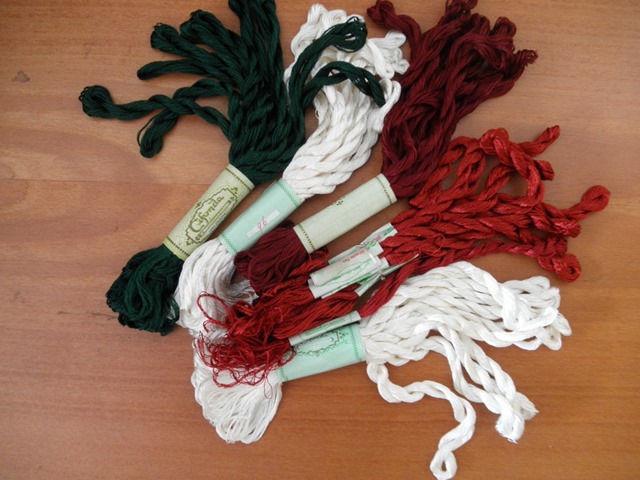

The name brand is Cifonda Art Silk. It’s not a spooled rayon intended for machine embroidery. As you can see, the put-up is more like cotton embroidery floss. And it turns out that the stuff is still being made, and is available in Australia, and even in the US – although mostly by special order.
The websites that offer this thread vary a bit in description. Some say it is a 35% silk/65% rayon blend. Others say it is all rayon. Contemporary put-ups specify 8 meter skeins. My vintage stash skeins are a bit longer, possibly 10 meters (I’ll measure tonight). The large bundles above are actually “super-packages” of ten individual skeins. You can see the bright red one at the left is broken open, with the single skein labels showing. On mine, color numbers are written on each skein by hand, not printed. There can be hue variances between the super-packages of the same color number, so I suspect that special care should be taken to buy all that’s needed at once, so that all is from the same dye lot.
Cifonda’s structure is that of standard floss – six strands of two-ply relatively loose twist. The individual strands are quite fine, two of them are roughly the equivalent of one ply of standard DMC cotton embroidery floss. The colors – especially deeper ones like red and indigo – do run when wet, although they do not crock (shed color on hands, ground cloth, or wax when stitching dry). I would not advise using this thread on clothing, table linen or other things likely to need laundering. It may be possible to set the colors before stitching using a mordant bath or long water soak, but I don’t have the experience, time, or materials quantity for experimentation.
I am pleased with the way the Cifonda looks in my work. It’s a bit shinier and finer textured than cotton floss, although it does not have the coverage of the true silk floss I’ve used (Soie d’Alger). My Cifonda is quite slippery. Two or more plies held together tend to disassociate and slide past each other for differential consumption, even when using short lengths in a small-hole needle. I tamed this by aggressive waxing – running the entire length of my threads over a block of beeswax before use. Since I’m doing linear counted work, any change in color or texture is not noticeable. Someone using this for satin stitch, long-and-short, or other surface stitches that maximize thread sheen would probably want to wax only the inch or so that threads through the needle.
Like all lightly twisted rayons, this thread does catch and shred a bit on rough skin. Care must be taken to use needles with very smooth eyes, and to hold the unworked length out of the way when taking stitches, because the stuff snags extremely easily. My own stash, well aged as it is, contains some colors that are a bit brittle. The bright yellow I’m using now, and the silver-grey I used on the last sampler are both prone to breaking under stress, and must be used in shorter lengths than the other colors.
I will continue to use up my India-souvenir thread stash, working smaller and smaller projects until it is gone. But in all probability, I will not seek out the Cifonda to replace that inventory as it is consumed.
Anyone else have experience or hints on using this rather unruly stuff?
IT ALL FALLS INTO PLACE
With an extended time sitting in one place and thinking yesterday, I’ve come to design decisions on the direction for the Permission sampler.
I’ve decided to do another bank of two solid columns of multicolor narrow strip bands above the motto, and finish out the top with either the same pomegranate border used at the bottom edge, or a coordinating one with pine cones, of the same size and visual density – also in the blue.
Progress is obvious since the last post. I finished the red voided buds with the grid-background at lower left, and marched the pomegranates across the entire width of the piece. I also did a quick strip of acorns over the words (aligning with the strips below), and I’ve begun on a yellow and red interlace and quaternary rose strip above that one. I’ll do a monochrome design above the red/yellow, probably green and relatively narrow.

As you can see, I am just ripping along. The large stitches on this one (it’s only 30-count stitched over 2×2), plus the sit-on frame that frees the second hand to pass the needle underneath the work are helping me to set local house records for sampler production.
Am I liking the thread? Yes and no. It’s “man made silk” and at least 20 years old before I bought it. Possibly even older. It’s thin and unruly, and needs extreme waxing to make it behave. My little beeswax block is being whittled down, slowly but surely on this one. I do like the sheen of the faux silk – even waxed. What I like less is the damage of age – brittleness, and a tendency to shred. Some colors have aged better than others. For example, the yellow I am using now is very prone to breakage, and must be treated gently, stitching with very short lengths. By contrast the red and blue are horse-strong, and far less likely to snap or denature. Perhaps my yellow is “elderly” compared to the other colors. In any case, I do notice that working with it does take longer and is more fiddly due to the short lengths and stops/restarts after an inopportune Thread Damage Event.
Questions answered:
These are from my inbox, about this project or stitching in general. Feel free to post questions here or write to me – kbsalazar (at) gmail (dot) com.
1. Do you decide on your patterns before you begin?
Not really. I pick them on the fly. On some pieces I stick to a style or unified theme, but often I just thumb through looking for something that has a pleasing contrast with the designs around it; like layering a geometric next to a floral, or using something with a lot of curves next to something that’s strongly angled.
2. Do you prepare your cloth?
I do now. I’ve had some projects that might have been better composed, but because I didn’t clearly mark my margins or centers, I lost track of where I was. Now I outline my stitching area, plus it’s center and quarter-center marks both horizontally and vertically. I use a single strand of Plain Old Sewing Thread, in a light color (in this case – pastel blue), basting it in to indicate those lines. The basting itself is rather haphazard. For example, I do not bother to make my basting stitches over the same number of threads as an aid to counting later. Others do.
I also hem my cloth. I used to use other methods of fray prevention (deliberately raveling out a half inch or so, a line or two of machine stitching, serging, or in a moment of poor judgment – tape), or not bother at all. However I find that I now prefer the finished edges and mitered corners of a nice, even hand-done finger-folded hem.
3. Will you be issuing a kit for this or any of your other projects?
Probably not. Definitely not for a composed kit, complete with thread. There are too many things I want to stitch myself to sit down and figure out thread consumption, buy fabric and thread in bulk, compose the kits, and do inventory management and fulfillment. That would suck the fun out of the thing, for sure. I might consider releasing full, drafted charts for some of the smaller projects like bookcovers for small standard-size notebooks or needle case/biscornu sets, but that also would eat up time I’d rather spend on my own work, or researching and drafting up new designs. I see myself sticking mostly to reference books of patterns and designs, and leaving employment of those designs to the readers.
4. Where are the snails?
One of the folk who visit here has noticed that I put snails in almost every sampler I do. Not every single one, but I do use a variant of this design from my first book on most, especially those for family:
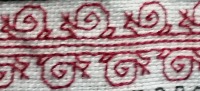

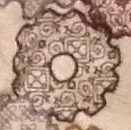
I haven’t gotten to the snails yet, but they are on the list for this project, too. Possibly next – the green strip I’m thinking of doing just above the current bit.
THE WHOLE THING
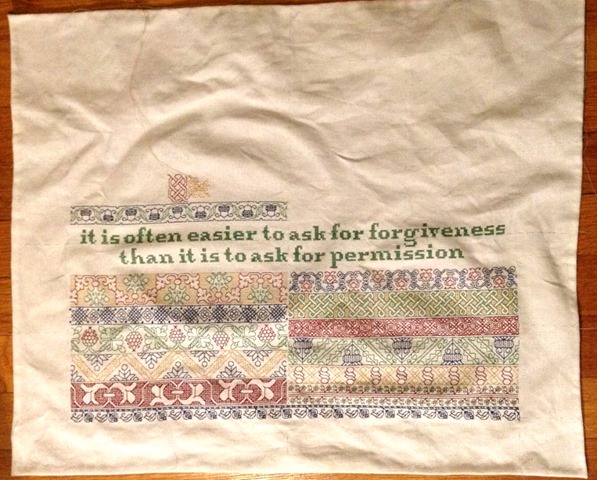
The permission sampler is rolling right along. At 30 threads per inch (15 stitches per inch) it’s fairly zooming. Here you see the whole cloth. I’m already mostly done with 25% of the patterned area:

That small bit of solid blue cross stitch at the bottom? I hate it and will be picking it out, presently. Originally I wanted to frame the piece top and bottom with a denser border, done in cross stitch. But I don’t like the look. The bottom border will still be blue, and will still span the entire width of the piece, but will be something directional in double-running, instead.
Now for the two newest strips:
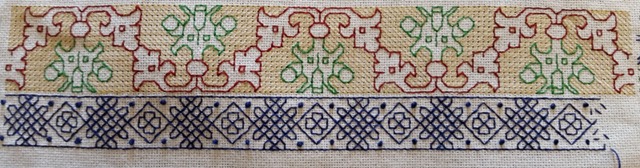
Both are patterns from my forthcoming The Second Carolingian Modelbook. The top one is done in two weights of thread – double strand for the red and green sections of the motif, and single strand for the yellow half-cross stitch ground. There’s no historical precedent that I can find for treating the background of a voided piece this way, but I do like the look of the more delicate field against the heavier outlines. It’s something I’ve used a couple of times now. Since there’s no requirement for this piece to be historically accurate, why not play? The pattern itself does have a source – a stitched sample book of designs in the collection of the Metropolitan Museum of Art, with a posted provenance of Spain or Italy, early 1600s.
As for the lower bit, in blue – that one is interesting, too.
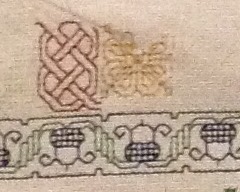
Here’s a close-up:

And here’s the source:

This is an excerpt from “Tafel 47” in Egenolff’s Modelbook of 1527. Note that the original is clearly a freehand piece – not graphed. But it translates very neatly to work as a counted pattern. If you look closely at some of the freehand drawings in Egenolff and his contemporaries, you’ll see that (to my eye at least) they were intended to be congruent with counted execution. That’s not to say they couldn’t be done off the count, but with constrained angles, no fine detail, and geometric execution, working them that way is a cinch.
Back to my modern piece. It’s pretty clear that the area below the words will be two columns of strip patterns. I am still thinking of what to do in the top part. I could do more strips of similar proportion. I could do one moderately wide strip (the area there is too narrow north-south for any of the really big patterns in T2CM, believe it or not). Or I might do a collection of spot motifs, or one large all-over. I haven’t decided. More bungee jump stitching ahead, as I continue to design on the fly.
ANOTHER SAMPLER
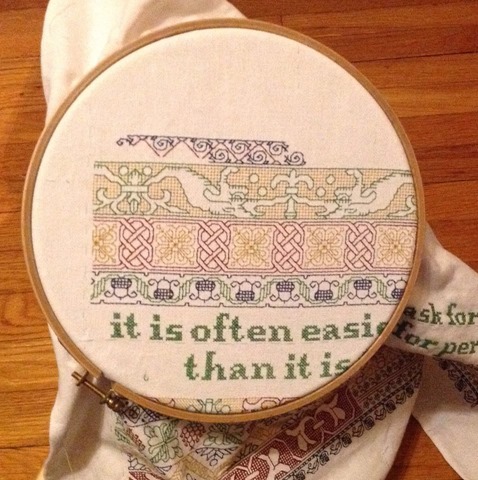
This one’s a quickie – a present for Denizen (one of Younger Daughter’s pals, currently staying with us). She’s also headed off to university next year, and deserves her own bit of stitched wall art with a favorite saying.
Denizen has requested the immortal words of Admiral Grace Murray Hopper, “It is often easier to ask for forgiveness than it is to ask for permission.”
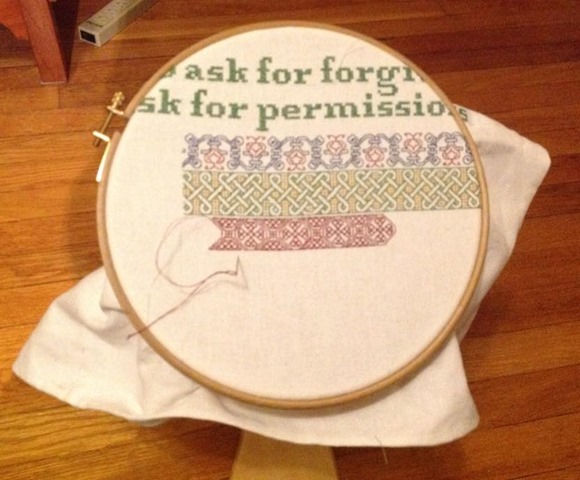
As you can see, I’ve already laid in the saying itself, using yet another of the alphabets from Ramzi’s Patternmakercharts.blogspot.com website. In this case, I’ve chosen a very simple all lower case set from Sajou #104. A fancy font would be too bombastic for this sentiment. I used plain old cross stitch (POCS) for the letters.
Ground this time is a large-as-logs 30 count even-weave linen remnant from my stash, long since disassociated from any label, vintage, or maker identification. The floss is more of my India-purchased faux silk – deep crimson, bright green, strident blue, and daffodil yellow. Patterns (so far) are all from The Second Carolingian Modelbook. Being unbound by any historical or usage constraints on this one, I’m happily playing with colors, limited only by the availability of my remaining threads. I’d like to use far more red to anchor the piece, but it’s the color of which I have the least, so I have to work it in more sparingly.
I’m also changing up the orientation and proportions of this one. Instead of long and thin like historical samplers, or portrait orientation like a standard reading page pieces I’ve stitched lately, I’m doing this one landscape – with the longer dimension east-to-west rather than north-to-south. I’ll probably run a more solid border the full width top and bottom, either POCS or long-armed cross stitch. There will be two banks of geometric bands, left and right both above and below the centered saying. Although I might mix that up with a collection of spot motifs above the saying. I haven’t decided yet.
One failure of note though. I wanted to do some Swedish Weaving stitch on this one, as a nod to the Denizen’s heritage. While that style is usually done on huck towling, it can also be done on plain tabby weave fabrics. Unfortunately, this particular ground cloth and my ultra-fine floss are a bad combo for the technique. I didn’t like the look so I picked it out and went with what I have. I’ll do a Swedish Weave project another time.
The motto took just one weekend, and at red bit is only one night’s stitching – about 2 hours worth, so I forecast that I’ll rip through this project in no time.
FINISHED!
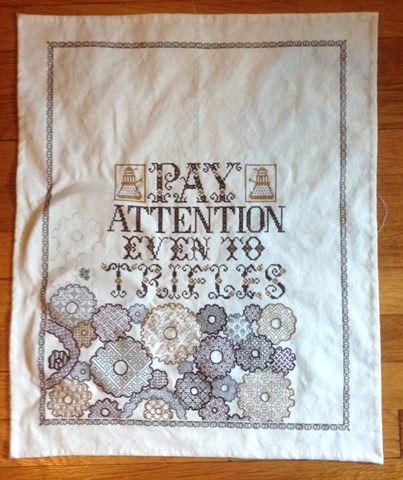
It’s done. All 80+ gears, each with a different filling pattern, worked with well-aged “Art Silk” (probably rayon) purchased for a single rupee per skein in India, on 30-count linen. The soot sprites (little black fuzzy creatures) playing the part of “Trifles” are in discontinued DMC linen floss, so that they contrast shaggy and matte against the brighter, smoother silky stuff. I’ve also attached some real, brass gears as embellishments, to add extra Steampunk flavor.
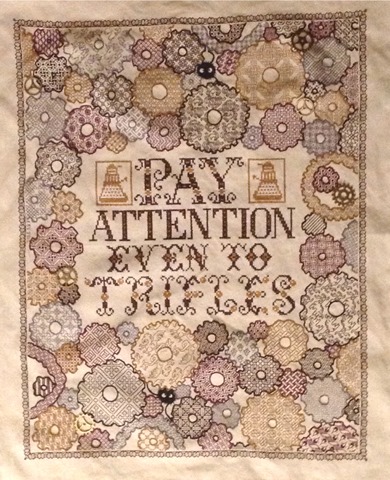
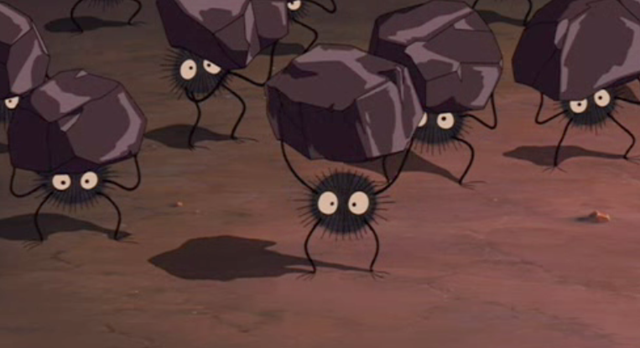
Here’s a close-up of the sprites in process, adapted from the little soot creatures in the movie Spirited Away.

To stitch them I worked totally off count. (Yes, I can do that, too). I outlined the eyes in split stitch using one strand of floss, and placed the eyes’ pupils, using French knots. Then I worked long and short stitch, encroaching on the split stitch eye frames, to get that spiky, unkempt, hairy texture. The arms and legs are close-worked chain with two strands, with the little toes and fingers (what of them there are) also in split stitch, but with two strands. The gears are filled in using (mostly) double running, with some departures into “wandering running” using two strands of the very fine art silk floss; and outlined in chain stitch using three strands of the stuff. All threads used were waxed using real beeswax, for manageability.
I am happy to say I’ve hit all of the specific design requests. And there were many:
- A good motto
- Steampunk (the gear theme)
- Something Whovian (the Daleks)
- Octopodes (dancing in one of the fills)
- Snails (ditto)
- Unicorns and/or dragons (ditto, and the winged, serpent tailed, beaky thing is good enough)
- Anime (the soot sprites)
- Interlaces (also inhabiting the gears)
- Autumn colors (brown, gold, russet, silver)
- Something from India (the thread itself)
The saying itself is particularly suitable for the target Daughter. It’s one of Mushashi’s Nine Precepts. The Daleks are from a graph by Amy Schilling, intended for knitting. The narrow border is in my forthcoming book, The Second Carolingian Modelbook. I found all of the alphabets used (there are four) in Ramzi’s Sajou collection. The gear shapes are adapted from a freehand tracing of a commercial airbrush stencil by Artool. Most of the gear fills can be found in Ensamplario Atlantio. The few that aren’t from that source are recent doodles, and will be made available in time, either as a fifth segment of that work, or perhaps as their own stand-alone sequel. Ensamplario Secundo, anyone?
Now Younger Daughter doesn’t head off to school until next fall, so I have about a year to add hanging tabs, or back the piece with contrasting fabric to make a scroll-like presentation. So while the stitching is complete, this piece may revisit String when I decide what the display treatment will be.
On to the next. I’ve got two more original stitched pieces in queue, with only a general idea of what each one will be, and what styles/designs/colors I’ll use. Free-fall stitching! Gotta love the adventure!
THAT SAD POINT AS A PROJECT WINDS DOWN
After lots of happy chugging along, as you can see Trifles is nearing completion.
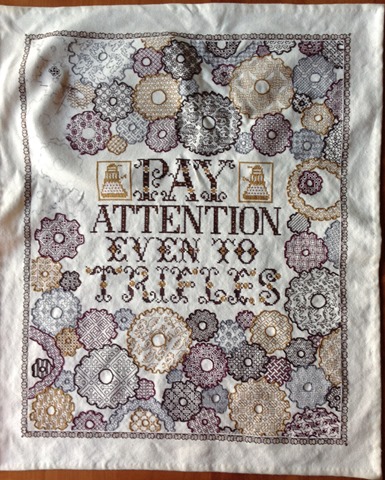
I’ve got only eight more gears to finish up, including the two in process now. Then come a couple of “Trifles,” modeled on the little soot demons from Spirited Away, another special request from the target recipient. The hapless little things will be prisoners in the mechanism.
Finally, if there’s room and it looks good, I plan to add some brass watch gears for extra Steampunk flavor.
To answer questions, no – I am not planning this in advance. I choose the fill and color as each new gear presents itself. I chose to use four colors as a nod to the (rarely used) four color theorem, which states that any contiguous plane map can be colored in using only four colors, and have no two regions of the same color touching each other. In my case as a non-mathematician, this was done on a lark, and adds geeky joy.
I do admit that a little logical thinking has been used to select the optimal color for each gear, in a “If I make this one brown, then this one will have to be gold, and that one must be maroon,” sort of way. But again I haven’t sat down and plotted my plan of attack, other than to make the juncture point where I finish adding gears around the motto be the narrowest point of the sampler, to simplify any color meet-up issues.
On fills, I’ve tried to mix up densities and shapes, to achieve as much contrast as possible. So fills based on interlaces abut fills with isolated spot motifs, which bump up against all-over small geometrics, which in turn are next to line-based fills with few or no closed shapes. I’ve had a lot of fun paging through Ensamplario Atlantio looking for the best choice for each gear. And I’ve ended up doodling a few more, just for fun. Here are a couple:

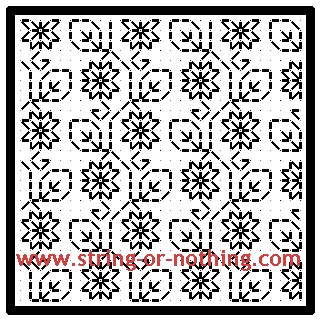
The rather annoyed unicorn is an adaptation of a motif from the open source pattern group exercise I hosted here back in 2010/2011. I have to say that doodling these is addictive. Just playing around, I’ve put together twenty more design squares, including those I collected from the Victoria and Albert Museum smock, item T.113-188-1997. I could easily do dozens more. Now comes a question, with T2CM now finished and awaiting only resolution of logistical and publication issues prior to general availability, do I release the new group as a fifth section of Ensamplario Atlantio, or do I go on and start on Ensamplario Secundo?
NEW TOYS!
I just got back from a quick business trip. Sadly, I came back with a hitchhiker – a bad cold. But to cheer me up upon arrival was my package from Hedgehog Handworks, with my new Hardwicke Manor sitting hoop frame:

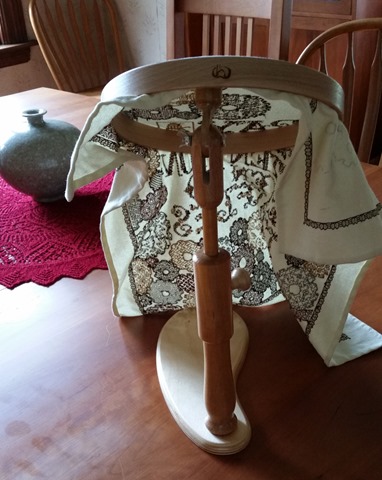
As you can see, I was so excited, I had to try it out right away, even before wrapping the inner hoop in twill tape. I’ll do that this weekend.
First the specs of my long-coveted indulgence. There are two joints providing freedom of movement. Looking at the back of the thing, the first is a slider that regulates height. The turned barrel at the base of the main vertical has a wooden screw tightener, allowing the vertical arm to be raised and lowered. Minimum height (pushed all the way in, with the frame positioned parallel to the ground) is 13.5 inches measured from table top to BOTTOM edge of the frame. Max height on which the tightening screw can be brought to bear is about 18.5 inches. The vertical stick also allows the frame to be rotated left and right, provided the wood screw is loosened to avoid damage.
The second degree of freedom is the y-shaped joint at the top of the vertical stem. The fixed attachment piece from the round frame fits into the slit of the y-shape, and is tightened by a bolt with a metal wing nut. (I will probably replace the wing nut with something a bit more finger-friendly in the future). This allows the frame head to swivel up and down, allowing access to the reverse of the work.
“Orthodox” use position and all of the pix I can find on line show the large paddle piece at the bottom being slid under the left hip, so that both legs sit upon it, and the frame is presented across the user’s lap. Users are also shown sitting bolt-upright on a chair or a sofa.
I’m a bit more relaxed. My favorite stitching chair is a Morris chair, with wide wooden arms, like mini-shelves left and right. It reclines. Instead of sitting upright, I tend to stitch in the reclined position. I also don’t want to bark the chair’s woodwork with the frame, so instead I straddle the base, with the paddle-bottom underneath my right thigh. I can adjust the position of the hoop so that it’s perfectly comfortable and accessible in that position.
All in all, I am VERY pleased, although I may need to stitch myself a small bolster on which to rest my left elbow when working with that hand beneath the frame. The chair arms are too high for comfort, and some support would be useful for extended sessions. Oh heavens. A quick project to make something useful that I can cover with MORE stitching. However will I cope? 🙂
In the same order, I also received some tambour embroidery hooks. I won’t show them here, but will save them for a future piece. Hmm…. that elbow cushion… What do you think?
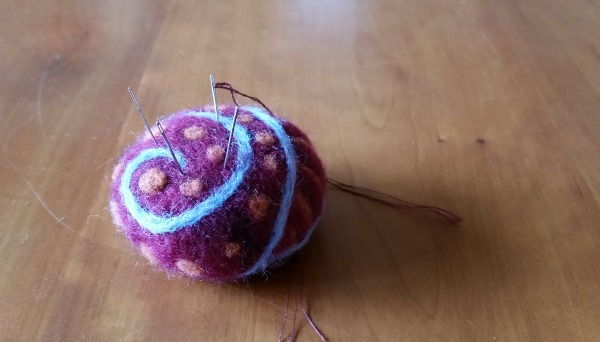
And finally as a cheer-me-up, Younger Daughter, Needle Felting Maven and all around good kid, saw that I was in need of a small, weighted pin cushion that was presentable to leave here in the library next to my chair. Although she usually does far more intricate shapes (dragons, tigers, airplanes), she made me a little sea-urchin, weighted in the bottom center with a couple of big rupee coins, for extra sentimental value. It’s adorable, simple, in colors that match the rug in the library, and at about 1.5 inches across, with the coins giving it a low center of gravity, so it doesn’t go skittering off – the perfect size and weight.
Finally, I have been making progress on Trifles. As you can see, I’ve got less than a quarter of the surround left to go. And every single gear uses a different filling.

PROGRESS CAN BE VERY BORING
You know you’ve hit full stride in a project when you think of what to write in a progress post, but have no new challenges, discoveries, tricks, or lessons-learned to report. All I can do today is show off more gears and cams, with more fillings:
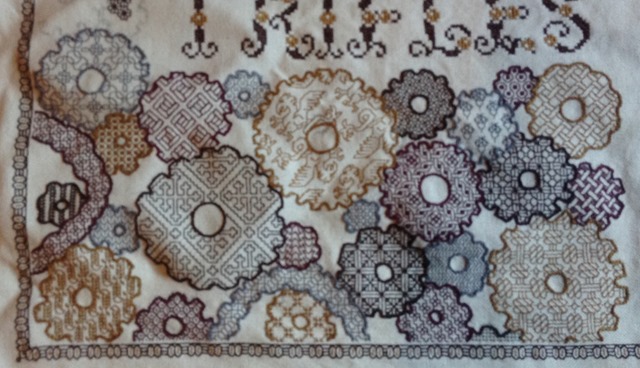
I’m continuing up the left side of the motto, then I’ll do the right side, and finish with the top. I’m having tons of fun selecting fill patterns from Ensamplario Atlantio.
I had hoped that when I released the thing I’d see more things on line that use its designs, but searching does turn up a few projects:
- Ben from Tiny Dream Stitchery is doing a sweet sampler, I really like the layout he’s using. It’s reminiscent of a formal Renaissance garden plan.
- Whispered Stitch is making adorable little needlebooks using motifs from the patterns, and offers a tutorial on their construction.
- And Stitches used the patterns in her rendition of a large group stitch-along project.
- Rebecca of Hugs are Fun did a name sampler, a striking and innovative idea for using the fills.
- Kathy at Unbroken Thread stitched up a spectacular piece, incorporating gold, paillettes, purl, and beads.
- Miriam did a bunch of nifty key fobs, using EnsAtl patterns along with ones from other sources.
- Colorize also has a sampler. She’s picked some of the more complex designs, brave soul!
- Susan at Tuesday Stitchers used a design in a large departure from the usual, as an embellishment stitch done on gingham in a crazy quilt. Very cool!
If you know of any others, please post them in the comments. It gives me immense joy to see the mischief that these designs get up to out there in the wide, wide world.
Sadly, I’ve also found a ton of pirate sites on line, mostly in Russia, who felt it necessary to steal the book and repost it in its entirety. I can’t do anything about them besides despise the lack of integrity and gutter slime ethics that such theft represents.
The ONLY authorized source for the book is right here on this site. It’s free. Link above, and under the Books tab on every page of String. If you have downloaded my book anywhere else, you have found a stolen copy.
GEARING UP
As you can see, Trifles is coming along. I’ve just about finished the first set of gears:


The next bit to do will be the two sides, proceeding left and right of the established bit, growing up to frame the motto. I’ll use the same stencil for my basic layout, rotating and flipping it to make the repetition less evident.
A couple of you have written to me to say that you find the gears rather disappointing – that they are not sharp and mechanical enough. In fact, the edges of some of them are more gentle, cam shaped rather than toothed, and the teeth do not mesh exactly.
Frankly, I don’t find this a problem, and I don’t care. The thing will be more representational than mechanistic. I’m going for the idea of gears here, not a CADD drawing.
I am having fun flipping through Ensamplario Atlantio looking for which fill to do next. Everything you see here has been done ad-hoc, one gear at a time, with no pre-planning on what design/color to use next. I’ve used four-color placement principles to avoid having two gears of the same color right next to each other. I’ve also tried to achieve a nice mix of densities and shapes, with contrast between horizontal/vertical and diagonal elements, all-overs/spaced spot motifs, and between straight lines/curvy patterns. On the whole I’m pleased. I’ll add more dark and density to the lower left, next. Also more gold there in that corner.
Stay tuned for further developments!
 String-Or-Nothing