LORD GANESH–ENDINGS AND BEGINNINGS
The stitching part of my Lord Ganesh is complete:

All that’s left now is a little bit of finishing around the edges of the cloth. I may try out some Italian hemming, just for the fun of it.
Although I didn’t create this stitching specifically in honor of the festival, it is fortuitous that the project’s completion will coincide with Ganeshotsav or Ganesh Chaturthi.
Ganesh Chaturthi is celebrated throughout India, although it holds special significance in western areas of the country, including Maharashtra, the state in which we live. Lord Ganesh is venerated at the time of his rebirth. He is beloved as the patron of arts and sciences, who watches over the good beginnings of any venture. As I mentioned before, Ganeshji is a daily presence in life here. His images protect almost every vehicle on the road, and guard the front door of most homes. His shrines are everywhere.
In spite of this ubiquity, the festival itself is not all that ancient, becoming popular as a protest movement in the 1890s. It was revived as a unifying, mass assembly of people for a very public celebration, in opposition to anti-gathering laws in place during the British rule of India.
Modern celebrations include the erection of decorated avenues and temporary platforms, on which images are displayed. These festival areas are also the center of both scheduled and street performances – everything from music and theatrics to impromptu dancing. During the festival, offerings and devotions are also performed at the platforms (pandals).
You can see signs of the upcoming festival now all over Pune, with street constructions sprouting in neighborhoods, near temples and shrines, and along commercial streets, as civic, religious or community affinity groups try to put on the most beautiful and elaborate display. Some of the modern displays and performances are dedicated to additional causes, especially those of social justice. Families make (or buy) special delicacies for the celebration and reunite to enjoy the time together. Devotions culminate at the end of the holy week with huge processions, in which the images are escorted to bodies of running water, where they are immersed and destroyed, in a ritual that echoes the impermanence of the universe – be it of gods or men.
This ritual immersion presents a number of logistical and environmental problems. Many of the images are crafted from plaster of Paris, and are decorated with paints containing heavy metals. The sheer number of these can produce major pollution events, and can leave toxic residues in the bodies of water used. There is growing awareness of this problem, even among the most traditional of the devout. Clay, as opposed to plaster of Paris statues are more widely sold, albeit at greater cost. Some people are making their own rather than buying them. There are even calls for volunteers to recover immersed floral offerings, similarly retired to the waters after the festival, in order to reduce the effects of a large biomass of decomposing vegetation.
Logistical challenges include crowd safety, personal security, and fire awareness for unbelievably large throngs of people, all of whom are intent on getting the best view, having a good time, and enjoying the day and night time displays (complete with light shows and fireworks). There are also civic infrastructure challenges – in the cities, pandal construction damages the streets when holes for the supporting poles are drilled. Electricity for lights and loudspeakers is leeched off street poles, with improvised connections. And construction of the platforms and drapery-lined avenues can also be problematic, with enthusiasm often outstripping engineering for the anticipated loads or required clearances.
Still, for all of the challenges, the city is poised for what looks like it will be a major celebration. I’m hoping we can experience some of the edges of the festival, and come back with memories and pictures to post here.
CROSS-CULTURAL STITCHING
Lord Ganesh is a beloved and hard-working Deity here in India. His image is omnipresent. Aside from gracing his many temples, Lord Ganesh rides on dashboards all over the nation, protecting almost every car, truck, and bus. He wards the door of most homes; and blesses many shops, schools and public buildings. His image has been rendered in just about every medium, from exquisite woodcarving to molded pink plastic. He has been sculpted, printed, woven, painted, and stitched. Hmm. Stitched.
So of course, I had to work my own.
I tried to draw up my own freehand design, but decided in the long run that it would be easier to use an established image. That way I couldn’t get the iconography wrong. I found a kids’ coloring book page via Google. Its simple shapes were particularly suited to inhabited blackwork – the traditional form with heavy outlines enclosing counted thread fillings. I sized the design for some cloth I had on hand, and printed it out. Here you see the cloth and the design taped to a window – a free version of a light table – for pattern tracing:

And here’s progress to date – about four days’ worth:

He’s red because red is a happy color. I’m about two-thirds done, with one ear, some “filler” and some of the lotus frame left to go. I’m very pleased with the way he’s turning out.
For the record, I’m using plain old DMC six strand cotton floss, color #498; two strands for the fillings, three four the chain stitch outlines. I’m working on a coarse cotton/acrylic “linen” that’s not quite even weave (you can see the distortion in the floral pattern in the face, with the north-south axis looking slightly squished compared to east-west). I’m doing this at (for me) a huge gauge of 16 stitches per inch, and the entire piece measures across from lotus-point to lotus point is approximately 8 inches across. All of the fillings above are from my free Ensamplario Atlantio collection.
I have a special purpose for my Lord Ganesh, which will be revealed in time.
PRECISION IN ALL THINGS?
First, for Davey – the wildly loud sofa pillow covers to coordinate with the wildly loud rug:
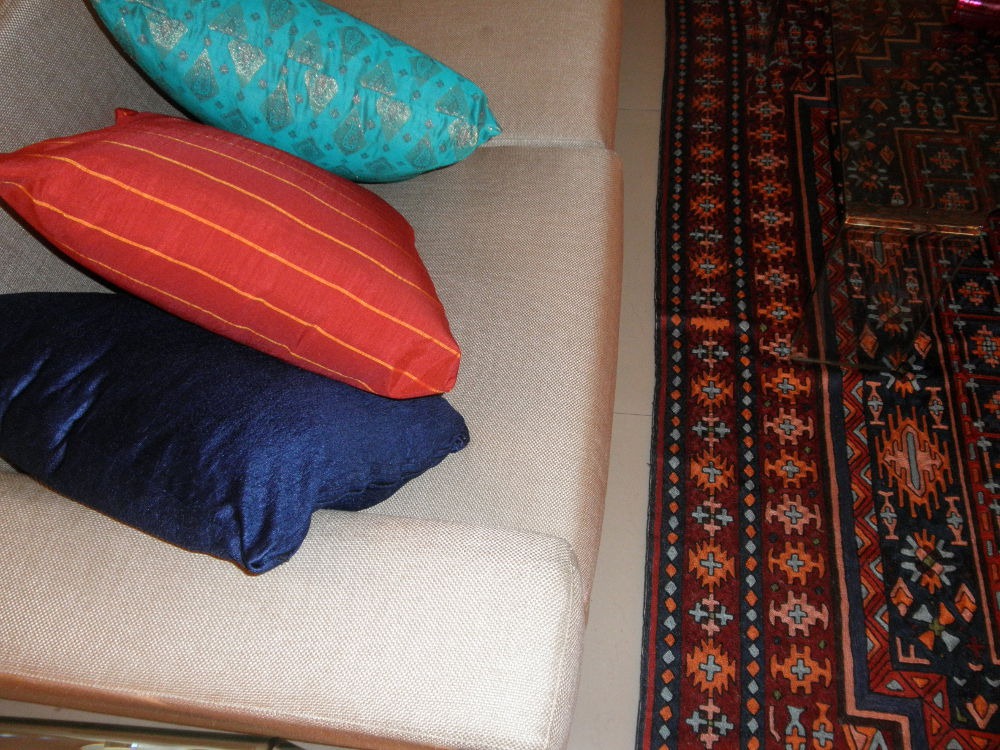
I picked the blue, red/orange stripe, and turquoise/gold from memory, and they work, even in spite of my equivocal photographic skills, and the flash-wash that makes the red pillow look paler than in real life. There are six pillows in total, two of each fabric.
Moving on, here’s progress through Row 103 of the Dozen shawl that I’m test-knitting:

It’s growing into a feral, interlaced dahlia of a design, which you can begin to see in this rough pin-out. Additional width will be more of the same.
And then there’s the Sarah Collins sampler kit, upon which I’ve started but have made no real progress:

Maybe I’ve ridden at liberty for too long, working at whim instead of direction. Maybe I’m too much of a tinkerer to do a stitched design laid out by someone else, or I have a touch of compulsive perfectionist in my soul – but for whatever reason, this kit is already driving me nuts. Don’t get me wrong, it’s a complete kit, thoughtfully laid out and as a reproduction, extremely well documented. The unruly element is me.
For example, it pains me to mindlessly duplicate the mistakes laid down by the original stitcher. See that twist column to the left of the frame? That’s verbatim to the pattern’s directions. But I tried, and tried, but just couldn’t let it sit that way. See the twist inside the frame, with the completed centers? I **had** to do it. I’ll probably pick out the offending imperfect twist and re-do it to match the edited bit.
There’s also working up the double running for this panel in two colors of sienna. The blue flower doesn’t bother me, I find that adorable. But using two threads for the framing spiral, alternating colors is maddening. It’s clear to me that dear Sarah might not have marled and finger-spun her threads properly, or perhaps ran out of one of the two shades, and that’s why the panel is done in alternating two-tone. It’s all I can do to grit my teeth and work as directed, because if I don’t, I risk running out of a color before the kit is done. Getting more matching thread, especially here, would be difficult in the extreme.
And then there’s the format of the charts. They’re huge, and orchestrate a stitch for stitch path, with every single one numbered. There are sufficient map pages in the thing to chart one’s way from Boston to Mumbai by rail (including the sunken parts via Atlantis). Paging through them is an exercise in where-the-heck-is-page-2b-left-got-to-now?” – then finding it under the sofa.
I’m also not fond of the indicated stitch logic. The paths described are not the ones I would choose. I tend to key off established bits, so that I can proof new sections against clean counts as I work. There’s too much “where no man has gone before” in this piece, with extremely long runs worked in advance of the growing body of work, and no way to confirm fidelity as one progresses.
Is there a moral to this story? Perhaps, not. But I have to admit that today’s post reveals that I’m a ruthless stickler for detail, caught up in color matching from memory, precision adherence to knitting patterns (where forays into originality are better left for after one has grokked the source design); but temperamentally incapable of similar fidelity to oh-so-obvious stitching directions. Mark it up as another character flaw, pass me a glass of wine, and move on, please.
10,000 SNACKS
France may be the land of 500 cheeses, but India is the land of 10,000 snacks.
They take their snacks very seriously here. There appear to be micro-regional specialties, and a dizzying variety of basic types – far beyond the chips (crisps for my UK readers), pretzels, tortilla chips, and smattering of other items seen in American supermarkets. I suspect if a new vegetable or grain were to spontaneously appear, the US FDA would study it for two years before decreeing wholesomeness, the European Union would ban it because there is no established tradition of farming or cooking it, but India would throw open her arms and overnight it would appear in fifty new packaged fried snack foods, each with a distinctively cheerful bag.
We’ve been trying some as our weekend treat, and we’ve barely scratched the surface of what’s available at the Hypermarket down the street:

Yes, those are potato sticks. The particular variety we tried is (like much of India) perfumed with cumin. Potato (aloo) sticks come in dozens of varieties, some spicy/hot/salty, some herbed, and some plain. We really liked this one, they’re easy to nibble and go great with roasted little red-skin peanuts, smaller than those in the US, but tastier.
Oh. I forgot to mention, combining these nibbles into one’s own custom snack mix appears to be a national pastime, so we’re following suit, mixing and matching these as whimsy overtakes us.
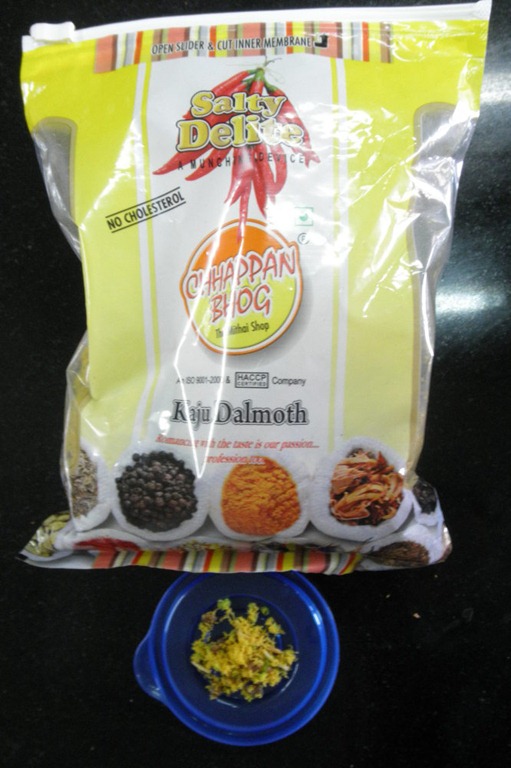
This one is a bit messier to eat. In texture, it’s like fuzzy dust studded with little bits of roasted lentils, cashew nuts, and other seeds and spices. It’s so fine it almost needs to be spooned. It’s also intensely spicy. I love the product tag line “A Munching Device.” A good mixer to use with other, less intense varieties.

These are The Resident Male’s favorite. They’re crunchier than Cheetos, and flavored with onion and chili instead of Mystery Orange.

Puffed wheat! Very roasty tasting, and a perfect background foil to these other hot and spicy treats. I knew a little about the variety of Indian foods and was prepared for that exploration, but the wealth of casual nibbles here took me by surprise. I find it a very amusing arena for small discoveries. I’ll post more about these as we try more.
On the needlework front, I’ve made a bit of progress on the Dragon Stole:

I’m just about up to the body, half way through the first dragon.
And I’ve unpacked my stitching. I’ve set up my big green sampler.
Unfortunately, there’s no good place in the apartment to work on it. I need very bright light, and even though we finally found the exotic flavor light bulbs used in the fixtures here, and have more than one 40 watt light source in the living room, there’s still not enough light to work it by. So as a stop gap, I’ve started the Sarah Collins kit I picked up at Winterthur in 2011:

I’ve never done a kit before, preferring to muddle about on my own. I am having mixed feelings about this. It’s cumbersome, with a zillion large scale detailed charts that require constant cross-referencing. The design is pleasing, the colors are o.k., not my faves, but well suited to the design. The linen is nice, and working 3×3 is a refreshing change, quite large compared to what I’ve been stitching of late. I opted for the cotton rather than the silk threads, in part because the silk kit was expensive. That’s why I’m working it on the padded round frame. Were this silk, it would fight for space on my flat frame with Big Green.
Oh, and yes – I’m working on T2CM, too. I’m up to the exquisitely boring part, where I add proofed counts to each pattern.
COMPULSION
Today I try to appease both my constituencies – stitchers and knitters.
First, for the knitters, I make confession that I’ve been seduced. I recently came into possession of a true one-skein wonder, two balls of Skacel’s Zauberball Crazy. One is an addled mix of red, turquoise, yellow and green (#1701), the other is chocolate, teal, cranberry and according to the official photo, on the inside somewhere – tan (#1507). It’s a lofty and soft fingering weight, 100g/459 yards per ball, enough to knit a pair of socks for me. Here are Skacel’s own photos of the two, at a color fidelity much better than I could achieve:


But looking at this stuff made me want to do something other than socks. Given the number of variables in play right now, I decided I didn’t want to take time to design my own pattern, so I began poking around the ‘net and found the Wingspan scarf. I’m working up this variant. It’s all garter stitch, with the demonstrative shaping formed by short rows. You can see the play of the extra long color repeat even in this traditional blurry String snap, taken at dawn:

A quick knit, totally on autopilot, with a clever system of traveling markers that make it impossible to make a mistake. More on this as the thing grows.
And on the Big Green Sampler, I’m inching along the fiddly bits at the bottom edge, filling in my voiding. The tightly drawn two-sided Italian cross stitch goes more quickly in an open field. Around these odd little bits – especially the Y-shaped extensions in the top and bottom borders (a detail done exactly this way in the museum original) – it’s a slow and exacting ride:

The little empty rectangles at the base of each Y are especially tricky to leave unworked. Still, I am making incremental progress none the less.
Now, why did I start the knitting project?
Compulsion. Plain and simple. I do 98% of my yarn acquisition at Wild & Woolly, my local yarn shop – a heaven on earth for knitters. But driving across the state to drop Elder Daughter off at college put me within striking distance of Webs, the Northampton, MA yarn hypermarket. My rule is not to buy stuff elsewhere that I can find locally, so Younger Daughter and I took a quick jaunt through the place looking for stand-outs – things I haven’t seen anywhere else.
That’s where I was attacked by the Zauberball. It fairly leapt of the shelf in a direct assault on my magpie color sense. It’s hard to describe this compulsion to a non-crafter. I HAD to get it, and I HAD to find something good to knit with it, and I HAD to cast on right away. That’s the way the best projects work – the absolute mandate to watch the piece take shape. Time flies on its own. Any encountered problems melt away. I look down and see more done than I realized was happening. Oddly enough, the final product while valued, is not the goal. It’s the process, the journey, the materials, and the sense of progress.
I’ll split my time between these two. Maybe I’ll figure out something myself to do with Zauberball #2. Or maybe not. But in any case, both balls have to be cooked, chewed and digested before I return to normal.
HALFWAY!
I had occasion to unroll the big green sampler last night in order to adjust the padding that was between the layers of previously stitched work. While it was out and open, I took some progress pix:


You can see that the entire piece spans the width of my dining room table. I’m more or less at the centermost strip, and at (more or less) the middle of that strip. The penny on the shot at the right will give you an idea of scale. I’m pleased with the density and patterning so far. I’m also pleased with the pulled background of the latest bit. But it is taking a VERY long time to stitch, and I’m looking forward to figuring out what will be next. Perhaps something in quick-to-finish double running, perhaps something a bit more geometric and very open. We’ll see!
In other news, I’m continuing to add both knitting and embroidery patterns to the patterns buttons at the top of the page. I’m going back through prior posts and standardizing formats, putting everything into convenient buckets for ready access. If you’ve got a request, let me know and I’ll bump it up in priority. Enjoy!
GREEN CONTINUES
[UPDATE: A pile more patterns have been added to the Knitting Patterns page (Button above).]
Yes, I’m still porting old site content over here, but to reassure my embroidery audience, my massive green sampler is still in the works. With the quickie book covers out of the way, I’ve turned back to it:

The pulled background fill does go slowly, but progress is being made. You’re looking at about half of the strip. The large downward pointing clump of lettuce at the left is actually the center. So I’ll be working on this one for a while.
Extra bonus: See that dangling thread? That’s how I end off without adding more knots, or adding bulk that obscures the drawn mesh effect. I take several running stitches down the center of an area that will be tightly overworked. Then after I do that stitching and the loose end is captured, I snip it close to the work. Starting a new thread is done in the same way.
Extra extra bonus: If you click to zoom on the photo, you’ll see a little arrow pointing out a mistake. I’ll be ripping that little bit out. My work isn’t perfect, just proofread.
BOOKED!
[NEWS FLASH: Kombu Scarf, Justin’s Counterpane and Mountain Laurel Counterpane patterns have been ported over. All are under the “Knitting Patterns” button above.]
The embroidered notebooks are finished and ready to send off to the recipient:

Each one took a bit over two weeks to finish out. The stitched area is approximately 5.3” x 8.25”, made to slipcover a standard 5”x 4” pocket journal style notebook (Moleskine is the most well known brand, but these were “work alikes” I found in Staples). Before you ask – they’re the same front and back – completely stitched. 🙂
Website Port
Thanks to everyone who sent encouragement on the port. The first three knitting patterns I reformat and post will be the Mountain Laurel blanket, Justin’s Octagon Blanket and the Kids’ Faux Chain Mail. I wish it were an instant process, but a bit of redrafting is in order. I’ll have all up ASAP.
Also thanks to the folks at Craftgossip.com who picked up the folded ribbon trim method I used on the Steampunk dress. If you’ve found String due to their link, welcome! I’ve got a lot more to show you.
SURPRISE!
Wondering what we’ve been up to?
Well… You’re looking at it.
After a good run, we’ve closed down wiseNeedle. Sustaining it was no longer possible. I’ll be rescuing the patterns and most of the articles from it, and reposting them here over time. And the yarn review collection will become part of the data trove at (as yet stealthy) Nimblestix. They’re still in Beta, but if you log on with “wiseneedle” after your user name, you’ll get a priority spot in their admission queue.
All String content is here. There will be some inevitable cleaning up as we settle into a new set of internal links. Most but not all links here from external sites should work. We’ll try to fix as many of the broken ones as we can. In the mean time, please take advantage of the much-improved category index and search features.
What have I been stitching?
On our trip to India and on our vacation at Cape Cod I busied myself with small, hand-held stitching projects: two quick book covers for small pocket sized appointment/jotting notebooks.
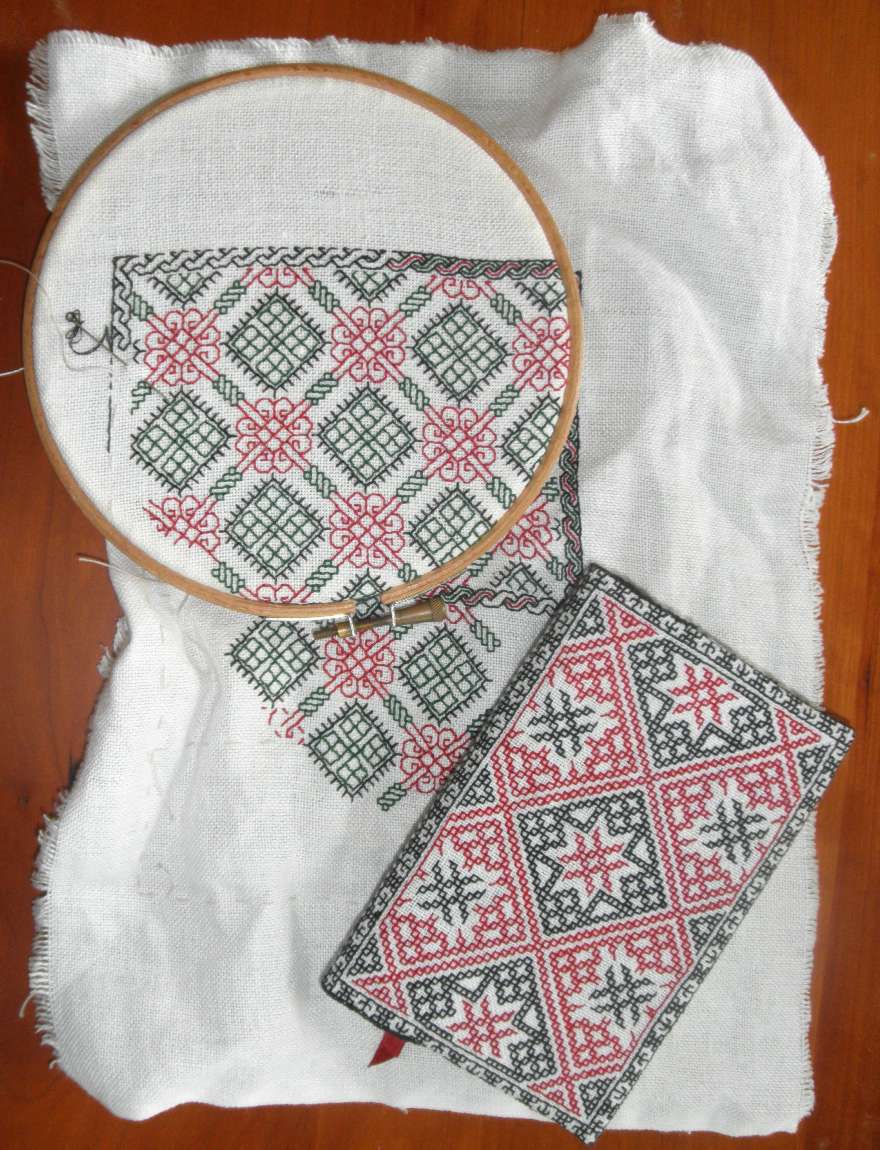
The finished book cover is adapted from two patterns that will be included in TNCM2. The one in process is a multicolor rendition of a filling in Ensamplario Atlantio, with a twist edging adapted from a larger design, also in TNCM2.
So. Be welcome! Let me know what you think of this new site and about what parts of wiseNeedle should be at the top of my rescue-me queue.
MESHY!
As some have pointed out, doing the fill in the voided background of this rather large strip will be a marathon effort. But I’m chipping away at it, slowly but surely:

The downward facing center spray is in fact the middle of the strip, so you’re only looking at about half of the total width. As graceful as this looks without voiding, with the background fill, it’s far more dramatic. I really like it.
Here’s another shot of the fill, held up to the light so you can see how meshy it is:

I’ve gotten better at the Italian two-sided framed cross stitch. While I had been waxing the last inch of the silk to assist in threading my needle, I’ve found that waxing the entire length really helps avoid splitting. I’ve also learned that the silk is mega-strong, and can take it when I pull firmly. So now my holes are larger and more uniform than when I began. Unfortunately I’ve also learned that this stitch is near impossible to tease out once done, so I won’t be able to go back and replace my “learning bits” stitched when I started.
For Susan – I’m using Two Sided Italian Cross Stitch, as shown in Christie’s Samplers and Stitches, 1920. I’m using the version shown in Figure 130, on page 85, but I am pulling it VERY tightly so that it behaves like a drawn thread stitch, compressing and bundling the weave while accentuating the holes. I’m using one strand of Soie d’Alger, color 1846, on a rather loosely woven (approximately) 40 count linen, and stitching with a small eye ball-point needle more commonly used for hand-hemming tricot fabrics. This particular pattern is being worked over 2×2 threads, laying down outlines first in double running, then going back and working the fill. If I had bothered to start and end my double running bits invisibly, this work would be totally identical front and reverse, with no way of telling which side is which. This is why this style was so popular in the 16th and 17th centuries for bed hangings, linens, napkins, cuffs and other items that showed on both sides. Prior to this piece I attempted this look on more standard densely woven modern even weave, with little success.
 String-Or-Nothing