YES, IT HAS BEEN A WHILE
Lots of non-report-worthy stuff happening here. We redid Younger Spawn’s room as a guest room, replacing furniture that no longer fit our needs with items that do, and making it a more versatile set-up in general. The Resident Male underwent a much-delayed hip replacement, and has already healed up better than he was prior to the surgery. My last round of radiation was completed, and consensus was achieved that the pain I experience is in fact linked to a post-radiation sacral fracture, which appears to be healing on its own without further intervention. We’ll keep an eye on that one, just in case additional reinforcement is required. Younger Spawn came and stayed with us to do fetching and hauling earlier this month when neither of us was up to full capacity. (Much appreciated!) So it’s no wonder that blogging fell by the wayside.
I can report progress on several fronts. First, on the Anything Could Happen sampler. I am up to the narrow band of leaves voided in blue that mirrors the one at the bottom edge.
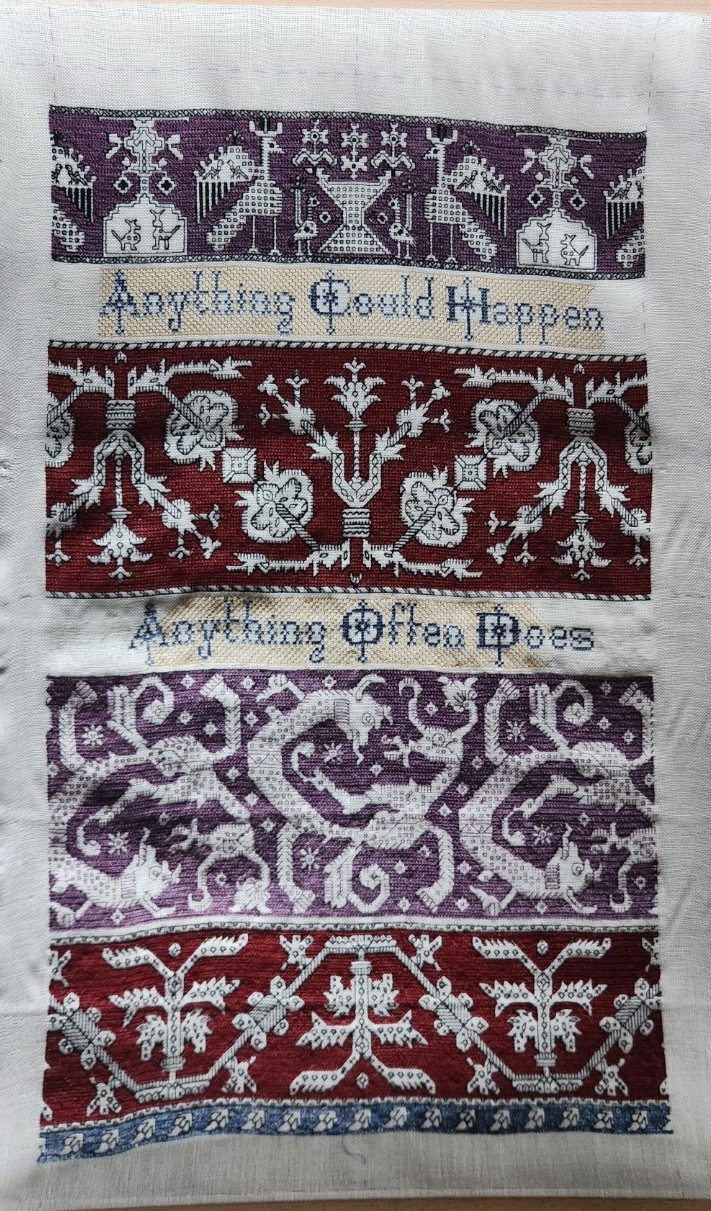
I also have to chart out the small motifs and signature/date squares that will go left and right of the two lines of the saying. Once I have those in place I will complete the yellow step-voiding on those panels. I have a good idea of what to put in there. My initials and year of completion, plus thumbnail sketches of a couple of items vital to the plot of The Hungry Judges – the as-yet unpublished book on which my Resident Male is now working.
And those in the know here will recognize that all of the major designs in this one are part of the Azemmour Cluster – a group of designs linked to Morocco which may have emerged as early as the 1500s, and continued on into the early 20th century. Lots of examples of this family were misclassified in museum collections for over 100 years. Fragments of these stitched designs carried the attributions attached when wealthy collectors doing their rounds on their Grand Tours of Europe bought them from dealers who probably thought that customers would pay more for Authentic Renaissance Era Embroidery Fragments than they would for bits of North African folk embroidery. And so they remained classified until advances in cataloging and communications, and the drive to photo-document these pieces brought them the attention they had lacked since they were first accessioned. Some bits with debatable attributions are still out there, but slowly and surely what is held and is in the public eye is being revisited and re-evaluated.
More progress. This time on my holiday socks for 2026:
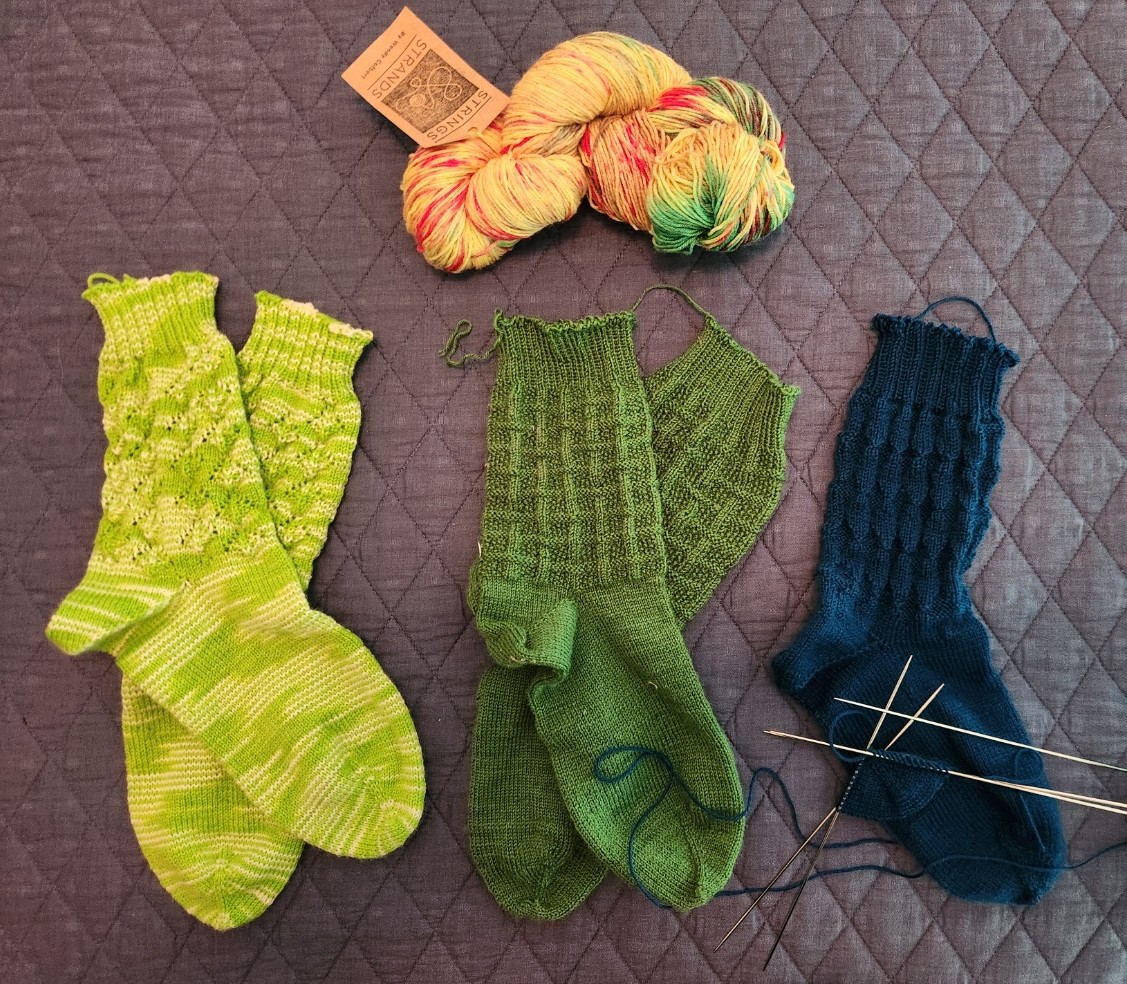
The three obligate pairs are either done or well begun. All three on the bottom row are knit from Cascade Heritage and Heritage Print. The as yet to knit skein above is Strings and Strands, a small and independent label, hand dyed, and a gift from a dear pal.
I try not to buy sock yarns at full price, since I go through them like popcorn. This yarn was on special at Webs. My cutoff price used to be $8.00 for 100g of sock yarn. Given the way of the world and the economy under the current occupying regime, that has had to move up to $10. per 100g. At the time both the solid color and print versions were under my ceiling. They aren’t anymore. Which is just as well. I found this yarn to be quite unruly for the traditional hard-spun wool/nylon blend sock yarn that it claims to be. Quite splitty, slubby, and prone to shredding. I think it will be ok in socks treated with tender loving care (as I have trained my spawn to do, they being the holiday recipients), but I also don’t think that this year’s output will last as long as that of other years.
That fancy one at the top? As I said, it was a present from a pal, so I feel entitled to use it to splurge on myself. When Blue Pair is completed, the next one up will be a pair for me. Probably combining that delightful multicolor with leftovers from all or some of the others. Maybe toes and/or heels in contrast. Possibly a few stripes on the ankle, or cuff ribbing. We will see what tickles my fancy when I get there.
As for the guest room – neat and clean, but nothing fancy. We donated the old twin size Captain’s bed to Household Goods in Acton, Massachusetts. It was in excellent shape, and they will find a family who could use it for another kid, grade school through high school. In its place we got a simple wooden queen size bed (no storage underneath); and a new nightstand to match. The old desk, dresser, and bookcase stayed. The desk, monitor and power source will be put in service when Younger Spawn visits. The perk of a 100% remote job is that remote can be anywhere, so we made sure to provide and anywhere against future need. You can’t see the dresser and bookcase, they are on the closet wall at the foot of the bed. But take my word for it, they are there. The matching nightstand is just to the cropped left edge of the photo.
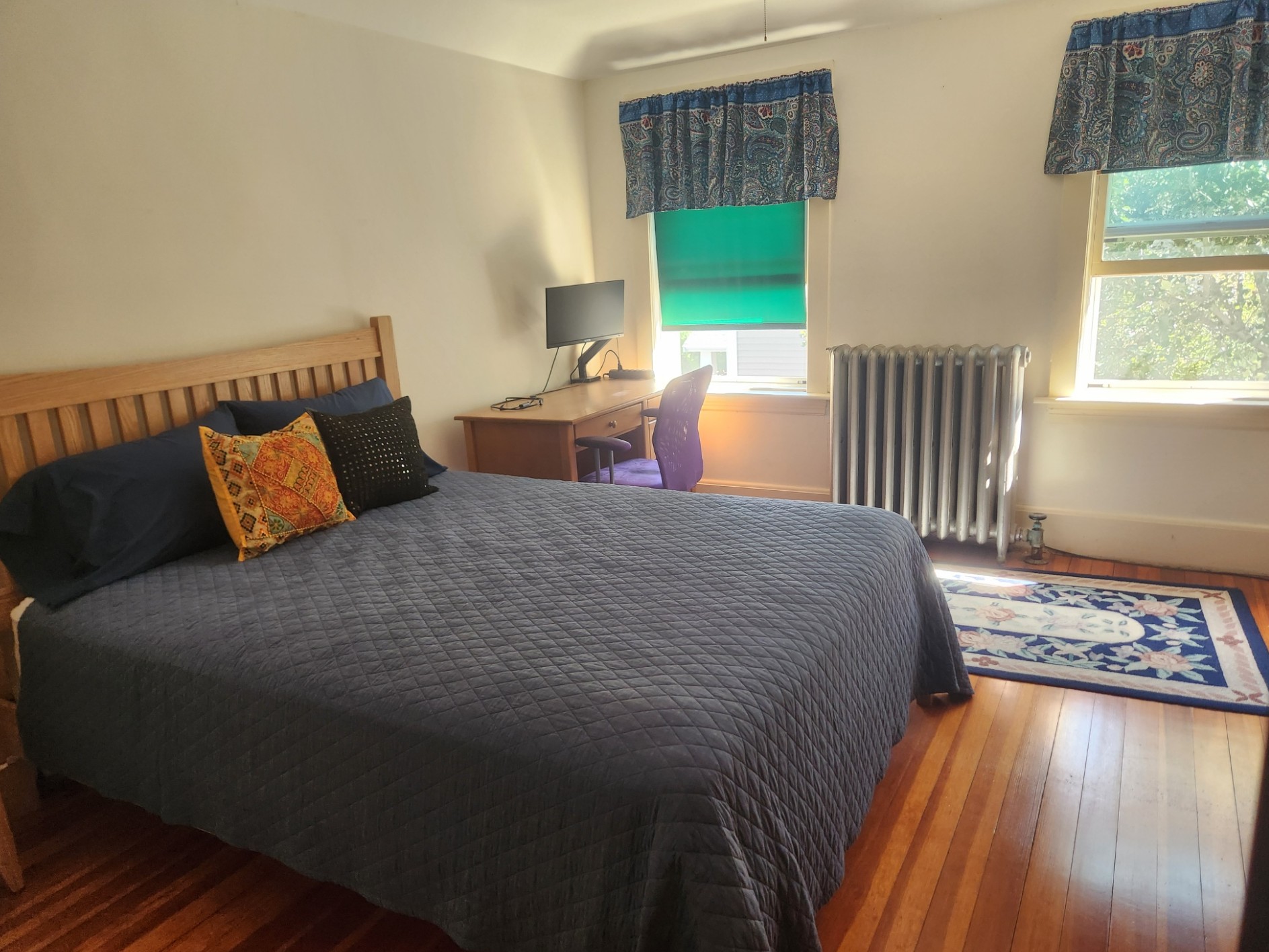
Items of special importance to the former resident have been carefully set aside, no rush to trash memories in the process. I also have some nice wall art to display over the bed, but I need to get those prints framed first.
So there you have it. A portion of what we have been up to, outside of healing, of course.
FILE FOLDER ARCHAEOLOGY
It happens that this week a couple of people have stumbled upon this old unfinished sampler that now hangs on my Wall of Shame.

It’s unfinished because I had started it as a wedding present for a friend. Sadly her engagement ended before the wedding. I never felt like finishing it off after that, although I still have it. It’s also the only piece I have ever done on Aida. I didn’t enjoy working that ground, which is probably another reason why it has languished since the early 1980s.
The reason these folks found it was that they were looking for a charted Hebrew alphabet. I knew I had one. Somewhere.
I had drafted one up, and it had gone through several iterations. The first was for a contemplated but never started service project for my family’s congregation – a Torah cover, to be exact. But I never had the time to follow through, so the scrap of graph paper was stowed in my doodle notebooks. About 8 or so years later I began this gift. I rescued the earlier scrap, played with the letter forms a bit based on the Macintosh pixel based Hebrew font. I added back a bit more of the pen and ink serifs, and messed with proportions a bit. After this project went into dormancy that doodle joined the earlier one. And I went looking for both this morning. Needless to say I didn’t find either. But I still have the sampler, so I re-graphed the alphabet based on how I stitched it (and tinkered a bit, again).

Click here for an easy to save PDF of the Hebrew alphabet chart above.
The first two lines at the upper right are the full alphabet. The five characters immediately below them are special. A few of the letters are written differently when they appear at the end of a word. You can’t write without them, so I offer them, too.
In addition to just a plain alphabet, I have charted up some of the most commonly stitched words.
Shalom – Peace
Mazel – Luck
Matzah (also spelled Matzoh) – The unleavened bread eaten at Passover. Some families have special linen napkins to cover the matzah for their Seder celebration.
Lechem – Bread. Like the Matzah cover for Passover, some families have a special napkin to cover the bread for holiday meals and for Shabbat.
Mizrach – East. In Europe it was the custom long ago to mark the Eastern wall of a place of worship or learning as a reminder of Jerusalem. It’s not done as often now as it used to be, but Mizrach embroideries do pop up on Judaica collections.
Now please don’t go asking me for translations or interpretations. I’m pretty much a late entrant to Hebrew School and I continued to struggle with the language in college. So much so that I ended up dropping back to French for my language credit to graduate.
The Hebrew chart will also join the others on my Embroidery Patterns tab.
Another Artifact of the Past
While I was hunting around for the alphabet doodles, I stumbled across the original of the handout I used to use when teaching basic sock knitting. It contains an abbreviated sock that we would work through together in the workshop, plus some of the other sock patterns available here on String. Also, it includes the pattern for the famous “You’re Putting Me On” Socks by express permission of Judy Gibson, that pattern’s author. Judy was major inspiration for sock knitters in the early days of the Internet, and merrily led hundreds of us astray into projects we wouldn’t have dared without her support. The 15 page booklet ends with some other useful references, including a chart of standard sock sizes and measurements, some (mostly dead) links to sock resources on the ‘net, and a visual on Kitchener grafting.

Click here for a free download of my Sock Knitting Workshop handout.
I’ll probably add it to my books page. Eventually.

