TOO BUSY TO BLOG
As ever, things have been very hectic here at String Central. Holidays, work obligations, family – you know the standard round of excuses. But that doesn’t mean that progress is not being made.
In no particular order, I present a subset of the accomplishments since the last post:
The Red Licorice pullover – finished. Amended slightly to meet the recipient’s specifications. Pix on this one are belated, since I gave it to the wearer who scuttled off with it before took photos of my own. I’ll go back and update this post when the pix come in, but I’ve held back publishing this long enough.
Six Pussyhats for the upcoming marches.

The now standard run of ten types of holiday cookies:

If you must know, clockwise from the top, they are coconut macaroons dipped in dark chocolate; chocolate chips; chocolate crinkles (aka Earthquakes); peanut butter, stamped with suns; hazelnut spritz with chocolate ganache filling (aka Oysters); raspberry jam filled vanilla wafers; Mexican wedding cakes; lemon cut-outs; bourbon/cocoa balls; and iced spice spritz cookies. In the center is homemade fudge, with and without hazelnuts. I also did two panfortes. Recipes for any/all available on request
And of course there were latkes (this year done in goose fat):
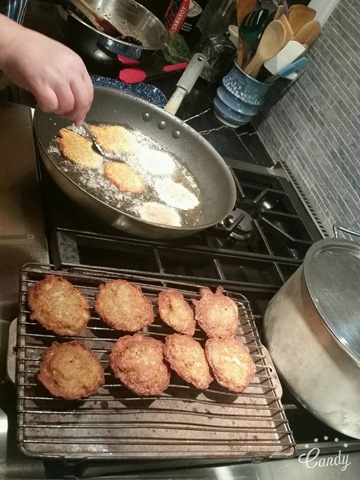
And of course over the three-holiday-week there were the donor goose; some heavenly fish quenelles (think gossamer gefilte fish and you would not be far wrong); a fantastic cassoulet made with duck confit we put up back in the summer; leek and potato soup; a home-made paté/terrine type loaf; our own sourdough bread; and an amazing spread of cheeses. Most of the heavy lifting cooking was done by The Resident Male.

We’re still eating the cheeses – there was so much that was (and still is) SO good. Thanks again to Cheese Gifters, Kim and Mike; and a shout-out to the Cheese Makers, Jonathan and Nina at Bobolink Dairy. If you love well-crafted, delicious cheese and have not tried theirs, you are missing out.
Along the way, I also started a couple more projects. First – curtains for the library. I’ve been threatening to do it for years, and have the linen and trim on hand, the trim being one of the embroidered things I treated myself to in India:

I’ve done all the calculations, pre-washed the linen, and ironed out the first panel of four. I’ve also obtained and pre-shrunk the lining. Next is to calculate placement of the trim and stitch it on to the first panel, prior to doing final assembly and hemming. I intend to use rings to hang the panels, from black iron or iron-look rods. Those will either be clip- or pin-type, so tabs are not needed. Parking these mysterious secret sauce numbers here for future reference (90, 10, 3).
And having finished the sweater and hats, I embark on another knitting project – Sandra’s Shawl, pattern by Sandra Oakeshott. This one features lots and lots of nupps – little multi-stitch bobbles. I am not a fan of making them, so instead of the nupps, I’m using beads. I’m using some really intense variegated green Zauberball Lace yarn (pix shamelessly borrowed from unrelated retail website):

And the beads are silver tone. As you can see, I’m already well into this one, past the unadorned center and out into the infinity rows where the beaded fun happens:
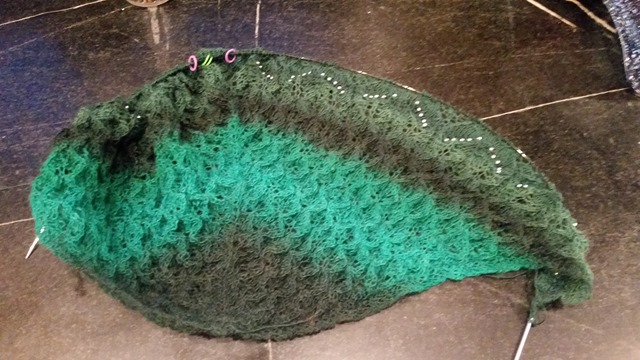
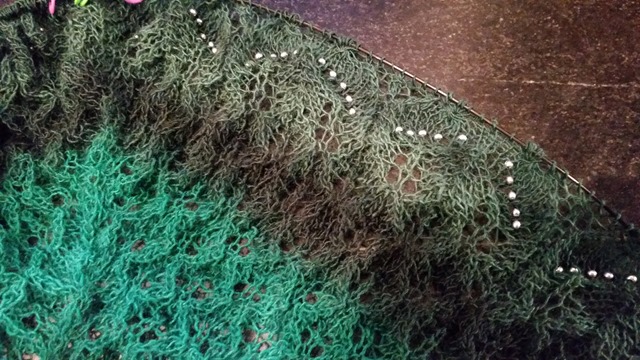
I can say that the pattern is well-crafted and easy to follow. I suggest putting markers at the beginning and end of the pattern repeat, to segregate out the edges in which the design is a bit perturbed by the increases required for shawl shaping. Some may wish to use markers between each pattern repeat, but I found it wasn’t necessary for me – the thing is easy to proof visually as one knits. And I most heartily recommend the use of beads rather than the fiddly nupps. Apologies to the designer, of course for using a non-traditional/alternative interpretation of her excellent pattern.
LONG HIATUS, BUT NOT INACTIVE
A frantic interlude of work related deadlines later, I return to this page.
And the recipient of the Crusher pullover, modeling it with standard ironic teenage attitude during Thanksgiving break:

Eye roll aside, she loves it. Really. Especially the three-quarter sleeves and front pocket. She’ll wear it with a collared denim or chambray shirt underneath, so the wide neckline and shorter sleeves (for rolled up cuffs) is spot on what she wanted. So armed, Younger Daughter returns now to college, full of turkey, and cocooned in wool.
On the knitting front, I am well into a Licorice Whip pullover possibly for me or Elder Daughter. I’m still trying to fit The Great Stash Largesse into my yarn boxes, so to make room, I’m doing up some quick knits from the bulkiest lots in them. This one is to use up some Araucania Nature Cotton, an Aran-weight thick-and-thin, kettle dyed cotton I’ve had on hand for at least six years. The skeins are not uniform, not even within dye lot (probably why I was able to snag it on special sale), so I am working from two of them at the same time, alternating to meld the colors and avoid any visible horizon likes (like the deliberate one in Crusher, above, where I used to strong contrast yarns on purpose).

The color is sort of washed out in the photo above. Red Licorice is really a very bright candy-apple red, veering to orange. The cotton is cushy and soft, but prone to shedding. It will most certainly be a gentle hand-wash garment when it is done.
In other news, two more pairs of briefcase-sox accomplished using Great Stash Largesse yarn. Standard figure-8 toe/short row heel, 76 stitches around, plain feet/interesting ankle. One brown pair already with its recipient, the other pair is mine, mine, mine:
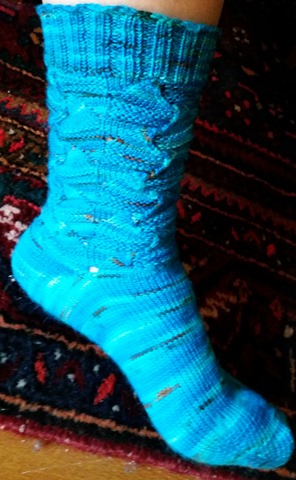
Yummy!
I also completed two baby sweaters, for Salazar Clan grandchildren born last month. One is with its target baby, the other is here in my basket, awaiting word of where to send it to rendezvous with the target great-nephew. Both are the same Lopez Island pullover and use same long stashed yarn in two different colors. Red is a 6 month size, and Blue is a 9-12 month size:.


In other knitting news, I will be needing a small project to carry with me on a trip the week after next. The bulky red pullover being too big for in-flight knitting. For that one, I’ve settled on Sandra’s Shawl, using a shaded deep to medium green laceweight from an earlier shipment of Largesse. I’ll knit up the larger size. However, I’m not a big fan of working nupps (the little bobbles that accent the edgings). Instead I will use silver beads. Cast on for this will be sometime this week, so I will be well enough along for relaxed knitting on the plane.
And finally, progress on the long stalled Second Carolingian Modelbook project. As I feared, in the format I had chosen, parallel to the original book, production – even in electronic format – will be prohibitive. I am now redrafting for release as a series of shorter works. The first of these will be a very short pilot folio – probably only five or six plates worth. By contrast, the book as I originally conceived it was 75 plates. If that works out well, I will continue with similar scheduled releases.
WITHOUT A NET
I’ve finished the no-pattern/no-gauge pullover I started the last week of September, at the beach:
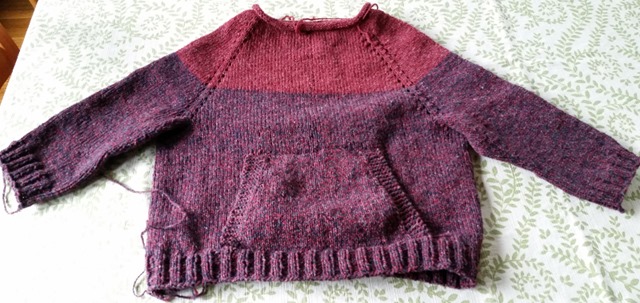
It’s a short but not cropped front-pocket/baggy-fit raglan pullover, knit in rustic New England style two ply Aran weight wool. The only seaming was grafting the top of the front pocket to the body. The thing is knit top down. Had I decided to add a pocket when I got to that point, I’d have worked it in, and knit the bottom edge into the body, and obviated any need to sew at all.
Younger Daughter has first dibs on the thing. It should fit her nicely, and if not – I’m sure I’ll find another family member or friend to wear it.
Here’s a working-method summary. I hesitate to call it a fully developed pattern because I haven’t calculated sizes, made exact measurements, or estimated exact quantities.
Wesley Crusher Unisex Pullover – A Method Description
Fits size 44 chest
Gauge: approx 18 stitches = 4 inches (10 cm) in stockinette
Recommended needle size: US #10 (6mm) circular for body, or size to get gauge; US #8 (5mm) circular for ribbing. You may wish to start the neck and finish the cuffs using DPNs of the same size.
If working the optional hand-warming pocket, either an additional US #10 (6mm) circ, or a pair of US #10 (6mm) straight needles, and a piece of contrasting color string, preferably a cotton in fingering weight or thinner, that will be used to baste the row to which the pocket is grafted, for better visibility in keeping that seam straight..
Materials: One skein of Bartlett Yarns 2-Ply Aran weight rustic wool (about 210 yards/192 meters) in shoulder color. 3.5 skeins of the same yarn in a contrasting color (about 735 yards/672 meters) for the body.
Other tools: 5 stitch markers, two large stitch holders or spare circular needles (any size) to hold the sleeve stitches while the body is being completed. Yarn sewing needle to darn in ends.
Neckline:
Using smaller needle, cast on 100 stitches, join in the round and work in stockinette for approximately 2 inches (a bit over 5cm). Switch to larger size needle.
Raglan Increases:
Place marker, knit 35 stitches (front); place marker, knit 15 stitches (sleeve top); place marker, knit 35 stitches (back); place marker, knit 15 stitches (other sleeve top). Knit one round. The four markers indicate the center point of the raglan increases. There will be one marker left over. We’ll use it later.
Increase round #1: *K1, YO, knit until one stitch remains before the next marker, YO, K1, move marker*. Repeat this three more times.
Increase rounds #2 and #3: Knit.
Continue working increase rounds 1-3 until you have enough depth on the shoulders so that the under arm area ends about under the arm (don’t worry if there isn’t enough depth for the front and back raglan “seams” to meet. We’ll be adding stitches under the arm, and working them into gussets. I did my raglan increase set 18 times (making 18 holes in a rows down my raglan “seam,” and ending up with 71 stitches between my front markers, and 51 stitches across each sleeve). Be sure to finish after round 3.
Separate out the sleeves:
Knit 36 stitches. Place the fifth marker. Continue knitting across the front to the first raglan marker. Set it aside. Take a stitch holder or spare circular needle (or a piece of string threaded onto a yarn needle) and slide the 51 stitches of the sleeve onto it. We’ll revisit them later. Set aside the next raglan marker.
Returning to your working needle and replace the marker. Holding the sleeve stitches out of the way, cast on 16 stitches, preferably with a half-hitch cast-on to minimize bulk. Place marker. Continue in stockinette, knitting to the next marker. Set it aside.
Set aside the stitches for the second sleeve in the same way, sliding them onto a storage device, replacing the marker, casting on 16 stitches, and placing the remaining marker after the cast-on stitches.
You should now have a marker indicating the center front, plus four markers – two at either side, isolating the cast-on stitches. Continue in stockinette to the center front marker. We are going to use that marker at the center front as the “begin round” point from here on.
Work the body:
Knit one round in stockinette.
Gusset Decrease Round #1. Knit to the side marker, move marker, SSK. Knit until two stitches before the other side marker, K2 tog. move marker. Knit across the back of the piece until you reach the other side marker. Move it, SSK, knit until two stitches before the next marker, K2tog, move marker, knit to the center front marker.
Gusset Decrease Rounds #2 and #3: Knit.
Repeat Gussett Decrease Rounds until only two stitches remain between them. On the next row, knit to the marker, take it off, knit one stitch, put it back; knit one stitch and set the second side marker aside. Repeat this for the back. You should now have a tube with about 176 stitches in total – 88 for the front and 88 for the back.
Continue knitting the body tube until it is as long as you want, minus 2 inches (about 5 cm) for the ribbing.
Optional hand warming pocket:
You will need a second ball of your body yarn at this point, or you will need to work from both ends of your current skein. I’ll call this secondary source the “pocket yarn.”
Using your original body yarn, knit all the way around your piece until you reach the marker for the second side. Move it and knit 19. 25 stitches should remain before the center marker. Holding your original yarn and your pocket yarn together, knit to the marker, then knit 25 stitches after the marker. Drop the pocket yarn and continue around with your original yarn (don’t worry if you’ve mixed them up – it makes no difference). Make sure that the pocket yarn emerges from the PUBLIC side (the knit side) of the work after you drop it, before you continue around with the original yarn. Stop when you get to the start of the doubled stitches.
Take your second #10 needle (straight, circ, whatever). Working carefully with your original needle, knit one stitch of each doubled pair and slide its brother onto your second needle. When you are done you should have 50 stitches on the pocket needle, and the same original 88 for the front (plus 88 for the back) on your original body needle.
Knit one round on the body, just to make sure everything is snug and safe.
At this point you can either finish the body or continue on to the pocket. Your choice. If you opt to finish the body first, skip below to Ribbing, then return to this point.
For the pocket – you will be knitting flat, back and forth. This means that to achieve stockinette, you will be knitting on the right side of the work, but purling on the journey back.
Turn the sweater upside down. We will be working from the bottom back to the shoulders for the pocket.
Pocket Row #1: Knit 5. Place marker. Knit 40. Place marker. Knit 5.
Pocket Row #2: Knit 5, move marker. Purl 40, move marker. Knit 5.
Pocket Row #3: Knit 5. Move marker. SSK. Knit to 2 stitches before the next marker. K2tog. K5.
Pocket Row #4: Knit 5. Move marker. Purl to next marker. Move marker. K5.
Pocket Row #5: K5. Move marker. Knit to next marker. Move marker. K5
Pocket Row #6: Knit 5. Move marker. Purl to next marker. Move marker. K5.
Pocket Row #7: K5. Move marker. Knit to next marker. Move marker. K5
Pocket Row #8: Knit 5. Move marker. Purl to next marker. Move marker. K5.
Repeat Pocket Rows #4 through 8 until 38 stitches remain on the pocket needles, or the pocket is deep enough. If you want it deeper, work remaining rows without decreasing. When done, DO NOT bind off the stitches. Instead, break the yarn leaving about 2.5 feet for seaming.
Keeping the pocket stitches on the needle, smooth it out against the front of the sweater. Note the row where the pocket should be grafted. On the row ABOVE that, take your piece of marking string, thread it onto your yarn sewing needle and run it through that row for the width of the pocket. This will make identifying the row for seaming easier. If you are confident in being able to graft a straight seam, you can skip this step.
Using your extra long tail end left over from the pocket, graft the pocket stitches to the row immediately below the one you have carefully marked with basting. Invisible horizontal seaming works nicely for this, uniting the live stitches off the working needle with the body stitches.
Ribbing:
Return to the original needle holding all of your body stitches. Take your smaller ribbing needle and working from the original needle onto the new smaller needle, start from the center front marker, and work K1, P2,* K2, P2* ending with K1 for the stitch immediately before the marker. Discard the larger needle and using the smaller one, continue in this K2P2 ribbing until you’ve worked 2 inches (about 5 cm) or the ribbing is long enough for you. Bind off in pattern.
Sleeves:
Take your #10 needle and transfer the stitches for your sleeve to it. Take your body yarn and starting at the left point of the stitches you cast on underneath the arm, place marker, pick up 8 stitches place the center sleeve marker (suggest this be a different color), pick up another 8 stitches to finish filling in the gap, place the third marker, and knit around the sleeve. Knit around until you have returned to the center sleeve marker. NOTE: As you continue the sleeve from this point you may find that it gets uncomfortable to use a larger diameter circular, even if you “loop out” the excess cable as you go. Feel free to switch to DPNs or a two-circ method at any time during completion of the sleeve.
Sleeve Gusset Decrease Row #1: Knit to 2 stitches before the next marker, K2tog, move marker. Knit around the sleeve until you reach the other sleeve gusset maker. Move it. SSK, knit to the center sleeve marker.
Sleeve Gusset Decrease Row #2 and #3: Knit
Repeat Sleeve Gusset Decrease Rows #1 to 3 until only two stitches remain between them (one on either side of the centermost marker). At this point you should have 53 stitches. You can remove the two sleeve gusset markers and continue working until you sleeve is long enough (minus 2 inches for ribbing). On the final row before starting the sleeve ribbing, start the row with a K2 tog, so that you have 52 stitches. Switch to the smaller needle(s) and starting at the center sleeve marker, K1, P2, (K2, P2)*, ending with a K1. Work this K2P2 ribbing for about 2 inches (5 cm). Bind off in pattern.
Darn in your ends, and you’re done.
ESCAPE KNITTING
So here we are at the beach again, seizing a weekend unoccupied by renters, to enjoy our place in North Truro. It’s not as warm as it can be in full summer, but it’s plenty comfortable enough for lounging on the beach, wandering the shoreline, and nosing around Provincetown.
And what’s lounging on the beach without a knitting project? It can be difficult to knit from a complex pattern on the beach – hard copy pages get damp, and tend to blow around. It’s often too bright to knit from designs stored on the iPad, the screen washes out in the sun. So I tend to look for projects that are mindless, memorized, or free-form.
So here’s the latest, photographed in full sun on our deck.

I’m working entirely without a pattern, using a rustic style Aran weight wool. I’ve got several skeins of well-aged Bartlett two-ply Maine wool, that are taking up all to much room in my stash boxes I’d prefer to put to other use.
I have a couple of heathered garnet red; a couple that are ragg-mix of one ply of the garnet, and one of a navy; and a couple of a medium blue which is too light to use in combo with the others. None are enough for an entire adult sweater but it’s time they earn their keep. Also the ragg style blue/red mix would overpower most texture work. So what to do?
A unisex, simple raglan, worked top down was the obvious choice. No pattern, no gauge. I started by casting on 100 stitches, and working a rolled stockinette collar on a US #8 (5mm) needle. I changed to a US #10 (6mm) needle. I’ve now got about 172 stitches around – roughly a 44-45-inch chest circumference. The fit is slouchy and sweatshirt-like, and the high lanolin content rustic yarn (though a bit itchier than Merino, and hand-wash) guarantees a hard wear sweater ideal for cool weather hiking, and winter sports. It’s a bit small for me, but between spawn, and a huge army of nieces and nephews, plus lots of outdoorsy friends, it’s bound to fit someone.
So, what do I call this no-pattern piece? The Wesley Crusher, of course. Named for the ubiquitous shoulder-colorblock casual sweaters and uniform blouses worn by him and the rest of the STNG crew.
Minor discovery during the course of this one. Many circular needles in larger sizes have a noticeable “bump” where the needle part slims down to the cable’s thin diameter. It can be annoying to shuffle stitches up that steep incline as you knit in the round. But you can minimize the problem if you are using an interchangeable needle set. I’ve outfitted one of the circs with a size #10 on one end, and a #8 on the other. Since stitch size and gauge is dictated by the needle you are using to form the stitches (as opposed to the one being knit from), the smaller size needle sits on the “feed” side of the round, and its slightly smaller diameter presents less of an impediment when shuffling the stitches around into “knit me” position. Give it a try!
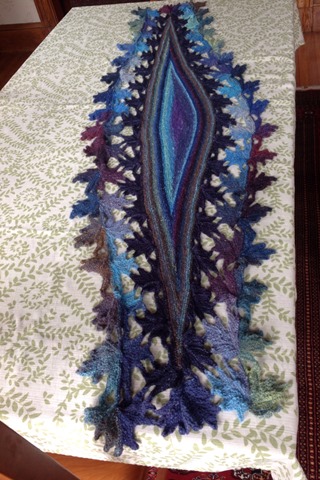
And in other knitting news, I have finished the leaf shawl/scarf:
It looks like work/home will crawl back to a more manageable schedule, so I hope to be posting more regularly again in the weeks to come. Next up is a tutorial on a simple method to finish out a sampler into a backed hanging.
BELATED FINISH
A very hectic month, between work and other obligations. I’m glad to say we’ve gotten Younger Daughter off and installed at college, purple hair and all:

And I finished her vintage shrug:


An interesting project, this was a very quick knit, but it did take a bit of attention in finishing. The instructions for seaming in the original are pretty rudimentary. Here’s what I did, in case you want ot make one of these for your own:
- Leave stitches live instead of binding off the final row
- After blocking, graft live stitches to the cast on edge, taking care to match the drop stitch ribs.
- Next, sew up the two sleeves, using grafting along their finished edges. Again, match the ribs.
- You now have the final seam left. Carefully match the center back seam to the center of the shoulder strip, and pin.
- Use mattress stitch to join the two strips together.
In effect, what you end up with is a T-shaped seam in the back, with the horizontal running between the lower edge of the armholes, and a vertical seam at the “spine” of the lower strip forming the center back. Both are hard to see in my photo of the back because (to brag) I took great care with my grafting and seaming.
Quite pleased with this one. Younger Daughter is into swing dancing, and will wear it not with t-shirts as shown, but with her 1940s/1950s-style dance dresses.
CATCHING UP
It’s been a while since I posted last. Hectic doesn’t begin to describe it. Kitchen finish, work-related deadlines, college graduations, and last – a blissful vacation week on Cape Cod in our new beachside condo, full of kayaking, golf, good food, and the active pursuit of doing absolutely nothing. All in all too many things to accomplish, with too little time to document any of it.
But through it all, a modicum of sanity-preserving handwork has happened: three pairs of hand-knit socks (my default no-thinking project of choice); plus some others.
First, thanks to the generosity of Certain Enablers who shall remain unnamed – a vintage shrug. I began working on this just before the vacation break. On US #9 (5.5mm) needles, this one was a quick knit. At left is the photo from the pattern. At right is my piece.

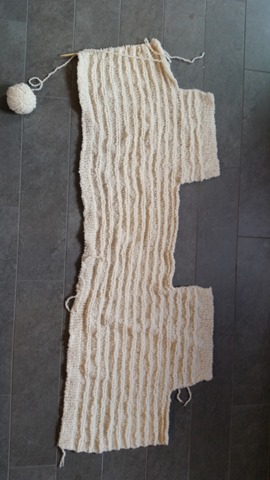
Those projections on the side are the sleeves. Obviously, I haven’t seamed the thing up yet. A bit of pretzel-type manipulation is slated to happen that will result in a T-shaped seam in the back, and the graceful drape of the simple drop-stitch rib pattern curving in the front. Or so we hope. I have the piece left on the needle because I haven’t decided yet on whether or not I will be doing some sort of live-stitch seam. It’s hot and sticky right now – too hot to sit with this tub of alpaca boucle on my lap. I’ll go back and finish this piece off when it cools off a bit. I’ll have to rush though, so Target Recipient can take the completed garment off to university with her next month.
Second is also a time-linked project. The first of two, in fact. I am edging off the two inspirational samplers I did for the girls, backing them and readying them for simple rod type hanging. Here’s the first. I’m hand’ hemming the backing/edging cloth to the stitching ground. The backing cloth is in one piece, strategically folded to be a self frame. I’ll baste a length of chain threaded on some thin woven tape in the bottom fold to provide weight, and leave small gaps in the two top corners for insertion of the hanging rod:
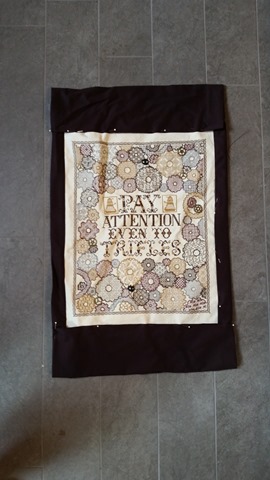
The second one will be close behind – the other sampler I did this fall/winter past. Also finished out for hanging from a rod. More on that after I’ve laid it out. In fact, if folk are interested, I’ll use the second one to illustrate the folding and stitching logic required to do this.
And finally, just for fun with no deadline attached (so you know what I’ll be working on tomorrow evening), an Autumn Lace shawl out of some unknown Noro fingering weight yarn, augmented by some Noro Taiyo Sock. The unknown Noro was also from the same Enabling Anonymous Donor, and was perfect for a project I’d been planning on working up for a long time:
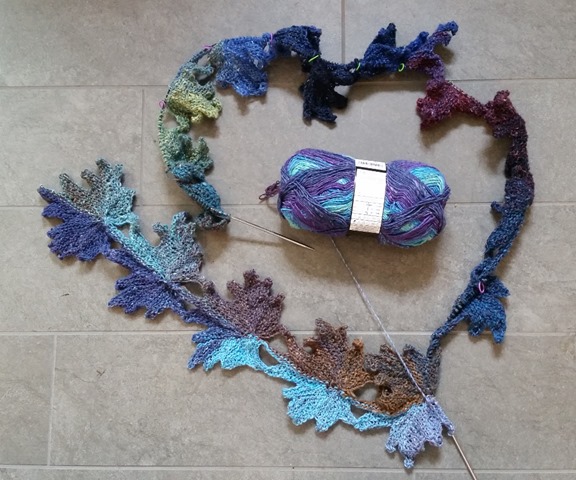
Here you see the first course of leaves (worked bottom half, then top half). This is not a particularly difficult pattern, but it is an exacting one, with a pattern that has to be closely followed, and that is not within my capability to memorize. More on this one as it develops.
TOPSY TURVY
Things here at String Central are about to be totally up-ended. We’ve now lived in the New House for about 10 years, which makes it not so new any more. In truth it hasn’t been new for quite a while, having been built in 1911 or so.
When we bought it we looked around and fell in love with the place. Some parts more than others: the large, open layout, the abundance of surviving original woodwork and detail, the high coffered ceilings in the living and dining rooms, having a tiny library(!) plus sufficient space for all of the bedrooms, office areas, and workrooms a family with a wide variety of solitary pursuit interests needs.
On the problem areas, we’ve gone through a long list of improvements over the years, most having to do with systems: heat, insulation, wiring; or structure. New plumbing, a full-house rewire to get rid of (barely) functioning knob-and-tube, secure/weather-tight basement windows, a new heating system with a separate upstairs heat zone, insulation, a new roof, and a new driveway are just a few. Other than rehabbing the poorly functional upstairs bath, we haven’t done much in the way of aesthetics or livability, beyond addressing basic needs.
But no longer.
After 10 years we are about to begin a major kitchen rehab, and FINALLY be rid of the sagging mint Formica countertops, the droopy cabinets, the dismally scratched (and hideously pink) floor tile, plastic sheet backsplashes; and the outdated, poor functionality of our layout. I can hardly wait!
Here’s the official set of Before Pictures:

 ‘
‘
In the shots above you can see the partial wall between the prep and dinette areas, that breaks up the space without adding value. They are remnants of what had originally been a full wall, separating a back day-room for maid’s work from the kitchen proper. This is now our eat-in area and will remain so, but the partial wall is going.

In this one you can see the patched- in wasted space above the cabinets in between them and the equally useless dropped soffits above the cabinets themselves. That overhead space will be put to far better use.

And here are the mint green counters and plastic backsplash of the inconveniently far from everything Other Counter. It’s the clutter-magnet area where we stash recycling, and although absent in this shot, where pantry overflow usually sits. This space will also no longer sit idle.

Although we do have an pantry, it is of very little use, with narrow shelves too shallow to accommodate most cans, boxes, or jars. The front part is a hinged armature that is very difficult to move if you want to access similarly shallow dead shelf space behind. We are in sore need of effective pantry space. The new design will address this, too.

The rusted, creaky round-abouts (lazy susans) are an invitation for stuff to fall behind and jam the mechanism, with center poles that preclude larger items. The gadget garage isn’t bad, but tends to be another clutter-magnet area, and uses up more useful space than it provides in return. Technology for corner cabinetry has vastly improved since the ‘80s. I’m looking forward to the new solution.
On overall design, the current kitchen/dinette area, although it looks large, is not wide enough to add an island or peninsula without serious bottleneck or access issues, so we are not going to radically change the footprint. However, the current arrangement of appliances and countertops isn’t very efficient. We end up doing 90% of our prep work in the two foot space between the sink and the stove. The stove itself does not have a vent to the outside, which doesn’t add to ease of keeping the room clean. And the kitchen is dark, with too many lights that don’t manage to provide illumination of the actual work areas.
So it’s time for all of it to go.
In the mean time, we’ve moved out of the kitchen, so the crew can come in tomorrow to start demolition. We’ve crammed everything into the living and dining rooms, and will live without stove, oven or microwave, dishwasher or useful kitchen sink for the time being:


We plan to address all of these issues. Stay tuned to see how!
For my knitting and stitching pals – don’t worry. This isn’t going to turn into a home-improvement blog. I continue to plug away on the wavy infinity scarf/cowl, plus progress on a pair of socks. I always have a pair going, as “briefcase knitting” to do while waiting for appointments, on line, or in other away-from-home-base moments of idleness.

It’s slow going. As I’ve said before, I spend as much time untangling as I do knitting. And I still need to pay attention to the pattern. I haven’t memorized the thing yet. So it’s difficult to do when I’m watching TV in the evenings – my favorite time to do handwork. Especially so because we’re re-watching our set of Lone Wolf and Cub TV series DVDs, which are in Japanese with subtitles, and on Netflix, the Norwegian series, Occupied, similarly subtitled from Norwegian.
So there you have it. Chaos is about to descend. But at least I can knit my way through it, while nibbling sandwiches in the dining room.
THIRD TIME IS THE CHARM
I’m still plugging away on the Mixed Wave pattern scarf for Elder Daughter: It’s based on a cowl pattern of the same name.

Now, why has it taken me two full rip-back and start again cycles on this one? Mostly because I can’t resisting tweaking here and there when I work from a pattern.
In this case, the recipient and I decided that a narrower piece was more desirable for wear with the target coat. So I removed a ten-stitch unit. Then we jointly decided that instead of two contrasting colors, we wanted to use three, in combo with our neutral color (black). It’s hard to see here, but I’ve got a cranberry red, a maroon, and a variegated that ranges from cranberry through maroon, with shots of turmeric here and there. After that it was the traditional matter of Not Paying Attention, forgetting to move counting markers, and getting incredibly tangled from all of the flipping as the short row segments (the almond shapes) are formed*. And let’s not forget the last forgetting – neglecting to make sure that stitch count was stable after every left and right edge segment pair.
But I’ve got it well in hand now. I’m even beginning to remember to alternate left and right leaning almonds, along with choosing which segment to work as an almond, cycling through the colors, and remembering to work the row-beginning decreases and row-ending increases that give the piece its rhomboid slant.
I will continue on this piece, making it a bit longer than the original, and eventually either graft it into a true infinity scarf, or finish it off as a straight scarf with pointed ends. We’ll see how my well my composure handles the all-too-frequent stopping to untangle.
* Yes, I know the trick of always flipping clockwise on front side and counter-clockwise on wrong side rows of the short row sequence. It isn’t helping.
REAL HIPSTER SOCKS
Well not, actually. Just socks that feature hips:


These are the socks I mentioned in my last post, bespoke by the Resident Male as a gift for his hip replacement surgeon. A frenzied week of knitting, to be sure, in order to be ready to be given at the scheduled follow-up appointment.
I will say that both TRM and the socks have knit up well. Thanks to all for the get well wishes. He’s hobbling around quite spryly with cane, and gains movement range and strength every day.
On the socks, as previously posited, I worked them on two circular needles, in the round on 80 stitches around (US #00s) with figure-8 toe and short rowed heels. I kept on that way until just after the completion of the heels, then splitting them at the center back, adding a stitch to the new left and right edges for later ease in seaming, and then continuing to work side by side, but this time, flat.
Here’s a typical late-night, poorly lit shot of the pair, side by side, being worked flat on a single circ, which I remembered to take at last minute:
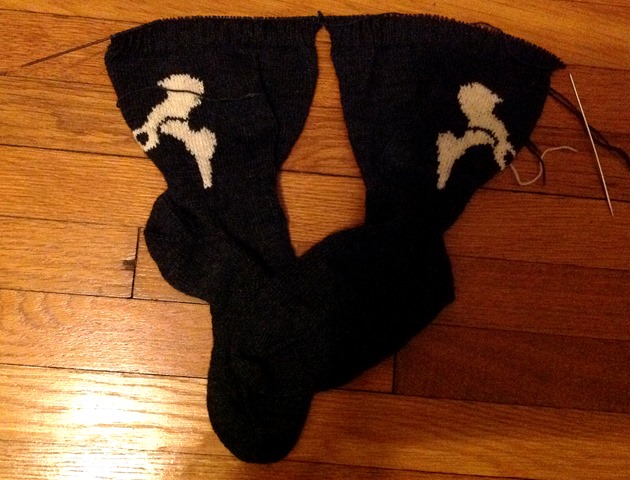
All in all, while I was happy to fulfill the special request, and interested in the experiment of working a pair on two circs with an Intarsia clock, I have mixed feelings about this project.
- If I had more time, the socks would be about an inch longer before the ribbing. The proportion would be better.
- I still am not a fan of Intarsia. That’s my mother’s favorite style of knitting. I vastly prefer textures, lace and stranding. Taming the multiple bobbins or yarn butterflies drive me crazy, no matter how careful I am at always using the strands in the right order and orientation.
- I should have used proportional graph paper rather than plain 1:1 squares when I charted the hip. The stitch height:width ratio has flattened the design somewhat, and has lost some of the more gracefully round curvy details. Here’s a place to make printable graph paper in any proportional ratio you need.
- I have and will probably use two-circs again for larger things like sleeves, but I don’t like that method for socks. Not one bit. Stopping to assort the needles and yarn slows me down big time over plain old DPNs. I know others adore the method, but it’s not for me.
On the up side, the socks are complete. They are the right size (I aimed at a guessed shoe size of men’s US 12-13, for a 6-foot guy), and although just a tad short from heel to ribbing, are totally wearable. The motif sits well in place, and the copious end-darning doesn’t create uncomfortable ridges inside. The mattress stitch seam worked perfectly, and the result is invisible from the outside of the work.
Now on to other projects!
HAPPY 2016!
Apologies for silence at this end. Things have been a bit unsettled here at String. The holidays came and went, with their obligatory cookies:

…and decorations.

Foods were cooked for the appropriate occasions, including cassoulet, latkes, boned-out stuffed ducks, panforte, ham, roast beef, and all sorts of sides. Gifts were obtained and exchanged. Wine and champagne were consumed. Visitors popped by. Spawn were supported as they wrestled with college application deadlines. And The Resident Male (TRM) had his hip replaced. He’s well on the road to recovery, and is delighted to be regaining utility that he had thought lost forever. Warning to his golfing pals – by the Spring, he’ll be back in training and itching to test out the new equipment, to see what it can do for his swing. But as you can see, the interval since my last post, although long, has been a tad hectic.
Even on the project end, I haven’t had time for as much as I planned. Between working from home part time and the rest of the laundry list, above, plus standard household stuff like shoveling, I didn’t get a chance to sew the the new curtains for the library that I had planned as my end-of-year break effort. I’ve also set aside the Mixed Wave Cowl for Elder Daughter, and didn’t get started on some other holiday knitting or needlework. Those things were derailed by a request from TRM to knit up a pair of socks as a post-surgical gift. So I am now trying to motor through a pair in very boring grey fingering weight. They will be enlivened by a design on the ankle – probably something skeletal and hip-like, worked in Intarsia. Here you see them, with the feet and half of the heel complete, almost up to the motif area; two rather dull, shapeless grey blobs.

To do Intarsia on the ankles of these toe-up in-the-round socks, I’ll cheat. After the heel is finished I’ll split the rounds at the center back, and work both socks flat. Since I’m doing them now side by side using two circs, I’ll re-assort the stitches onto one circ and continue, to guarantee uniform length and design placement.
How do I like the two-circ method for knitting a pair of socks at the same time? Frankly, not much.
I find I am actually faster at five DPNs because I don’t have to stop and fiddle at the end of each half round to retrieve the correct needle end, and I don’t have to pause to untangle twisted feeds from two balls of yarn (or both ends of the same ball). But the idea here was to use this project to try something new to me that so many others recommend, and to ensure the hard-to-count charcoal color yarn produced two socks of the same size and length. On the latter, I have to give kudos to the two-circ method. No actual counting – just keep on and you are guaranteed uniform products.
So here we are. January has been achieved. All sorts of seasonal and special-case speed bumps have been successfully traversed. Bring on the rest of the year. After December 2015, I can handle anything.
 String-Or-Nothing