PERMISSION GRANTED, MORE OR LESS
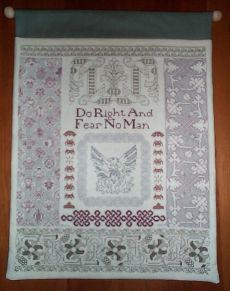
Here it is, totally finished, and with a vaguely decent picture (but as yet, unsigned and un-mounted).

The recipient is thrilled, which is always gratifying.
UPDATE: People want the specs on this piece so they don’t have to hunt through previous posts. 30 count evenweave linen ground, stitched over two threads (15 spi). The 6-strand floss is man-made “silk”, rayon actually; a vintage find brought back from India, slightly thinner than standard DMC floss. I stitched all of the foreground using two strands. Some of the background I did in single strand for contrast. Pattern strips with one exception are all from my forthcoming book The Second Carolingian Modelbook. The alphabet is from a vintage Sajou booklet #104 reproduced at Patternmakercharts.blogspot.com. I hemmed my linen by hand before starting.
The reason I haven’t done the last teeny bits is that I’m trying to finish off some end-of-year gifts for the spawn.
First up and already done was the new pair of Susie Rogers’ Reading Mitts, done in a sparkly yarn for Younger Daughter. She’s a fan of the surreal Welcome to Night Vale podcasts. One of their taglines is “Mostly void, partially stars.”
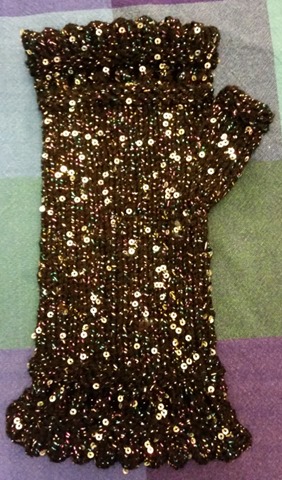
To get the partially-stars look, I used Loops and Threads Payette – an acrylic with a running lurex thread and small paillettes (flat sequins). Both inspiration and enablement are courtesy of Long Time Needlework Pal Kathryn, who sent this stuff to me. Just seeing it sparkling at me kicked off this project. Kathryn’s initial intent was to knit socks from the Payette, but that effort was a no-go. And rightly so. The stuff is not fun to work with, and would make supremely uncomfortable socks. The base black yarn is waxy feeling. The lurex thread breaks easily and is scratchy, and the paillettes can make stitch formation difficult – especially on decreases. Oh, and forget about ripping this stuff back. The lurex snaps. But the look can’t be beat, especially for a big-box-store available yarn.
Yarn aside, this project is a great quick-knit. Both mitts together took two evenings. I used the Payette doubled, and knit the smallest size, which fits perfectly. The only change I made to the original design is eliminating the bulk of cast-on and cast-off. To begin, I work a figure-8 or provisional cast-on. When I get to the last row before the cuff welt, I reactivate the bottom stitches and fold them up, knitting one bottom edge stitch along with its live pre-cuff counterpart. This melds the bottom into the work, and eliminates the final bit of sewing up, and cuts down on pre-cuff bulk.
To cast-off, instead of making a finished edge and then sewing it down, I leave a long tail and fold the live edge inside the work. Then I use that to secure each last-row stitch to its counterpart in the first row after the fancy welting on the upper edge.
Final verdict – the kid loves these. The original design’s pretty welt and eyelet detail is lost in the sequined look and it’s over the top sparkly. But it fits in perfectly with the Nightvale-inspired theme.
Next on the needles is a new scarf for Elder Daughter. As I mentioned in the last post, I’m enchanted by Sybil R’s designs and was determined to make one or another of them. At first we contemplated a different scarf, but rummaging through my stash, we came up with yarn better suited to her Mixed Wave Cowl, an exercise in nested short row enhanced stripes. Here you see the bare beginnings of mine:
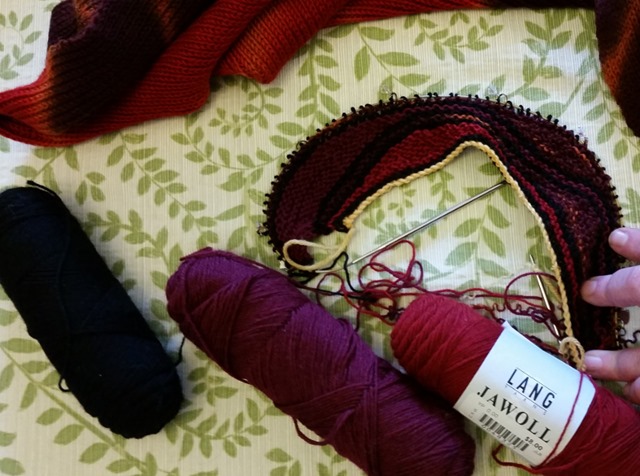
I’m using an eclectic mix of well-aged stash denizens, plus a more recent variegated yarn seen here in a rather blue-shifted photo. The black and russet are both Lang Jawoll bought who-knows-when. The claret (again not as purple as it looks here) is Froehlich Wolle Special Blauband, which I’m pretty sure I had when we moved back to Boston in ‘95. The variegated scarf thingy is Regia Creativ one of the unravel-me-and-knit dyed strips, in a mix of autumn colors including chocolate, russet, claret, and burnt orange. The pattern is written for DK, on rather small 3.5mm needles. I’m using fingering-weight sock yarn on 3.0mm needles, which is making a slightly looser fabric.
More on this one as it grows…
SURFACING
It’s been lonely here at String. So few posts over such a long period of time. I apologize for that. Life has been hectic, with work deadlines, the close of Younger Daughter’s school year, and house projects just getting under way.
For a start, here’s Younger Daughter, decked out for Junior Prom.
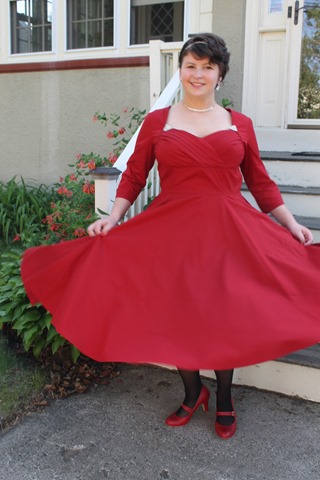
No copycat column dress for her, she took inspiration from decades past, and found a bargain repro-1950s dress on line. Much child/parent conspiring took place to round out the outfit. The rhinestones for example are excavated from my jewelry box, and ultimately belonged to my grandmother and great-aunt. Younger Daughter looked great, and had a wonderful time. And not a bit of envy for dance-able comfort from some of her more elaborately dressed peers.
On the Trifles sampler, I ran into a roadblock. I tried drafting and tracing meshed gears, which I intend to use as a background, filling each one with a different counted blackwork-style filling. But I wasn’t finding a great amount of success. So I caved in and bought a plastic stencil. I’ll use selected bits of it, tracing the precision cut cams onto the cloth and tiling the thing where needed (it’s calculated to do that!). More on this once I get going.
I’m also working on a two-person knit-along with Friend Kim – a mesh-knit three-quarter sleeve pullover from a Kate Bellando pattern. I think we’re both at about the same mid-sleeve point:
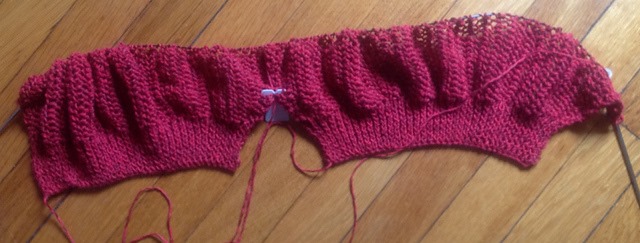
For the record, we’re both using SMC Select Reflect, a light DK/heavy sport yarn in rayon/cotton blend. I can say that both of us have had extreme problems making gauge and have had to adjust needle size and move down in selected garment size to compensate.
And I’ve done a ton of socks as I noodled out the various problems and challenges, above. This pair was knit up from a hand-painted sock blank – Plymouth Happy Choices, in the Fiesta color.

In essence, a sock blank is a long scarf-like machine knitted strip that a dyer then paints with her or his chosen colors. When the scarf is unraveled for use, its patterns knit up in unexpected ways. I knit mine straight from the blank rather than re-winding, working my standard figure-8 toe, short-rowed heel sock. The crinkle made no difference in the finished product, and the convenience of working from something that wouldn’t escape and skitter down six rows was perfect for airplane knitting. The lace pattern on the ankle is from Walker’s fourth treasury.
And on larger, family projects – we start to consider redoing our kitchen. The floor tiles are worn past their surface color, the cabinets and countertops are sagging beyond simple repair or re-use, and the layout/look is inefficient and dated. The room was spruced up around 1980, as a peace offering between the warring couple that sold the house to us. I have detested the shell pink/mint green/faux Colonial cabinet combo from the day we moved in. Before pix in next post, for sure. Ten years is enough, and it’s time!
NIECE, SLIGHTLY DAMAGED
As happens to so many, my gymnast niece Veronica had a disagreement with gravity, momentum, torque, and a body part; and has landed in cast. She’s on the mend, but disappointed to miss out on the remaining Spring competitions, and (living in Buffalo) regrets her now chilly, exposed toes.

Knitting to the rescue!
To cheer her up and warm those toes, I whipped up a quick set of tie-on toe socks. I used worsted weight washable acrylic or superwash wool blends, all leftovers from prior projects, and US #5 needles, playing with simple stranding, eyelet patterns, or no design at all, as whimsy manifested. I think that the pale blue is in fact left over from a Fishy Hat I knit for Veronica years ago…
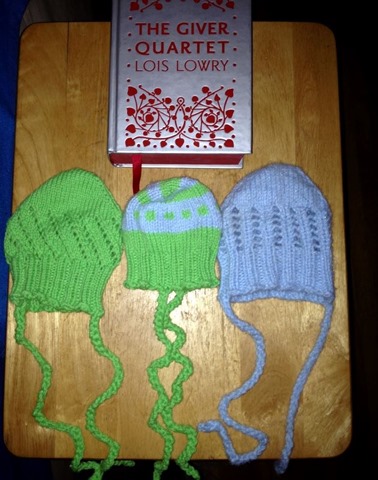

The toe is my standard Figure-8 no-sew toe cast-on, but rendered wide enough to go over the end of the cast. After that I worked about three inches of foot, and ended with 20 rows of ribbing. I made crocheted strings to tie the things on. Apparently I didn’t make them long enough (being several hundred miles from the recipient), and they are not quite adequate to tie behind the heel. The directions below are modified to add the extra, needed tie-string length.
BASIC TIE-ON TOE SOCKIES FOR THE CAST-BOUND
Washable worsted weight yarn with native gauge of 5 stitches = 1 inch. I recommend an acrylic or a washable wool.
Set of five US #5 double pointed needles (can also be done Magic Loop or two-circ style)
US size G crochet hook for ties (ties can also be done using I-cord, braiding, or any other method you desire)
Tapestry needle for ending off ends.
Gauge
Roughly 5.25 stitches = 1 inch. You want these socks knit tightly for warmth and durability.
Directions
No-Sew Toe Cast-On
Take two of the needles and wrap the yarn around them, figure-eight style. The yarn should loop around the bottom needle and cross to the opposite side of the top needle. Loop over it and then return between the two. The result should look something like this:

Continue wrapping the yarn this way until you have 12 loops on each needle. Let the end dangle free with no knots or other securings – you’ll need to work looseness in the first row out towards the end later. Knots will interfere with this in-flight adjustment. Take a third dpn and knit across the top needle. Take the fourth dpn and knit across the bottom needle. Be careful not to twist stitches – one needle’s loops will be “backward” with the leading edge of the loop on the rear side of the needle. Make sure you knit into the rear side of these “backward” loops. You now have a very narrow and slightly awkward strip of knitting suspended between two needles. There should be 12 stitches on each needle. Don’t worry if the stitches running down the center are loose, in a couple of rows you can tighten them up by carefully working the excess down towards the dangling tail end.
Toe Shaping
Row 1: k1, M1, k5. Using another dpn, k5, M1, k1. Using a third dpn, k1, M1, K5. Using the fourth dpn – K5, M1, K1. You should now have 4 live needles in your work, each with 7 stitches on it.
Row 2: Knit all stitches
Row 3: *k1, M1, k6 [Note – this is the end of first needle, remainder on second needle] K6, M1, K1* repeat
Row 4: Knit all stitches
Row 5 and subsequent odd rows: Continue adding one stitch after the first stitch of the first and third needles, and one stitch just before the last stitch of the second and fourth needles.
Row 6 and subsequent even rows: Knit. When you have 14 stitches on each needle (56 stitches total) the toe is done.
Foot
The foot is just a cylinder worked on all 56 stitches, for about 3 inches after completion of the toe. You can work this in plain stockinette, or go wild here, working simple stranding or eyelet lace patterning. Repeats of 4, 7, 8, 14 or 28 stitches are all possible. For example, my wide eyelet ladder is
Row 1: *K2tog YO2, SSK*
Row 2: *K1, K1P1 into double YO, K1*
Ribbing
When the foot part is complete, it’s time for 20 rows of ribbing. I tend to use K2, P2 ribbing because it pulls in more than K1P1 ribbing, but feel free to use anything that’s comfortable for you. Bind off and darn in all ends.
Ties
I crocheted my tie strings for speed. I located the “side welts” – the stitch column that corresponded to the beginning of needle #1 and the end of needle #4, and the stitch column that corresponded to the end of needle #2 and the beginning of needle #3. It will be very visible on the side of your toe. I walked those points up to the ribbing for my designated side attachment points – one on each side of the sockie.
Using the crochet hook and my yarn, I worked a two-stitch column of single crochet.
Row 1: Single crochet 2, chain 1 (this is the turning chain)
Row 2 and subsequent rows: Skip turning chain, single crochet 2.
I made my strings about a foot long, but I strongly suggest making yours about 18 inches long. Darn in ends, and you are finished.
I report that the sockies work, mostly (they need longer ties), and the recipient is warmer and happier. Heal quick, Veronica! We all want to see you dancing (and tumbling) real soon.
AN ACTUAL FINISHED PRODUCT
Yes, I do have lots of small ones, but I don’t make a lot of adult size sweaters, and even fewer for me. And even fewer of those are from commercial patterns. But this one is done:


This one ended up being an extremely quick knit. I used Sarah James’ Entrelac Pullover pattern. This is the second piece of hers I’ve knit up. The first was her Ribbed Leaf Pullover – a challenging bit entirely predicated on twisted stitches. Lots of twisted stitches.
This one was equally fun, but far easier. In essence, you knit four Entrelac panels; two small ones for the top of each sleeve, then one for the front and back of the sweater. Only the one in the front bears any shaping at the neck. A seed stitch panel is picked up along the long side of the sleeve panel, and knit longitudinally, using short-rows to add width at the top of the sleeve. That panel is joined to the other side of the sleeve Entrelac panel using a pick-up-and-knit-together technique, eliminating hand-seaming (although you could do it that way if you were timid).
The front and back fancy panels are joined at the shoulders, and a seed stitch panel is added right and left to bring the piece out to shoulder width and provide the desired total body size. Once those panels are done, the sleeves are sewn in and the side seams are done. Then cuffs, necklines and hem ribbing are added.
Because the piece is so square and boxy, adding extra width to the top size of 46” was easy. First, I used a slightly heavier yarn than indicated. My tiny bit bigger gauge gave me about an inch across the Entrelac. Then a couple of additional rows to the seed stitch panels made short work of the rest of the size adaptations.
My other change was the treatment of the ribbing. The pattern original advocates using the same variegated yarn as the body. Instead I chose solid black, as a framing element.
I am pleased by the the color play of Noro Taiyo – the yarn I used. However I strongly caution that this is not a good yarn for an inexperienced knitter, or for someone who doesn’t have the patience or inclination to tame it. Taiyo is a fluffy, multi-fiber single. It relies on over-spin for structural integrity. That means that the yarn kinks back on itself, twisting and tangling as one works. It also denatures quite easily. If you rip back and re-knit this yarn, you’ll have to re-introduce some of that twist, otherwise the strand will shred and break. Sewing up with it also introduces the counter-spin that shreds the strand. If you use this, spare yourself and find another yarn for seaming. In my case, I used Valley Yarns Berkshire for seaming and for all of the ribbing. Berkshire is a wool/alpaca blend single, roughly comparable in weight to Taiyo.
All in all, I am quite happy with the finished product. And even though it’s a very warm pullover, we still have lots of cold weather left in which to wear it.
GADGETS – THE HUMBLE BREAD TAG
I haven’t made a knitting gadget post in a long time. Here’s a frugal crafting tip, echoing something I posted in 2004.
Save those little, rectangular plastic clips that seal up bags of commercial bread, pizza dough, bulk food purchases, and other groceries. They are very handy for knitting and crochet. Here are some uses.
Stitch markers. Very obvious. All of the standard and exotic stitch marker tricks can be done with these, marking repeats, separating design panels, using them to delineate a group of stitches that will be added or decreased away, using them as an in line abacus to keep track of row or pattern repeat counts.
Progress tags. Like fancier plastic clip style closeable markers, tags can be fastened onto in-progress knitting to mark spots of interest, like centers of pieces to be matched together later while seaming. Because tags are larger than commercial clips, and disposable (in my house, a renewing resource like wire hangers), they can be written on with a Sharpie marker, for one-use notation.
Seam basters. Use the jaws of the tags to hold pieces together when seaming instead of pins.
And here you see another use: pick-up tracking. I have a lot of stitches to pick up along the edges of my current project’s center entrelac panel. The desired number works out to ten stitches per edge triangle. It’s very easy to lose track, an annoying to constantly repeat the count. But if I clip a tag onto the needle, pick up ten stitches after the tag, then I clip it and repeat, the process is relatively painless.

LIFE ATTACKS
Wow. Over a month since my last post. Not good. I apologize and plead an attack of real life, including work deadlines, multiple snowstorms, and other consumers of discretionary time.
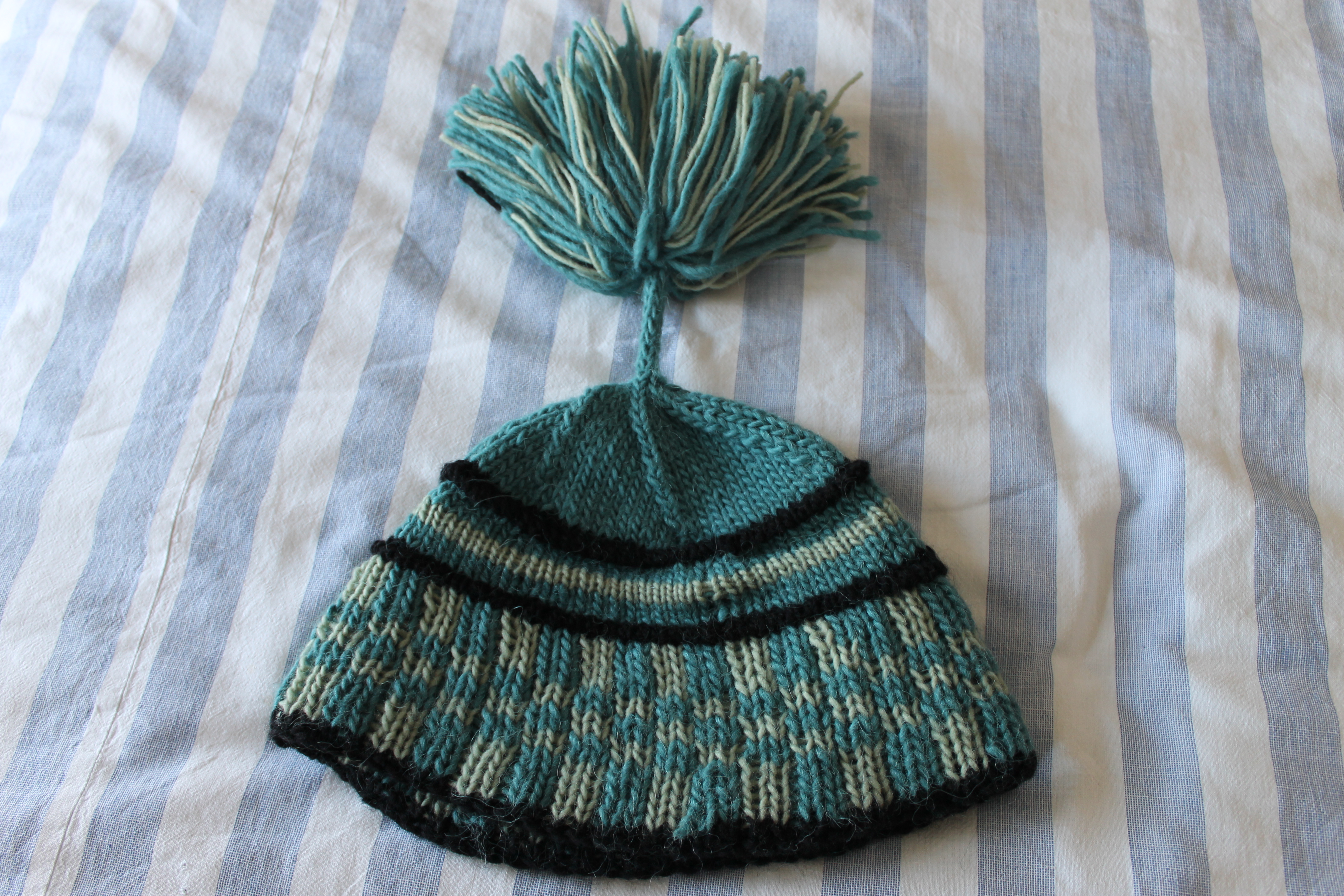
Still, I have not been entirely idle. There has been knitting. Double knitting, to be precise:
And sewing:

The dog jacket is actually a combo of knitting and sewing, with a polar fleece rectangle being the base of the garment, edged out with a knitted rib collar and chest section, plus a bit of ribbing to gather the hind part somewhat. If folk are interested, I’ll post a more detailed method description so others can make one, too.
And on to more knitting. I’m currently working on an Entrelac tunic pullover, from a commercial pattern by Sarah James. This is the second pattern I’ve done by that designer, the first being her Autumn Leaf pullover. I’m using Noro Taiyo yarn, an Aran weight variegated made in Japan, that has a very improvised and rustic Raku-ware look to it. The yarn I’ve chosen is slightly heavier than the heavy worsted/Aran weight yarn specified, although they have the same native gauge. This is not turning out to be a problem for me because I want my finished product to be slightly larger than the larger of the two provided sizes.
At this point I’ve finished the sleeves, the center back panel of Entrelac, and am now on the center front panel. The construction of this piece is slightly unusual. First the (mostly) rectangular fancy-work panels are knit, then the interstitial parts making up the sides of the sweater or back of the sleeve are picked up and worked from the rectangles. These extra bits are done in seed stitch, and are then bound off against another Entrelac panel. This (plus the Aran weight gauge) makes for quick execution. I just started on Saturday evening.
 Both sleeves finished, and
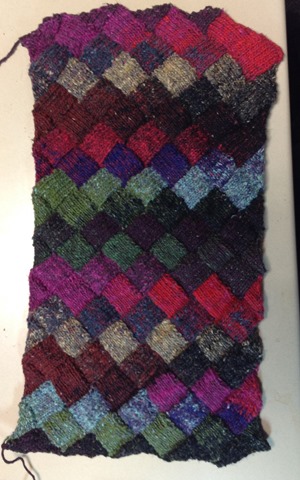 The back center panel.
I have not done the ribbing at the cuff because I may want to do all the ribbings in a complementary solid color, possibly charcoal grey, because I am not fond of the stripy/spotty look of variegated in ribbed stitches.
BABY BLANKET BINGO
Finished.

We’ve got columns up and down, and rows across. Bingo!
A simple double-eyelet lace pattern from the first Duchrow book. Knitting on modular-style using the pull-loop method I learned doing the Forest Path entrelac stole. The same large-eyelet edging I invented to use with my Motley scrap yarn blanket. And a measly 10 evenings of knitting time, using US #10 needles and 5 skeins of worsted weight Plymouth Encore Colorspun. A lightning project if ever there was one.
SECOND HELPING OF TRIFLES
Two progress status reports today!
First is the Trifles sampler, in progress as a dorm gift to Younger Daughter, who will need such a thing in a year or so. (I have given myself lots of time for completion). As you can see, the motto is finished, using four different alphabets from Ramzi’s Sajou collection. I’ve played with them somewhat, working in the gold color accents, which are not marked as a secondary color on the charts.

I have also stitched in two small Daleks, to comply with her request, stitched in gold and off white silks. I am up to the surround now. I had originally planned to stitch lots of linear strips, patterns from my upcoming book, but as I alluded to before – I have been seized by Another Idea. The small stitched area just getting underway next to the T of TRIFLES is the beginning. I am going to make an interlocking and overlying mesh of gears of various sizes and configurations, each outlined in a heavier non-counted stitch, but filled in using the geometrics found in my Ensamplario Atlantio. I’ll be using coordinating fall colors for these – a bit of the brown and gold from the alphabet, but also cranberry, silver, and possibly a deep green. The total effect should be rather Steampunk, and a lot of fun.
However as much fun as this piece is, necessity intrudes. A friend of mine is welcoming a baby come the turn of the year. She’s expressed a fondness for traditional baby colors, so I am knitting up a small baby blanket for her. It will be car-seat and basket sized, not crib or reception size, so it is going quite quickly.

I’m using Encore Colorspun worsted, an acrylic/wool mix for maximum washability, this being a baby blanket and all. I’m knitting it on US 10.5 (6.5mm), which is relatively large for worsted in order to bring out the lacy stitch pattern. The stitch pattern itself is adapted from an 18-stitch-wide strip pattern appearing in Knitted Lace Patterns of Christine Duchrow, Volume I. I’ve chosen the narrow strip so that the gradual color changes pool, rather than speckling across the rows. I’ve also chosen to work the stripes horizontally because I only have four balls of this yarn. If I had run the piece the long way I might have risked running out before I reached a useful width. By fixing my width, I can keep going until I have just enough to do an edging, or I can find a coordinating pink or off-white Encore for the edging, if there isn’t enough of the graded color yarn. And finally, being a lazy person and not wanting to sew the strips together, I am using the long-loop join method I learned while working Fania Letouchnaya’s Forest Path Stole to knit the strips together as I march along.
Oh, and yes – those are massively long DPNs – about 12 inches long. I really like extra long DPNs for hats and sleeves, and generally don’t use circulars for anything less than 20 or so inches around. As a result I’ve got a collection of these admittedly unusual needles.
ENDINGS AND BEGINNINGS
Some of each to report.
First, goodbye, this year’s crop of giant grass:

I cut it down with our hand-sickle. Younger Daughter is stripping leaves from the longest stalks. Elder Daughter and she bagged the remains for yard waste recycling, setting aside the best canes for use in next year’s bean trellis. Resident Male took a heavy maul and split the clumps, which after two years unsupervised, were threatening a massive campaign of lawn-conquest. So goodbye grass! Hello, next year’s beans!
Second, Swirly is finished!
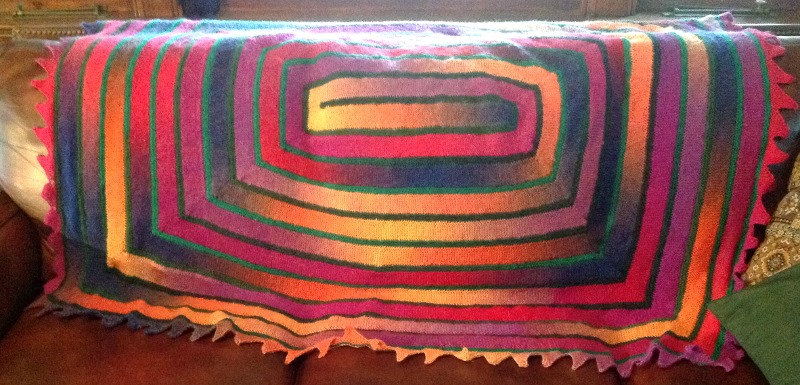

I like the way the mitering worked, even on the very narrow green strips. I also used a sawtooth with a ten-row repeat, so I was able to easily fit it around corners, letting the natural splits between the teeth accommodate the direction change. Swirly now goes to Elder Daughter, to replace the last blanket I knit for her, back when she was born.
Third, I can’t just sit. Especially when I am thinking or listening. I have to have something going. So, as a think piece, to keep my fingers occupied, and because I haven’t knit a pair of socks for me in so long my own sock drawer is looking more like a darn-me convention, I finished a quick pair for me.

This was done in Plymouth Happy Choices – a yarn that comes pre-knitted into a long scarf strip, then dyed. The idea is to unravel the thing and re-knit it. Depending on what you make the resulting pattern will be different, and always a surprise. These are standard 72-stitch toe-ups on US #00 needles, with figure-8 toes and short-rowed heels. I started at the same place in the color cycle repeat for both, but you can see that slight variations in dyeing produce fraternal instead of identical twins. I happen to love it, but others may be more fastidious. And yes – there’s a simple double YO diamond detail on the ankles, just for fun.
And another beginning – this time a stitching project.
I begin my Trifles sampler. This is a promised/bespoken piece. I made a sampler for Elder Daughter for her to take with her to her university dorm room. It bore a motto, as a subtle bit of parental nagging, embedded in a loving-hands-from-home wrapper:
Younger daughter is now in 11th grade, and wants one, too.
Hers will have a different motto, chosen just for her: “Pay attention even to trifles,” – one of Musashi’s nine precepts. She’s also asked that it bear at least one Dalek.
Here is the materials set – the remainder of the 30-count linen I used for her sister’s, plus a pile of autumn colors chosen from the stash of silk floss I bought in India:

In addition to Amy Schilling’s Dalek (chart at link above), I am using several alphabets from Ramzi’s collection of vintage Sajou and Alexandre leaflets, available at his Free Easy Cross and Pattern Maker website – a fantastic resource that should be better known. You’ll note that for once I’ve actually laid out the motto ahead of time, rather than trust to luck and eyeballing. This is because Younger Daughter is a creature of logic and symmetry. I accommodate her preferences with a bit more precision than I usually use.
More on this project as it develops. This time I’ll try to document what goes into my rather ad-hoc pattern selection decisions, and any tech tips I can.
Fall is after all, a time of endings and beginnings, and my favorite time of year.
SEPARATED AT BIRTH?
It’s not uncommon to find knitting yarns that are twins – products of the same factory, but bought and sold through different distributors. Today’s case in point: Marks & Kattens Fame Trend, and Wisdom Yarns Poems Sock.

Label info for the two varies slightly:
- Poems Sock – 75% wool, 25% nylon, 100g, 420m. Made in Turkey. 28st/36rows = 4in or 10cm on 2-2.75mm needles.
- Fame Trend – 75% wool, 25% polyamide, 100g, 420m. Made in Turkey. 26 st/37rows=4in or 10cm on 3mm needles.
Polyamide and nylon are the same thing, so the only real difference in labeling is the minor difference in gauge, with Poems being marketed at the slightly tighter sock gauge.
It’s clear that there is some difference in the color ranges carried under each label, but in this case I can say that Fame Trend color #666 is exactly the same as Poems Sock color #955. So if you are short one yarn or another, you can try looking for its long-lost twin. You may luck out and find the extra you need.
Now, why was this momentous discovery made? It’s because of Swirly, which has grown to sofa size:

So far I’ve used 1.75 skeins of the green Zauberball, and four of Poems Sock. I had one more skein of Poems, purchased via mail order from Webs. As is common in long repeat variegateds, not every skein is equally bright. My one remaining ball is a bit muddy compared to the others, and I was hoping I would not have to use it. However, you can see that I ran out midway up the second side of my very simple sawtooth edging. I clearly am going to need more…
But not to despair! Albuquerque Nancys to the rescue!
I have a long time pal also named Kim who lives out that way. She’s a knit buddy and life-friend. We’ve even worked side by side for more than a couple employers. When she heard that her two local friends were planning a trip out to Boston, she suggested that they (both named Nancy) and I get together. The Nancys were in the middle of a Great Stash Trim, refocusing their collections on the yarns they wanted to use most. So I ended up being the beneficiary of a bag of onesies and twosies, all sock weight and lace weight – all most beautiful and prime quality. Luck was clearly on my side because not only did I get a treasure that someone had to haul halfway across the country; buried in that treasure were two **perfect** skeins of the Marks & Kattens.
So I can put away my muddy skein of Poems, saving it for future socks. I can finish my sawtooth edging with vibrant color Fame Trend and finally complete Swirly. And best of all, I got to meet the Nancys!
 String-Or-Nothing