BRIGHTER!
Obviously re-constructing is a slower process than demolition. But we had a small milestone yesterday – our new, larger window, presented here side-by-side with what was there before.

You can se that it’s about the same width, but taller, with the extra transom panel on top.
The kitchen is along the north side of the house. It has always been dark. The new window is already bringing in considerably more light. And being on the north side, it will never be a conduit for the direct blast of the summer sun’s heat.
Not sure what’s on tap today, but it’s fun to come home and see the progress each evening.
STILL BARE AND BARREN
OK. The kitchen rehab enters the beginning of the “we’ve taken it all away – now we put it back” phase.
As I reported on FaceBook, those remaining walls and ceiling bits had to go. The previous homeowner, in a typical fit of doing things in the cheapest, and most stupid way, used a low grade of plain old wallboard underneath the skim coat plaster when he ripped out the original lath and plaster during his redo of the room in the early ‘80s. That means that they were not salvageable. We had not planned on taking down the parts that were not going to be modded, but we were forced to because the walls were crumbling. Oh well… There’s no such thing as a renovation of a vintage house that does not involve an Unexpected Surprise.
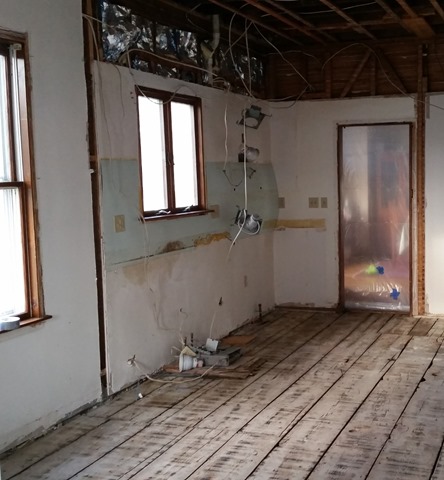
What’s there right now looks more or less like it did when this picture was taken on Friday.

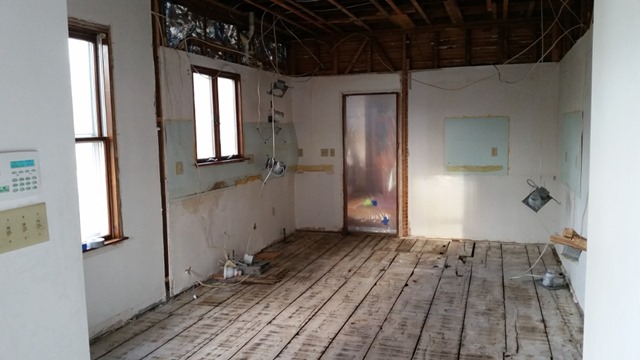
All the way back to the studs that used to support the lath and plaster, everywhere (with the previous stage picture provided for comparison.
Monday the crews came back, and removed the last bit of flooring underneath the radiant heater where the sink used to be, the room radiator and washing machine/dryer – disconnecting the water lines to do so.
They also roughed in the main plumbing lines. We are moving the sink from underneath the window to the other side of the room. While it’s nice to have the window view, moving the sink gives us a large span of prep counter adjacent to the rangetop, and allows us to put the dishwasher on the right hand side – much more convenient for us right-handed folk. But to do this, they had to relocate the main water and waste lines, and remove the unused components from the old location.
So progress towards reconstruction has officially started. From now on in, things should start to appear, rather than disappear.
Aside from the continuing drama of living in a construction zone, I did get to peel off this weekend and have some fun. I went to an SCA event – the Hrim Schola held in Barony Beyond the Mountain, on Saturday. For my non SCAdian friends, the day was a roster of classes in technique and history, focused on needlework, weaving, knotting, knitting, and allied techniques and tools. It was held in southern Connecticut.
First of all, I have to thank Needlework Pal Mistress Kathryn Goodwyn (she of “too many centuries, too little time”) for providing me with a suitable dress. I have been an SCA recluse for many years, and really and truly had nothing to wear. Since the day is done in historical dress, I could not have gone without her assistance. Sad to say, although I promised to take a photo of her Anne of Brittany dress and hood, I forgot… Still, many people admired it and gave me compliments on it, and were delighted to find out that it came from her hand, so many years ago.
Second I want to thank Lady Eadgyth for prodding me to attend, and to Aaradyn, Lady Ysane, and the rest of the Occasional Weekend Sewing Circle for helping me mend the gown and dress me in it (it takes a committee to do this).
I had a ton of fun, learning how to do Elizabethan-era plaited braid stitch in metal thread, seven or eight variants of lucet cord (I lost track of how many we covered), and swinging a hammer to dish out a small copper thimble from a disc of copper. While I can’t swear to the efficiency of metalworking while wearing a corset, I did produce a result. The teachers of these classes also deserve copious thanks for making the day worthwhile – respectively, the talented Elaine Howys, Lady Eadgyth, and the very patient Anton Leflamme. (Apologies if honors or names are mangled).
And one thing made the day even more special. I finally met my Stealth Apprentice. This green belt, when finished, will be for her:
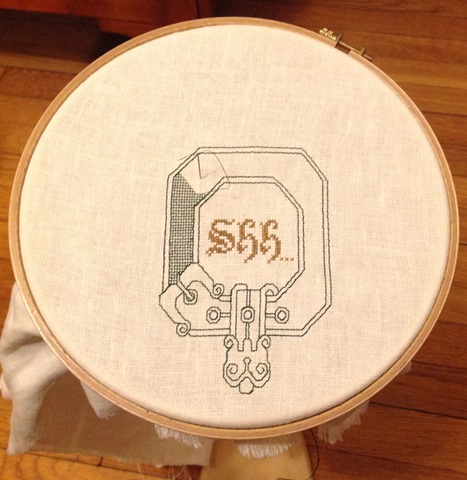
Yes, it’s more conventional to give an actual green belt rather than a representation of one, but I’ve always been unconventional. And this way she can choose the style of her belt herself, to match whatever period garb she prefers.
Her name? Well, she is a Stealth Apprentice, after all. I’ll let her chime in if she so desires. 🙂
BARE BONES
Progress! The soffits we worried about two days ago turned out to be improvised and totally non-structural. And the walls we wanted gone were similarly non-load-bearing. So they are now all gone. Our kitchen has been reduced to a bare-bones box.

The awful pink tile is also gone. It had been affixed to plywood, which was mounted on top of the original oak flooring. That turned out to be too damaged to salvage, but we anticipated that – our new design includes new tile. With the old tile and underlayments gone, the new tile can be installed flush with the existing floors on the rest of the downstairs. No more 3/4-inch “trip me” strips at the doorways!
In terms of house archaeology, a few things have been revealed. I get a big smile from the wide-board underfloor, now exposed. You just don’t find slabs of tree like that in a new house.
You can see the footprint of the old butler’s pantry pass-through on either side of the door to the dining room. Those cabinets and dry sink were long gone before we moved in, although the butler’s pass-through still exists in the sister house next door to us.
Also harder to see, is the framing for the heat grille that brought kitchen warmth up to the bedroom that’s now Elder Daughter’s – which must have been the nursery at one time. The grille is gone from upstairs, and the floor is patched in there, but looking up at the ceiling now exposed below, you can see the frame in which the vent used to sit.
On the far wall are remnants of old knob and tube wiring. My contractor is VERY happy we have written certification that all knob and tube in the house is dead, a victim of the general house re-wire we had done when we first moved in.
Another thing that isn’t shown well here is the framing for two windows in the kitchen, both larger than the remaining old over-sink window. We know they existed from faint scars in the stucco outside, but we still have framing for them inside. This turns out to be a good thing.
The last bit of interest revealed are marks on the overhead joists, which show where the original lath and plaster ceiling existed. It was full-height – the same as in the rest of the downstairs. Having that room overhead again will make the kitchen feel much larger, and will keep it cooler in the summer.
Now having almost maxed out on the Destruction Phase, we begin Reconstruction.
First up today – the new windows. Four to be exact. The two in the dinette area replace the existing ones, with no change in dimension (I would have liked to make one of those bigger, but budget realism manifested). The other two replace the smaller window that is over where the sink used to be. We will be re-using some of the old window framing to put in a new window plus a transom panel above it, to bring more light into the north-facing room, and to use up some of the awkward space between the window area and the now significantly higher ceiling.
Stay tuned!
AND IT’S GONE…
Demolition begins. Goodbye trashy counters and sink. That one square of green plastic backsplash remains to taunt me…

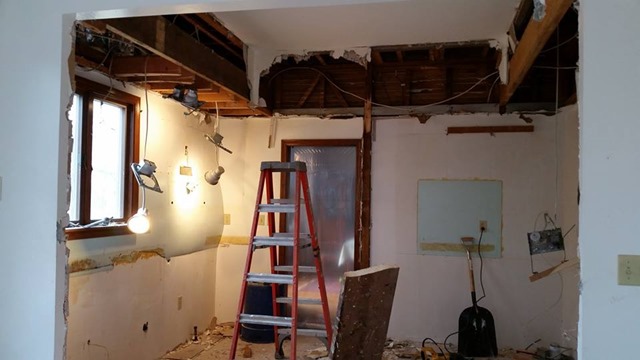
Now to find out if Hidden Horrors lurk below the surface. With luck, the structure revealed by the removal of the soffits existed purely to form the soffits. It doesn’t appear to be weight-bearing, but The Experts will advise us tomorrow.


On the other side of the room, my back-door cabinets are also gone. Totally gone. 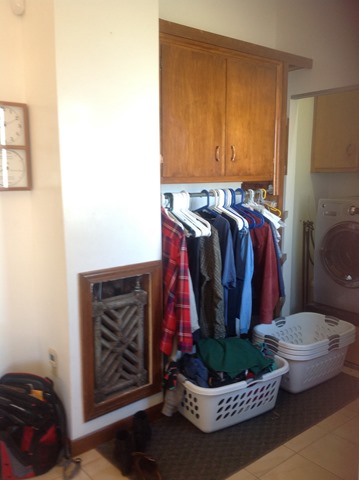
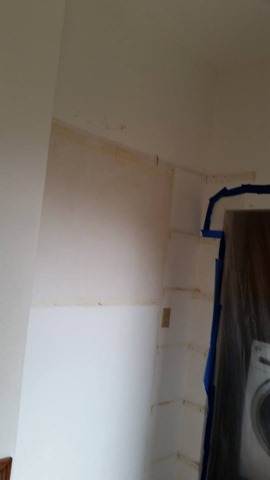
(Yes, the active laundry was removed long before the crew arrived.)
More updates as things develop further. Photo credits and thanks to the Resident Male, for documenting today’s progress.
TOPSY TURVY
Things here at String Central are about to be totally up-ended. We’ve now lived in the New House for about 10 years, which makes it not so new any more. In truth it hasn’t been new for quite a while, having been built in 1911 or so.
When we bought it we looked around and fell in love with the place. Some parts more than others: the large, open layout, the abundance of surviving original woodwork and detail, the high coffered ceilings in the living and dining rooms, having a tiny library(!) plus sufficient space for all of the bedrooms, office areas, and workrooms a family with a wide variety of solitary pursuit interests needs.
On the problem areas, we’ve gone through a long list of improvements over the years, most having to do with systems: heat, insulation, wiring; or structure. New plumbing, a full-house rewire to get rid of (barely) functioning knob-and-tube, secure/weather-tight basement windows, a new heating system with a separate upstairs heat zone, insulation, a new roof, and a new driveway are just a few. Other than rehabbing the poorly functional upstairs bath, we haven’t done much in the way of aesthetics or livability, beyond addressing basic needs.
But no longer.
After 10 years we are about to begin a major kitchen rehab, and FINALLY be rid of the sagging mint Formica countertops, the droopy cabinets, the dismally scratched (and hideously pink) floor tile, plastic sheet backsplashes; and the outdated, poor functionality of our layout. I can hardly wait!
Here’s the official set of Before Pictures:

 ‘
‘
In the shots above you can see the partial wall between the prep and dinette areas, that breaks up the space without adding value. They are remnants of what had originally been a full wall, separating a back day-room for maid’s work from the kitchen proper. This is now our eat-in area and will remain so, but the partial wall is going.

In this one you can see the patched- in wasted space above the cabinets in between them and the equally useless dropped soffits above the cabinets themselves. That overhead space will be put to far better use.

And here are the mint green counters and plastic backsplash of the inconveniently far from everything Other Counter. It’s the clutter-magnet area where we stash recycling, and although absent in this shot, where pantry overflow usually sits. This space will also no longer sit idle.

Although we do have an pantry, it is of very little use, with narrow shelves too shallow to accommodate most cans, boxes, or jars. The front part is a hinged armature that is very difficult to move if you want to access similarly shallow dead shelf space behind. We are in sore need of effective pantry space. The new design will address this, too.

The rusted, creaky round-abouts (lazy susans) are an invitation for stuff to fall behind and jam the mechanism, with center poles that preclude larger items. The gadget garage isn’t bad, but tends to be another clutter-magnet area, and uses up more useful space than it provides in return. Technology for corner cabinetry has vastly improved since the ‘80s. I’m looking forward to the new solution.
On overall design, the current kitchen/dinette area, although it looks large, is not wide enough to add an island or peninsula without serious bottleneck or access issues, so we are not going to radically change the footprint. However, the current arrangement of appliances and countertops isn’t very efficient. We end up doing 90% of our prep work in the two foot space between the sink and the stove. The stove itself does not have a vent to the outside, which doesn’t add to ease of keeping the room clean. And the kitchen is dark, with too many lights that don’t manage to provide illumination of the actual work areas.
So it’s time for all of it to go.
In the mean time, we’ve moved out of the kitchen, so the crew can come in tomorrow to start demolition. We’ve crammed everything into the living and dining rooms, and will live without stove, oven or microwave, dishwasher or useful kitchen sink for the time being:


We plan to address all of these issues. Stay tuned to see how!
For my knitting and stitching pals – don’t worry. This isn’t going to turn into a home-improvement blog. I continue to plug away on the wavy infinity scarf/cowl, plus progress on a pair of socks. I always have a pair going, as “briefcase knitting” to do while waiting for appointments, on line, or in other away-from-home-base moments of idleness.

It’s slow going. As I’ve said before, I spend as much time untangling as I do knitting. And I still need to pay attention to the pattern. I haven’t memorized the thing yet. So it’s difficult to do when I’m watching TV in the evenings – my favorite time to do handwork. Especially so because we’re re-watching our set of Lone Wolf and Cub TV series DVDs, which are in Japanese with subtitles, and on Netflix, the Norwegian series, Occupied, similarly subtitled from Norwegian.
So there you have it. Chaos is about to descend. But at least I can knit my way through it, while nibbling sandwiches in the dining room.
THIRD TIME IS THE CHARM
I’m still plugging away on the Mixed Wave pattern scarf for Elder Daughter: It’s based on a cowl pattern of the same name.

Now, why has it taken me two full rip-back and start again cycles on this one? Mostly because I can’t resisting tweaking here and there when I work from a pattern.
In this case, the recipient and I decided that a narrower piece was more desirable for wear with the target coat. So I removed a ten-stitch unit. Then we jointly decided that instead of two contrasting colors, we wanted to use three, in combo with our neutral color (black). It’s hard to see here, but I’ve got a cranberry red, a maroon, and a variegated that ranges from cranberry through maroon, with shots of turmeric here and there. After that it was the traditional matter of Not Paying Attention, forgetting to move counting markers, and getting incredibly tangled from all of the flipping as the short row segments (the almond shapes) are formed*. And let’s not forget the last forgetting – neglecting to make sure that stitch count was stable after every left and right edge segment pair.
But I’ve got it well in hand now. I’m even beginning to remember to alternate left and right leaning almonds, along with choosing which segment to work as an almond, cycling through the colors, and remembering to work the row-beginning decreases and row-ending increases that give the piece its rhomboid slant.
I will continue on this piece, making it a bit longer than the original, and eventually either graft it into a true infinity scarf, or finish it off as a straight scarf with pointed ends. We’ll see how my well my composure handles the all-too-frequent stopping to untangle.
* Yes, I know the trick of always flipping clockwise on front side and counter-clockwise on wrong side rows of the short row sequence. It isn’t helping.
REAL HIPSTER SOCKS
Well not, actually. Just socks that feature hips:


These are the socks I mentioned in my last post, bespoke by the Resident Male as a gift for his hip replacement surgeon. A frenzied week of knitting, to be sure, in order to be ready to be given at the scheduled follow-up appointment.
I will say that both TRM and the socks have knit up well. Thanks to all for the get well wishes. He’s hobbling around quite spryly with cane, and gains movement range and strength every day.
On the socks, as previously posited, I worked them on two circular needles, in the round on 80 stitches around (US #00s) with figure-8 toe and short rowed heels. I kept on that way until just after the completion of the heels, then splitting them at the center back, adding a stitch to the new left and right edges for later ease in seaming, and then continuing to work side by side, but this time, flat.
Here’s a typical late-night, poorly lit shot of the pair, side by side, being worked flat on a single circ, which I remembered to take at last minute:
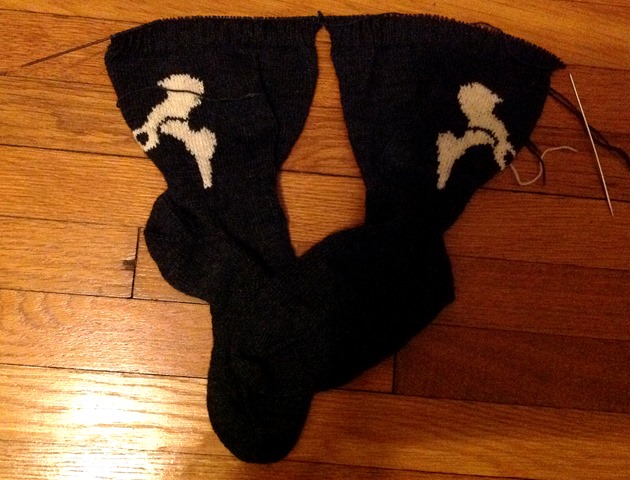
All in all, while I was happy to fulfill the special request, and interested in the experiment of working a pair on two circs with an Intarsia clock, I have mixed feelings about this project.
- If I had more time, the socks would be about an inch longer before the ribbing. The proportion would be better.
- I still am not a fan of Intarsia. That’s my mother’s favorite style of knitting. I vastly prefer textures, lace and stranding. Taming the multiple bobbins or yarn butterflies drive me crazy, no matter how careful I am at always using the strands in the right order and orientation.
- I should have used proportional graph paper rather than plain 1:1 squares when I charted the hip. The stitch height:width ratio has flattened the design somewhat, and has lost some of the more gracefully round curvy details. Here’s a place to make printable graph paper in any proportional ratio you need.
- I have and will probably use two-circs again for larger things like sleeves, but I don’t like that method for socks. Not one bit. Stopping to assort the needles and yarn slows me down big time over plain old DPNs. I know others adore the method, but it’s not for me.
On the up side, the socks are complete. They are the right size (I aimed at a guessed shoe size of men’s US 12-13, for a 6-foot guy), and although just a tad short from heel to ribbing, are totally wearable. The motif sits well in place, and the copious end-darning doesn’t create uncomfortable ridges inside. The mattress stitch seam worked perfectly, and the result is invisible from the outside of the work.
Now on to other projects!
HAPPY 2016!
Apologies for silence at this end. Things have been a bit unsettled here at String. The holidays came and went, with their obligatory cookies:

…and decorations.

Foods were cooked for the appropriate occasions, including cassoulet, latkes, boned-out stuffed ducks, panforte, ham, roast beef, and all sorts of sides. Gifts were obtained and exchanged. Wine and champagne were consumed. Visitors popped by. Spawn were supported as they wrestled with college application deadlines. And The Resident Male (TRM) had his hip replaced. He’s well on the road to recovery, and is delighted to be regaining utility that he had thought lost forever. Warning to his golfing pals – by the Spring, he’ll be back in training and itching to test out the new equipment, to see what it can do for his swing. But as you can see, the interval since my last post, although long, has been a tad hectic.
Even on the project end, I haven’t had time for as much as I planned. Between working from home part time and the rest of the laundry list, above, plus standard household stuff like shoveling, I didn’t get a chance to sew the the new curtains for the library that I had planned as my end-of-year break effort. I’ve also set aside the Mixed Wave Cowl for Elder Daughter, and didn’t get started on some other holiday knitting or needlework. Those things were derailed by a request from TRM to knit up a pair of socks as a post-surgical gift. So I am now trying to motor through a pair in very boring grey fingering weight. They will be enlivened by a design on the ankle – probably something skeletal and hip-like, worked in Intarsia. Here you see them, with the feet and half of the heel complete, almost up to the motif area; two rather dull, shapeless grey blobs.

To do Intarsia on the ankles of these toe-up in-the-round socks, I’ll cheat. After the heel is finished I’ll split the rounds at the center back, and work both socks flat. Since I’m doing them now side by side using two circs, I’ll re-assort the stitches onto one circ and continue, to guarantee uniform length and design placement.
How do I like the two-circ method for knitting a pair of socks at the same time? Frankly, not much.
I find I am actually faster at five DPNs because I don’t have to stop and fiddle at the end of each half round to retrieve the correct needle end, and I don’t have to pause to untangle twisted feeds from two balls of yarn (or both ends of the same ball). But the idea here was to use this project to try something new to me that so many others recommend, and to ensure the hard-to-count charcoal color yarn produced two socks of the same size and length. On the latter, I have to give kudos to the two-circ method. No actual counting – just keep on and you are guaranteed uniform products.
So here we are. January has been achieved. All sorts of seasonal and special-case speed bumps have been successfully traversed. Bring on the rest of the year. After December 2015, I can handle anything.
PERMISSION GRANTED, MORE OR LESS
Here it is, totally finished, and with a vaguely decent picture (but as yet, unsigned and un-mounted).

The recipient is thrilled, which is always gratifying.
UPDATE: People want the specs on this piece so they don’t have to hunt through previous posts. 30 count evenweave linen ground, stitched over two threads (15 spi). The 6-strand floss is man-made “silk”, rayon actually; a vintage find brought back from India, slightly thinner than standard DMC floss. I stitched all of the foreground using two strands. Some of the background I did in single strand for contrast. Pattern strips with one exception are all from my forthcoming book The Second Carolingian Modelbook. The alphabet is from a vintage Sajou booklet #104 reproduced at Patternmakercharts.blogspot.com. I hemmed my linen by hand before starting.
The reason I haven’t done the last teeny bits is that I’m trying to finish off some end-of-year gifts for the spawn.
First up and already done was the new pair of Susie Rogers’ Reading Mitts, done in a sparkly yarn for Younger Daughter. She’s a fan of the surreal Welcome to Night Vale podcasts. One of their taglines is “Mostly void, partially stars.”
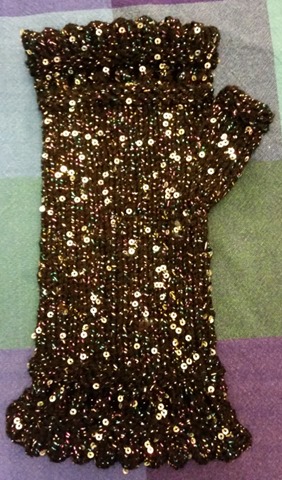
To get the partially-stars look, I used Loops and Threads Payette – an acrylic with a running lurex thread and small paillettes (flat sequins). Both inspiration and enablement are courtesy of Long Time Needlework Pal Kathryn, who sent this stuff to me. Just seeing it sparkling at me kicked off this project. Kathryn’s initial intent was to knit socks from the Payette, but that effort was a no-go. And rightly so. The stuff is not fun to work with, and would make supremely uncomfortable socks. The base black yarn is waxy feeling. The lurex thread breaks easily and is scratchy, and the paillettes can make stitch formation difficult – especially on decreases. Oh, and forget about ripping this stuff back. The lurex snaps. But the look can’t be beat, especially for a big-box-store available yarn.
Yarn aside, this project is a great quick-knit. Both mitts together took two evenings. I used the Payette doubled, and knit the smallest size, which fits perfectly. The only change I made to the original design is eliminating the bulk of cast-on and cast-off. To begin, I work a figure-8 or provisional cast-on. When I get to the last row before the cuff welt, I reactivate the bottom stitches and fold them up, knitting one bottom edge stitch along with its live pre-cuff counterpart. This melds the bottom into the work, and eliminates the final bit of sewing up, and cuts down on pre-cuff bulk.
To cast-off, instead of making a finished edge and then sewing it down, I leave a long tail and fold the live edge inside the work. Then I use that to secure each last-row stitch to its counterpart in the first row after the fancy welting on the upper edge.
Final verdict – the kid loves these. The original design’s pretty welt and eyelet detail is lost in the sequined look and it’s over the top sparkly. But it fits in perfectly with the Nightvale-inspired theme.
Next on the needles is a new scarf for Elder Daughter. As I mentioned in the last post, I’m enchanted by Sybil R’s designs and was determined to make one or another of them. At first we contemplated a different scarf, but rummaging through my stash, we came up with yarn better suited to her Mixed Wave Cowl, an exercise in nested short row enhanced stripes. Here you see the bare beginnings of mine:
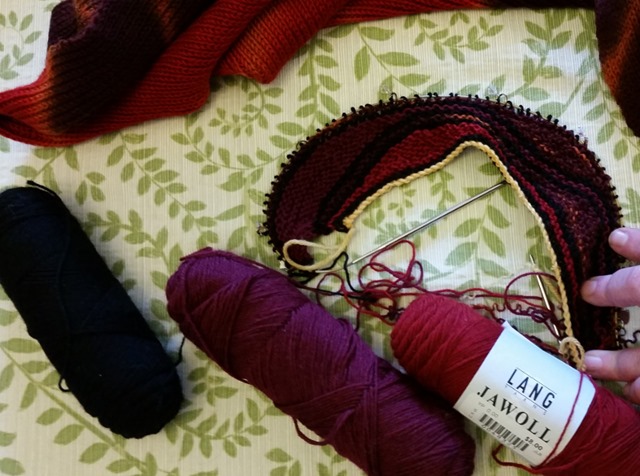
I’m using an eclectic mix of well-aged stash denizens, plus a more recent variegated yarn seen here in a rather blue-shifted photo. The black and russet are both Lang Jawoll bought who-knows-when. The claret (again not as purple as it looks here) is Froehlich Wolle Special Blauband, which I’m pretty sure I had when we moved back to Boston in ‘95. The variegated scarf thingy is Regia Creativ one of the unravel-me-and-knit dyed strips, in a mix of autumn colors including chocolate, russet, claret, and burnt orange. The pattern is written for DK, on rather small 3.5mm needles. I’m using fingering-weight sock yarn on 3.0mm needles, which is making a slightly looser fabric.
More on this one as it grows…
SO CLOSE I CAN TASTE IT
Alllmmoooosssstttt there….
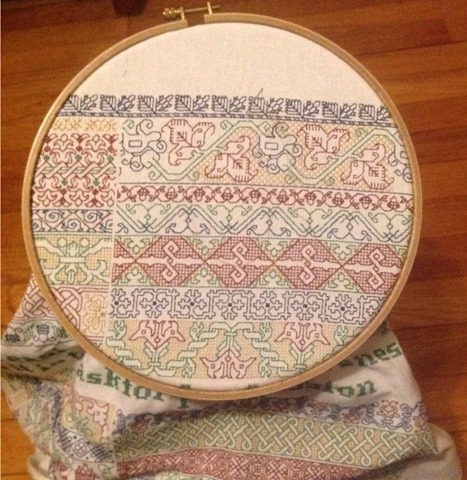
This is the last quadrant. I’m using yet another non-historical fill behind the scrolling flowers. This one is just cross stitches, arranged on the diagonal so they form on-point squares. I also worked this filling (and for that matter – all of the other fillings) using only one strand of my floss, so the shading is quite light. By contrast, all of the foreground stitching is done with two strands. You can see this quite clearly in the red lozenge twist, about five strips down. The foreground is two strands of red, and the simple box treatment background is only one strand of red. I’ll post a whole-sampler shot when that last stitch is complete.
So what’s next?
A couple of things. First, I have another sampler promised to a pal. This one will be heavy on the words, with far fewer accompaniments. I haven’t composed it yet, but I’ve been playing with concepts in my mind. One idea that keeps popping up is to work the thing more or less like a manuscript page, with a very demonstrative single large capital letter in the upper left; the phrasing flowing down from there; possibly with a single figural strip across the bottom, but a foliate edging of some type all the way around. Oh, and it will probably be monochrome or nearly so – a darker, unbleached natural linen ground, with deep forest green stitching. I’m not ruling out accents in another color yet, but the predominating color will be the green.
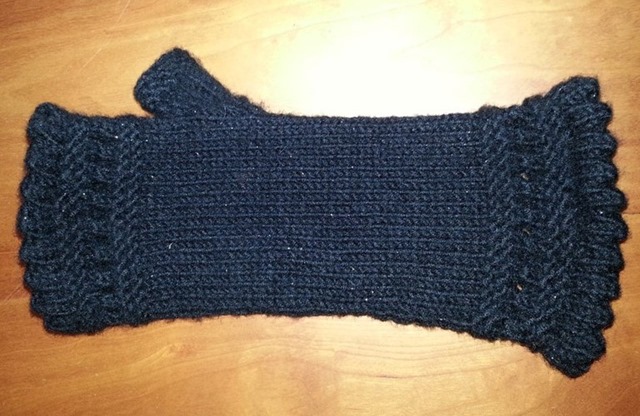
I also have promised some knitstuff to the spawn. It’s cold-hands time here in Massachusetts, so Younger Daughter has requested a replacement for her pair of fingerless mittens (muffatees). Long time needlework pal Kathryn has sent me some sequined black yarn that just cries out to become a pair of Suzie’s Reading Mitts. I’ve made this design before, and I know it knits up quickly and looks great, especially in black. Here’s one from the last iteration, knit as a gift for my niece:
And Elder Daughter has loved her angel-variant Wingspan scarf to pieces. It was the first one I did, and she’s been seasonally-inseparable from it since 2012. Here it is in less frayed times:

I’m considering several candidates for this project, but right now the leader is the Stripes, Stripes & Stripes Scarf from Knitting-and-so-on.blogspot.ch. I think Sybil Ra’s stuff is pretzel-clever, and with some screaming orange fingering weight, plus some wild but coordinating variegated, I think I can make an eye popper for sure. After this I’d probably attempt one of her even more dramatic pieces, for myself. 🙂
 String-Or-Nothing