SPLURGES
Aside from the weakness for yarn common to all knitters, I don’t often spoil myself buying things for my own use. But given just a nudge, I have given in and have treated myself to two things:
A Hardwicke Manor sit-on round frame (aka a fanny frame), and a tambour needle set (not shown in proportion to each other).
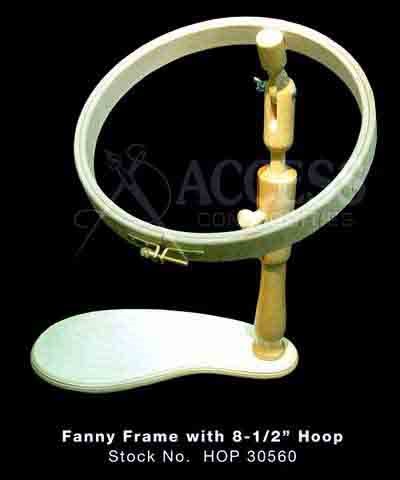

I’ve wanted to try the round sit-on frame for quite a while. I like using my flat frame on its holder. Doing so allows me to position one hand above and one hand below the work, and stitch more efficiently, without needing to conjure a third hand to hold the frame in place.
For smaller pieces in non-fragile threads and stitches, I do prefer to use the smaller hoop though. But using it does raise those same third-hand issues. I am eager to experiment with the sit-on, and hope that I don’t miss the agility of being able to rotate the hoop in hand for optimal stitching direction at the same time as I appreciate having both hands free to work.
A fixed position frame is one of the things that enables use of a tambour needle. Again, one hand uses the needle on one side of the work, the other is positioned on the opposite side, and feeds thread to the hook, using up my quotient of hands before holding the frame in a convenient position is achieved.
I looked for a tambour hook in India. One would think that given the staggering array of tambour-produced textiles there, finding one would be easy. Indian Ari hooks are (in theory) slightly longer and finer in diameter than hooks made for the Western market. Sadly, I never saw one myself. In my region there were few shops that offered needlework supplies, and the ones that I found catered to ladies of leisure rather than people doing embroidery to make a living. Clerks in those shops either didn’t understand what I wanted (although I was armed with the correct name and drawings); or they didn’t carry them because they were “working” rather than “leisure” tools.
What sort of things are embroidered using an Ari? The overwhelming majority of stitched textiles offered in traditional crafts markets. Not all – running stitch quilting, satin stitch, poorly done Shisha, and pattern darning were also present, but tamboured pieces that looked like chain stitch predominated, especially in the better quality works that interested me most. Here’s a smattering of what we brought back:


The cushion cover on the left that we had made into the chair seat is densely stitched in wool on a cotton backing. I believe it’s from Kashmir.
Also from Kashmir is the rug in the center. Yes – that’s 6’ x 9’ (1.8 x 2.7 meters), totally stitched in tamboured cotton, with no ground showing. I had it professionally cleaned when we returned from India because it had been in daily use there. I’m not sure where we will eventually put it, so it’s rolled up in safe storage right now.
The third thing is our Dodo Curtain – a large cotton panel covered in tamboured metal threads, with probably man made silk (rayon) accents and paillettes. It’s covered with roundels featuring this bird, giving it a very Medieval appearance. I have plans to back this cloth with linen, then hang it as a portiere curtain between my living and dining rooms. We got this piece in Agra, but its ultimate province of origin wasn’t noted.
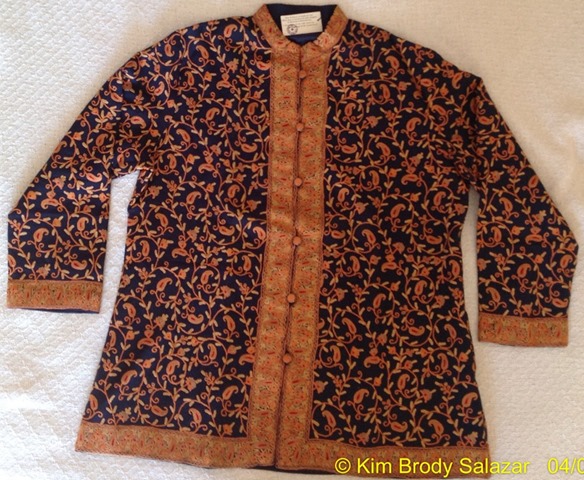
The jacket is also Kashmiri. It’s fine Pashmina, entirely tambour-worked using the same fiber. Even the plackets and hems that look like trim are densely packed tambour chain. This is probably the most extravagant thing The Resident Male bought for me on our stay, and wearing it makes me feel like royalty.
A side trip into literature and symbolism for those who wish to hang around for such things:
Some folk have told me that my curious dodo hanging may show the Garuda Bird, the king of birds, champion of justice, and celestial mount of Lord Vishnu, but I am doubtful. The noble Garuda is usually shown in with wings outspread, robust and fearless, often with a human face and limbs.
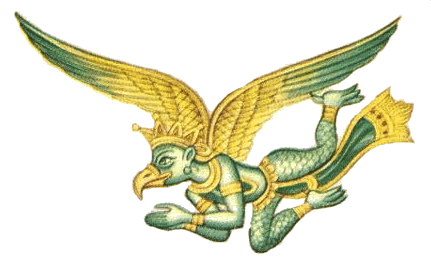
These big-beaked, comfortably round, bald birds, if not dodos, may represent vultures.
There are several vultures in Hindu epics. One is the mount of the deva Shani, revered as a teacher and righteous judge, punishing evildoers and betrayers. But Shani’s mount is rarely pictured alone. Other famous vultures in the story cycles appear in the Ramayana – two brothers, Jatayu and Sampaati. They figure in several tales, including one that echoes aspects of the Icarus myth, with Jatayu flying so high he was seared by the sun, but rescued by his loyal and courageous brother Sampaati who used his own wings to shield Jatayu from the sun’s fury. Unlike Icarus, Jatayu survived, and is not a symbol of the folly born of overconfidence. Jatayu also plays a supporting role in the story of Sita’s abduction by the demon Ravana, flying to Rama with news of Ravana’s escape route.
One last possibility – dodos were giant flightless parrots. If these birds are parrots, we veer off from justice and bravery into the worlds of compassion and love.
Origin stories vary, but Sukadeva was a parrot, and pet of the gods, particularly befriended by Krishna, who showed mercy and compassion to it when Sukadeva fluttered away from his mistress Radha. I’m not clear on the relationship between that story and others, but Sulka the parrot is often painted in henna on the feet of brides, in recognition of his service as the sacred mount of Kamadva (also known as Mandan and Mara) the god of sensual love.
While not as lofty as Garuda, if my dodos are the vulture brothers, they are still exemplars of bravery and self-sacrifice. However, if the bird shown is Sulka, the connection with love might make my curtain more apt for the bedroom than the dining room.
PROGRESS CAN BE VERY BORING
You know you’ve hit full stride in a project when you think of what to write in a progress post, but have no new challenges, discoveries, tricks, or lessons-learned to report. All I can do today is show off more gears and cams, with more fillings:
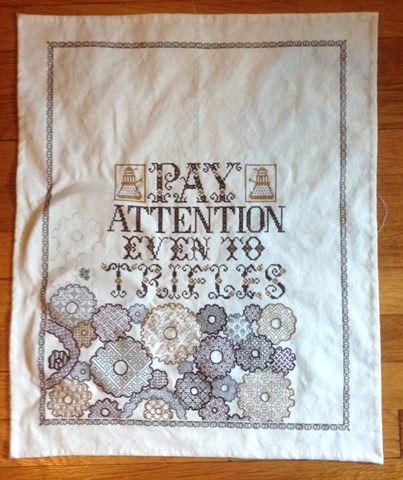
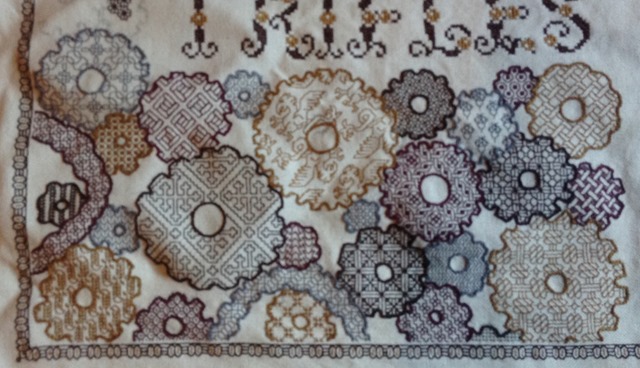
I’m continuing up the left side of the motto, then I’ll do the right side, and finish with the top. I’m having tons of fun selecting fill patterns from Ensamplario Atlantio.
I had hoped that when I released the thing I’d see more things on line that use its designs, but searching does turn up a few projects:
- Ben from Tiny Dream Stitchery is doing a sweet sampler, I really like the layout he’s using. It’s reminiscent of a formal Renaissance garden plan.
- Whispered Stitch is making adorable little needlebooks using motifs from the patterns, and offers a tutorial on their construction.
- And Stitches used the patterns in her rendition of a large group stitch-along project.
- Rebecca of Hugs are Fun did a name sampler, a striking and innovative idea for using the fills.
- Kathy at Unbroken Thread stitched up a spectacular piece, incorporating gold, paillettes, purl, and beads.
- Miriam did a bunch of nifty key fobs, using EnsAtl patterns along with ones from other sources.
- Colorize also has a sampler. She’s picked some of the more complex designs, brave soul!
- Susan at Tuesday Stitchers used a design in a large departure from the usual, as an embellishment stitch done on gingham in a crazy quilt. Very cool!
If you know of any others, please post them in the comments. It gives me immense joy to see the mischief that these designs get up to out there in the wide, wide world.
Sadly, I’ve also found a ton of pirate sites on line, mostly in Russia, who felt it necessary to steal the book and repost it in its entirety. I can’t do anything about them besides despise the lack of integrity and gutter slime ethics that such theft represents.
The ONLY authorized source for the book is right here on this site. It’s free. Link above, and under the Books tab on every page of String. If you have downloaded my book anywhere else, you have found a stolen copy.
GEARING UP
As you can see, Trifles is coming along. I’ve just about finished the first set of gears:


The next bit to do will be the two sides, proceeding left and right of the established bit, growing up to frame the motto. I’ll use the same stencil for my basic layout, rotating and flipping it to make the repetition less evident.
A couple of you have written to me to say that you find the gears rather disappointing – that they are not sharp and mechanical enough. In fact, the edges of some of them are more gentle, cam shaped rather than toothed, and the teeth do not mesh exactly.
Frankly, I don’t find this a problem, and I don’t care. The thing will be more representational than mechanistic. I’m going for the idea of gears here, not a CADD drawing.
I am having fun flipping through Ensamplario Atlantio looking for which fill to do next. Everything you see here has been done ad-hoc, one gear at a time, with no pre-planning on what design/color to use next. I’ve used four-color placement principles to avoid having two gears of the same color right next to each other. I’ve also tried to achieve a nice mix of densities and shapes, with contrast between horizontal/vertical and diagonal elements, all-overs/spaced spot motifs, and between straight lines/curvy patterns. On the whole I’m pleased. I’ll add more dark and density to the lower left, next. Also more gold there in that corner.
Stay tuned for further developments!
GEAR-HEADED
Trifles is moving right along. Waxing the thread has greatly speeded up production. You can see my working method: filling first, then outline to cover up any edge fill irregularities.
Here’s the gear set now:


I’m having fun picking out the fillings on the fly, trying to vary density, color, and form, so that abutters contrast nicely. For those who have asked – yes, every filling used so far appears in Ensamplario Atlantio. I have it downloaded to my iPad. My favorite sewing/knitting chair is a Mission-style recliner with very wide, flat wooden arms. I am able to stand the iPad up on one and zoom in on the chosen designs as needed. Very convenient.
Progress will get a bit less exciting from here on in. I plan to totally fill the ground around the motto with gears, each worked in a different filling design. No other colors will be used. I’m sticking to the deep russet red, chocolate, gold, and silver. I may or may not add some real brass gears as embellishment. I may add some small large-eyed tiny critters stuck in the gearwork, sort of like the soot sprites from the movie, Spirted Away. That’s another of the target recipient’s favorite fandoms.

TRIFIAL PURSUIT
Back from our annual escape to North Truro, and reporting progress on the recently dormant Trifles sampler, being stitched for Younger Daughter to take with her off to college next fall. I decided that for my no-longer-little Steampunk (and Dr. Who) fan, instead of working lots of bands, the design for this one would feature gears. But I had a lot of problems hand-drafting up a nice set of them. It took a while, but eventually I hit on the idea of using a commercial stencil intended for airbrush work, then filling in the traced gear shapes with blackwork counted fills.
Here’s where I am now:

I’ve finished the main motto and the frame around the to-be-worked area. Minor brag: Note that having marched all the way around the piece without drafting first and using only counts of the border repeat to stay on target, I ended up even, perfectly aligned.
All of the fillings I will use on this will be from my free eBook, Ensamplario Atlantio. The ground patterns are stitched using two plies, mostly in double running, with lots of departures to accommodate the non-continuous nature of many of the fills. The outlines are plain old chain stitch, done in three plies of the same color as the gear filling. I am not taking any special pains to make the cam teeth totally square, or to make them mesh. I am liking the rounding and imprecision. Right now I’m thinking of covering the entire piece with gears in burgundy, brown, gold, and silver, relying on classic Four Color Theory to avoid making any two contiguous gears the same hue. Choosing fills for color in addition to density and form is adding a new dimension to this decidedly un-traditional yet somewhat traditional blackwork piece. And I may insert a surprise Trifle or two, just to emphasize the point.
On execution, I can report that I’ve managed to tame the extremely unruly Indian “silk” (in reality, man-made rayon) thread.
Beeswax.
I occasionally wax the last inch or so of my silk threads to make threading easier and to help ward off “ply creep” – when one ply of a multi-ply threading is consumed faster than the others. But I usually don’t wax the entire length unless I’m working with linen thread. However this stuff is hellaciously difficult, shredding and sliding, breaking and fraying, and catching. Using shorter lengths wasn’t the answer – no usable length was short enough to use comfortably. So I moved up to waxing the entire strand, and when I did so, most of my problems disappeared.
I am very pleased with the results using the fully waxed threads. They don’t break. They don’t escape from the needle’s eye. They don’t shred. Both plies are consumed at the same rate. Double running is nice and crisp. A major improvement that’s increased the enjoyment factor of a project that might have been truly tedious.
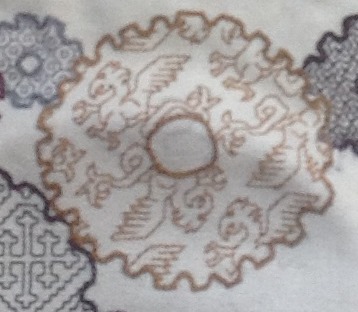
And I’ve wanted an excuse to stitch up those griffon-drakes since I drafted them up for the book.
REVISIONIST SAMOSAS
When I was living in Pune, India, I posted about my attempt to make samosas there. They turned out quite nicely with a good flavor, although my clumsy shaping ensured they were clearly not “desi” by birth. I used some ingredients there that are sort-of, but not quite parallel to what I can find in US supermarkets here in the US.
For example – flour. Wheat flour in Northern India is a huge staple. Many people buy grain in bulk and grind it themselves, or bring it to a mill to grind. Even the Western style supermarket I frequented offered bulk wheat purchase, with in-store milling to the fineness desired. But I generally bought pre-milled bagged flour, of two types – attah and maida. Maida is white flour; attah is whole wheat. Both are much higher protein than US all purpose flour, and attah especially is often augmented by other grains or vitamin enrichment.
Another example are potatoes. Here we are blessed with many kinds. In India the potatoes were halfway between flaky white Idaho or Maine style potatoes, and the Yukon Gold yellow or waxy red russet types favored for boiling rather than baking. They cooked up a bit firmer than whites, but were not as fine textured as the yellows or reds. I take advantage of US abundance and use a combo, relying on the yellows for texture and the whites for the substrate of the filling. If you use just one type, an all purpose white potato will serve.
Spices. There is no comparison, so I have tried to punch up the US version to reach the flavor levels of what we found in India. There I was lucky enough to have received jars of “family masala” from our friends as gifts. Every one was different, fiercely tasty, and oh, so good. Pre-made garam masala here in the US is quite anemic by comparison. The best of them that I’ve found was at Atlantic Spice in Truro. Penzey’s is ok, but bland. Kashmiri mirch (hot chili powder) is heavenly – fruity and complex. Cayenne is hot but not as nuanced. Some New Mexico style powdered chilis are too heavily smoked for this recipe. Try to find a less-smoked, fruity yet chili pepper powder use here.
Over the past weekend I had an occasion to make samosas again, making substitutions specific to what’s on hand here. For example, I’ve tried to make the roti style flatbreads I used to make in Pune, but with equivocal success. I suspected the flour. Especially the white flour, which is too soft. So I have made some changes to the types and proportions of flour, to get a better result. Apologies for not having pix of the finished samosas, post frying. They were too delicious, and did not survive long enough for photography.
Note that if you are shopping in a specialty grocery that caters to expat Indians, you will probably want to follow my original posting, and not the directions below.
One American Chick’s Sort-of-Samosas
Revised for a US kitchen
Makes 32 large snack-sized filled fried pastries
(makes filling for twice that many – extra may be frozen and used later)
Outside pastry:
1/2 cup white all-purpose flour
1/2 cup white bread flour
3/4 cup whole wheat flour or whole wheat bread flour
2 1/2 Tbsp stick butter or clarified butter – MUST BE SOLID, NOT MELTED
3/4 cup water
1 tsp salt
3/4 tsp baking powder
Oil for deep-frying
Filling:
2 medium size yellow onions, diced (roughly 2 cups)
2 Tbsp oil or clarified butter for sautéing.
8 cloves garlic, minced fine
2 cups frozen peas
2-3 fist-size white potatoes, peeled
2-3 fist-size yellow potatoes, peeled
2 Tbs whole mustard seeds, preferably black
3 Tbs garam masala spice mix (or other spices to your taste). Note that US-sold garam masala is usually quite weak. If you have a fresh home-made blend or an imported blend from an import store, use less.
2-3 Tbs hot red pepper powder. Kashmiri mirch is best, but if you can’t find import, choose a fruity and hot dried pepper rather than a heavily smoked paprika. Use less if you don’t like fiery foods.
1/2 tsp dried coriander (I added this because the US masala was weak).
1/2 tsp dried oregano (I added this because the US masala was weak).
1 Tbs cumin powder (I added this because the US masala was weak).
1 tsp tumeric powder
3 Tbs clarified butter or stick butter for flavor
Fresh cilantro leaves – about a big handful, de-stemmed and washed free of sand, then chopped roughly
3 Tbsp salt
Dipping sauce
1/2 small, sweet onion, like a Vidalia
1 clove of garlic
Large bunch of fresh cilantro leaves (the remainder of the bunch) de-stemmed and washed free of sand.
Salt to taste
1/2 Roma tomato or 6 or so cherry or grape tomatoes, seeded.
Instructions
1. Peel both kinds of potatoes, chunk them into two or three pieces and set them to boil until tender. Drain the potatoes and salt them.
2. While the potatoes are cooking you’ll have some time. Mix the two flours, the salt and baking powder together. If lumpy, sift. Work the hard clarified butter or stick butter into the flour mix with your fingertips or a fork, as if you were making scones or pie crust, until all the butter is incorporated, and the flour looks crumbly and grainy – past the point at which you’d stop if this was pie crust.
3. Add about half of the water to the flour/butter mix and combine. Keep adding water slowly and mixing until the dough can be gathered up and briefly worked into a smooth mass. Do not over-knead or the shells will be hard as rocks. Set the dough aside under a damp cloth or in a plastic box. The dough needs to rest and evenly hydrate for at least an hour before use.
4. Take the cooked yellow potatoes and dice them into small chunks, about 1.5 cm (1/2 inch). Precision isn’t important, you just want them to be small but noticeable bits in the stuffing. Rough mash the white potatoes with the back of a fork or large slotted spoon.
5. In a VERY large frying pan, start a couple of tablespoons of oil over a medium heat. Throw in the mustard seeds and listen/watch for them to begin popping, like mini popcorn. When they pop, sauté the onions in the oil until light golden. Add the minced garlic and sauté for a minute or two more, until the garlic is fragrant, but not brown. Sprinkle all the dried spices, salt, and dried herbs onto the onions and sauté for another minute or two, until everything is very uniform and paste like spice coats the onion bits, smelling wonderful. Toss in the potato cubes and let them get coated with the oily spicy oniony garlicky mix. Then toss in the mashed potatoes and the remaining butter and stir all together to distribute the butter as it melts. When incorporated, stir in the peas. Taste it and add more salt if needed. Let the stuffing heat on low for another ten minutes for the peas to thaw and cook, and for the flavors to meld. Stir occasionally to scrape up any yummy bits from the bottom back into the filling, and to keep the potatoes from sticking to the bottom. Fold in the fresh coriander leaves. This fully cooked filling can be made way ahead and fridged until needed, although I suggest taking it out and letting it warm up before stuffing and frying the samosas, to ensure that the centers don’t remain cold.
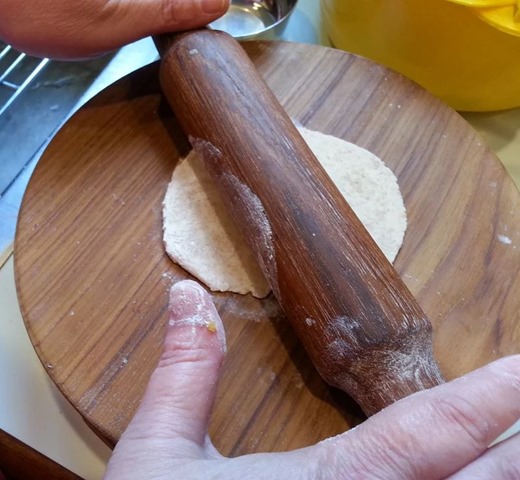
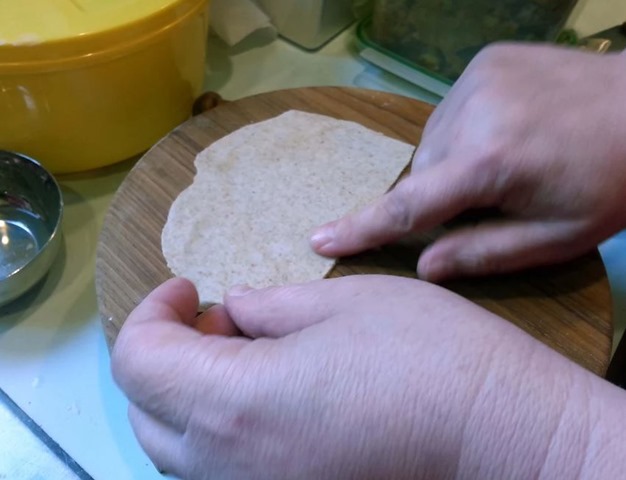
6. To assemble – have your filling ready. Have a small rolling-pin ready. Take the rested dough and divide it into 16 equal parts. Put the parts back under the damp cloth towel or back into the plastic box until needed. Take the first lump of dough. Finger-flatten it into a fat pancake and pat it into some loose flour. Roll it out into a circle, as large and as thin as you can (mine was about 6 inches around, and about an eighth of an inch thick). Take a knife and cut the circle into two halves. Each half will make one samosa.
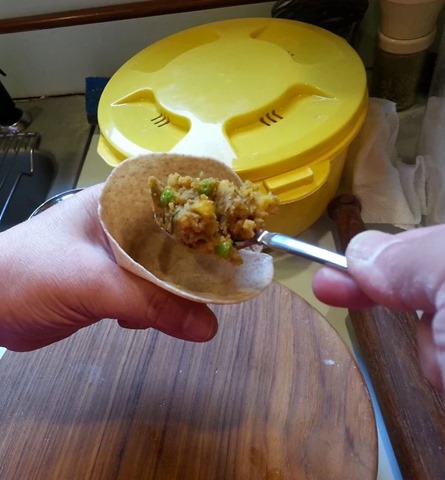
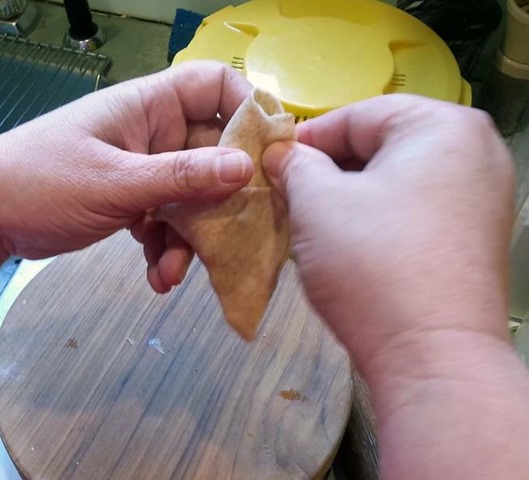
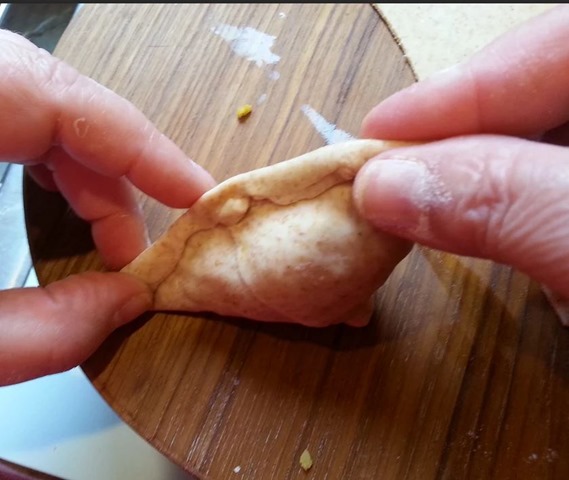
7. Try to follow this video’s folding logic. Moisten the straight edge of the half circle with water, then pat it into a cone. Hold the cone in one hand and fill it with the other hand, patting the filling in to make sure there are no air holes. Moisten the top edge, then pinch the top of the samosa closed in the center (where the cone’s seam is), then pinch the seam shut left and right of that point. Finally, fold the left and right corners of the newly formed seam together and pinch them, too. The professional samosa chef does this by plopping the thing down on the counter and using the side of his hand to make the second seal, at the same time giving his pastry a nice, flat, triangular bottom. Mine were more free-form, looking sort of like the back end of a fleeing chicken. In spite of the laughably unorthodox shape, mine did stay closed while cooking, which is what counts.
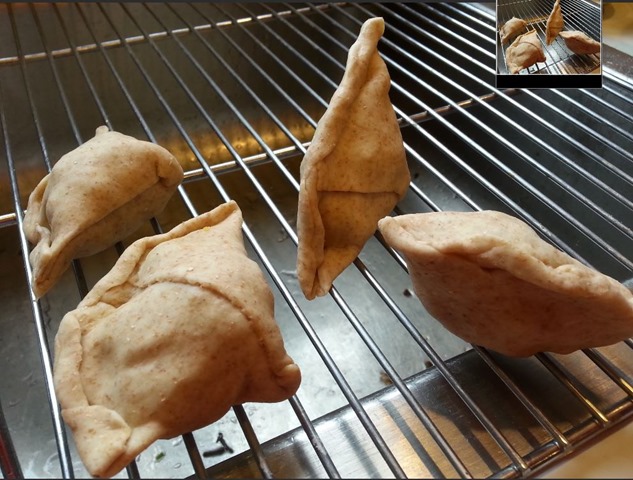
8. As the samosas are done, place them on a plate or rack, making sure that they do not DO NOT touch each other. If you are forming them ahead of time and intend to refrigerate before frying, this is an absolute necessity. You can stack them in a large plastic box, but if you do, make sure each one is separated from the others, and waxed paper or plastic wrap between layers is highly advised.
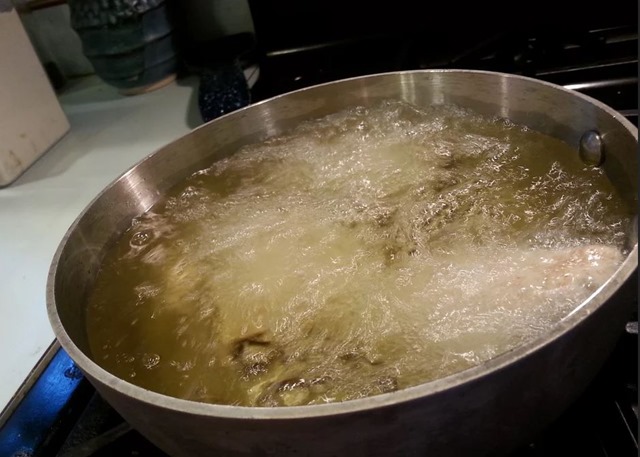
9. When the samosas are all formed they can be either baked or deep-fried three at a time in a small, deep saucepan. The oil should be quite hot, but not smoking, and the samosas should take only a minute or two each to get golden brown. I suggest letting them drain on a baking rack rather than on paper towels so that the bottoms don’t get soggy.
10. To make the dipping sauce, use a small blender, the chopping box attachment on a stick blender, or a full size food processor to buzz the onion and garlic to mush. Toss in the tomato, making sure to remove as much of the inner moisture as possible before doing so, and buzz to incorporate. Then add the cilantro leaves. Process until everything is evenly textured. Add salt to taste. You may want to pour off some excess liquid before serving – it depends on how juicy the vegetables were.
Serve the samosas hot with the dipping sauce, or cold. They are best when still crispy, but also good after they’ve cooled.
All pix courtesy of Elder Daughter, who knows her way around a camera better than I. The belan and chakla (rolling pin and platform) were hand made for me by family friend Rupesh Rocade’s father, and as you can see – are much used and appreciated!
BACK TO TRIFLES
As usual, I have several projects going at once. Right now these include the giant green sampler, the pullover I am knitting with a friend (now awaiting total rip-back and restart after An Inadvertently Destructive Incident), and the Trifles sampler I am working up for Younger Daughter. Although I do not intend to leave my co-knitting pal in the lurch, the last one is the only one with a hard deadline.
I’ve been road-blocked on Trifles for a while. I wasn’t sure how I would edge it, and what would define the interior space. I knew I wanted to do inhabited blackwork cogs for the filling, but the one I hand-drew wasn’t working out very nicely; plus getting many different sizes of gears to mesh properly was proving problematic. So I set the thing aside to ponder.
I’m now done pondering. My solutions are:
- Work a narrow edging around the entire piece, in slightly heavier stitching than the infillings, in order to define the field.
- Cheat. Use a commercial stencil to achieve the gear shapes. Not only does the stencil present a nice, large field of meshing cogs, it is also calculated to tile properly.

I found the stencil on line. It’s plastic, and much more durable than any downloaded/paper printed solution. I liked the clear differentiation among the shapes on this one, with very little overlap that would require hand-drawing the missing teeth. Although it wasn’t inexpensive, it will save me an infinite amount of grief. I will modify the individual gear shapes on the fly – stitching some with full interior detail as presented on the shapes, and some without, making more solid gears. I also have a little packet of brass Steampunk watch gear shapes, if I decide to add them as an added embellishment.
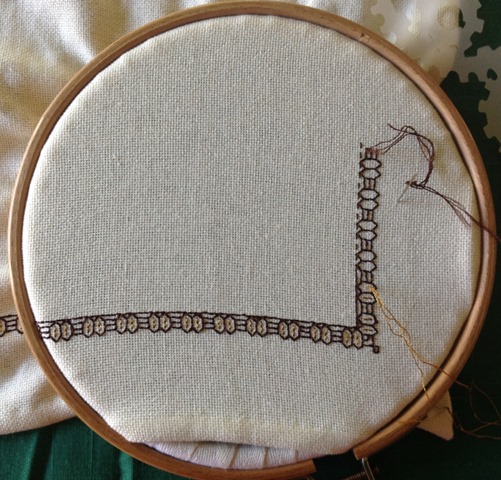
The narrow edging is yet another design from my forthcoming book, but worked in two colors. And I will be picking out the beginning of the filled gear underneath the letter “T.” Once I have the outer edging finished, I will trace the field using the stencil. Then I will stitch up the gears using fillings from Ensamplario Atlantio, with their edges defined crisply using either back stitch or chain stitch (experimentation will ensue).
On working a symmetrical counted edging without drafting up the entire thing ahead of time – it’s easy on a simple geometrical one like this. Begin at a corner. I improvised a corner treatment, where north/south and east/west meet. Then at the center of the piece (conveniently marked ahead of time by a line of basting), I improvised a symmetrical join, then mirrored the completed stitching previously done. Eighteen pattern repeats later, I mirrored the improvised corner. I will continue my march north until I get to the basted center line. There I will make another decision on how to treat the center and soldier on to complete that edge. I work that same kludge on the left hand edge. Since the centers will match top/bottom and side to side (even if they are different) – no one will notice them, and every corner will be crisp.
As to the thread – I am using the art silk stranded floss I found in India. I am not loving it. It’s rayon, and very slippery. Surprisingly, its tensile strength is less than that of cotton, no where near the mighty nature of real silk. It shreds, and must be used in short lengths. In addition, the plies separate and “walk” against each other. I have to use a laying tool to get even these short stitches to look nice. I would not recommend the stuff, and am glad that I will be using up pretty much my entire stock on this project.
IT’S GETTING CLOSER!
Don’t look behind you and duck, I’m only talking about The Second Carolingian Modelbook. Here’s the tentative cover

It’s getting closer to publication. I am NOT ready yet to take pre-orders, but when I am, I’ll post here.
What it will have:
- 180 or so pages, including 75 plates of graphs – 50 line unit, 25 block unit.
- Over 250 individual patterns, with museum citation sources, degree of fidelity to the source, and (when available) date and provenance, plus height and repeat width stitch counts.
- Articles on stitching methods, commonly used names for the styles, etc.
- Index, source bibliography, research bibliography
- Photo illustrations of some of the patterns, worked.
To chivy myself along towards completion I post my to-do list:
- Finish the description and how-to photos of the meshy stitch, so often used as background in historical voided pieces

- Finish the last few entries in the index
- Correct some of the earliest drafted pages, updating a typo in the background frame
Once these things are done I can do final prep for electronic publication, and finish up the legal/infrastructure needs of setting up the business end of the offering.
I know everyone has been VERY patient. I promise the thing will be worth the wait.
SURFACING
It’s been lonely here at String. So few posts over such a long period of time. I apologize for that. Life has been hectic, with work deadlines, the close of Younger Daughter’s school year, and house projects just getting under way.
For a start, here’s Younger Daughter, decked out for Junior Prom.
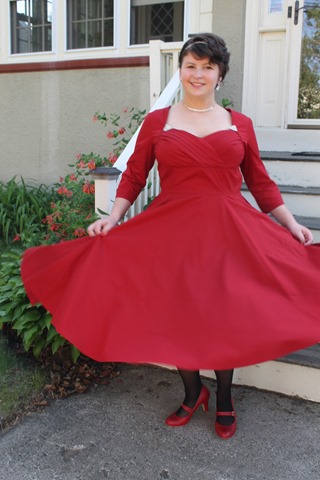
No copycat column dress for her, she took inspiration from decades past, and found a bargain repro-1950s dress on line. Much child/parent conspiring took place to round out the outfit. The rhinestones for example are excavated from my jewelry box, and ultimately belonged to my grandmother and great-aunt. Younger Daughter looked great, and had a wonderful time. And not a bit of envy for dance-able comfort from some of her more elaborately dressed peers.
On the Trifles sampler, I ran into a roadblock. I tried drafting and tracing meshed gears, which I intend to use as a background, filling each one with a different counted blackwork-style filling. But I wasn’t finding a great amount of success. So I caved in and bought a plastic stencil. I’ll use selected bits of it, tracing the precision cut cams onto the cloth and tiling the thing where needed (it’s calculated to do that!). More on this once I get going.
I’m also working on a two-person knit-along with Friend Kim – a mesh-knit three-quarter sleeve pullover from a Kate Bellando pattern. I think we’re both at about the same mid-sleeve point:
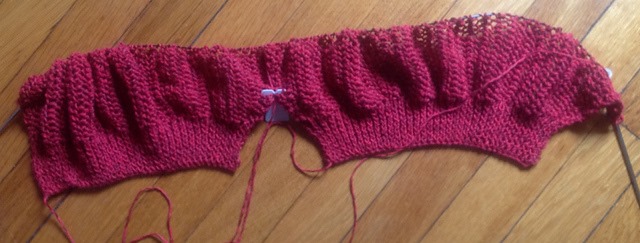
For the record, we’re both using SMC Select Reflect, a light DK/heavy sport yarn in rayon/cotton blend. I can say that both of us have had extreme problems making gauge and have had to adjust needle size and move down in selected garment size to compensate.
And I’ve done a ton of socks as I noodled out the various problems and challenges, above. This pair was knit up from a hand-painted sock blank – Plymouth Happy Choices, in the Fiesta color.

In essence, a sock blank is a long scarf-like machine knitted strip that a dyer then paints with her or his chosen colors. When the scarf is unraveled for use, its patterns knit up in unexpected ways. I knit mine straight from the blank rather than re-winding, working my standard figure-8 toe, short-rowed heel sock. The crinkle made no difference in the finished product, and the convenience of working from something that wouldn’t escape and skitter down six rows was perfect for airplane knitting. The lace pattern on the ankle is from Walker’s fourth treasury.
And on larger, family projects – we start to consider redoing our kitchen. The floor tiles are worn past their surface color, the cabinets and countertops are sagging beyond simple repair or re-use, and the layout/look is inefficient and dated. The room was spruced up around 1980, as a peace offering between the warring couple that sold the house to us. I have detested the shell pink/mint green/faux Colonial cabinet combo from the day we moved in. Before pix in next post, for sure. Ten years is enough, and it’s time!
NIECE, SLIGHTLY DAMAGED
As happens to so many, my gymnast niece Veronica had a disagreement with gravity, momentum, torque, and a body part; and has landed in cast. She’s on the mend, but disappointed to miss out on the remaining Spring competitions, and (living in Buffalo) regrets her now chilly, exposed toes.

Knitting to the rescue!
To cheer her up and warm those toes, I whipped up a quick set of tie-on toe socks. I used worsted weight washable acrylic or superwash wool blends, all leftovers from prior projects, and US #5 needles, playing with simple stranding, eyelet patterns, or no design at all, as whimsy manifested. I think that the pale blue is in fact left over from a Fishy Hat I knit for Veronica years ago…
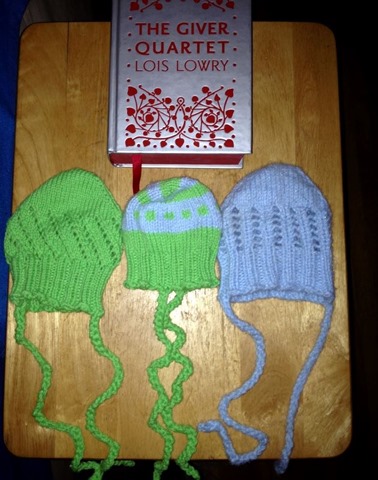

The toe is my standard Figure-8 no-sew toe cast-on, but rendered wide enough to go over the end of the cast. After that I worked about three inches of foot, and ended with 20 rows of ribbing. I made crocheted strings to tie the things on. Apparently I didn’t make them long enough (being several hundred miles from the recipient), and they are not quite adequate to tie behind the heel. The directions below are modified to add the extra, needed tie-string length.
BASIC TIE-ON TOE SOCKIES FOR THE CAST-BOUND
Washable worsted weight yarn with native gauge of 5 stitches = 1 inch. I recommend an acrylic or a washable wool.
Set of five US #5 double pointed needles (can also be done Magic Loop or two-circ style)
US size G crochet hook for ties (ties can also be done using I-cord, braiding, or any other method you desire)
Tapestry needle for ending off ends.
Gauge
Roughly 5.25 stitches = 1 inch. You want these socks knit tightly for warmth and durability.
Directions
No-Sew Toe Cast-On
Take two of the needles and wrap the yarn around them, figure-eight style. The yarn should loop around the bottom needle and cross to the opposite side of the top needle. Loop over it and then return between the two. The result should look something like this:

Continue wrapping the yarn this way until you have 12 loops on each needle. Let the end dangle free with no knots or other securings – you’ll need to work looseness in the first row out towards the end later. Knots will interfere with this in-flight adjustment. Take a third dpn and knit across the top needle. Take the fourth dpn and knit across the bottom needle. Be careful not to twist stitches – one needle’s loops will be “backward” with the leading edge of the loop on the rear side of the needle. Make sure you knit into the rear side of these “backward” loops. You now have a very narrow and slightly awkward strip of knitting suspended between two needles. There should be 12 stitches on each needle. Don’t worry if the stitches running down the center are loose, in a couple of rows you can tighten them up by carefully working the excess down towards the dangling tail end.
Toe Shaping
Row 1: k1, M1, k5. Using another dpn, k5, M1, k1. Using a third dpn, k1, M1, K5. Using the fourth dpn – K5, M1, K1. You should now have 4 live needles in your work, each with 7 stitches on it.
Row 2: Knit all stitches
Row 3: *k1, M1, k6 [Note – this is the end of first needle, remainder on second needle] K6, M1, K1* repeat
Row 4: Knit all stitches
Row 5 and subsequent odd rows: Continue adding one stitch after the first stitch of the first and third needles, and one stitch just before the last stitch of the second and fourth needles.
Row 6 and subsequent even rows: Knit. When you have 14 stitches on each needle (56 stitches total) the toe is done.
Foot
The foot is just a cylinder worked on all 56 stitches, for about 3 inches after completion of the toe. You can work this in plain stockinette, or go wild here, working simple stranding or eyelet lace patterning. Repeats of 4, 7, 8, 14 or 28 stitches are all possible. For example, my wide eyelet ladder is
Row 1: *K2tog YO2, SSK*
Row 2: *K1, K1P1 into double YO, K1*
Ribbing
When the foot part is complete, it’s time for 20 rows of ribbing. I tend to use K2, P2 ribbing because it pulls in more than K1P1 ribbing, but feel free to use anything that’s comfortable for you. Bind off and darn in all ends.
Ties
I crocheted my tie strings for speed. I located the “side welts” – the stitch column that corresponded to the beginning of needle #1 and the end of needle #4, and the stitch column that corresponded to the end of needle #2 and the beginning of needle #3. It will be very visible on the side of your toe. I walked those points up to the ribbing for my designated side attachment points – one on each side of the sockie.
Using the crochet hook and my yarn, I worked a two-stitch column of single crochet.
Row 1: Single crochet 2, chain 1 (this is the turning chain)
Row 2 and subsequent rows: Skip turning chain, single crochet 2.
I made my strings about a foot long, but I strongly suggest making yours about 18 inches long. Darn in ends, and you are finished.
I report that the sockies work, mostly (they need longer ties), and the recipient is warmer and happier. Heal quick, Veronica! We all want to see you dancing (and tumbling) real soon.
 String-Or-Nothing