LEFT TWIST (1X1 CABLE) – MINOR REFINEMENT
Just because there’s nothing in my world that doesn’t get tinkered with just for the distraction of the tinkering, I played a bit more with twist stitch directions last night, and found a minor refinement that (for me at least) improves the look of a left twist – the one where the rightmost stitch ends up on top of a 1×1 cable:
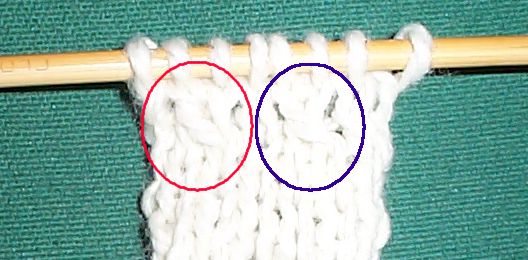
I know the photo is very hard to make out (blame my cheap camera and poor skills), but in the purple circle is a left twist that looks a bit pinched at the bottom. That was done the way described yesterday, the way that’s outlined in Walker and most other books:
- Identify your two-stitch unit. Skip the first stitch and knit into the back of the second, then knit BOTH stitches together through the back of the loop and slide the entire unit off your needle
I did almost the same thing to the twist in the red circle on the left – with one minor additional manipulation, shown in red, below:
- Identify your two-stitch unit. Slip the first stitch knitwise, then return it to the left hand needle. Now knit into the back of the second, then knit BOTH stitches together and slide the entire unit off your needle
This flips that first stitch over and places its leading leg to the rear of the needle. This eliminates the slight twist that’s formed at the base of the topmost stitch. If you’re unfamiliar with the leading leg problem, there’s a short summary on it here.
Other than this minor epiphany and about an inch of the back of my Ribbed Leaf Pullover, not much got done here last night. I’m in the midst of holiday shopping (100% on-line), plus planning for our annual cookie deluge, and for the hand-made-tamales-to-feed-30 I promised would be ready for an annual holiday bash held on Christmas day. I also owe lots of personal replies to letters and notes. I’m getting there. Glub.
LEFT TWIST AND RIGHT TWIST
I got a note yesterday from someone who commiserated at the slow going doing a piece so full of left twist and right twist 1×1 cables, and who wanted to know if there were other ways to do them.
There are several ways to go about it. Some are documented in B. Walker’s stitch treasuries, others elsewhere. The first and most obvious is to do a plain old 1×1 cable, slipping the stitch that needs to go in back onto a cable needle or spare DPN, working the one that needs to land on top, then returning the slipped stitch to the active needle and working it, too. Nice and neat, but time consuming.
Some people have a knack for working these small cable crossings without using a cable needle or other aid to hold any stitches. This works best in a nice, cooperative and slightly sticky wool, but with practice can be employed in most other materials, too. Famous Wendy is especially good at it, and has a nice tutorial on no-needle cables on her website. Although it is employed there for a 3×3 cable, the same principle holds for a simple 1×1 twist. Grumperina also has an illustrated no-cable-needle tutorial. Her method is slightly different and works well, too.
But being a klutz and prone to dropping stitches, I prefer some of the other less adventurous methods. My irrational preference here is sort of like people who prefer to keep their fingers on the keyboard while using a word processing program, disdaining use of the mouse in favor of key command sequences.
Here are a couple of other ways to make 1×1 twists. B. Walker advocates the second method described below for each (the ones I attempted to illustrate). As with most cases in which there are several ways to accomplish the same thing, experimentation is always a good idea. Different methods will give different gauges and depending on the materials used, may have an effect on fabric drape and loft. If you’ve got a pattern that’s heavily dependent on LT and RT, take a moment to play with the various ways to accomplish them when you are swatching. You may find that one of the many ways to produce them works best for your project in hand.
Left Twist (LT) Methods – Rightmost stitch ends up on top
- Identify your two-stitch unit. Skip the first stitch and knit into the back of the second, then knit the skipped stitch through the back of the loop and slide the entire unit off your needle.
- Identify your two-stitch unit. Skip the first stitch and knit into the back of the second, then knit BOTH stitches together through the back of the loop and slide the entire unit off your needle
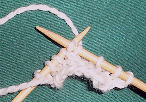
Knitting into the back of the second stitch
Knitting both together
Completed twist unit


Right Twist Methods – Leftmost stitch ends up on top
- Identify your two-stitch unit. Skip the first stitch and knit into the front of the second, then knit the skipped stitch and slide the entire unit off your needle.
- Identify your two-stitch unit. Knit both stitches together, but do not remove them from the left needle. Knit the first stitch again, and slide the entire unit off your needle.
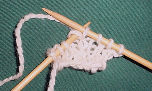
Knitting both stitches together
Knitting the first stitch again
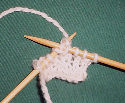
Both completed twists (placed a couple of rows apart, they make up the C shape in the center of the mini-swatch)

LEAF SWEATER PROGRESS
Back from a holiday sojourn with my husband’s family, I present my leaf sweater progress:
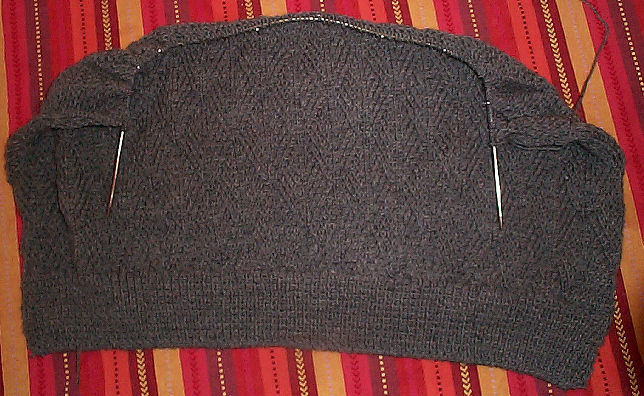
As you can see, the preponderance of twisted stitches (1×1 cables, not knit into the back of the stitch type twisting) do slow me down quite a bit. I can say however that I am almost done with the third 50-gram skein of Jaeger Matchmaker. Since I had just started the second before we left, I can attest to a modicum of progress. A couple people asked for close-ups of the texture pattern
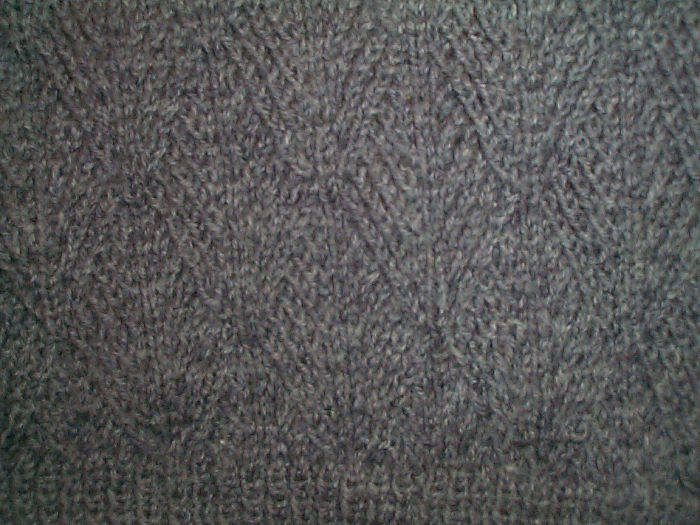
Again, my poor photography skills do not do my object justice. This is however a very common twist stitch pattern, and appears as “Ribbed Leaf” on page 151 of B. Walker’s Second Treasury of Knitting Patterns. The Sarah James leaflet gives the directions in prose, very much akin to Walker’s. I however had to graph the thing out because I find working from charts much easier to do than working from prose. Here’s my chart:

On the holiday, we drove cross country from the Boston to Buffalo metro area, delighting in accompanying several zillion fellow travelers in the process. Thankfully most of them turned south and headed to New York City rather than trekking out across the upper part of the state with us. We spend a comfortable night in Utica, but send sympathy to Utica residents on what their local reviewers laud as an excellent restaurant. We found it to be grindingly mediocre at best (Italian restaurants whose sauces are both gummy and indistinguishable in texture from their pasta should be avoided). Also ear-splittingly loud.
The family and food at the end of the trip made the migration worth it, with the kids being thoroughly spoiled by their grandmother. And even us grown-ups had a chance to sneak out and have some fun visiting the Frank Lloyd Wright’s Martin House and the Roycroft cooperative over the weekend.
LEAF SWEATER AND TUBULAR CAST-ON
A day late, but not forgotten in the pre-holiday rush, I present progress on my Sarah James Ribbed Leaf Pullover:

You can see the wide twist-rib section; the tubular cast-on I used (my fave); and about 80% of the first full pattern row repeat. I’ve described the tubular cast-on before. You can also see the beginnings of the soft drape of the body, with just a bit of blousy fullness above the ribbing. My gauge is just a squidge looser than that recommended, but I am not worried about fit. I am at the top end of the pattern’s presented range of sizes. A bit more fullness won’t matter. Plus I have plenty of yarn. Two whole bags full – about six balls more than the pattern projects.
On the Jaeger Matchmaker DK, I can confirm my opinion yesterday. It’s soft. Very soft. Also a bit splitty for this particular use. I’d probably recommend a crisper, more tightly spun yarn for maximum texture effect, but this one is serviceable for the purpose and I like the hand of the fabric that’s resulting. I am a bit disappointed in quality though. I’m only on my second ball, and I’ve found more than a half dozen spots where a ply was spliced. No whole strand knots, but lots of repaired ply breakage. Most were large enough to be noticeable and I ended up cutting them out. That means more ends to end off. Also, I suspect that the luscious softness of this Merino yarn will display a typical weakness – pilling. I noticed that when ripping back, the yarn looks more used and fuzzy than I would normally expect. It mates with itself an exceptional amount for a superwash. All that easily encouraged surface fuzz usually bodes badly for pilling down the road. I’ll keep an eye on that.
In the mean time, I’ll be taking a computer vacation for a couple of days, and will catch up with both wiseNeedle and String after the holiday. If you’re in the US – may your long weekend be a pleasant one whether it be away with family or cozy at home. If you’re overseas, were my house to be big enough, I’d wish I could invite you all over for dinner.
PROJECT KICK-OFF – SARAH JAMES RIBBED LEAF MOCK TURTLENECK
Well, faced with all the knitting I HAVE to do, plus an upcoming holiday week with some time to (potentially) do some but with a limited noodling window, I have done the only impractical thing. I’ve opted to knit none of the above. I decided to do a commercial pattern with little or no alterations (for maximum mindlessness) and produce a sweater I can wear to work.
I’ve opted to knit Sarah James Ribbed Leaf mock turtleneck. I am using Jaeger Matchmaker, in a medium charcoal gray. I don’t see any on-line write-ups of anyone else who has tried this one, so I can’t compare/contrast experiences with other knitters.
I’ve gotten about one skein into the thing. Past the twist stitch ribbing (using my favorite tubular cast-on) and about two inches into the body. I did end up graphing out the texture pattern from the prose directions in the leaflet.
I have some cautions on this pattern. This is knit in DK or sport weight, at a gauge of 6.6spi. Two main body motifs (33 stitches) should equal 5 inches across. Gauge is taken over the pattern and if you knit up a gauge square according to the directions in the pattern, room exists for considerable error (more on this below). The entire pattern is produced using copious twist stitches, and they carpet every right-side row. Wrong-side rows are purled. The preponderance of twist stitches does make for slow knitting, and allows ample scope (for me at least) for stitches to be inadvertently dropped. I’ve had to go back several times now and rescue a loose stitch several rows back. Because of the heavy twisting, if I don’t catch a dropped stitch within one or two rows, I can’t easily ladder down and re-knit. All the entire intervening rows have to be ripped back and reworked.
Taken together these things mean that this pattern isn’t for those who like quick knits at big gauges and who are less than comfortable with precise patterning. It is good however for those who are looking for a very attractive project that will be wearable indoors and out; that will allow purchase of smaller gauge yarns that can often be found on special due to reduced demand; and that will take a while to complete (more knitting time per dollar invested).
Now on the problem with the gauge square instructions, the pattern directs the knitter to cast on 33 stitches and work Pattern 2 (the leaf motif body) for 28 rows. Then cast off, block or wash, dry, and measure the swatch – which should measure 5 inches square. The problem here is that for many knitters, the first several and last several stitches are not knit at the same gauge as the interior of the swatch.
Casting on only 33, then measuring edge to edge, taking these sometimes distorted stitches into account can introduce an error, making the gauge appear to be fewer stitches per inch than it actually is. Someone with this problem will find that their work ends up being smaller than expected based on their swatch. I’d advocate casting on for three repeats (49 stitches) and knitting more than the one full pattern repeat. The texture pattern however would make counting gauge very difficult. This can be addressed by taking two contrasting color lengths of sewing thread or other fine string and laying one between the 8th and 9th stitch and one between the 41st and 42nd stitch (there should be 33 between them). Every other row or so I’d flip the thread or string up the column, laying it through the the spot between those same stitches. Over time, the thread will look like it’s been basted through the work vertically, leaving clear lines between which gauge can be accurately measured. The same thing can be done with row count, threading a colored thread horizontally through a row life-line style a couple of rows up from the bottom, and a couple of rows before ending off, having counted out 28 rows from the first one marked. A larger than directed square of this type can now be washed, blocked and measured, and the gauge confidently extrapolated from the “prime” area so delineated in the center.
You wanted pix? Tomorrow. My camera is out of batteries.
BEGINNING TO BECOME HUMAN AGAIN
UPDATE: AN EASY TO PRINT FULL PAGE VERSION OF THIS DESIGN IS NOW AVAILABLE AT THE EMBROIDERY PATTERNS LINK, ABOVE.
I met my major deadline today, and am beginning to decompress. The best way to do that is to think of something completely different, so I’ve begun to contemplate patterns in general, with some idle thought to my Spanish hat. So I began playing with motifs I have lying around. Like this one
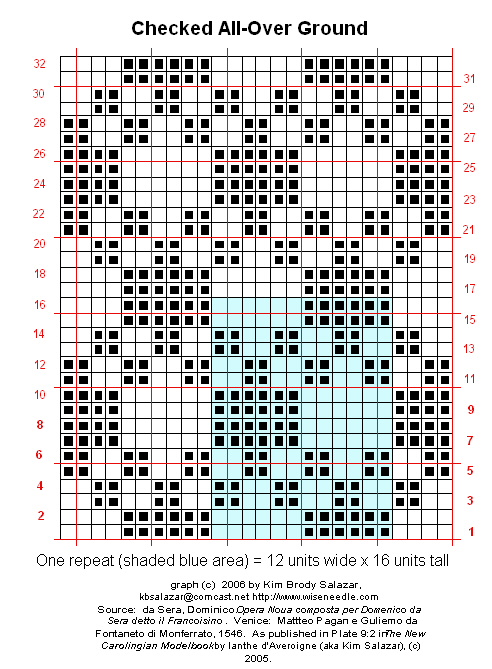
I don’t think this particular one is great for the hat, but I have an odd fondness for it, plain as it is. As the source annotation states, it’s one of the patterns I included in The New Carolingian Modelbook. While it looks like it would be at home as a border on the wall of a 1950s era tiled bathroom, it does in fact date back to 1546 by specific annotation. It may well have appeared elsewhere, although most of the da Sera patterns are pretty unique to his books. (If you think pattern piracy is rife these days, you’ll not be surprised by 16th century publishing ethics).
This particular pattern would work as nicely for stranding or for knit/purl textures as it does in cross stitch or other forms of counted thread embroidery. In fact it would have a number of advantages if done in knit/purl:
- Complete reversibility
- Low curl factor – roughly equivalent amounts of knit and purl
- Deep texturing – the knit/purl sections would pull in a bit like ribbing unless strongly blocked
- Ease of memorization – purl rows mimic the lay of the knit rows below them, and there are only two different row patternings, alternating blocks of k2, p2, and alternating blocks of k6, p6
So I put it here in part to make up for the consternation I caused with yesterday’s subject line.
KNIT ANGORA BONDAGE CUFFS
First off, I want to warn and/or reassure everyone that there is no actual content anywhere on this site that relates to today’s subject line.
That line is however one of the many Google search topics that have landed people at this site. I’ve got several visitor statistics compilation tools attached to wiseNeedle. Some come as part of the hosting service package provided by the website ISP, some came with the dasBlog software The Resident Male used to build this new home for String. Between them they provide an interesting profile of visitors here, including some of the stranger ways they arrived. Now I can’t see from where exactly any one query originates, so please don’t worry that I know the topic above emanated from your individual computer or account. But I can see that someone on one particular day went to Google, typed in that phrase and wound up here.
Why? Because that person did a search that turned up pages that listed one or more of the words in that phrase. Knit I’ve got. Angora, too. It’s even possible that on the day in question, I mentioned work on the ribbed cuffs of an ongoing project. That’s three out of four hits on the admittedly unusual search phrase, so the seeker saw a listing for this site near the top of the probability of relevance sorted results page. (There are lots of ways to avoid this problem by targeting your searches with more precision. Google’s own tutorials are a good place to start).
Still, the search and visitor logs can be fascinating. I’ve seen a recent surge in traffic from Japan. Apparently the Kureopatora’s Snake Scarf has hit mini-fad status over there. I can even trace some referrals back to sites that show pictures of newly accomplished snakes nestled in pages full of text I haven’t a hope of reading. (Translation software helps some, but not much).
Most searches however are understandable. In the past 24 hours, I’ve seen them for
- free knit gift patterns
- spool knitter cow
- how do i make a swatch
- strickfingerhut Australia
- Montse Stanley
- Forest Path Stole
- Visio Stencils
- Solve for values of X
- Upscale beanie weenies
and some for yet another topic that appears nowhere on this site: “knit pattern g string pasties.”
My conclusion from all this – Knitters are looking for lots of information. And some of them lead far more exotic lives than mine.
On my own knitting – I’m not quite surfaced from deadline hell. I’ve had just enough spare time to tend to processing in yarn reviews and answering advice board questions. I have an inbox full of personal notes to answer, plus a couple of questions to answer that appeared here as String comments. Apologies to everyone who has waited so patiently, wondering if I’d fallen off the edge of the world. I’m still clinging on, and hope to climb back fully by the weekend.
SIGH
I am still mid-frazzle with work deadlines, and will be so for the bulk of the coming weekend. I have to say I came home last night too tired to knit, or even think about knitting. I have a pile of stuff that needs doing, but no get up and go to get up and get done.
For example, I have to finish off my Wave scarf. I’m up to the point where the ends of the edging need to be grafted together, and the hole that developed just after the start pf the edging where my yarn broke needs to be mended. I’ve got the Spanish Hat to plot out. Another table is in need of a protective runner. There are holiday socks to be started. I do have a head start on some gift knitting this year, with several scarves and sock pairs knit in idle moments lagered away against need.
There are also some long-standing residents of my Chest of Knitting Horrors(tm). Halloween arrives each and I feel them haunting me. I generally try to finish off at least one in November/December. In particular this year is the Rogue pullover in the dragon skin texture stitch pattern I started for Elder Daughter. That has had its front partially unraveled in a knitting accident (comic but annoying in retrospect). I need to figure out what the heck I was doing, rip back to a stable point and move forward.
And then there are the various other stitching projects I’ve been thinking of lately, curtains and the like for the house. Plus the figuring out what enlightening or entertaining knit-related articles I should be posting here, and working on the wiki (which is languishing as well for want of time.)
But I’m too harried right now to do much more than think of this pile of what is supposed to be fun work with anything else besides a lingering and wistful guilt. So apologies here. No enlightenment, no entertainment. Just a whiny blogger’s typical post full of self-indulgent sighing.
KNIT REPAIR
Today I document a Good Deed.
A co-worker, all puppy eyes and pleading, brought his favorite sweater to me yesterday. He bought it in Ireland, and practically lives in it all winter. He’d caught the elbow on something sharp, and cut a strand. And then the snag started to run. He asked me if I could fix it.
The sweater is of good quality, rustic finish wool. It looks like it was knit from two strands of sport or guernsey weight. The seams are machine-sewn, and there’s a nice “commando collar” – double thick ribbing, inset in a V, with a low turtleneck finish and center zipper. I’m not a machine knitter, so I’m not really up on what can and cannot be done using one, but the cables are not deeply embossed. They’re all formed by traveling stitches rather than multiple-stitch cable crossings.
Still, it’s a particularly nice and obviously beloved item. So I brought it home to fix.
Fixing hand knits with runs in them should be second nature to most knitters. First, you want to identify the break. Then if a run or ladder has developed, you want to spot the bottom-most good stitch that sits below the run. That’s the one that needs to be secured, and the one that you’ll use later in the repair. In this case, I secured it temporarily with a safety pin so it wouldn’t ladder down any farther.
If the yarn has broken, the ends need to be secured. Since this is a nice, sticky, traditional finish wool, the stitches left and right of the broken one hadn’t raveled side to side. (A plus for working with real wool). I reinforced them gently on the wrong side with some darning yarn of the same color, taking care not to let my repair show through to the front. Then I smoothed out the lumpy ladder, separating the rungs. Obviously there was one rung missing – the one that would have been formed by the broken strand. I laid some long stitches across that spot with my matching darning yarn until I had approximately the thickness of the original yarn built up.
Then I took a crochet hook and starting with that stitch at the base of the run, I re-formed the knitting stitches. I did this by pulling each rung through the stitch below it. Luckily this particular repair occurred in a plain stockinette area. I didn’t have to deal with crossed stitches or purls.
Once I had re-built all of the stitches, I had one top stitch that needed to be secured. Again I was lucky. This particular column of stitches “dead ended” at a traveling stitch cable. I used my darning yarn to take a tiny stitch, securing the loose loop to the side of the cable at the point where it would have been eaten by the decrease that formed the cable’s movement.
Here’s the result (not that my lousy photography skills and a charcoal gray subject make it any easier to see):
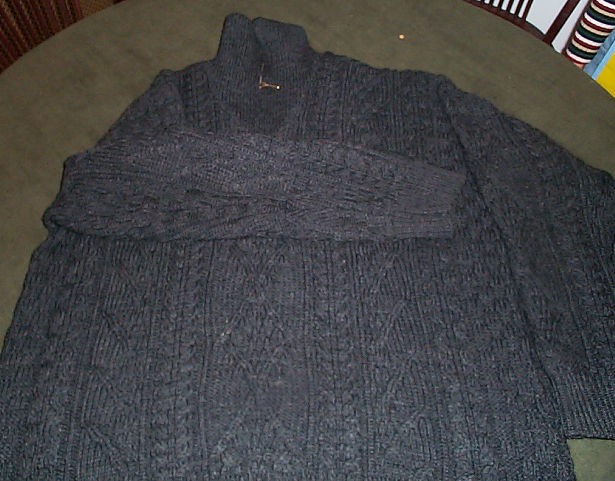
The formerly broken bit is in the top center of the sleeve that lies across the body, roughly below the zipper slider. You can’t see it, but take my word for it – the repair is totally invisible.
So, today’s morals are:
-
Don’t toss damaged hand-knits in a corner in despair. You can use your knitting-developed skills to rescue some of them. and
-
Ease of repair down the road is yet another reason to use the best quality materials you can afford.
SOCK DEMISE AND MORE SNAKES
While I’m still under deadline pressure here and have not gotten to the Spanish Hat, I do have some knitting-related musings to report today.
The first is sock yarn wear. I have knit pretty much the same sock in terms of fit since shortly after I began knitting socks. This is especially true for socks knit with sock yarn or fingering weight yarn. I’ve also stuck to a group of sock yarns that are a mix of washable wool and nylon – the standards, Fortissima, Socka, Regia, and Melienweit – all major labels and not house brands or knockoffs. And I’ve not changed the way I care for them. I still do the soak, spin, air dry thing rather than subjecting them to more stressful full machine washing. AND I am always knitting more, increasing the numbers of pairs I own, so that individual pairs are worn less frequently.
So why then are my socks wearing out faster?
This is a big mystery to me. I have several pairs of Fortissima and Socka socks that are pushing their 10th birthday, and were among the first I knit. They’re fine. A bit floppy, but not significantly abraded or worn through. I have other socks knit in the past year that are already showing holes at the ball of the foot.
There doesn’t seem to be any correlation between yarn maker and sock failure. Nor does the failure seem to be related to gauge, since all the victims were knit on the same size needles.
So. Is anyone else experiencing this? Or is it just me…
The second is a product of the need to do mindless knitting. I started another Snake Scarf, knit from an extravagance – Schaefer Yarn’s Helene. This yarn is next-to-skin soft, with all the luster of silk. It is however an Aran weight/light bulky weight single, and like all singles spun from soft yarns, has a tendency to split. I suspect that it will also catch a bit. But it’s lovely stuff, and giving the scarf away will be difficult to do. I can’t identify the exact Schaefer color combo my Helene is (I bought it over a year ago and lost the tag), but it’s mostly navy and raspberry, with hints of brown. The color repeat is however quite short, and does not produce the eye popping striped effect of longer color run yarns. (I’ll be posting a yarn review of the stuff soon).
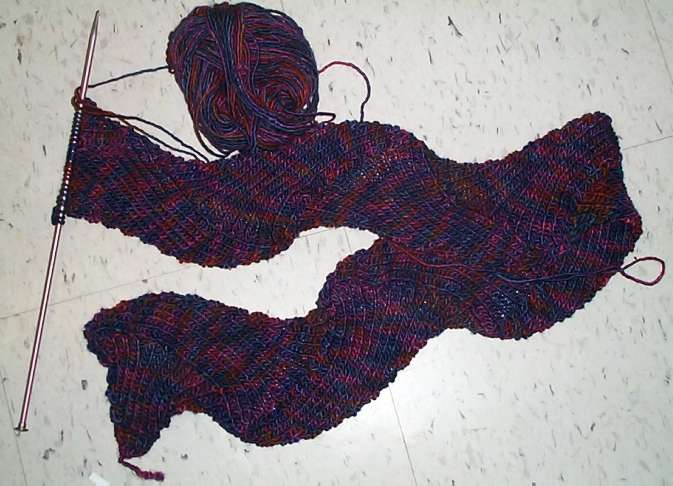
Still, the subtle mottled effect doesn’t fight too badly with the scarf’s basic wiggly shape or stitch direction, so I’m pleased. On another note, I see that my original write-up of the snake scarf’s beginning is flawed. I’ll be correcting it later this week from my new working notes. Apologies to everyone who has been challenged by it. On the bright side, I only got one note from a confused knitter. The thing is so dead-simple that most people appear to have taken the error in stride and weren’t tripped up by it.

