PERMISSION GRANTED, MORE OR LESS
Here it is, totally finished, and with a vaguely decent picture (but as yet, unsigned and un-mounted).

The recipient is thrilled, which is always gratifying.
UPDATE: People want the specs on this piece so they don’t have to hunt through previous posts. 30 count evenweave linen ground, stitched over two threads (15 spi). The 6-strand floss is man-made “silk”, rayon actually; a vintage find brought back from India, slightly thinner than standard DMC floss. I stitched all of the foreground using two strands. Some of the background I did in single strand for contrast. Pattern strips with one exception are all from my forthcoming book The Second Carolingian Modelbook. The alphabet is from a vintage Sajou booklet #104 reproduced at Patternmakercharts.blogspot.com. I hemmed my linen by hand before starting.
The reason I haven’t done the last teeny bits is that I’m trying to finish off some end-of-year gifts for the spawn.
First up and already done was the new pair of Susie Rogers’ Reading Mitts, done in a sparkly yarn for Younger Daughter. She’s a fan of the surreal Welcome to Night Vale podcasts. One of their taglines is “Mostly void, partially stars.”
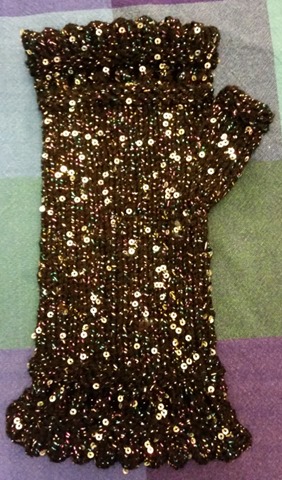
To get the partially-stars look, I used Loops and Threads Payette – an acrylic with a running lurex thread and small paillettes (flat sequins). Both inspiration and enablement are courtesy of Long Time Needlework Pal Kathryn, who sent this stuff to me. Just seeing it sparkling at me kicked off this project. Kathryn’s initial intent was to knit socks from the Payette, but that effort was a no-go. And rightly so. The stuff is not fun to work with, and would make supremely uncomfortable socks. The base black yarn is waxy feeling. The lurex thread breaks easily and is scratchy, and the paillettes can make stitch formation difficult – especially on decreases. Oh, and forget about ripping this stuff back. The lurex snaps. But the look can’t be beat, especially for a big-box-store available yarn.
Yarn aside, this project is a great quick-knit. Both mitts together took two evenings. I used the Payette doubled, and knit the smallest size, which fits perfectly. The only change I made to the original design is eliminating the bulk of cast-on and cast-off. To begin, I work a figure-8 or provisional cast-on. When I get to the last row before the cuff welt, I reactivate the bottom stitches and fold them up, knitting one bottom edge stitch along with its live pre-cuff counterpart. This melds the bottom into the work, and eliminates the final bit of sewing up, and cuts down on pre-cuff bulk.
To cast-off, instead of making a finished edge and then sewing it down, I leave a long tail and fold the live edge inside the work. Then I use that to secure each last-row stitch to its counterpart in the first row after the fancy welting on the upper edge.
Final verdict – the kid loves these. The original design’s pretty welt and eyelet detail is lost in the sequined look and it’s over the top sparkly. But it fits in perfectly with the Nightvale-inspired theme.
Next on the needles is a new scarf for Elder Daughter. As I mentioned in the last post, I’m enchanted by Sybil R’s designs and was determined to make one or another of them. At first we contemplated a different scarf, but rummaging through my stash, we came up with yarn better suited to her Mixed Wave Cowl, an exercise in nested short row enhanced stripes. Here you see the bare beginnings of mine:
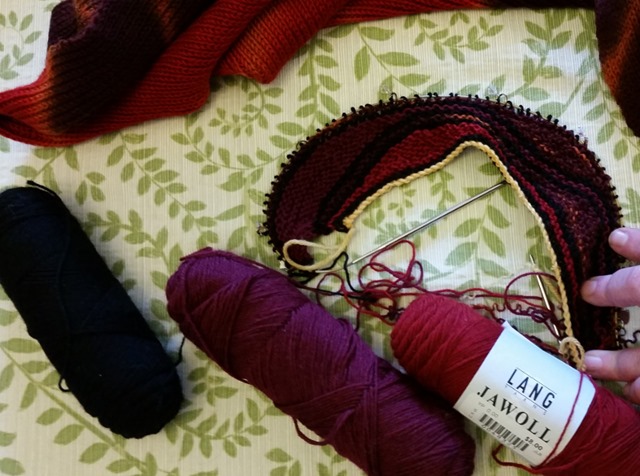
I’m using an eclectic mix of well-aged stash denizens, plus a more recent variegated yarn seen here in a rather blue-shifted photo. The black and russet are both Lang Jawoll bought who-knows-when. The claret (again not as purple as it looks here) is Froehlich Wolle Special Blauband, which I’m pretty sure I had when we moved back to Boston in ‘95. The variegated scarf thingy is Regia Creativ one of the unravel-me-and-knit dyed strips, in a mix of autumn colors including chocolate, russet, claret, and burnt orange. The pattern is written for DK, on rather small 3.5mm needles. I’m using fingering-weight sock yarn on 3.0mm needles, which is making a slightly looser fabric.
More on this one as it grows…
IT ALL FALLS INTO PLACE
With an extended time sitting in one place and thinking yesterday, I’ve come to design decisions on the direction for the Permission sampler.
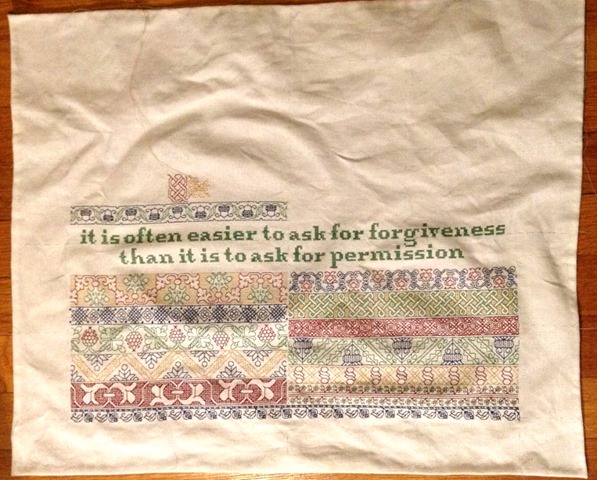
I’ve decided to do another bank of two solid columns of multicolor narrow strip bands above the motto, and finish out the top with either the same pomegranate border used at the bottom edge, or a coordinating one with pine cones, of the same size and visual density – also in the blue.
Progress is obvious since the last post. I finished the red voided buds with the grid-background at lower left, and marched the pomegranates across the entire width of the piece. I also did a quick strip of acorns over the words (aligning with the strips below), and I’ve begun on a yellow and red interlace and quaternary rose strip above that one. I’ll do a monochrome design above the red/yellow, probably green and relatively narrow.
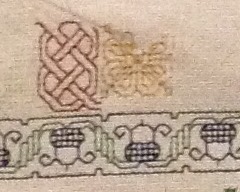

As you can see, I am just ripping along. The large stitches on this one (it’s only 30-count stitched over 2×2), plus the sit-on frame that frees the second hand to pass the needle underneath the work are helping me to set local house records for sampler production.
Am I liking the thread? Yes and no. It’s “man made silk” and at least 20 years old before I bought it. Possibly even older. It’s thin and unruly, and needs extreme waxing to make it behave. My little beeswax block is being whittled down, slowly but surely on this one. I do like the sheen of the faux silk – even waxed. What I like less is the damage of age – brittleness, and a tendency to shred. Some colors have aged better than others. For example, the yellow I am using now is very prone to breakage, and must be treated gently, stitching with very short lengths. By contrast the red and blue are horse-strong, and far less likely to snap or denature. Perhaps my yellow is “elderly” compared to the other colors. In any case, I do notice that working with it does take longer and is more fiddly due to the short lengths and stops/restarts after an inopportune Thread Damage Event.
Questions answered:
These are from my inbox, about this project or stitching in general. Feel free to post questions here or write to me – kbsalazar (at) gmail (dot) com.
1. Do you decide on your patterns before you begin?
Not really. I pick them on the fly. On some pieces I stick to a style or unified theme, but often I just thumb through looking for something that has a pleasing contrast with the designs around it; like layering a geometric next to a floral, or using something with a lot of curves next to something that’s strongly angled.
2. Do you prepare your cloth?
I do now. I’ve had some projects that might have been better composed, but because I didn’t clearly mark my margins or centers, I lost track of where I was. Now I outline my stitching area, plus it’s center and quarter-center marks both horizontally and vertically. I use a single strand of Plain Old Sewing Thread, in a light color (in this case – pastel blue), basting it in to indicate those lines. The basting itself is rather haphazard. For example, I do not bother to make my basting stitches over the same number of threads as an aid to counting later. Others do.
I also hem my cloth. I used to use other methods of fray prevention (deliberately raveling out a half inch or so, a line or two of machine stitching, serging, or in a moment of poor judgment – tape), or not bother at all. However I find that I now prefer the finished edges and mitered corners of a nice, even hand-done finger-folded hem.
3. Will you be issuing a kit for this or any of your other projects?
Probably not. Definitely not for a composed kit, complete with thread. There are too many things I want to stitch myself to sit down and figure out thread consumption, buy fabric and thread in bulk, compose the kits, and do inventory management and fulfillment. That would suck the fun out of the thing, for sure. I might consider releasing full, drafted charts for some of the smaller projects like bookcovers for small standard-size notebooks or needle case/biscornu sets, but that also would eat up time I’d rather spend on my own work, or researching and drafting up new designs. I see myself sticking mostly to reference books of patterns and designs, and leaving employment of those designs to the readers.
4. Where are the snails?
One of the folk who visit here has noticed that I put snails in almost every sampler I do. Not every single one, but I do use a variant of this design from my first book on most, especially those for family:
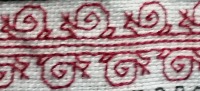

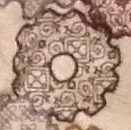
I haven’t gotten to the snails yet, but they are on the list for this project, too. Possibly next – the green strip I’m thinking of doing just above the current bit.
GEARING UP
As you can see, Trifles is coming along. I’ve just about finished the first set of gears:


The next bit to do will be the two sides, proceeding left and right of the established bit, growing up to frame the motto. I’ll use the same stencil for my basic layout, rotating and flipping it to make the repetition less evident.
A couple of you have written to me to say that you find the gears rather disappointing – that they are not sharp and mechanical enough. In fact, the edges of some of them are more gentle, cam shaped rather than toothed, and the teeth do not mesh exactly.
Frankly, I don’t find this a problem, and I don’t care. The thing will be more representational than mechanistic. I’m going for the idea of gears here, not a CADD drawing.
I am having fun flipping through Ensamplario Atlantio looking for which fill to do next. Everything you see here has been done ad-hoc, one gear at a time, with no pre-planning on what design/color to use next. I’ve used four-color placement principles to avoid having two gears of the same color right next to each other. I’ve also tried to achieve a nice mix of densities and shapes, with contrast between horizontal/vertical and diagonal elements, all-overs/spaced spot motifs, and between straight lines/curvy patterns. On the whole I’m pleased. I’ll add more dark and density to the lower left, next. Also more gold there in that corner.
Stay tuned for further developments!
TRIFIAL PURSUIT
Back from our annual escape to North Truro, and reporting progress on the recently dormant Trifles sampler, being stitched for Younger Daughter to take with her off to college next fall. I decided that for my no-longer-little Steampunk (and Dr. Who) fan, instead of working lots of bands, the design for this one would feature gears. But I had a lot of problems hand-drafting up a nice set of them. It took a while, but eventually I hit on the idea of using a commercial stencil intended for airbrush work, then filling in the traced gear shapes with blackwork counted fills.
Here’s where I am now:

I’ve finished the main motto and the frame around the to-be-worked area. Minor brag: Note that having marched all the way around the piece without drafting first and using only counts of the border repeat to stay on target, I ended up even, perfectly aligned.
All of the fillings I will use on this will be from my free eBook, Ensamplario Atlantio. The ground patterns are stitched using two plies, mostly in double running, with lots of departures to accommodate the non-continuous nature of many of the fills. The outlines are plain old chain stitch, done in three plies of the same color as the gear filling. I am not taking any special pains to make the cam teeth totally square, or to make them mesh. I am liking the rounding and imprecision. Right now I’m thinking of covering the entire piece with gears in burgundy, brown, gold, and silver, relying on classic Four Color Theory to avoid making any two contiguous gears the same hue. Choosing fills for color in addition to density and form is adding a new dimension to this decidedly un-traditional yet somewhat traditional blackwork piece. And I may insert a surprise Trifle or two, just to emphasize the point.
On execution, I can report that I’ve managed to tame the extremely unruly Indian “silk” (in reality, man-made rayon) thread.
Beeswax.
I occasionally wax the last inch or so of my silk threads to make threading easier and to help ward off “ply creep” – when one ply of a multi-ply threading is consumed faster than the others. But I usually don’t wax the entire length unless I’m working with linen thread. However this stuff is hellaciously difficult, shredding and sliding, breaking and fraying, and catching. Using shorter lengths wasn’t the answer – no usable length was short enough to use comfortably. So I moved up to waxing the entire strand, and when I did so, most of my problems disappeared.
I am very pleased with the results using the fully waxed threads. They don’t break. They don’t escape from the needle’s eye. They don’t shred. Both plies are consumed at the same rate. Double running is nice and crisp. A major improvement that’s increased the enjoyment factor of a project that might have been truly tedious.
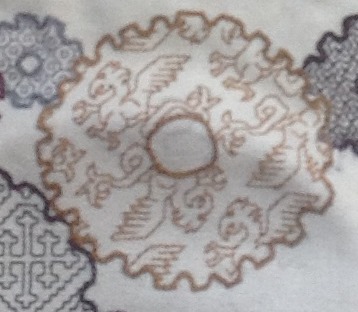
And I’ve wanted an excuse to stitch up those griffon-drakes since I drafted them up for the book.
SECOND HELPING OF TRIFLES
Two progress status reports today!
First is the Trifles sampler, in progress as a dorm gift to Younger Daughter, who will need such a thing in a year or so. (I have given myself lots of time for completion). As you can see, the motto is finished, using four different alphabets from Ramzi’s Sajou collection. I’ve played with them somewhat, working in the gold color accents, which are not marked as a secondary color on the charts.

I have also stitched in two small Daleks, to comply with her request, stitched in gold and off white silks. I am up to the surround now. I had originally planned to stitch lots of linear strips, patterns from my upcoming book, but as I alluded to before – I have been seized by Another Idea. The small stitched area just getting underway next to the T of TRIFLES is the beginning. I am going to make an interlocking and overlying mesh of gears of various sizes and configurations, each outlined in a heavier non-counted stitch, but filled in using the geometrics found in my Ensamplario Atlantio. I’ll be using coordinating fall colors for these – a bit of the brown and gold from the alphabet, but also cranberry, silver, and possibly a deep green. The total effect should be rather Steampunk, and a lot of fun.
However as much fun as this piece is, necessity intrudes. A friend of mine is welcoming a baby come the turn of the year. She’s expressed a fondness for traditional baby colors, so I am knitting up a small baby blanket for her. It will be car-seat and basket sized, not crib or reception size, so it is going quite quickly.

I’m using Encore Colorspun worsted, an acrylic/wool mix for maximum washability, this being a baby blanket and all. I’m knitting it on US 10.5 (6.5mm), which is relatively large for worsted in order to bring out the lacy stitch pattern. The stitch pattern itself is adapted from an 18-stitch-wide strip pattern appearing in Knitted Lace Patterns of Christine Duchrow, Volume I. I’ve chosen the narrow strip so that the gradual color changes pool, rather than speckling across the rows. I’ve also chosen to work the stripes horizontally because I only have four balls of this yarn. If I had run the piece the long way I might have risked running out before I reached a useful width. By fixing my width, I can keep going until I have just enough to do an edging, or I can find a coordinating pink or off-white Encore for the edging, if there isn’t enough of the graded color yarn. And finally, being a lazy person and not wanting to sew the strips together, I am using the long-loop join method I learned while working Fania Letouchnaya’s Forest Path Stole to knit the strips together as I march along.
Oh, and yes – those are massively long DPNs – about 12 inches long. I really like extra long DPNs for hats and sleeves, and generally don’t use circulars for anything less than 20 or so inches around. As a result I’ve got a collection of these admittedly unusual needles.
IT’S NOT A MYTH
I know I’ve been promising for quite a while, but serious progress is being made on The Second Carolingian Modelbook:
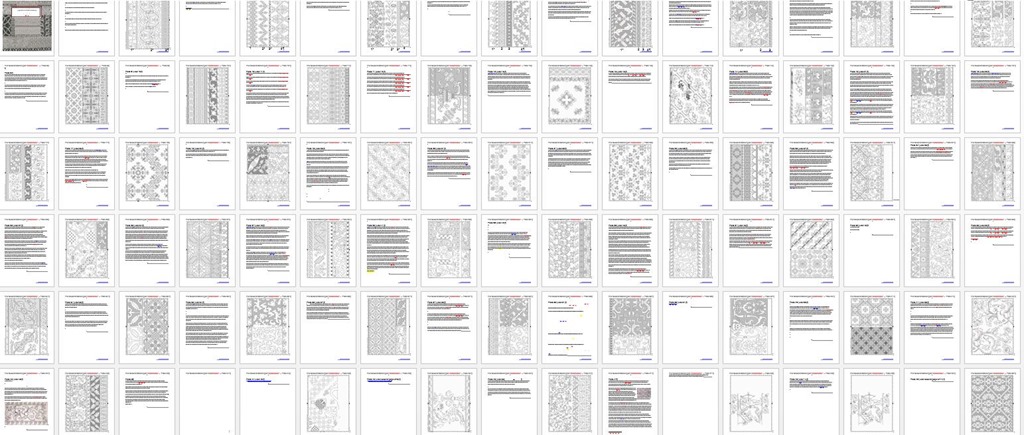
The thumbnail shows the first fifty or so plates, plus their write-up pages. There are seventy-five in all, well over 200 patterns, with each and every one linked to a specific historical artifact or primary source.
About two thirds of the patterns are specific for counted linear styles, or mixed linear/voided works. The rest are solid block unit patterns suitable for background or foreground stitching. They can also be used for knitting, crochet, marquetry, mosaics, or any other craft that uses charted motifs.
Right now I’m touching up a few of the pages, writing a similar number of comments, plus the intro essay, and cleaning up the bibliography. I’m torn about including indices like I did in the first book. I don’t think they were of much use, so I am thinking of omitting them in order to get this puppy finished for once and all.
So that’s where I’ve been, and what I’ve been doing. I promise to trumpet here when the book is available for sale.
ELIZABETHAN BLACKWORK SMOCK
O.k. I know a few of you want me to do a blow by blow travelogue of our London trip. But that’s not my forté. I’ll wander over and cover some of that material several posts, but mostly want to write about specific things we saw, this being one of the first times I’ve been able to get relatively up close and personal with historical artifacts. Besides, The Resident Male is a much better travel writer than I am.
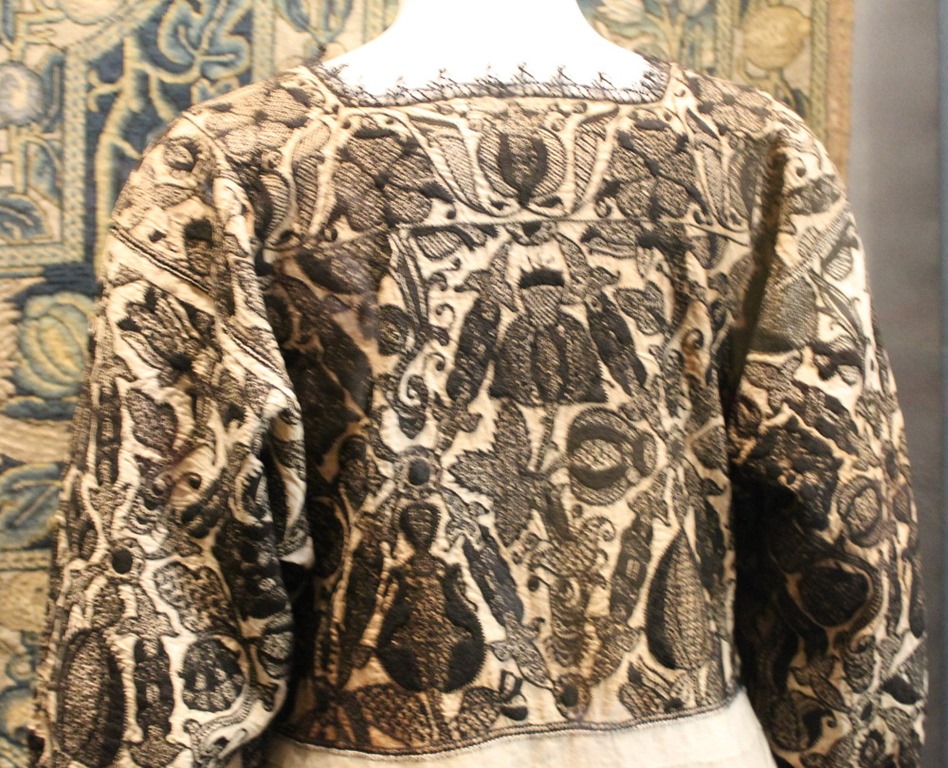
First off, to satisfy my stitching readers, is this blackwork smock, currently on exhibit at the Victoria and Albert Museum:

The full citation cites it as being of British make, and stitched some time during 1575 to 1585. They posit home manufacture rather than a professional house. If you read through the full description, you’ll find out that the top part (the stitched bodice) was done on fine linen, and the unseen and unstitched lower part was also linen, but of a much coarser fabric. The plain lower skirt and the needle lace around the neckline and cuffs are modern reproductions. The accession number is T.113 to 118-1997.
I tried to take pix of this artifact to show the details. It’s basically three large rectangles, with underarm gussets (each sporting a flower, and unseen here). One rectangle for each sleeve, plus a larger one with head hole for the front, back and shoulders. I wanted to see if that center strip was seamed from smaller parts, but I wasn’t able to do so based on my examination.
One thing that delighted me was the use of various techniques for the fills. Some were done on the count. It looks like the grid may be 4×4 threads. I can’t estimate the stitch per inch count, but it’s roughly comparable in look to between 20 and 25 stitches per inch. The thread does look finger spun from floss silk, with some areas more tightly twisted than others, and some variation in thickness.
Some filling placements were eyeballed, and done freehand (note the trailing vines and spot motifs that follow the flower forms rather than marching rigidly in diagonals). The solid bits look to have been done in satin stitch or a stitch in the Romanian couching family. The dark borders around the shapes look to be either outline or stem stitch in some places, and in other places possibly whipped or threaded back stitch. There may be knot stitches in there, too, (especially the knotted line stitches that sport little side stitch “legs”) but my eyes couldn’t pick them out for absolute identification.
Effort was made to use the same filling in matching areas of symmetrical designs, but some variations do occur. In fact, the occasional lapses in attention to detail on the fills, and that some are presented in a couple of variations (see below) are charming, and makes me think that my guess that the fillings were thought up on the fly, rather than being copied from canonical works may be true. (Filling inventors, take heart.)
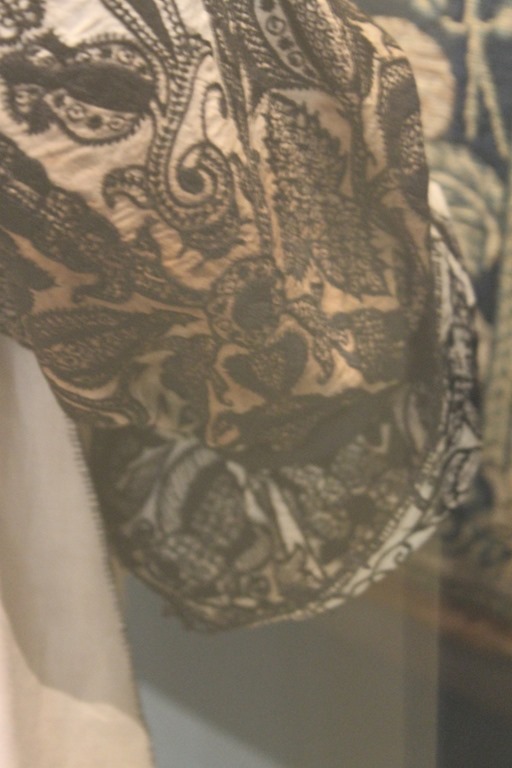
I tried to get very close to the turned back cuffs to determine whether or not they were exactly double sided, with both front and back identical. Well, they’re close but not absolute. My pictures aren’t good enough to show it, but there are (barely) detectable knots on the inside of the cuff. The double running stitch fills and solid areas (satin stitch in this case) are certainly worked very neatly, especially compared to the relative chaos of the back sides of other contemporary work, but they are not spot on exactly the same front and back, although they are presentable and nicely done, for sure.
Here are some more pix of the thing. These shots were taken by Elder Daughter, with her superior camera skills and equipment:


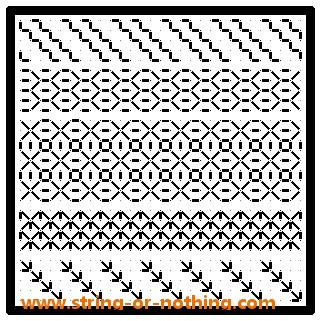
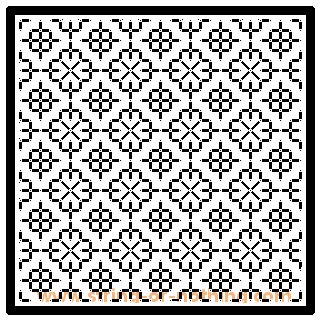
And finally, to satisfy the people who pointed out that I did not include exact citations for every fill in my free-to-download Ensamplario Atlantio collection, here is a set of 10 plates with fills sourced specifically to this artifact.


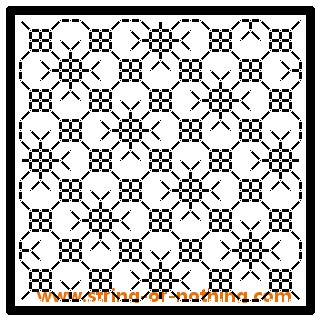
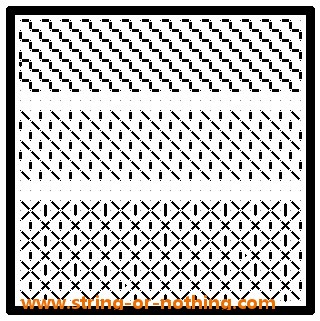


So much for facts. I have to say there were several items on display that caused me to hyperventilate like a Twilight fangirl. Blackwork geek that I am, this was one. It’s in excellent condition, with the stitching, dense, the threads shiny, and minimal wear or damage. The overall effect was one of understated opulence, but not splendor. For one, there is an aspect of “loving hands at home” to this piece, especially in the composition and heaviness of the fills.
But what struck me the most was that the standard of excellence in this piece is entirely achievable today. Yes, it’s exacting, and acquiring the materials would be difficult, but it’s not miles beyond the capability and reach of modern amateur needleworkers. It’s time we stop bowing to “the ancients” and banish our temporal craftsmanship insecurities The best of us are darned good (no pun intended), and many of the contemporary projects I see on the web are just as well executed as this prime piece from the 16th century.
CHECKING IN
Where have I been? In Pune, but now home in the US for a brief visit. What have I been doing? Mostly wallowing in ennui. For whatever reason, I have not been motivated to do much, not working on projects, researching, or writing here.
I can report that aside from the transoceanic trip, we did do one major thing. We hosted a “happy hour” party for 25 of The Resident Male’s coworkers, holding it at the apartment. I did all of the prep and cooking. I made samosas, falafel, hummus, guacamole, and Chinese scallion pancakes (adding some minced hot peppers to the scallions). I also improvised a mixed olive salad, and paneer with a Thai-style peanut sauce. Everyone had a good time, and using consumption as a barometer – the snacks were well received. The scallion pancakes in particular were prime, and a do-again, for sure!
There is some minimal progress on my latest shawl. I test-knit a new MMarioKnits product, but others were far speedier than me. Most of the corrections I found were posted by others, and my finished project was not completed in time for photography for the cover of the pattern. The main reason for this was a major lace disaster. While photographing the piece, I managed to drop upwards of 90 stitches, and needed to ravel back to a solid point and re-knit. After coming in so slowly for completion, I decided to punt the official as-written, minimal bind-off treatment, and add a knit-on lace edging. I selected a simple one from Sharon Miller’s Heirloom Knitting, picked both for complimenting the lines of the shawl’s main motifs, and for being a multiple of 12 rows, and began. I’m about two-thirds of the way around my circumference, and hope to be done soon.

However, just because I’ve been a slouching, IPad/browser game playing slacker, doesn’t mean the rest of the world stands still.
I’ve said before that I get an enormous kick out of seeing what people do with the patterns and designs I post. Occasionally, folk write to me to ask questions, or send me photos. Other times, I track links to my pages back to the point of origin. If I stumble across something I ask the owner if I can repost their work here, with links or attributions as they desire. Here are the products of two people who sent me pix of their stitching this month.
Elaine from Australia delighted me with these two projects that include filling motifs from Ensamplario Atlantio:
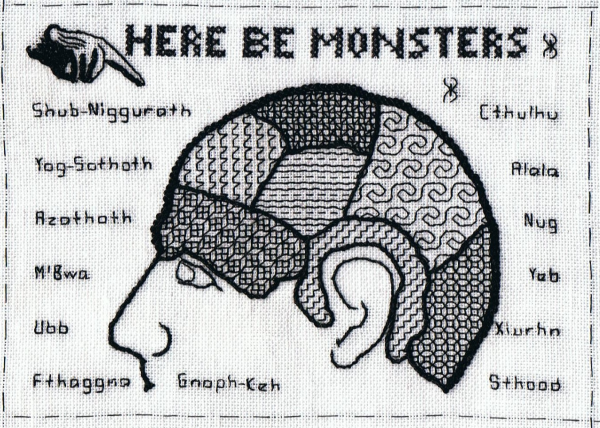

Both were presents for friends. I’m not sure which one I like more – the piece for the Kiwi audiophile, or the one for the Lovecraft aficionado.
Meanwhile, Jordana in New York used two of the Ensamplario designs for the cover of a charming two-sided needle case. Here are her photos of the work in progress, and the finished item:
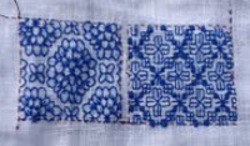
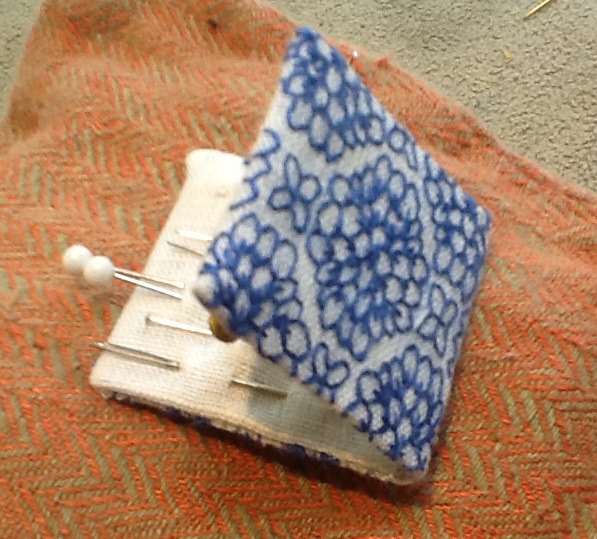
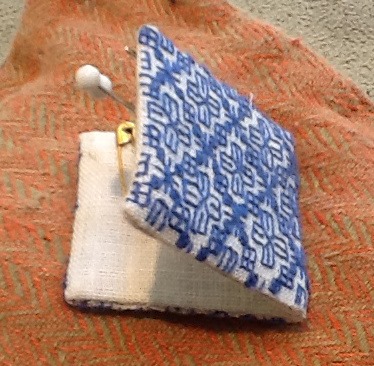
Well done to Elaine and Jordana! Special thanks to both of them for making my day!
 String-Or-Nothing