AND NOW WE ARE FOUR
I report the finish on my RESIST sampler. Completed, signed and dated.

Don’t worry about that dot on the bottom margin – that’s just fluff I neglected to brush off prior to the photo. The message is dead serious, but there are some silly bits in it. Like the dragon heads that parade across the top. The eyes in the original are empty – no pupils. But I put some in on this strip, and got several emotions when I did. My dragon heads look angry, attentive, contemplative, attentive, and bored. And more. Just a whim.
I am also pleased with the Pegasus strip – doodled up just for this piece. It will be included in my forthcoming Ensamplario Atlantio Volume III (EnsAtl3). No timeline yet for that release. Here are the sources for all fifteen bands, top to bottom.
- Dragon head edging – The Second Carolingian Modelbook (T2CM), Plate 25:4. Redaction with impromptu manic eyeball improvisations.
- Acorn meander – T2CM, Plate 25:3. My original.
- Line interlace – T2CM, Plate 11:3. Adaptation of non-graphed modelbook design.
- Twisted meandering eels – T2CM, Plate 27:2. Redaction
- RESIST using alphabet border – Whole alphabet blocks and bits that fit around them, EnsAtl3. My original.
- Lily buds – Several versions in my various works, this one from my free class handout available on my patterns tab. Adapted redaction.
- Kittens and string – EnsAtl3. My original.
- Large floral all-over – EnsAtl3. My original.
- Doubled simple flower strip – T2CM, sample figure on building larger borders from narrow ones, on the write-up page for Plate 7. Original narrow strip, T2CM, Plate 6:3. My original.
- Cursed bunnies eating my hostas again – I had fun stabbing these guys, too, for obvious reasons. EnsAtl3. My original.
- Very large sprouting all-over. Broadside available here on String here and on my patterns tab. Redaction.
- Block edge border T2CM. Plate 23:2. My original.
- Thistles – T2CM, Plate 30:3/ Adaptation of non-graphed modelbook design.
- Pegasus strip – EnsAtl3. My original.
- Rooster edging – (Turn it upside down and you’ll see them). EnsAtl3. My original.
Now RESIST joins the three fangirl samplers I have completed, celebrating the science fiction works of my Resident Male. That’s a lot of stitching since June, shown here on my Wall of Shame, where all my finished but not yet framed works live.

What’s next? Probably another in the PERSIST-RESIST grouping. ASSIST will be longer than RESIST. Also on a high count not-so-evenweave linen remnant. As you can see, the prep step of hemming has started.

I’m torn about colors and threads. And I have to calculate the thread count of this scrap piece. I have a feeling that it’s a bit more skew than the other four, and probably a skosh coarser than RESIST. I have some silks in various colors that might work on it, doubled in happy polychromatic chaos. Or I might do it all in deep red, possibly with a spot of a shiny black for emphasis.
As to what to put on it, I’m also contemplating options. The word, for sure. Possibly some voided bits or heavy foreground long-armed cross stitch strapwork bands (I haven’t done much of that recently). Or maybe I’ll work in some tiles of fills. But not worked inside freehand drawn shapes – just in geometrics. I have LOTS of fills begging to be taken out to play, some of which I came up with on the fly for the Unstitched Coif project. Since that’s off at the V&A, it seems proper that I stitch them up on something I can look at and enjoy here at home.
Stay tuned for more stitchy mischief.
RAGE STITCHING CONTINUES
I’ve made more progress on the non-name sampler I’ve been working on since the beginning of November:

I’ve added three strips since the last post. The pink/purple and blue one at the top, and the bottommost two below the bunnies.
From top to bottom, RESIST was done in some vintage Belding Corticelli silk, size A. I have a bag of about 15 small wooden spools of the stuff in assorted strident colors. All are unstarted 100 yard spools, and most are singles. There are only a couple of colors for which I have two spools. Here are the two I stitched with on this project, along with the no-name black silk I’ve been using for (most of) the rest of this piece (small embroidery scissors and laying tool for scale).

They were among the goodies re-homed to me by a fellow townsperson who was clearing her late mother’s stash of knitting and stitching supplies. It’s tightly twisted silk, and is perfect for stitching at this gauge. I have fallen in love with it. Sadly, it’s a limited resource. The Belding Corticelli mill closed in 1932. I’ll not be finding more when these are gone. Such is the nature of true love.
The boxed alphabet used for RESIST is from my free book Ensamplario Atlantio II, Plates 33 and 34. I drafted up a band with a design element that looked like an H. Once I had that it occurred to me that folk might like to put mottoes or initials along edges of chemises (a historical usage), so I doodled up the rest of the alphabet for use with that design band. The eagle eyed will spot that the design band I employed with RESIST is slightly different than the one in the book. I can’t help it. Anything worth tinkering with is worth tinkering with again. Oh. And the color choice? It’s not a coincidence.
Moving down to the bottom, the very involved wide floral panel beneath the bunnies is also available free on this site. It’s the all-over I used for the discussion of how to redact a design. That discussion is here, complete with a link to the downloadable pattern. It can also be found on the Embroidery Patterns tab here on String. I enjoyed stitching this one. It went much faster than I expected because the design though involved covers a lot of territory but uses comparatively few stitches to do so.
In deliberate contrast to the open airy nature of the floral strip is the close geometric immediately below it. That one is original, a “roughly inspired by” that appears in my (not free) Second Carolingian Modelbook, Plate 23:2.
Now…. What to add next? As usual I really will not know until it hits me. To that end I am paging through my own pattern books, both published and pending. I may use something from one of them or from the free broadsides on the Embroidery tab page, or something from the Epic Fandom Stitch-Along, or I might draw up something new. Right now I’m on the hunt.
ASIDE: That Epic Fandom Stitch-Along tab is rather cumbersome to use if one is interested in downloading the whole project at once rather than week-by-week piecemeal. Would anyone like me to put the whole thing into a single booklet and add it as a free download to the My Books page here on String?
PENULTIMATE, BUT ROSY
Having fallen a bit behind in timely progress posting, I present current status covering three strips.
First, here is the sword interlace – my own design with no direct historical precedent. Here it’s finished and the color accents have been applied. Since I wrote about it in my last post there’s not much to add other than I am pleased with the way it turned out. The yellow bits are worked in two strands, using plain old cross stitch for the blades and pommel, and two strands in double running (on skew count) for the interlace embellishments and sword hilts.
This pattern in its original slightly taller and more graceful form it will appear in Ensamplario Atlantio Volume III. I think this would make killer trim on the shirt of someone who might favor martial motifs rather than floral or plain geometrics.

The next strip down has debuted here on String, about a year ago. It’s available at my original post, and in the embroidery tab page on this site, where it’s listed as “Sleeve Band, 1500.” I may put it into The Third Carolingian Modelbook, as well. (Yes, I’m working on that one, too). The short story is that I redacted it from a portrait in the collection of the Bristol Museum and Art Gallery, Accession K1651; Italian, circa 1500. Here is its page in Art UK.
Although the majority of the design is as close as I could get to the sleeve decoration in the portrait, for this decidedly non-historical piece I took two liberties. Obviously the first is my use of the second color – in the case done in single strand, simple diamond mesh to contrast with the strongly horizontal/vertical foreground in black. The other departure is the small black square I added at the centerpoint defined by where the birds’ tails meet. That detail isn’t on the original and isn’t on my chart of it. I added that because I work in double running, and it served as a very convenient bridge point that helped me navigate jumps between the non-contiguous motifs.
The only connection I can see between this motif as a tribute to the Treyavir source material is that this style of pattern persisted for a very long time, working its way from haute adornment for noblewomen during the Renaissance to becoming part of a peasant folk tradition that could have been stitched anywhere from the Baltic to the Aegean at any point in time over the past 300 years. And there is a very brave peasant woman in the Resident Male’s novel.

The third band is something that started out with historical underpinnings but took a whole bunch of left hand turns along the way.
If you have a copy of my Second Carolingian Modelbook to hand you will find the original on Plate 27:4. The accompanying blurb cites it as being redacted from an embroidery at Belton House, Lincolnshire, UK, registered with the National Trust as Inventory Number 436944. But in the original the roses were a supporting secondary border, all sprouting from a single straight baseline in the same direction.
I started working the first one that way, then decided to go feral, and do them more closely spaced together, and in the zig-zag manner below. I also added the second color accent I didn’t bother regraphing the design, I just did the mental rotation and kept going. If you like it this way, you can find the book and do the flip yourself, too.
As for why I did it, this is a themed piece after all. Treyavir features an estate that’s a safe haven for women who are economic refugees or endangered survivors of a feudal, patriarchal society. So I’ve taken that and put my roses each in their own secure room, open to come or go as they please, yet protected from life’s more brutal realities. Non standard presentation, but I think it’s an improvement on the rather humdrum original.

Finally, here is the whole thing to date so you can see the balance of density, accent color, and movement. I have room below the roses for one more strip. And I’ve drafted up something special to put there.

DO WHAT’S RIGHT
And we have more progress to report on the latest sampler strip in my series of stitched pieces commemorating the literary output of my Resident Male.
First we start with the now expected Mysterious Saying. In this case, “Ant-Aransa,” a quotation from the inspiring work – Treyavir. It translates roughly to “Do what’s right.” An admonishment that should be heeded more often for us all.

The lettering is not from my usual source for typefaces. I started by looking up pixel based fonts, many from the early days of screen display, and mashed up several Uncial like adaptations to chart out the letters I used. There is no one clean source, but the closest would be Scriptorium. I probably should have allotted more space for the hyphen, but so it goes. The lettering is worked in four sided cross stitch (each cross stitch outlined by a straight stitch on all four sides. I did that to make the saying pop, and to have optimal coverage.
Below Ant-Aransa is a very narrow ancillary border from the upcoming Ensamplario Atlantio III. I believe I show it there in combo with other design elements, and without the second color accents.
Moving on, I designed the strip in progress specifically for this sampler, with specific points of reference to the source inspiration. Treyavir is a work of fantasy with science fiction elements. It tells the story of Reignal Maigntar, Falcon Knight, so of course there have to be prominently featured falcons. Other story elements here include the waning sun, his spear, Grey Hallet (his castle/manor house), and curious crystalline magic gems. All present and accounted for.
As usual the foreground black stitching is worked in double running, but I’ve chosen to do the yellow voiding in long armed cross stitch. This choice was probably not optimal, due to the headache of squeezing that stitch into a few of the very narrow spaces between the foreground motifs. But again, there it is. I might include the falcon strip in Ens Atl III. That decision is still pending. As is revisiting the center of the suns to add some interior decoration. I will wait to see the whole strip completed, including voiding before I make that choice.
What’s left? As you can see below I’m only at the halfway point and there is still plenty of real estate to cover. Probably more swords or other weaponry. In a knightly story there is always room for armaments. Other than that, I haven’t a clue. As usual I’ll figure that out when I get there.

REBOOT
Yes, I did go back and tease out ALL of the stitching seen in my last post. I was not happy with the discontinued DMC linen I was using. Single strand it was (mostly) too thin for this 26.6 tpi linen ground. Doubled, the slubby nature of the thread – especially where two thick sections ended up side by side – made what should be smooth lines very haphazard in appearance.
Not being near home base with my stash to hand, nor near any useful retail outfits or access to reliable one-day delivery where I am, I had to rely on what was already in my stitching box. Back to the black Sulky 30. In this case, on the very coarse ground, two strands work nicely. I teamed the black up with a strong golden yellow (DMC 3820), also worked as two strands.

The yellow is not dark enough to be distinctive on its own for the linear elements, but as fill and voiding, it is effective. So I’m playing with it as accent rather than as a full-fledged “partner color” as done with the two colors on Stone by Stone and Ferthan, Fuur, Fustovv.
The sharp eyed will note a major error on my part, that I will go back and fix the hard way. Look at the right side of the piece. The chain elements end there two units further along in the repeat than they do along the left edge of the stitching. Because the squirrels are not a symmetrical repeat, I did not notice that my centerline was off until I did the second strip. I will go back later and fudge those two left side units in the shorted strips so that everything is nice and even.
And if I hadn’t confessed this sin here, I bet you would never have noticed.
The squirrels and the double chain are both slated for inclusion in Ensamplario Atlantio Volume III. Both are my own designs. The chain will include variants like corners, a centered yoke treatment, so that it can be easily stitched up as embellishment on cuffs and collars for shirts and chemises.
I haven’t decided yet to include the current strip in EnsAtl III, or to hold it in reserve for The Third Carolingian Modelbook (also in production, but not as far along). The reason is that it is a redaction rather than an original. I have a clean point source for it, although it’s late (1697). More on the design as the stitching develops and I figure out how to bling it up with yellow accents.
As to the size of this piece, it’s narrow, but long. You can see how much real estate I have to cover:

I do have a few very tall strips to include on this one. And another Enigmatic Saying in an Unearthly Language. Stay tuned!
IT’S BEEN A WHILE
A catch-up post on what’s been stitched since I explained the Mystery Saying. Just a bit over two weeks, in fact. This is what I’ve been up to:

Forgive the tilt. The lacing is a bit uneven and the work appears skewed. All will be nice and parallel when it’s finally off the frame.
I was in the middle of the fish strip when I last posted. Obviously that plus three more have been completed. Plus a partial that I’m currently stitching. All of these new designs are my own. The fish, pretzel knots, crystal-like flowers, toothed border, and strange furry beast will be in Ensamplario Atlantio III when that’s finally released.
The fish, crystal flowers, and the current monster-bearing strip are all keyed on various stories in Fractured Symmetry, the Resident Male’s book that I am using as inspiration for this piece.
- The fish is well, an otherworldly fish, not much to say about them other than they are a point of minor triumph when they appear.
- The crystal flowers are an interpretation of fractalites – engineered/grown aesthetic constructs that are a special hobby of Terrendurr, the alien half of the detective duo whose adventures the book chronicles.
- And the menacing yeti/gorilla/bigfoot creature is a Yyrgamon, a forest dweller native to the planet Raylic – a bit less mythical than a yeti, rarer than gorillas, and of greater cultural significance than the bigfoot; and of highly significant appearance in one of the books’ stories.
On the sampler the Yyrgamon’s presence will bring some balance to the bottom half of the piece, and provide weight to compliment the saying block, above.
Note that basted line down below my current strip. That’s the bottom edge of the stitching area. I have room for one more band. Or possibly one with a “sprouting” narrow edging across the bottom. No clue as to what will end up there yet. I might have to draft up something new to fit.
Stay tuned!
MINI-SAMPLER PROGRESS
Munching along on my portable summer project, sized and scoped for on-the-go production. I’ve completed the first band and have started on the second.

Both of these original designs will be in Ensamplario Atlantio Volume III. As will (in all probability) the others I use on this thing.
Yes, I’ve chosen a second color – this piece will be in black and deep green. There’s a reason for that which I will reveal in the fullness of time. I’ve also chosen a motto for it – again for a specific reason that I will describe when appropriate.
I had begun this in part as a test of the single ply of Sulky 30 on this ground. While the thread is performing well in terms of ease of stitching, I’m not entirely happy with it. It’s too thin and weedy for best presentation, and two plies would have been overly massive. Here’s a discussion of thread thickness and grounds that will help you understand why I am less than pleased.
How big will this entire piece be? It’s a second-hand store piece of hand-hemstitched linen, a bit more rectangular than but about the same size as a dinner napkin.

You can see here how I tease out my guidelines as I progress, so that I never stitch over them. I know people who do full coverage cross stitch sometimes don’t bother to remove them, but since my style includes so much “white space” I find it better to never encroach on the lines. That makes picking out easier. For the record, I baste with some ancient 100% cotton machine sewing thread from my grandmother’s stash. It’s too fragile to use for structural sewing, but being non-crocking and very smooth, is extremely easy to pull out cleanly.
You can also see that I start in the middle. I worked the dragon strip right, to the guideline at the right edge. Then I filled in the top companion border to end to mate up with the line established by the dragon strip. After that I did dragon to the left, finishing up at the same point already established at the right edge. Since the strip is symmetrical, it terminates at the same distance from the hem on both sides of the work. Again the companion (non-symmetrical) narrow edging at the top was worked to the same point. Now that I have my edges established, I will work all subsequent rows aligned to the first one, using my basted center line for guidance, and finish them left and right in line with the previous work. Really and truly, this is MUCH easier to do than some folks think. Plus working this way does NOT require drafting up the entire strip to fit the available area. The only thing I WILL be drafting out custom will be the motto, so that I can determine its center. Since it will be narrower than the stitching area, I may go back to the doodle board and figure out what I can use to eke out that row left and right. Or maybe not. Another narrow strip after this one, and then we’ll find out…
LOWERY STAND HACK
In one of those “this never happens” moments, I ran across a Lowery stand being offered on my local freecycle exchange. Of course I leapt on the opportunity. Although I have one I now have a second to use in another room, or to leave at our Cape hideaway, so I have less to schlep when we visit.
This one is a bit older than the one I bought several years ago. It came with two attachments – a plastic tray in daisy form meant to hold stitchers’ oddments, and a bar with a pincushion, plus a crosspiece of unknown purpose. I took off the tray because it was very awkward and space-inefficient.
Some digging led me to the answer for the crosspiece bar – originally it held a plastic comb-like attachment, over which waiting threads were to be draped. But this re-homed stand has seen some hard use, and the plastic comb insert was long gone. And for me – not missed. I generally do monochrome or limited color set pieces, and have no need for an extra set of fingers to hold my rainbow of threads.

But the crossbar did suggest something to me. I have always wanted to display a design page alongside my work. Using my big scrolling frame mounted on the Lowery large frame extension, this wasn’t a problem. I could easily affix a page to my working surface or to a little magnet mounted on the end of the frame’s stretcher bars, using a magnetic needle minder. But if I plan on employing the Lowery to hold a smaller hoop, there isn’t enough real estate for that.
I have a flat metal magnet board of the type commonly sold for stitching. But the angle and aperture of the crossbar’s slit were wrong. The board didn’t sit well, nor was it at a useful angle. And it wobbled in the stand. So I went looking for something that might help.
More serendipity. This is the plastic “zipper style” cutting slider strip that comes with large boxes of Stretch-Tite brand plastic wrap. I find them pretty useless for their intended function, but being a packrat, I tend to keep the slider bar in the drawer with the box of wrap until the wrap is used up and the box is consigned to recycling. Here you see it clipped onto the leading edge of the crossbar. I haven’t pushed it all the way on so you can see how they engage.

Obviously I will eventually cut the plastic to length and discard the blue thumb slider. But here is the magnet bar, mounted behind the now-thicker/plastic covered front edge of the crossbar, wedged between it and the crossbar’s back. Nice and secure. At a useful angle, and ready for pattern page deployment.

Oh. That thing I’m stitching? A very small piece of linen I rescued from yet another estate sale. It came neatly hand-hemmed. It’s too small even for my hoop-on-a-stick sit-upon, so I had to pull out my hand-hoop for it. It’s exceptionally nice fabric, with evenly spaced, easy to count warp and weft. There’s a couple of minor stains on it, but once it’s stitched they won’t be noticeable. I’m looking forward to working a hoop on my hand-me-down Lowery. It will be a first, since I usually only pull it out for larger pieces.


The count on this is roughly 33.25 threads per inch in each direction (penny count method – 25 threads covered x 1.33). I’m using this doodle piece to test if I like using Sulky 30 as a single, and to beta some of the designs that will be in Ensamplario Atlantio Volume III, which I’m composing right now.
You can see my basted guidelines marking the center, and on two sides, marking about a half-inch in from the edges. That’s all I need. Gridding for this isn’t necessary. I will stitch out from the center to the right edge, and note where in the pattern I am when I reach my edge-mark guideline. Then I’ll go back and stitch to the same point at the right. For the strips symmetrical to a center line that will be the same point left and right. For strips that are centered on a box unit instead of a line, that will be within one box unit further than the iteration on the right (assuming I center the left edge of the central box on my based centerline). And for non-symmetrical or unidirectional borders like the one I’ve established on top, I’ll just work in the general direction left/right but wait until I’ve established an edge with the symmetrical strips, then I’ll “catch up” to them and make the edges even.
Do I have any idea what strips I will be using? What the overall design will be? What motto or word (if any) this will bear? To what use I will put so fully an embroidered small cloth?
Nope.
No clue as to any of those things. But that hasn’t stopped me before. Like I said – this is an experimental doodle, a portable bit of amusement to eke out the summer’s migrations. Not a deathless Project For The Ages, or an incipient family heirloom. Stay tuned to see how this one evolves. If nothing else, it will be a bit of bungee-jump stitching fun.
A HOLBEIN COLLAR
Special thanks to Karen over at the Elizabethan Costume group on Facebook, who visited the current “Holbein at the Tudor Court” exhibit a the Queen’s Gallery, and came away with an assortment of extreme close-up photos of various clothing details. One of them showed an intimate view of the portrait of Thomas Howard, third Duke of Norfolk, a painting in the Royal Collection. The Duke died in 1554. and the painting was probably done in the decade before he was arrested for treason, which was about 8 years before his death.

He’s quite an imposing gentleman in his lynx fur, and his collar is hard to see in the official full-size repros of the portrait. But Karen’s extreme close-up helped. Her shot is below, shared with her permission.
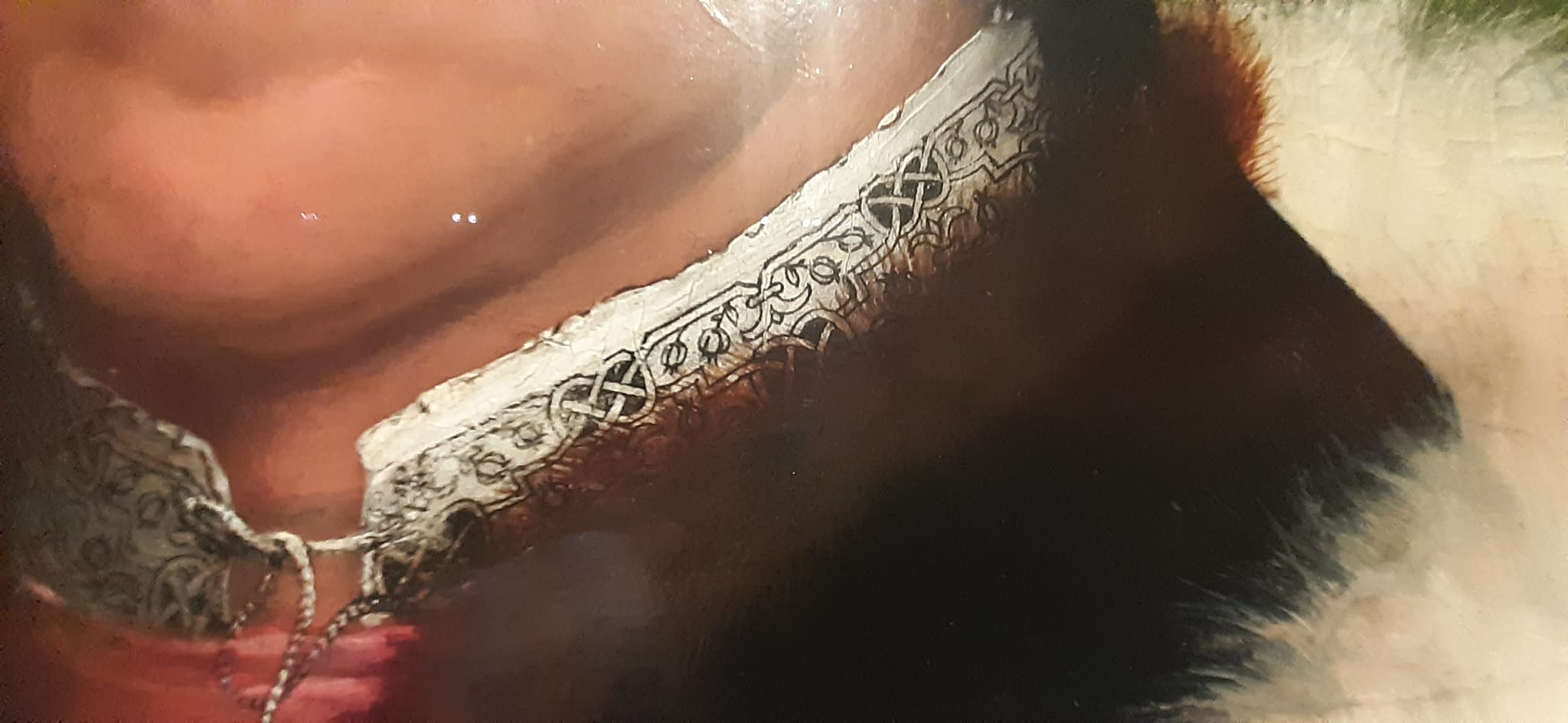
Here’s the blackwork band I transcribed from his collar, more or less.

This redaction is only posited. It’s harder to chart from a painting than it is from a stitched artifact. Luckily this was a Holbein, who understood and clearly depicted the geometry and alignments of countwork. I’ve used my standard rules on this one:
- Modern blackwork and its expanded vocabulary aside, historical examples employ only straight lines, right angles, and 45-degree angles.
- Stitch length units are regular, and are constrained to multiples of a single whole unit, either on edge or on the diagonal. Yes, there are some artifacts with instances of half-unit stitches, but for the most part they are extremely infrequent in foreground design. They do appear sometimes in voided work, to help the stitcher cozy up to the outlines of their previously laid down foreground design.
- Gaps between stitches in a continuously linked design will be the same multiple of the base unit. There are no “floating islands” in this piece. Every bit is straight-line attached to every other bit, and therefore must be on the same base grid.
- Not every iteration of the original is assumed to be spot on accurate. Especially in painted depictions, where three dimensional rendering of rumpled cloth can add imprecision, or the painter not being constrained by a drawn grid, did a “you get the idea” representation rather than a stitch-faithful one.
On this chart I have rendered the background inside the interlaces as a block of solid color, as they were in the painting. It’s not clear what stitches were used to achieve this, but long armed cross stitch, boxed (four-sided) cross stitch, and plain old cross stitch are all good candidates. Note that because these areas are bounded by diagonals there will be considerable fudging with half diagonals (aka quarter stitches in modern cross stitch) to eke out coverage. The solid fill result here is what matters most.
In any case like most of the pieces offered here on String, this is available for your personal use. It’s Good Deed Ware – if you work it up please consider paying the kindness forward, assisting someone in need, calling a friend or family member who could use a bit of cheering up, or otherwise making the world a tiny bit more pleasant. And please note that my representation of this design is copyrighted. if you are interested in using it commercially or for larger distribution, either incorporating it into a pattern for sale or other dissemination, or if you want to use it on items that are made for sale or donation, please contact me.
And as always, I love to see what mischief the pattern children are up to out there in the wide-wide world. Feel free to send me a photo or a link. And if you give permission, I’ll add your work with or without your name (as you desire) to the growing Gallery page here on String.
THE UNSTITCHED COIF EXHIBIT
As promised, here’s a recap of the exhibit. It was an immersive whirlwind of talent, exuberance, and fun. I am very happy we were able to go. I just wish we had longer to chat with all the delightful, creative folk in attendance. But first, here’s a run-down of the displays. Note that while the Unstitched Coif was well represented, it isn’t the only project Toni Buckby is doing. More on those other efforts after the coifs…
The Unstitched Coif
I tried to take photos that showed the individual displayed pieces in situ, among their neighbors. The official website http://blackworkembroidery.org is hosting stitcher-provided blurbs and supplemental photos – the same info that is in the official exhibit book. This linked page indexes all of the stitchers alphabetically by first name. I provide the names of the stitchers for each photo below to save squinting. Pop over to that official site page for high-res closeups of any coifs that catch your eye.
First, the introductory material – a brief on the project, plus a sample of the pattern transcribed onto cloth (but not stitched) and made up into wearable configuration. If you open the poster photo in another window you may be able to zoom in enough to read the text.


And on to the coifs, in groups of three as displayed. There is an amazing variety of techniques, approaches, color interpretations, embellishments, and general artistic vision. The little QR codes on the name tags led to the stitcher’s personal submissions referenced above. Again, if you see something that you want to examine in lovely detail, go to this page and click on the stitcher’s name to read that material.
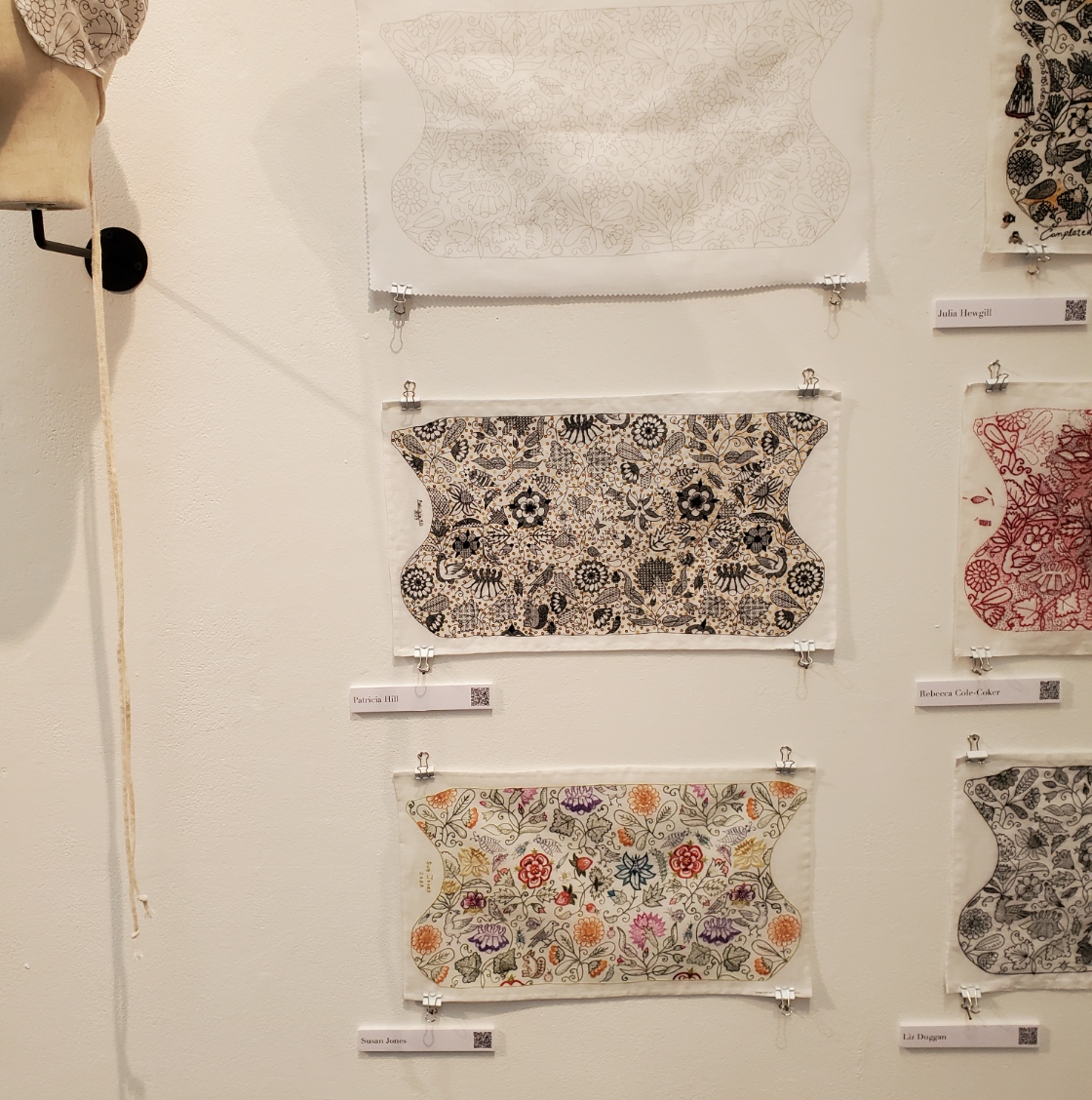
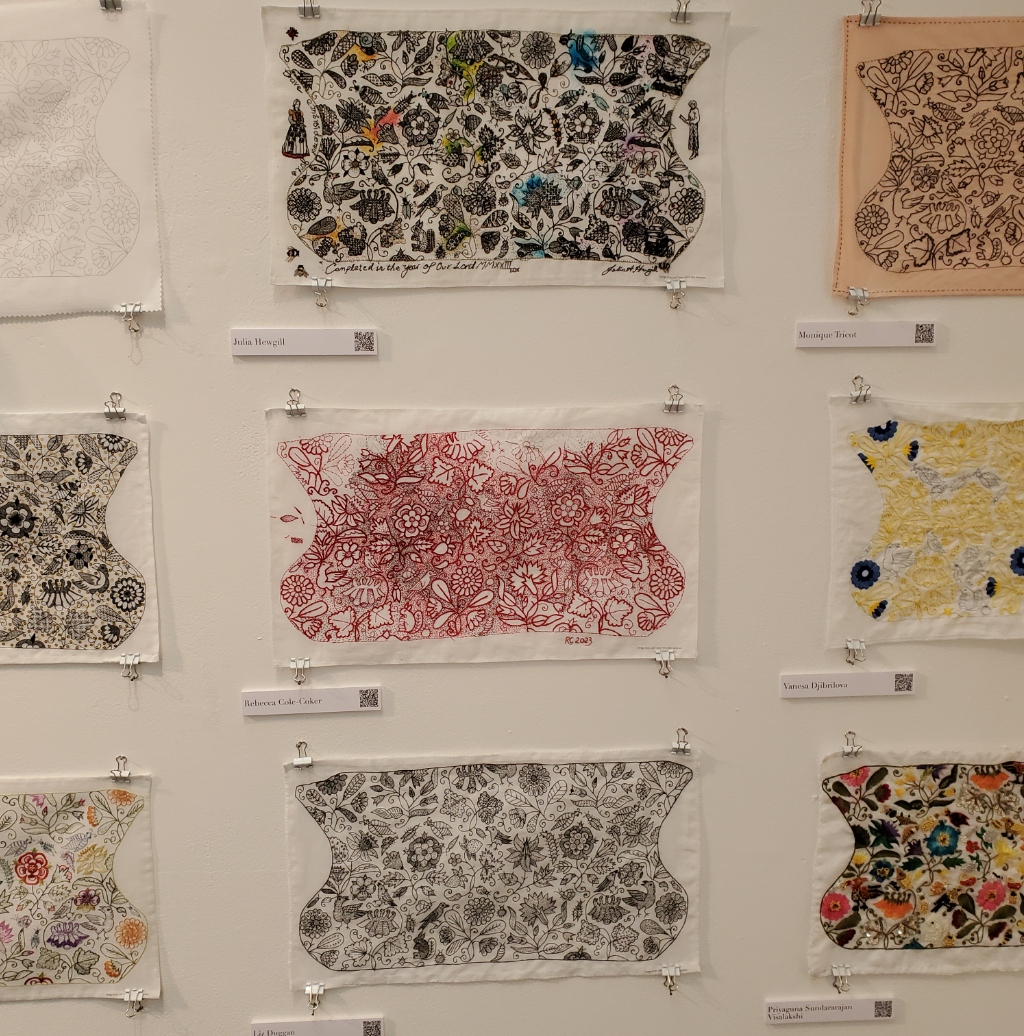

| Unstitched cloth Patricia Hill Susan Jones | Julia Hewgill Rebecca Cole-Coker Liz Duggan | Monique Tricot Vanesa Djibrilova Priyaguna Sundararajan Visalakshi |
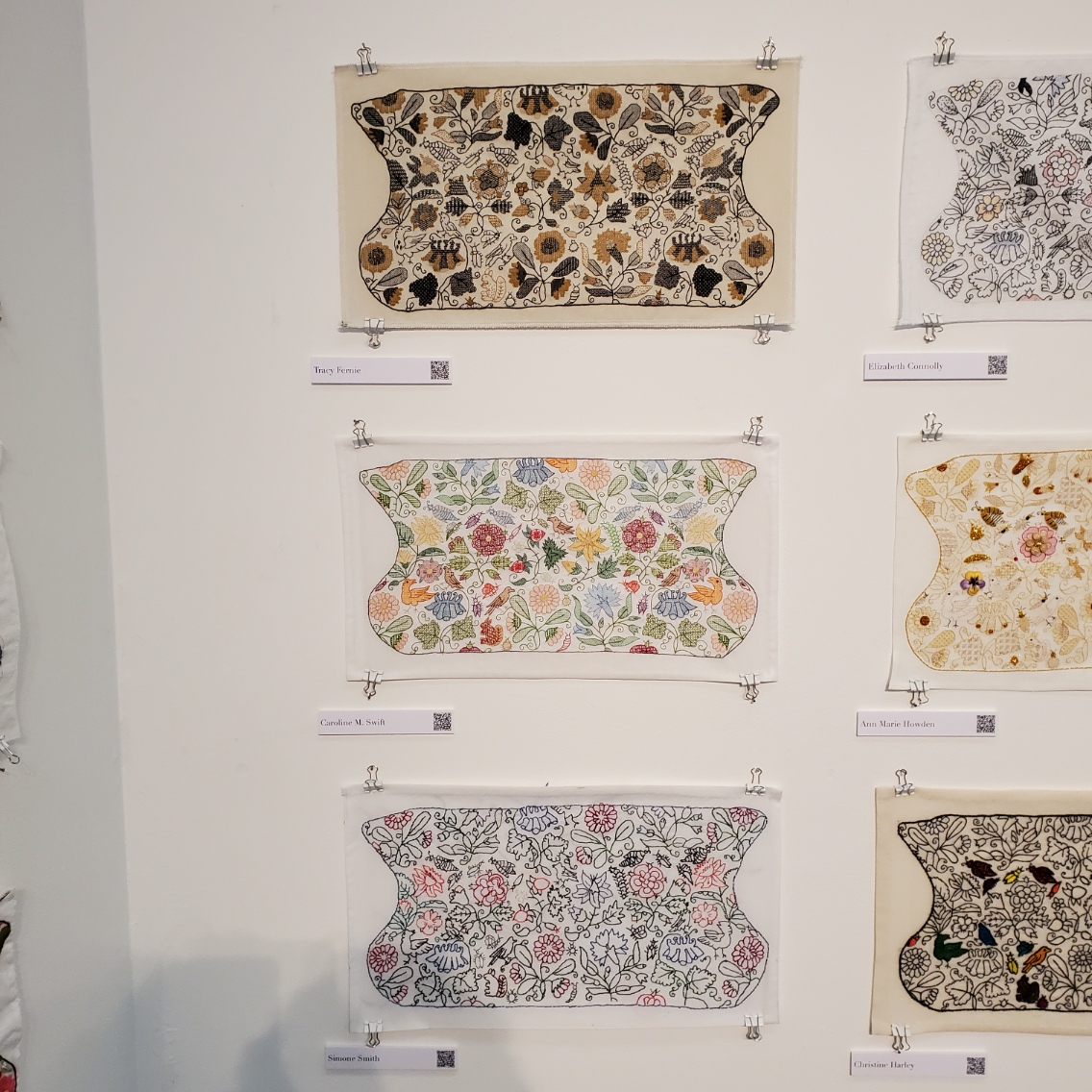

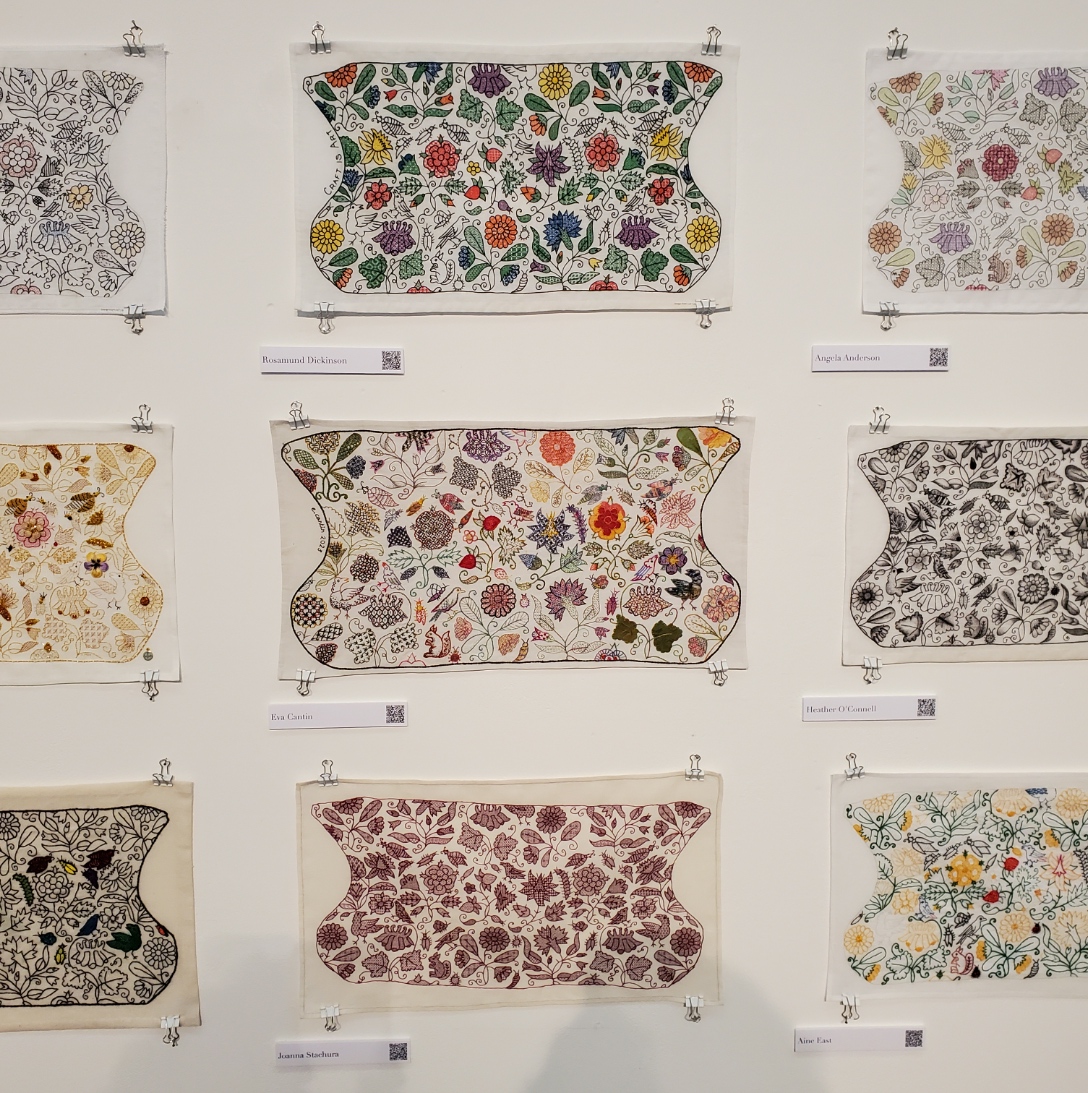
| Tracy Fernie Caroline M. Swift Simone Smith | Elizabeth Connolly Ann Marie Howden Christine Harley | Rosamund Dickinson Eva Cantin Joanna Stachura |
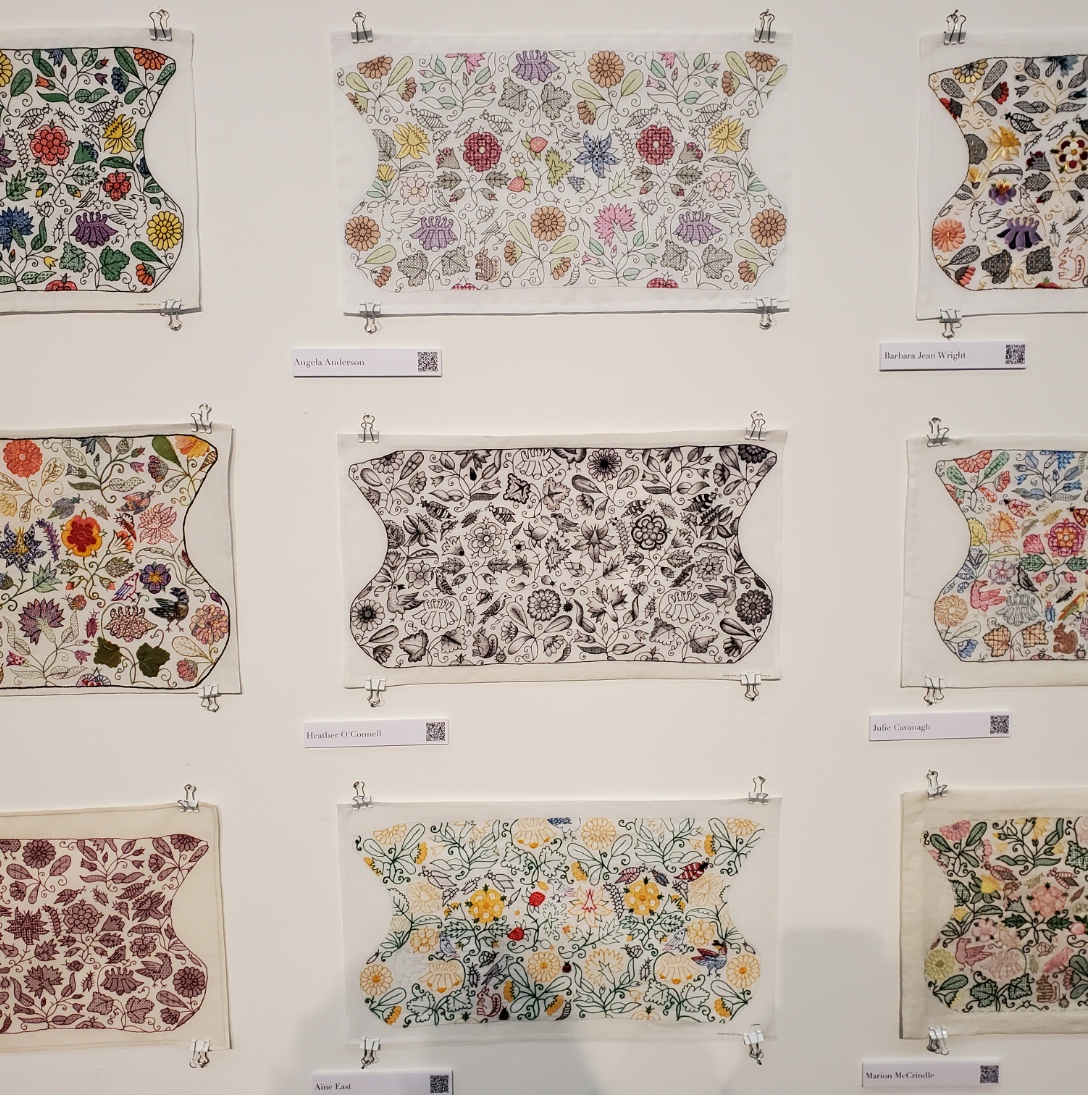


| Angela Anderson Heather O’Connell Aine East | Barbara Jean Wright Julie Cavanagh Marion McCrindle | Elizabeth Dymond Holly Searle Margery Dickson |


| Jane Burnham Vicki Parsons Jen Cable | Anna Tagg Sue Critchley Becky Stewart | Louise Goult Jill Kipnis Sarah Capel |


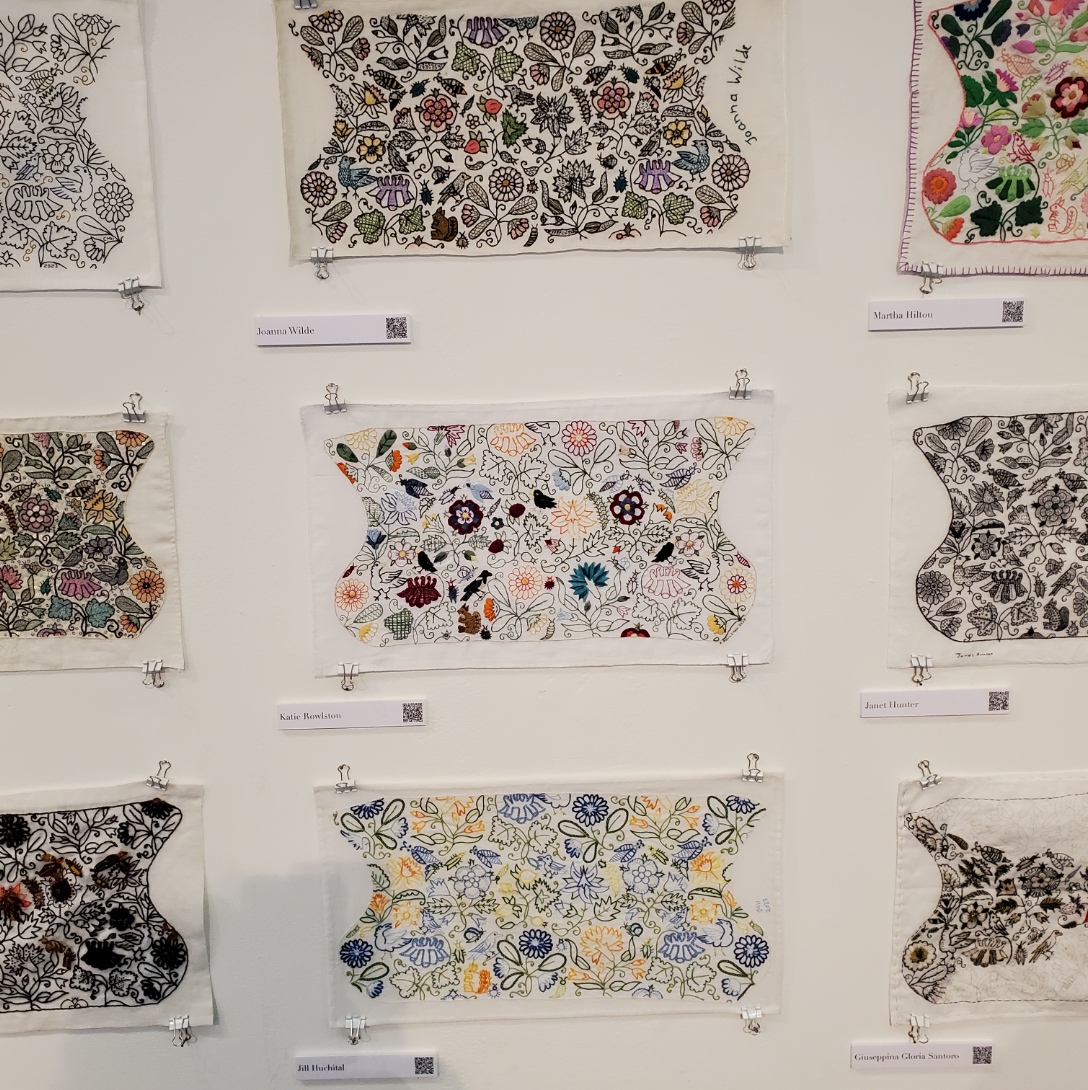
| Catherine Hill Kim Brody Salazar Jen Best | Christine Hillman Jo Tyrrell Victoria Keech | Joanna Wilde Katie Rowlston Jill Huchital |
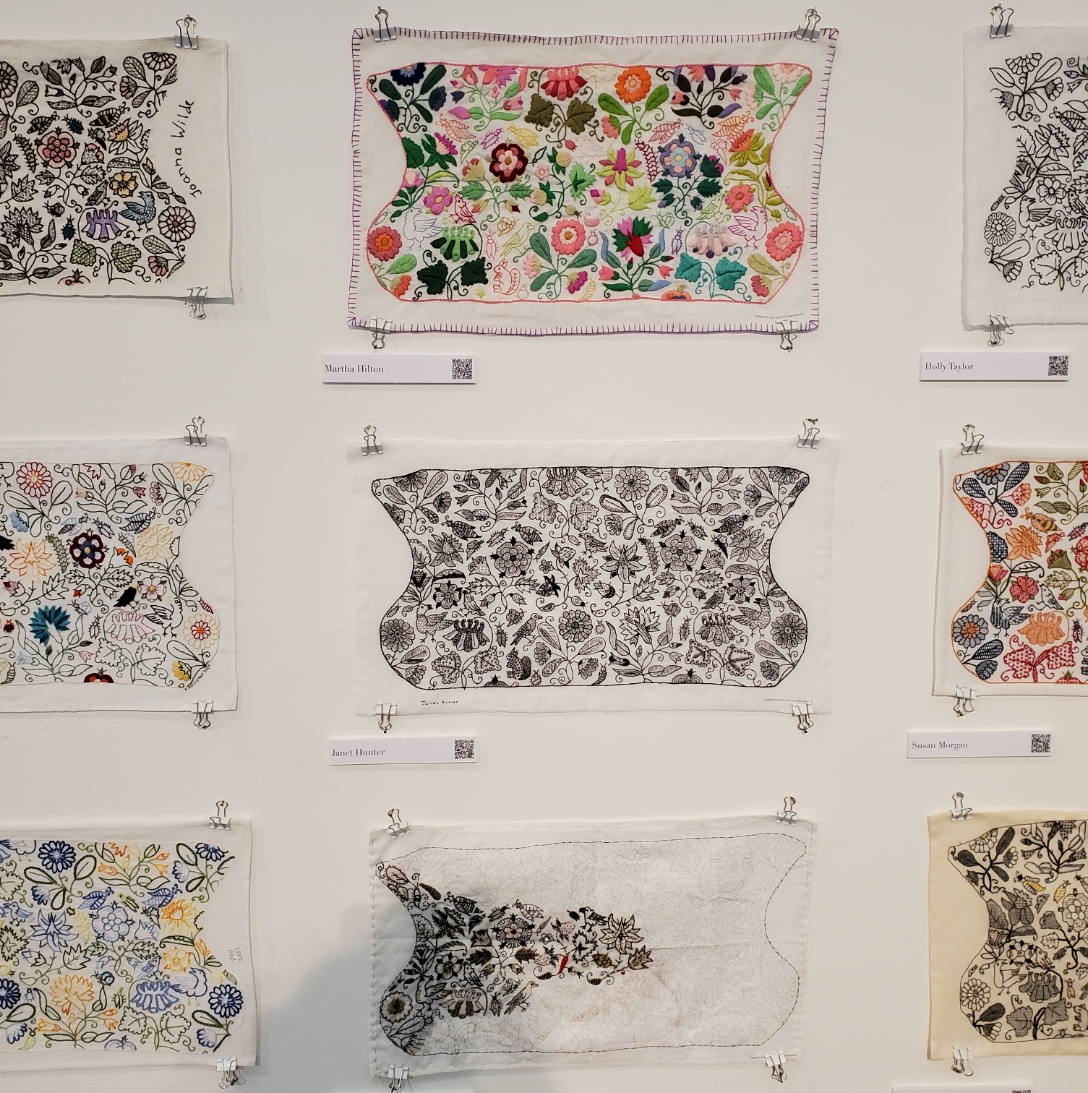

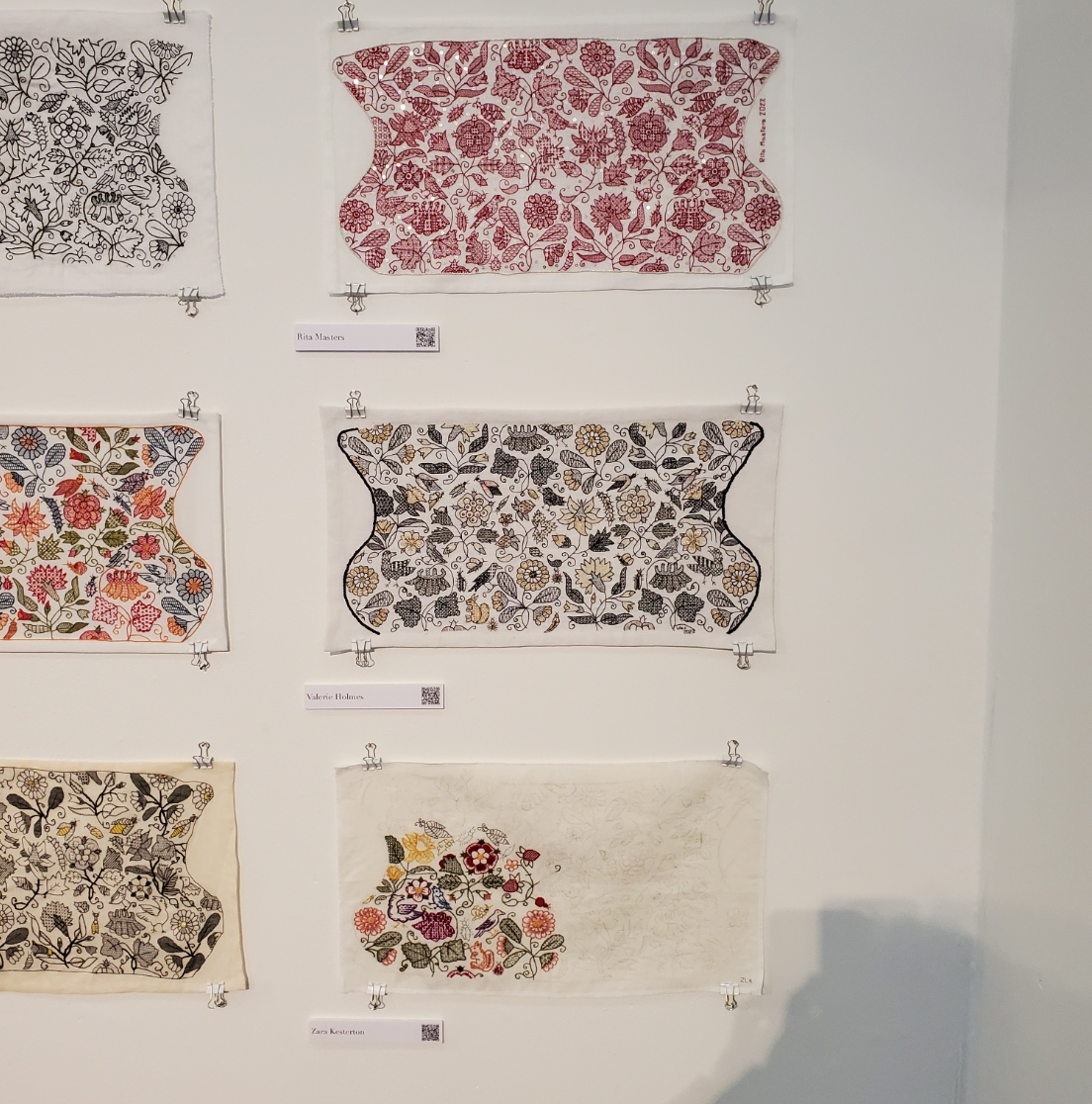
| Martha Hilton Janet Hunter Giuseppina Gloria Santoro | Holly Taylor Susan Morgan Leila Scott | Rita Masters Valerie Holmes Zara Kesterton |
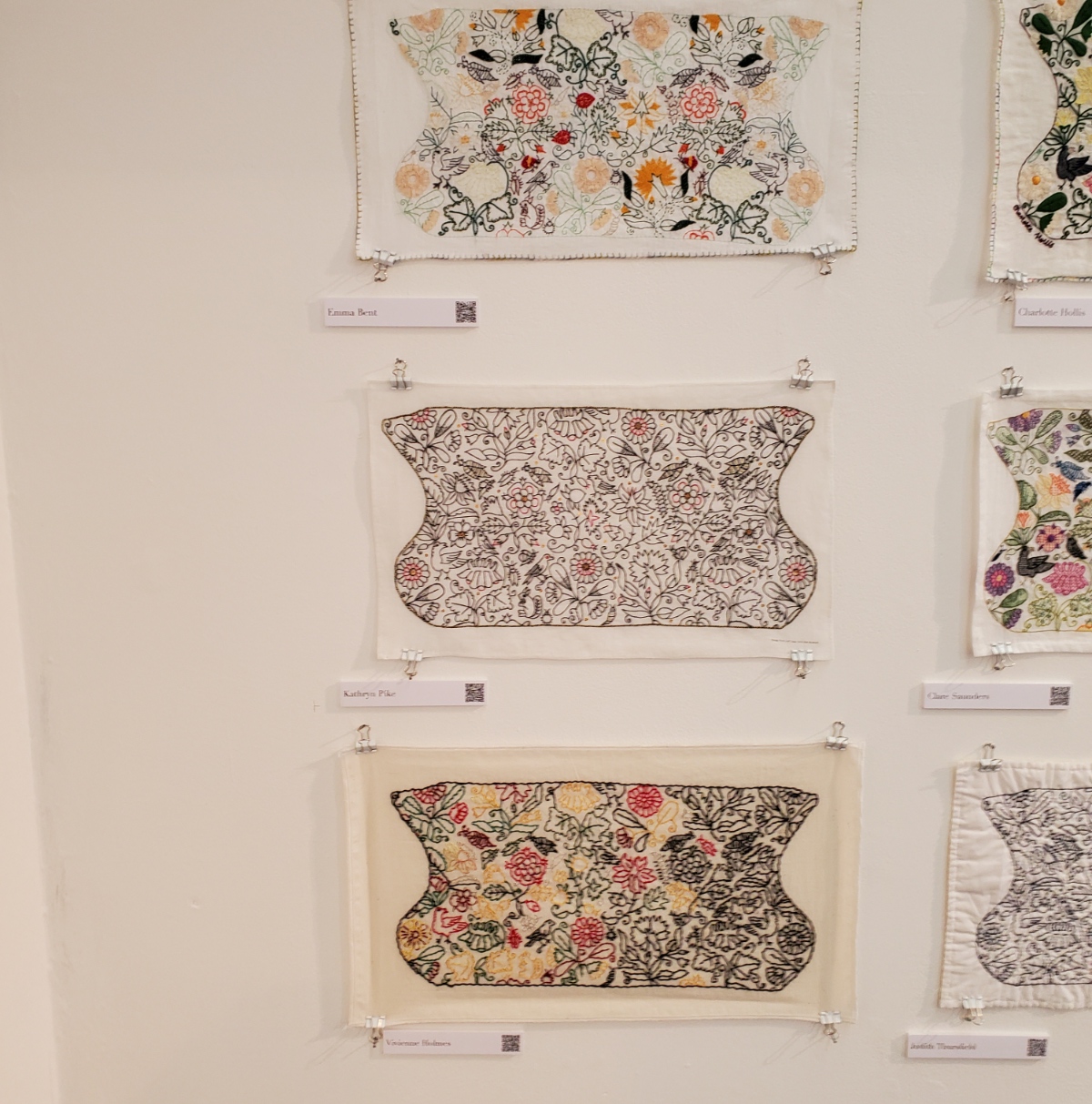
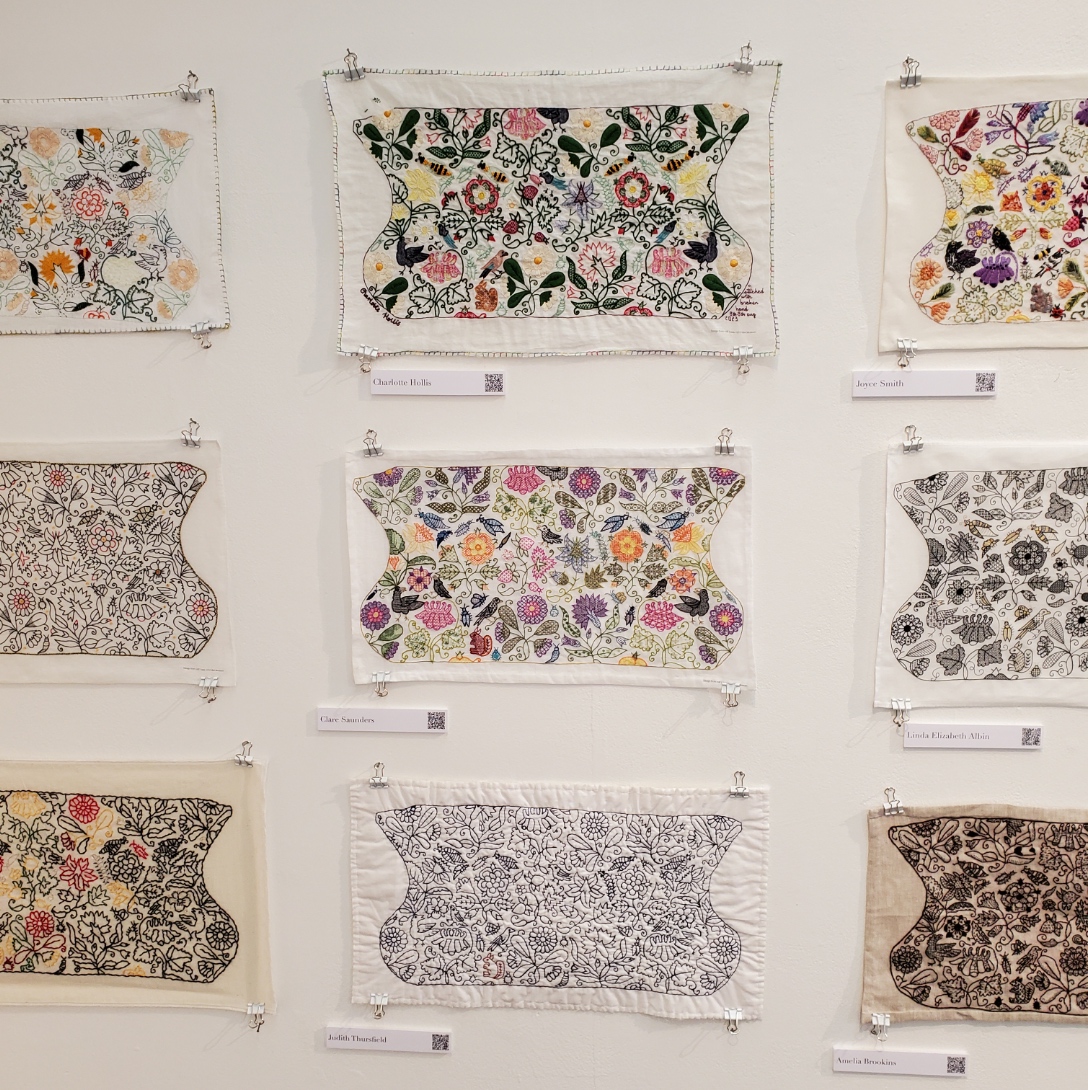
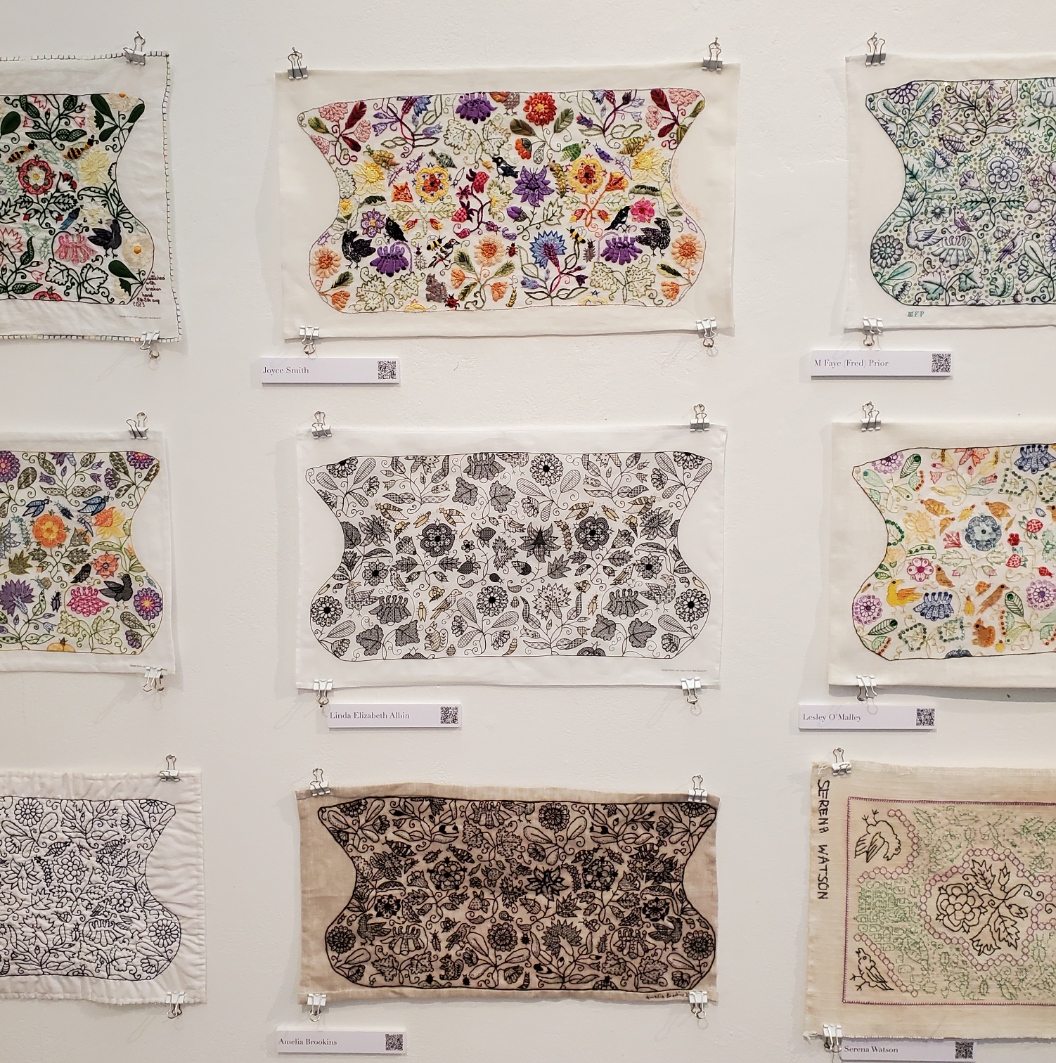
| Emma Bent Kathryn Pike Vivienne Holmes | Charlotte Hollis Clare Saunders Judith Thursfield | Joyce Smith Linda Elizabeth Albin Amelia Brookins |


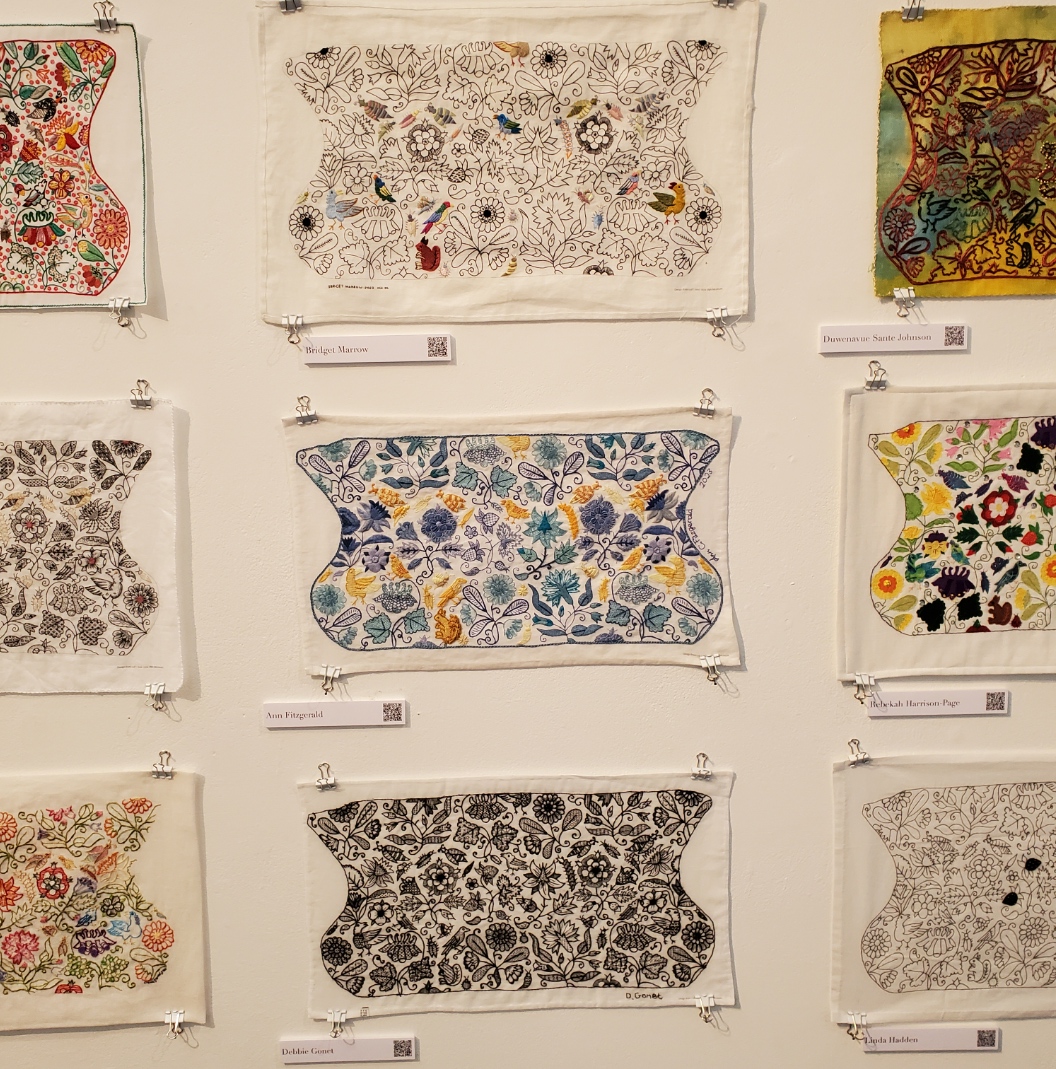
| M. Faye (Fred) Prior Lesley O’Malley Serena Watson | Isabelle Verny Mathieu Anna Vereker Fiona Johnston | Bridget Marrow Ann Fitzgerald Debbie Gonet |
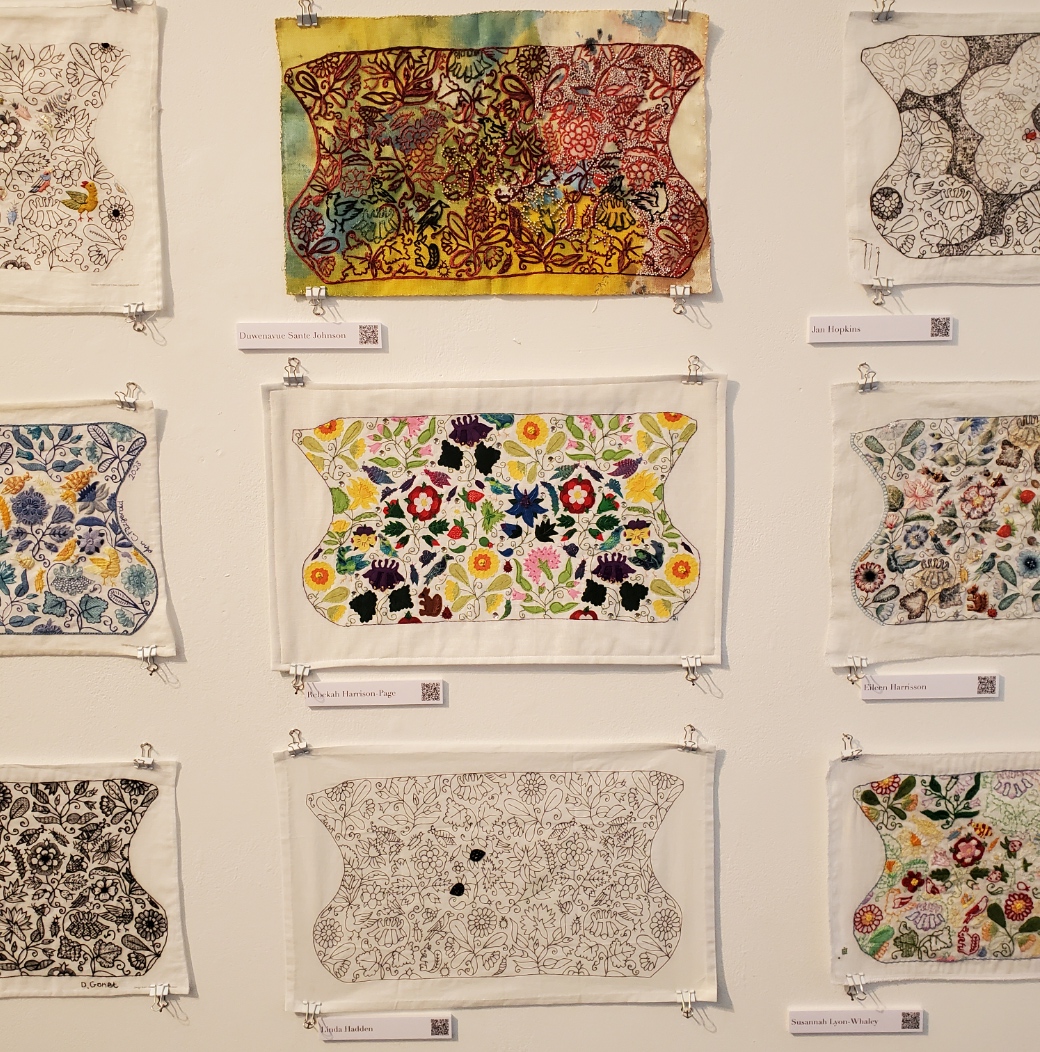
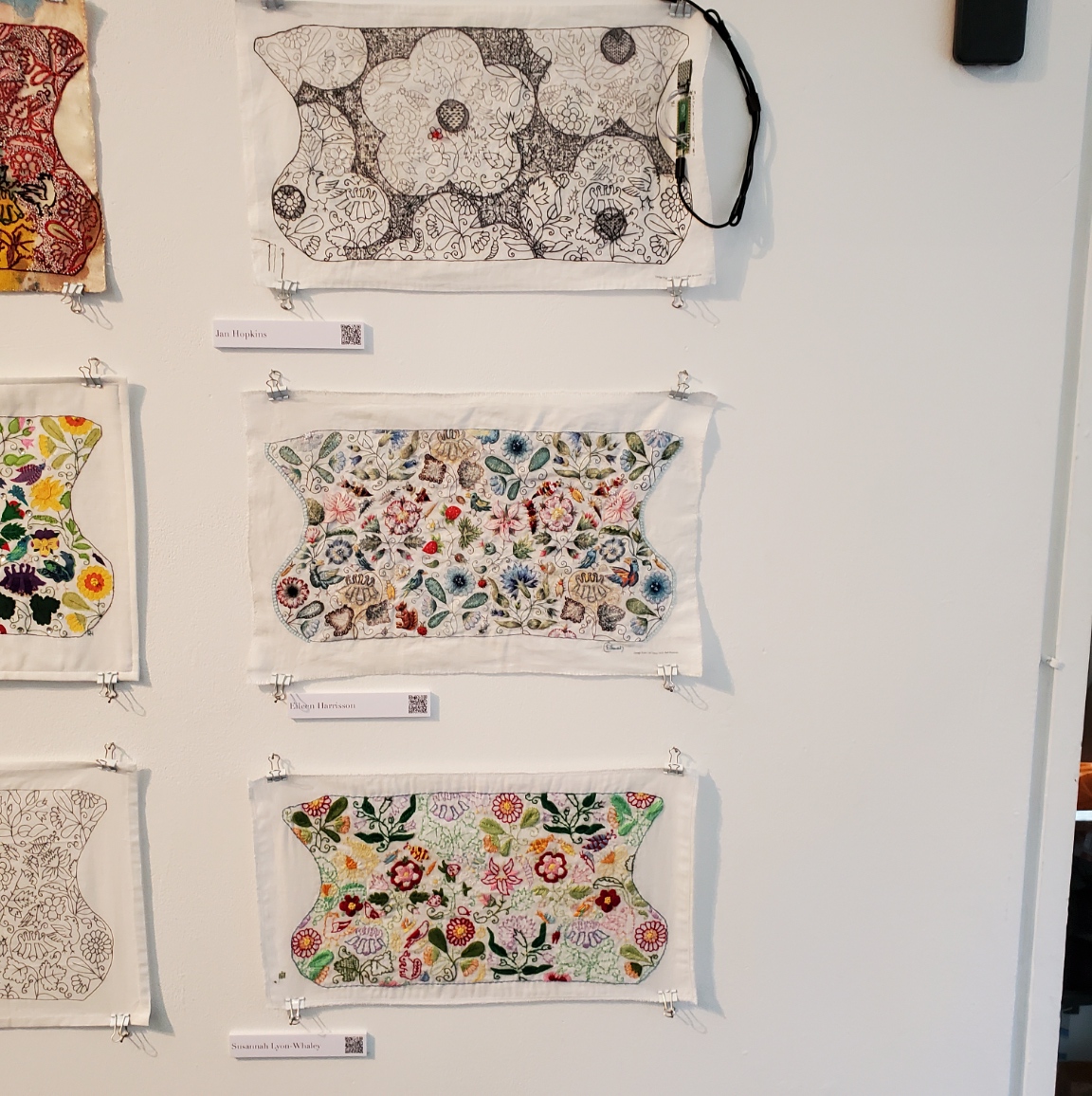

| Duwenavue Sante Johnson Rebecca Harrison-Page Linda Hadden | Jan Hopkins Eileen Harrisson Susannah Lyon-Whaley | Long wall photo to round out the set. |
Coif Replication
As she describes it, Toni Buckby hit upon the idea for the Unstitched Coif project while working on a replication assignment for the Victoria and Albert Museum. They have many pieces of blackwork that are literally eating themselves to death – the tannic black dye used on the silk threads turns them brittle over time. Now, some 400-500 years after they were stitched they are crumbling, leaving only the holes in the ground behind. But these pieces are still sought after for research by visiting enthusiasts/scholars. Toni was commissioned to do a full stitch by stitch reproduction of V&A accession T.12-1948, a well known and popular (although rapidly disintegrating) piece. Her reconstruction is intended for use in educational and outreach efforts because the original is now to fragile to be handled for view.
Toni sourced modern materials as close as possible to those of the original (the 72/74 threads per inch ground is the same one recommended for use on the Unstitched Coif project). She used forensic investigation of the “fossil” piercings and older photos to work out the now crumbled fills and outlines that can no longer be seen on the artifact itself. Her repro is at right.


Other Forensic Analyses and Reproductions
Toni is mapping out another very famous bit of blackwork in the V&A’s collection – the Falkland Pillow Cover, Accession T.81.1924. (In coincidence, this is the piece whose tiny thumbnail photo in Mary Thomas’ Embroidery Book set me off on my own blackwork journey back in the early ’70s). She is using layered drafting methodology to posit the placement and patterning of sections that have now largely disappeared.
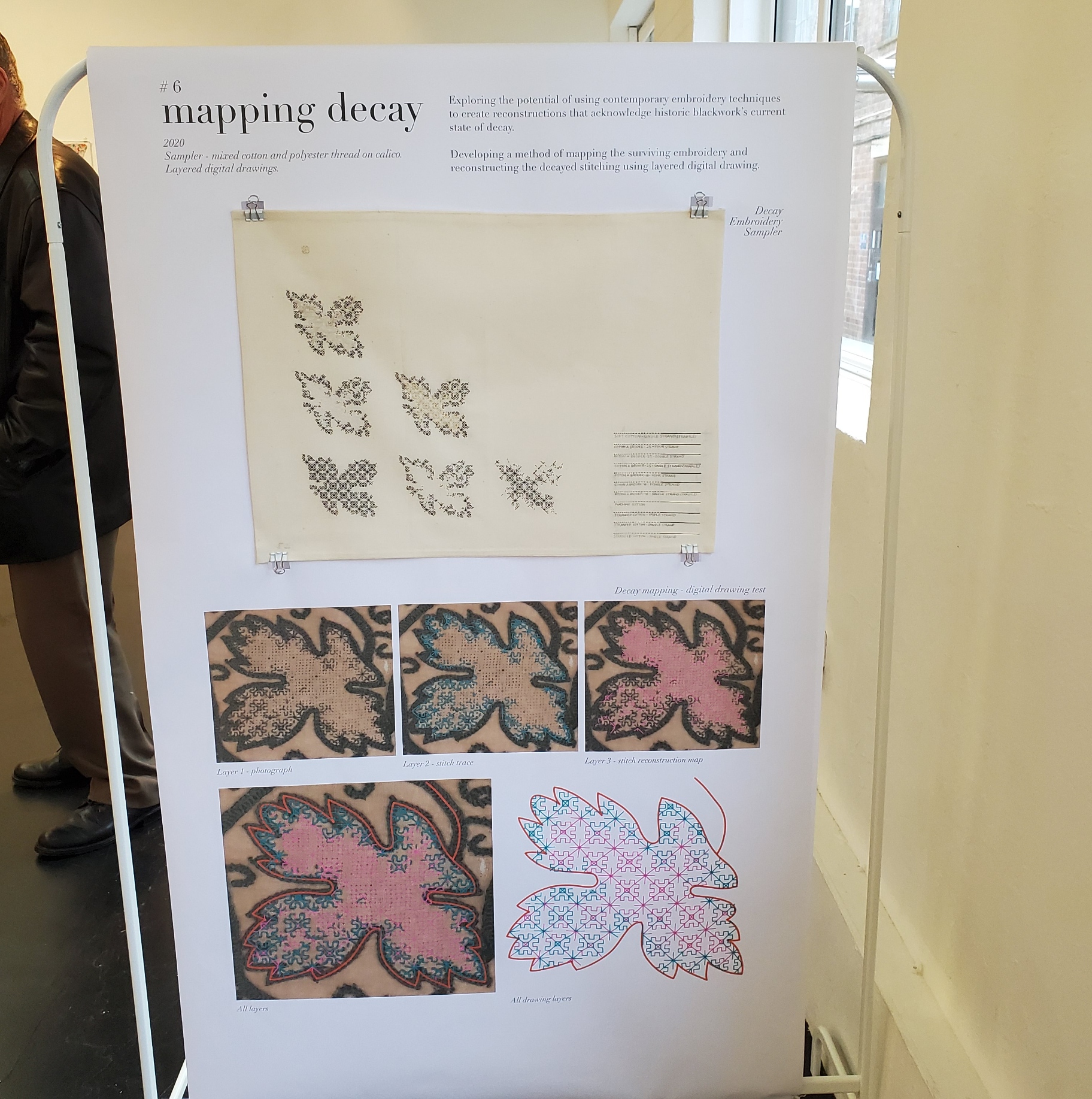

Toni is also in mid-project of an ambitious effort to map the patterns on the three dimensional Falkland Waistcoat , V&A Accession T.80-1924, also a victim of thread degradation, plus other distortions and alterations. The goal of this effort is to chart the 3D design and translate it into flat patterning on garment sections that can be replicated and reassembled into a full reproduction. As you can see, exploring the garment shape by modeling is already underway. (Again, click on the photos to open in a new window, so you can enlarge them to read the text).


There was much more to the exhibit – a series of photos and explanations on materials suitability and choice methodology, and samples of the stitches used. But I’ve gone on long enough.
Suffice it to say that it was total immersion in the subject matter that sings to me, surrounded by people who understand and appreciate the artistry, time, and technique it requires. I met so many people, so talented and so gracious, who took time to chat with me, share their insights, and to mutually giggle in joy of finding others of the like mind. I’ve learned a lot from this project both in my own stitching, and from each and every version displayed here. I am deeply indebted to Toni for pulling the community together, orchestrating the effort, inspiring us along the way, and pointing the way forward, beyond. I do hope that this stitched together fellowship persists, and joins forces on future efforts. I know my needle is sharp and ever ready.
 String-Or-Nothing