EPIC FANDOM STITCHALONG – BAND 12
We continue, this week’s offering is rest and relaxation again after the last band. Think of the fabled treasures sought in so many books, movies, and series: the sparkling gems, items of destiny, and priceless bric-a-brac. You don’t need to be a dragon to have your own hoard. Just stitch this up.
Time Factor 1 – it’s very simple. The only big challenge here would be all those ends if you succumb to my temptation to do this in multicolor In plan monochrome it would make fabulous trim, and would be even more special if worked in several jewel tones.
134 stitches wide x 8 stitches tall. 2 blank rows left between this and the following strip. If worked as a stand-alone continuous band, one full repeat in 28 units. However, if you want to work just one unit of graduated stones, starting and ending on either side with one complete smallest gem element, the count would be 32 units.
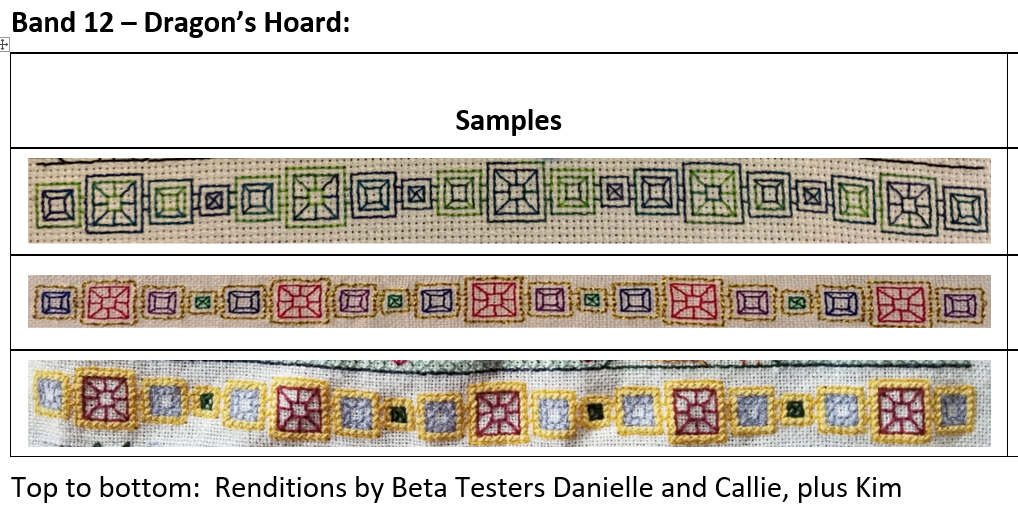
Use one color, multiple colors, or variegated threads, as you prefer. As with the rest of Epic, there are no rules or must-do approaches.
As usual this band plus working notes and hints has been appended to the bottom of the write-up on the SAL page, accessible via this link or via the tab at the top of every page here on String-or-Nothing.
If you are working our Epic Fandom SAL either as a whole or as a strip excerpt, please let me know. It gives me great joy to see how my “pattern children” fare out in the wide, wide world, especially when they meet up with creative, playful people. And if you give permission, I’d be happy to share your pix of this developing sampler, it in its finished state, or derivative projects including one or more of the Epic bands here on String, in a gallery post, with full credit to you as interpretive artist.
Band 13 debuted on the Facebook Enablers group today, and be echoed here on 26 April 2022.
#epicfandomSAL
EPIC FANDOM STITCHALONG – BAND 11
On to one of our heavily themed strips – WHERE NO STITCHER HAS GONE BEFORE.
I know you’ve been waiting for this one. Our voyage continues. To seek out new worlds, new civ… Well, to possibly to try new techniques and have fun along the way.
This is another chance to attempt voiding – filing in the background for dramatic effect (in this case, The Final Frontier). I suggest long-armed cross stitch, plain old cross stitch, but you can see in the examples that one of the more open fills also works nicely. The stars really pop against any of the backgrounds. But even without voiding the piece presents well, so if you prefer not to do it, don’t feel pressured.
Time Factor 4 for height and complexity. Time Factor 5 if you choose to work the background, too. Use one color, multiple colors, or variegated threads, as you prefer. As with the rest of Epic, there are no rules or must-do approaches. Use one color, multiple colors, or variegated threads, as you prefer. As with the rest of Epic, there are no rules or must-do approaches
134 stitches wide x 26 stitches tall. 2 blank rows left between this and the following strip. If worked as a continuous band, one full repeat in 93 units.

As usual this band plus working notes and hints has been appended to the bottom of the write-up on the SAL page, accessible via this link or via the tab at the top of every page here on String-or-Nothing.
If you are working our Epic Fandom SAL either as a whole or as a strip excerpt, please let me know. It gives me great joy to see how my “pattern children” fare out in the wide, wide world, especially when they meet up with creative, playful people. And if you give permission, I’d be happy to share your pix of this developing sampler, it in its finished state, or derivative projects including one or more of the Epic bands here on String, in a gallery post, with full credit to you as interpretive artist.
Band 12 will debut on the Facebook Enablers group on 29 March, and be echoed here on 4 April 2022.
#epicfandomSAL
EPIC FANDOM STITCHALONG – BAND 10
Time for one of the “in-betweeners” – the simpler bands that alternate with the more complex, themed ones. This one is entitled PORTAL TO NOWHERE
Yes, I know this was supposed to be a plain and boring strip. It started out as a simple geometric with some interlaced bits to make it interesting. After I finished drawing, I noted the vague echo of a Portal Cube in its center motif. Subconscious channeling from other dimensions? Probably just coincidence. Yes, that’s right. Coincidence.
Time Factor 2 for height and the overlapping flanges on the motifs (Without those layered bits I’d consider this a Time Factor 1.) Use one color, multiple colors, or variegated threads, as you prefer. As with the rest of Epic, there are no rules or must-do approaches
134 stitches wide x 18 stitches tall. 2 blank rows left between this and the following strip. If worked as a continuous band, one full repeat in 12 units.
| Samples | Fabric Used | Stitch | Thread Consumption/ Notes |
 | 28 count evenweave | Back stitch, 1 ply | About 1 yard each of black and red |
 | 18 count Aida | Back stitch, 1 ply | Variegated floss |
 | 28 count evenweave | Back stitch, 1 ply | |
 | 28 count evenweave | Double running, 2 plies | About 1.75 yards of light red, remnants of light green |
As usual this band plus working notes and hints has been appended to the bottom of the write-up on the SAL page, accessible via this link or via the tab at the top of every page here on String-or-Nothing.
If you are working our Epic Fandom SAL either as a whole or as a strip excerpt, please let me know. It gives me great joy to see how my “pattern children” fare out in the wide, wide world, especially when they meet up with creative, playful people. And if you give permission, I’d be happy to share your pix of this developing sampler, it in its finished state, or derivative projects including one or more of the Epic bands here on String, in a gallery post, with full credit to you as interpretive artist.
Band 11 debuted on the Facebook Enablers group today and will be echoed here on 15 March 2022.
AMENDS
Modern Assisi work vs. historical voided work. I know that the counted thread stitching community lumps them together, but they are not exactly the same thing. What I call “modern Assisi” is the 19th century revival of voided stitching, that draws heavily on Italian folk and church embroidery styles, which in turn trace their roots back to Renaissance era voided pieces. And that late 19th century revival was again echoed in the 20th century, with the collection and republication of many patterns, and issue of new books on the subject.
Yes, both Assisi and earlier styles include prominent outlines usually done in double running or back stitch. And both feature largely unstitched foregrounds (sometimes with additional ornamentation) that contrast strongly with a stitched background.
One of the key defining characteristics of modern Assisi is the use of cross stitch for the background. That’s “plain old cross stitch (POCS)” – not long-armed cross stitch. The Renaissance era voided styles use many different ground stitches and approaches, but so far after looking at hundreds of extant examples, I haven’t seen any in POCS.
Which is why I got very excited when I stumbled across this piece. Now before you get excited too, I did NOT find the unicorn of POCS in pre 1650-era voided work.

“End of a Tablecloth” 15th-16th century. Italian, Sicilian or Spanish. Metropolitan Museum of Art, Accession 08.48.132
I made the mistake of idly browsing on my phone with its tiny screen, and jumping the gun I posted about the piece before I got back to my laptop and high resolution monitor. Obviously, once I was able to zoom in I corrected my mistake, but I did look like an idiot.
So to atone for my egregious lack of judgement, I charted the design in question, and make the chart available as a broadside, for your own personal, non-commercial use. Please do not republish my redaction or include it in other pattern collections.
CLICK HERE TO DOWNLOAD A PDF BROADSIDE OF THE CHART.
Some notes on this piece.
My redaction is not true to any one repeat of the design. Instead I averaged all of them, evening out replication errors as best I could, to arrive at a single, uniform representation of the motifs. All design elements are there, in correct proportion and placement to each other, but there will be small deviations between the chart above and any one of the artifact’s pattern iterations.
The background is not worked in POCS. It was worked squared and unlike every other example of the squared filling on historical works I’ve seen, the stitches were pulled very tightly, bundling the ground cloth’s threads together. Meshy techniques for grounds were very popular in the 1600s and 1700s, but every other example I’ve seen has completely covered the bundled threads with stitching, making a very hard-wearing totally overstitched square mesh ground. In this case the ground cloth’s weave does show through.
The squared filling was worked up to but not touching the outlines of the foreground motifs. A one-unit “halo” was left around them. I’ve tried to represent that on my chart. There was considerable “fudging” in the way the filling was carried into the nooks and crannies of the foreground design. I’ve chosen the least acrobatic of them to include in the chart. Note that there are a couple of deviation points where a diagonal stitch was used to carry the ground thread up into a narrow area of the design.
Colors. Your guess is as good as mine. The outlines and the ground fill are clearly two different colors. If I had to guess, I would probably opt for black for the outlines and madder red for the fill. But other color combos do exist – not every historical piece was done in black and red.
The outlines – double running or back stitch? It’s impossible to tell from just looking at the front. I do note however that the spots on the leopards are all connected to the outline. There are none just floating in space, which makes the piece easier to execute in double running than a piece with discontinuous bits. The only minor challenge in this one if worked in double running would be that little hunting dog. It’s a small area not connected to any of the rest of the design.
And finally, the complementing edging. Note that the squared background is terminated with little “fingers” that slant up and to the right on the top of the strip, and down and to the left at the bottom. I tried to get the whole repeat on the chart, but I ran out of room. For absolute fidelity, work the bottom fingers exactly as tall as the ones on top. Don’t truncate as I was forced to do.
The moral of the story? Check, double check, and do so on the highest resolution display device you have to hand. Never let your excitement run away with you.
EPIC FANDOM STITCHALONG – BAND 8
To continue our slither through North American winter I present Band 8 – Snakes! And They’re Plain!
OK. So, this one is a bit more creepy-crawly than it is classic-blackwork-floral-ordinary. My excuse is that I drew it in the run-up to the 2019 Halloween season, adapting it from a design in Ensamplario Atlantio II, one of my free books of blackwork fills and borders. Plus, we should only ignore those who adore campy horror movies at our own peril.
Time Factor 1 for height and the ultra-simple straight repeat. Our scaly friends are all identical, with the second row flipped and travelling the opposite direction. Feel free to work all the right-bound crawlies in one pass, and then all the left bound ones, or hop back and forth as you please. Use one color, multiple colors, or variegated threads, as you prefer. There are no rules or must-do approaches here. One of the beta testers used beads for the eyes – a charming enhancement.
134 stitches wide x 16 stitches tall. 2 blank rows left between this and the following strip. If worked as a continuous band, one full repeat in 23 units.
| Samples | Fabric Used | Stitch | Thread Consumption/ Notes |
 | 28 count evenweave | Back stitch, 1 ply | |
 | 18 count Aida | Back stitch, 1 ply | |
 | 28 count evenweave | Back stitch, 1 ply | About 2 yards Plus 20 beads (See below) |
 | 28 count evenweave | Double running, 2 plies | About 1.5 yards each of light red and light green, about 0.75 yards of light blue and yellow each |
As usual this band plus working notes and hints has been appended to the bottom of the write-up on the SAL page, accessible via this link or via the tab at the top of every page here on String-or-Nothing.
If you are working our Epic Fandom SAL either as a whole or as a strip excerpt, please let me know. It gives me great joy to see how my “pattern children” fare out in the wide, wide world, especially when they meet up with creative, playful people. And if you give permission, I’d be happy to share your pix of this developing sampler, it in its finished state, or derivative projects including one or more of the Epic bands here on String, in a gallery post, with full credit to you as interpretive artist.
Band 9 debuted on the Facebook Enablers group today, and will invade here on or about 1 February 2022. I’m betting you’ll be long finished with Snakes before then.
EPIC FANDOM STITCHALONG – BAND 7
We roar back with Band 7 – So Sue Me! What can possibly be more anachronistic than this?
Every movie with a ravenous T-Rex in it looms in front of us now. Let’s see, aside from the obvious, there’s the original King Kong, Lost World, Fantasia, Prehistoric Beast, Land Before Time, Night at the Museum, Land Before Time, Dino Riders, several Dr. Who episodes, and many, many more. How could we continue without including an iconic dinosaur?
And the title? Named after Sue, a very famous Tyrannosaurus Rex specimen now on display at the Field Museum in Chicago, Illinois.
If desired this band, like the Pirates band can be worked voided – with the background filled in using long-armed cross stitch or plain old cross stitch, squared or stepped filling, diagonal filling, or another fill as desired. This is highly optional – no pressure here because the T-Rex strip would look good either way.
If voiding is chosen I think the design would show to best advantage if the background fill was done in a different color than the outlining, because if both were worked in the same thread the slender stems of the flowers curled in the tail would disappear. Remember – voiding eats both time and floss in direct proportion.
Time Factor 3 for height and flip/mirror complexity if only the outline is worked, but Time Factor 4 if voiding is chosen.
134 stitches wide x 30 stitches tall. 2 blank rows left between this and the following strip. If worked as a continuous band, one full repeat in 57 units.
| Samples | Fabric Used | Stitch | Thread Consumption/ Notes |
 | 28 count evenweave | Back stitch, 1 ply | |
 | 18 count Aida | Back stitch, 1 ply | |
 | 28 count evenweave | Back stitch, 1 ply | About 8 yards for outlines, 6.5 yards for voiding |
 | 26 count evenweave | Double running, 1 ply | |
 | 28 count evenweave | Double running, 2 plies | 1.5 yards blue, 1 yard, green, 0.25 yard red, 2 yards of light red for voiding |
The second from the bottom, by guest Beta Tester Robert (known to some of you as Master Geoffrey d’Ayr of Montalban) is actually part of a strip of the design he worked as cuff and collar trim for a shirt – proving the point that many of these designs can be worked as long band repeats.
As usual this band plus working notes and hints has been appended to the write-up on the SAL page, accessible via this link or via the tab at the top of every page here on String-or-Nothing.
If you are working our Epic Fandom SAL either as a whole or as a strip excerpt, please let me know. It gives me great joy to see how my “pattern children” fare out in the wide, wide world, especially when they meet up with creative, playful people.
Band 8 will be released here on or about 18 January 2022, giving you ample time to romp with this one.
EPIC STITCHALONG – BAND 6
A breather after the last rather involved and challenging to count Gameroom panel!
Grape Balloons is another original, loosely based on a historical pattern family. Bands or horizontal columns with lozenges and/or striations are pretty common in strapwork of the late 1500s to 1600s, as are grape clusters. But sprigging them together this way is something I doodled up.
This one should be comparatively easy to stitch, especially after the last no-repeat panel. All you need to do is remember that the slanting bands on the center rod mirror – everything else is a simple flip, either up/down or left/right – no tricky half-drops, or meanders.
134 stitches wide x 16 stitches tall. 2 blank rows left between this and the following strip. If worked as a stand-alone continuous band, one full repeat in 17 units.
| Samples | Fabric Used | Stitch | Thread Consumption/ Notes |
 | 28 count evenweave | Back stitch, 1 ply | About 2 yards of floss |
 | 18 count Aida | Back stitch, 1 ply | About 3 yards of variegated thread (not floss) |
 | 28 count evenweave | Back stitch, 1 ply | |
 | 28 count evenweave | Double running, 2 plies | About 1.25 yards of light blue, 0.5 yards of light red, scraps of red. |
As usual this band plus working notes and hints has been appended to the write-up on the SAL page, accessible via this link or via the tab at the top of every page here on String-or-Nothing.
If you are working our Epic Fandom SAL either as a whole or as a strip excerpt, please let me know. It gives me great joy to see how my “pattern children” fare out in the wide, wide world, especially when they meet up with creative, playful people.
Band 7 was released today in the Enablers Facebook group feed, and will be echoed here on or about 21 December.
#epicfandomsal
EPIC STITCHALONG – BAND 5
The world is starting to open up again, but among us there are folk who felt the lockdown most keenly during convention season.
They missed meeting friends, swimming in a sea of fellow fans – regardless of fandom; reveling in the costumes either as a cosplayer or just an appreciative passer-by; viewing films, trailers, and shorts; listening to authors, famous actors or other community celebrities as they reminisce, lecture, or engage in open panel banter; shopping for that special Something that sings to the inner nerd; and more. Like the Game Room. There’s almost always at least one, where folk compete for the sheer fun of it, or sometimes for prizes.
I know many people who live for game rooms, then bring home their favorite games and introduce them to their circle of local friends. This strip is for them, the gamers, be they lovers of electronic formats, the classic card and board games, multiplayer role playing games like Dungeons and Dragons, or the new set of tabletop/parlor games, like Settlers of Catan.
This strip is 134 stitches wide x 28 stitches tall, including the narrow companion border at top and bottom. 2 blank rows are left between this and the following strip.
| Samples | Fabric Used | Stitch | Thread Consumption/ Notes |
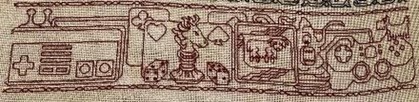 | 28 count evenweave | Back stitch, 1 ply | Pips are French knots |
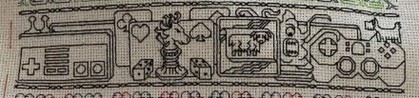 | 18 count Aida | Back stitch, 1 ply | About 3 yards. Pips are French knots |
 | 28 count evenweave | Back stitch, 1 ply | Pips are French knots |
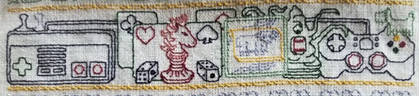 | 28 count evenweave | Double running, 2 plies | About 1 yard of blue, 1/2 yard of yellow, 1/4 yard of red, 1/4 yard of light blue. The snake eyes pips are each 2mm paillettes. Other pips are tiny 1×1 cross stitches |
As usual this band plus working notes and hints has been appended to the write-up on the SAL page, accessible via this link or via the tab at the top of every page here on String-or-Nothing.
If you are working our Epic Fandom SAL either as a whole or as a strip excerpt, please let me know. It gives me great joy to see how my “pattern children” fare out in the wide, wide world, especially when they meet up with creative, playful people.
Band 6 be released on 23 November in the Enablers Facebook group feed, then echoed here on or about 7 December.
MORE COUSINS
Just because I’ve taken a departure from classic stitching and am issuing heretical blackwork patterns for spaceships, robots, and dinosaurs doesn’t mean I haven’t abandoned research. I am also inching The Second Carolingian Modelbook (T2CM) closer to the goal posts.
I continue to find multiple instances of design duplicates scattered across various museums. Here’s a trio. Clearly stitched from the same inspiring pattern. Whether it’s from an as yet unidentified modelbook or broadside sheet, an atelier’s cloth reference sample, or just copied among stitchers hand to hand is impossible to determine. However, this design will be included in T2CM so stitchers of the future can keep this historical “chain letter” going..
First, my own stab at the thing, as worked on my big blackwork sampler. I call it “Leafy-Bricks” for obvious reasons.

The first instance of Leafy-Bricks I stumbled across is in the Boston Museum of Fine Arts, Accession #07.816. It’s a small fragment, but it’s the one on which I based my redaction. They tentatively identify it as likely to be Italian, but do not date it. This snippet was collected in the very late 1800s/first decade of the 1900s during the “Indiana Jones” era of embroidery and lace sample acquisition – the time in which monied families took a season touring Europe, vying with each other to bring back the most exquisite samples of whatever struck their fancy. These collections were eventually donated to major museums to form the backbone of their historical embroidery holdings. The time/place provenances furnished by dealers or middlemen and conveyed with these pieces upon donation are not necessarily to be trusted. Many museums are now revisiting these pieces to correct annotations that haven’t changed in 75+ years.
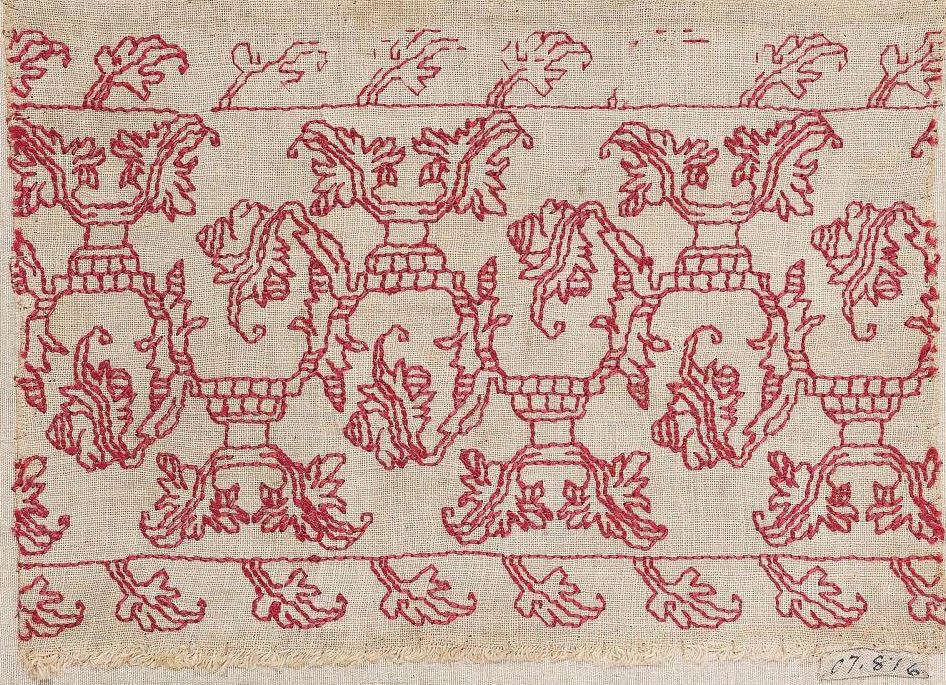
One interesting thing to note is that the count of the historical ground above is not as square as the count of my modern linen. The design is somewhat squashed left to right and elongated north-south compared to mine, although the unit counts are the same.
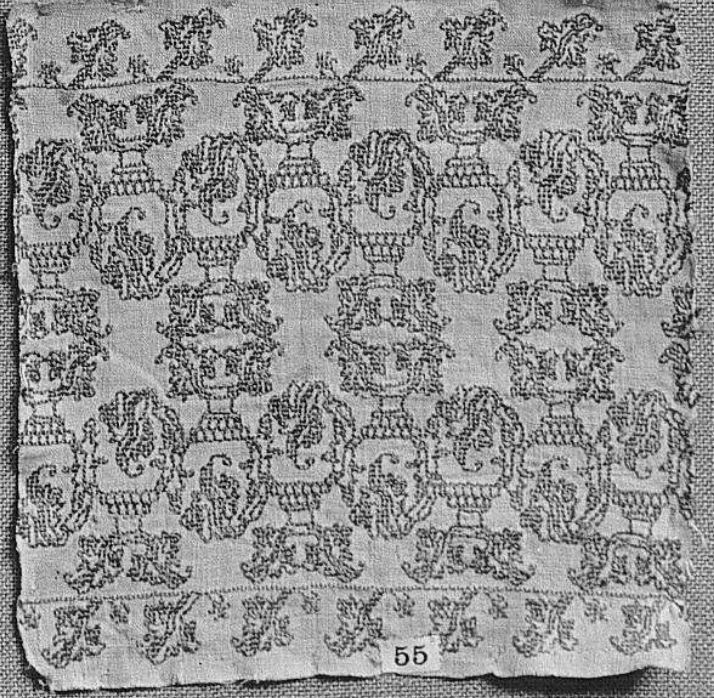
The second one is in the collection of the Metropolitan Museum of Art, Accession 09.50.55. Unlike many duplications among museums it’s not an instance of one original artifact having been cut apart for sale to multiple buyers. Not only is the center panel duplicated here, there are also subtle differences in the design, especially in the border. The Met only shows this in black and white and does not provide information on the color used. They date it to the 1600s, and attribute it to Italy.
And third, which I only stumbled upon today. This one appears to be a photo only recently released by the Victoria and Albert Museum, Accession 645-1896. Be still my heart, it shows the design on fragments that were pieced into a wearable apron, providing a use case beyond what can be known from a simple fragment. The V&A also notes that the apron was composed from previously stitched fragments. They label the assembled wearable as 1630-1660, Italian, but it’s unknown what life the embroidered strips had before that usage. Best of all, among their images is one that shows the back. Yup. Double running stitch. And yes, I know they see vases in the composition, but my mind is stuck on describing the center bits as bricks.

Note the stretch across the bottom, seamed together from two distinct fragments. And the butted corner formed by a third, although butted corner treatments are more commonly represented in survivals than are pieces with carefully planned mitered or otherwise customized corners. As far as the design’s manifestation on the apron, it’s very, very close to that on the MFA’s fragment. But it’s not identical. There are small differences in the veining pattern of the main repeat’s leaves which lead me to believe it’s a fragment of another original, and not a leftover from whatever item was repurposed into the apron.
If you’ve spotted other instances of Leafy-Bricks out in the wild or have seen it in a modelbook of the 1500s to 1600s, please let me know.
Oh. And if you are interested in obtaining a copy of The New Carolingian Modelbook (my first and now out of print book), I know it’s hard to find. I don’t have any to sell myself, but on rare occasion someone finds a copy and sends it to me. Just such a copy recently came into my hands. I have sent it on to a charitable auction to benefit the SCA Barony Concordia of the Snows, which recently lost all of its communally held equipment in a devastating fire. That auction will be held on 28 August at East Kingdom Coronation. I do not know if the auction will be web-accessible. If I find out I will update this post accordingly.
BAGGED UP AND READY TO GO!
A finish! The mini-bag kit I savaged and repurposed to feature my own choice of stitching is now complete, and can be sent to the recipient.


To recap, in order to have better access for my hoop I unpicked the side seams of the evenweave decorative layer, and of the heavy cotton twill lining. The evenweave had no seam at the bottom. The twill lining was left with the bottom unseamed. Earlier in the process the bag could be splayed out flat, with only the bit of seaming at the top surviving – where the lining and evenweave were sewn together with the red handles. Here you see it draped out and in the hoop.

When I finished both sides, I sewed it back together by hand – my sewing room and machine being off limits due to the big basement rehab project. First I sewed the lining using back stitch. Then I attempted a fancy decorative openwork seam in black to reunite the two sides of the evenweave.
It didn’t work.
It looked rather Frankenstein-like. Of the stuff of nightmares. So I covered up the buttonhole stitch based seam with three rows of reverse chain, done with a whole 6-ply strand of my linen floss. The first row of reverse chain went down the openwork bit at the center of my former decorative seam, and the other two courses went left and right of that, hiding the bits that encroached into the body of the bag. Which is why there’s now a thick black stripe along both sides of the thing. Not an optimal solution but the best I could do right now.
And on to the next project.
This one I have to admit I am posting as a tease. I used time over the past pandemic year to design a free stitch-along. It’s a rather large and complex stitch-along, with a distinctly nerd-world/fandom theme. It will be released on The Enablers Facebook group, and also here on String, on a two-week delay, starting sometime in August. I will be creating a new page here on String to host it. Beta-test stitchers from that group have been working on their pieces to proof the design and confirm the directions, and their efforts have been much appreciated. The thing will NOT be a mystery stitch-along (folk should know what they’re in for before they commit), but it will be released one panel at a time, with periods between releases pegged to the complexity of the individual panels.
However, until now I haven’t started my own rendition. I won’t spoil the surprise, but as I warned – I will tease here.

Obviously not a historical redaction (for a change), and that’s going to be part of the fun.
 String-Or-Nothing