SAMOSAS AND STUFF
An eventful week here at String India, punctuated by the refusal of Windows Live Writer to run without crashing, which explains the lack of posts.
First, I present the results of a local yarn crawl. Local Ravelry KnitPal RedHeadedWoman and I went on a yarn and stitching supply locating expedition to the center of Pune. We crawled in and out of tiny shops that offered the most amazing variety of trims, beads, sequins, pre-stitched blouse yokes, and brocades. No where on earth does bling with the variety and joyful elan of India. Yarn was harder to find, and real wool or silk was unicorn-rare. But there were lots of colors of man-made fibers in various weights.
I came away with some crimson laceweight. It’s about a 2/20 weight and in all probability, either all acrylic or an acrylic/nylon blend. I’ve got roughly 400 grams (about 14 ounces), so I’d estimate that I have in the neighborhood of 4,500 yards. I also got two fistfuls of small metallic beads, one silver tone, and one antique gold. The princely haul below set me back about 600 rupees, roughly $11 US.
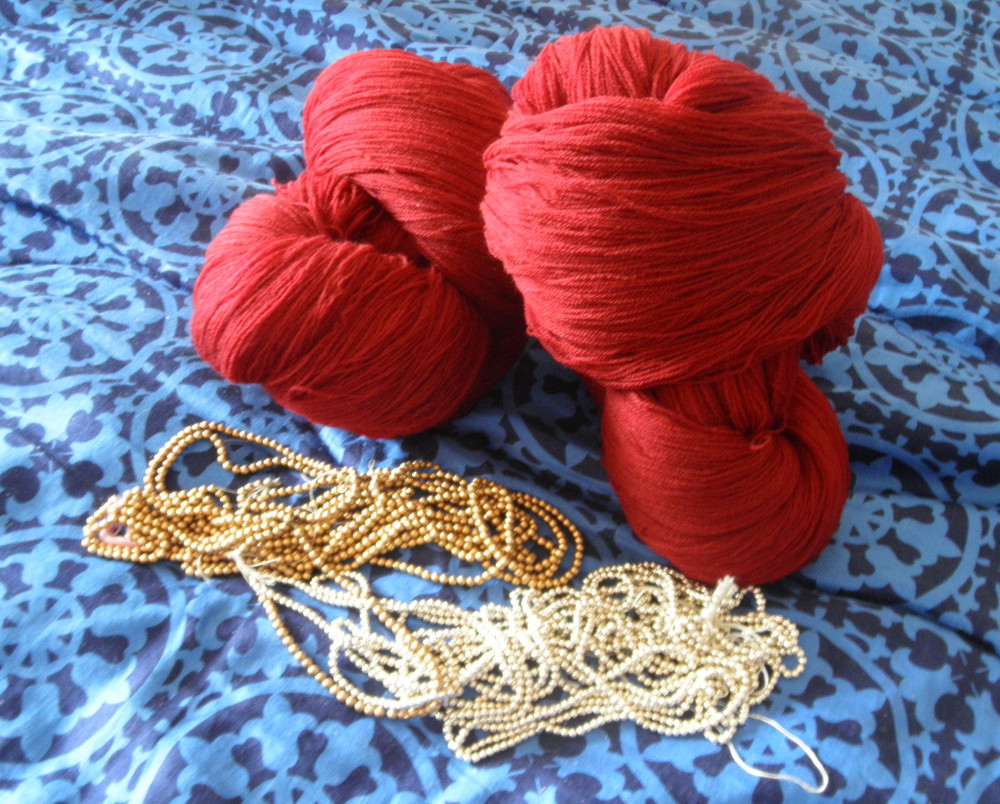
Special thanks to RedHeadedWoman for the fun of poking around the market stalls!
Second, I present a happy food triumph of the slightly misshapen variety: Samosas.
Samosas are one of the 10,000 snack foods for which India is famed. It’s a highly adaptable fried or baked turnover, turning up with all sorts of fillings, in all sizes, and at all venues, from the most posh cocktail parties to street food stands. About all I can see that unites them is a vaguely triangular shape and the happiness with which they are greeted.
I tried my hand at one of the most common types – a “truck stop size” samosa, filled with potatoes, peas and onions, spiced with lots of garlic and masala (a spice mix that varies from region to region and cook to cook). We had ours with soup for dinner, but this is the type that’s most commonly available as street food, at roadside rest stops, or other places where food on the go is appreciated.
I started with this recipe, but quickly veered off on my own. Note that the filling can be prepared way ahead and fridged, then brought back to room temperature before stuffing the samosas and frying them.

Therefore, not pretending to offer up anything remotely resembling “authentic,” I present my own version.
LATE BREAKING UPDATE: IF YOU WANT TO MAKE THESE IN A WESTERN KITCHEN, USING WESTERN INGREDIENTS, I HAVE POSTED A REVISED RECIPE HERE.
One American Chick’s Sort-of-Samosas
Makes 16 “truck stop lunch size” filled fried pastries
Outside pastry:
3/4 cup white all-purpose flour (maida)
3/4 cup whole wheat flour (atta)
2 Tbsp ghee or butter – MUST BE SOLID, NOT MELTED
1/2 cup water
1 tsp salt
1/2 tsp baking powder
Oil for deep-frying
Filling:
2 medium size onions, chopped
2 Tbsp oil for sauteeing.
8 cloves garlic, minced fine
2 cups frozen or fresh peas
5 fist-size potatoes, peeled
2 tsp garam masala*, or other spices to your taste
1 Tbsp salt
Instructions
1. Peel the potatoes, chunk them into two or three pieces and set them to boil until tender. Drain the potatoes and salt them.
2. While the potatoes are cooking you’ll have some time. Mix the two flours, the salt and baking powder together. If lumpy, sift. Work the hard ghee or solid butter into the flour mix with your fingertips or a fork, as if you were making scones or pie crust, until all the butter is incorporated, and the flour looks crumbly and grainy – past the point at which you’d stop if this was pie crust.
3. Add about half of the water to the flour/butter mix and combine. Keep adding water slowly and mixing until the dough can be gathered up and briefly worked into a smooth mass. Do not over-knead or the shells will be hard as rocks. Set the dough aside under a damp cloth or in a plastic box.
4. Take about half of the cooked potatoes and dice them into small chunks, about 1.5 cm (1/2 inch). Precision isn’t important, you just want them to be small but noticeable bits in the stuffing. Rough mash the rest of the potatoes with the back of a fork or large slotted spoon.
5. In a large frying pan, saute the onions in the oil until light golden. Add the minced garlic and saute for a minute or two more, until the garlic is fragrant, but not brown. Sprinkle the masala mix onto the onions and saute for another minute or two. Toss in the potato cubes and let them get coated with the oily spicy oniony garlicky mix. Then toss in the mashed potatoes and stir all together. When incorporated, stir in the peas. Taste it and add more salt if needed. Let the stuffing heat on low for another ten minutes for the peas to thaw and cook, and for the flavors to meld. Stir occasionally to scrape up any yummy bits from the bottom back into the filling, and to keep the potatoes from sticking to the bottom. This fully cooked filling can be made way ahead and fridged until needed, although I suggest taking it out and letting it warm up before stuffing and frying the samosas, to ensure that the center doesn’t remain cold.
6. To assemble – have your filling ready. Have a small rolling-pin ready. Take the rested dough and divide it into 8 equal parts. Put the parts back under the damp cloth towel or back into the plastic box until needed. Take the first lump of dough. Flatten it into a pancake and pat it into some loose flour. Roll it out into a circle, as large and as thin as you can (mine was about 10 inches around, and about an eighth of an inch thick). Take a knife and cut the circle into two halves. Each half will make one samosa.
7. Try to follow this video’s folding logic. Moisten the straight edge of the half circle with water, then pat it into a cone. Hold the cone in one hand and fill it with the other hand, patting the filling in to make sure there are no air holes. Pinch the top of the samosa closed in the center (where the cone’s seam is), then pinch the seam shut left and right of that point. Finally, fold the left and right corners of the newly formed seam together and pinch them, too. The professional samosa chef does this by plopping the thing down on the counter and using the side of his hand to make the second seal, at the same time giving his pastry a nice, flat, triangular bottom. Mine were more free-form, looking sort of like the back end of a fleeing chicken. In spite of the laughably unorthodox shape, mine did stay closed while cooking, which is what counts.
8. As the samosas are done, place them on a plate or rack, making sure that they do not DO NOT touch each other. If you are forming them ahead of time and intend to refrigerate before frying, this is an absolute necessity. You can stack them in a large plastic box, but if you do, make sure each one is separated from the others, and waxed paper or plastic wrap between layers is highly advised.
9. When the samosas are all formed they can be either baked or deep-fried. I have no oven and have NOT tested my variant of the pastry for baking. I fried mine, two at a time in a small, deep saucepan, and drained them on paper towels.
* Masala just means spice mix. Garam masala means hot spice mix. There are as many masala mixes as there are Indian households and cooks. The one I dipped into for the potato filling was a home-made gift from Driver Rupesh’s family. It’s a mix of red chili powder, anise, cloves, coriander, cumin, cinnamon and lord knows what else, pan roasted together and ground into tasty goodness. I have another one that’s a home-made gift from work colleague Bavouk’s family. It’s very different, with a subtle lemony/astringent perfume, and is especially delicious on vegetables and chickpeas.
BLINTZES IN BHARAT
Yes! Blintzes! Bharat being the name of this land to those who live here. Perhaps missing comfort foods just a tad, I had a Stranger in a Strange Land kitchen interlude today, and share my results.
Long time readers here may remember that I shared my grandmother’s blintz recipe a while back. Making them even in the US can be problematic because workable cheeses can be hard to find. I’ve experimented with lots of different cheese mixes over the years, because the ones my grandmother used were not always available where I was living. But inspired by paneer, which is like a super-dry farmer cheese, I was determined to make them here in India. And make them, I did, with excellent success!
Here’s a modified blintz recipe, adapted to local ingredients and availability, and halved in quantity from my for-freezer storage original. For the record, the paneer, dahi (an unsweetened thick yogurt) can be found in every market in India. Mascarpone (a soft, spreadable cheese in the cream cheese family) was found in Auchan Hypermarket – the supermarket a couple of blocks from my apartment. I’ve also seen it in Dorabjee’s.
Please note that blintzes are dairy, but not totally vegetarian, because both the crepes and the filling contain eggs. For equipment you’ll need a grinder/blender, although a hand-held electric mixer would work even better, also a non-stick slope-sided omelet or crepe pan, a paper towel or basting brush, a couple of clean non-fuzzy/non-terry kitchen towels, and a ladle or scoop of some type.
Bharat Blintzes
Makes about 28-30 or so
For the crepes:
10 enormous heaping table tablespoons (as opposed to measuring spoons) of all-purpose flour (pile these so high that more can’t balance on the spoon)
3 pints of water
6 eggs
2 tsp salt
Vegetable oil for frying
For the filling:
600g paneer
200g mascarpone cheese
1/2 cup dahi
2 tsp salt
1/4 tsp ground black pepper
3 eggs
Directions
Making the crepes
Using the grinder/blender, and working with only HALF of each quantity above at a time (due to small blender carafe capacity), Combine water and flour until completely smooth with no lumps. Blend in the eggs. Repeat with the other half of the ingredients, and mix the results of the two batches together. This should give you a very runny vaguely yellowish batter. It will be a bit frothy at first – let it sit for about 15 min to disperse some of the foam.
Spread out one clean kitchen towel in a safe spot near the stove. Pour a VERY SMALL quantity of oil into your omelet pan, wiping most of it out with the paper towel. Reserve the towel because you’ll use it again between crepes. Set the pan to heat. When the pan is hot, take it off the heat and ladle just enough batter into it that when the pan is swirled, the bottom is covered. Set the pan back on the flame. The edges of the crepe will release from the side of the pan and curl in, and the top of the crepe will eventually look dry and less shiny. When that has happened, take the pan over to the towel and inverting the pan and rapping it on the towel, turn out the cooked crepe. If it landed folded, spread it out to cool, with the cooked side up. Wipe the pan with the oily paper towel.
Keep making crepes until you run out of batter. It should take only a minute or two for each new crepe to cool. As they cool, stack them in a pile with the cooked side up. The crepes should be thin enough that any pattern or printing on the kitchen towel should show through. If they crack or are totally opaque, they are too thick. You won’t get 28-30 from the recipe. The crepes can be made ahead and left to sit, covered with another kitchen towel, but they should be filled on the same day as they are made. If they are fridged between making and filling, let them come up to room temperature before you attempt to separate them.

Making the filling:
I made the filling in three batches, again because of the limited capacity of my blender/grinder. If you are using an hand-held electric mixer, there’s no reason not to do it all at once.
Using a third of the filling ingredients at a time, blend all together until smooth. Combine the three batches and stir them together, just in case the division was less than perfect.
Filling and cooking the blintzes:
Place a crepe in front of you, cooked side up (you want the cooked side of the crepe to be in contact with the filling, and the uncooked side to be on the outside of the blintz) . Spoon one or two tablespoons of filling onto the bottom third of one side. Fold the bottom edge up over the filling. Fold in the left and right sides. Roll the crepe away from you to make a cylinder roughly the size of a Chinese eggroll. The filling should be entirely encased.

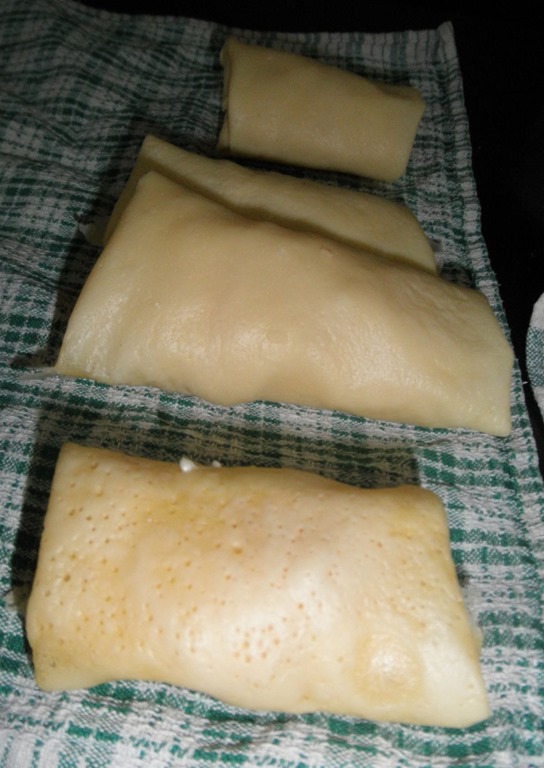
These may be frozen or refrigerated at this point – both of these processes work best if the blintzes are not touching each other. Otherwise they might stick and the outsides might tear.
Saute lightly in vegetable oil starting with the “flap” side down. Blinzes are done when the skin is golden and the filling is firm. Serve with dahi, sour cream, or with applesauce or another sweet condiment. This being India of course, any manner of savory, hot and sweet chutney might be used.
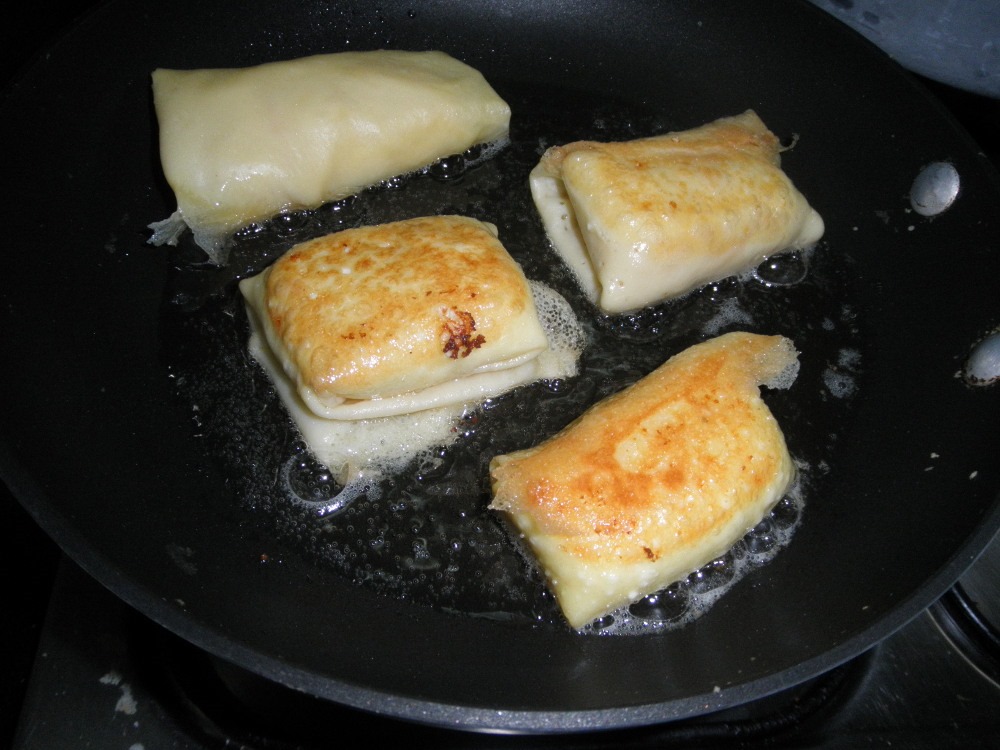
Moral of the story: where there is a will (and cheeses) there is a way!
157 AND COUNTING
Well, here I am on row 157 of Dozen, with about another 20 or so to go.

It’s a wild zaggedy thing, for sure. I also have to say that this is the last picture I’ll be posting of the thing spread out until I’m all finished and bound off. I lost 30 or so stitches in pinning this, and am not relishing going back the five or six rounds I need to now, in order to rescue them.
The directions end with a plain bind-off. I’m not going to do that. Instead, I’m planning on knitting an edging onto the live stitches. Which one, I’m not sure yet. It needs a very solid element in order to frame all this wild zappage, along with some sort of coordinating triangle or dag to carry the theme forward. I may end up having to cobble something together, or design my own to work with the last row’s stitch count.
Am I pleased with the result so far? Yes and no. I’m having fun knitting this, but I have to say that I now that I see it all expanded, I think that the outermost 20 or so rounds shown above are too textured, and detract from the star-like center.
Off to perform CPR on those 30 stitches…
PRECISION IN ALL THINGS?
First, for Davey – the wildly loud sofa pillow covers to coordinate with the wildly loud rug:
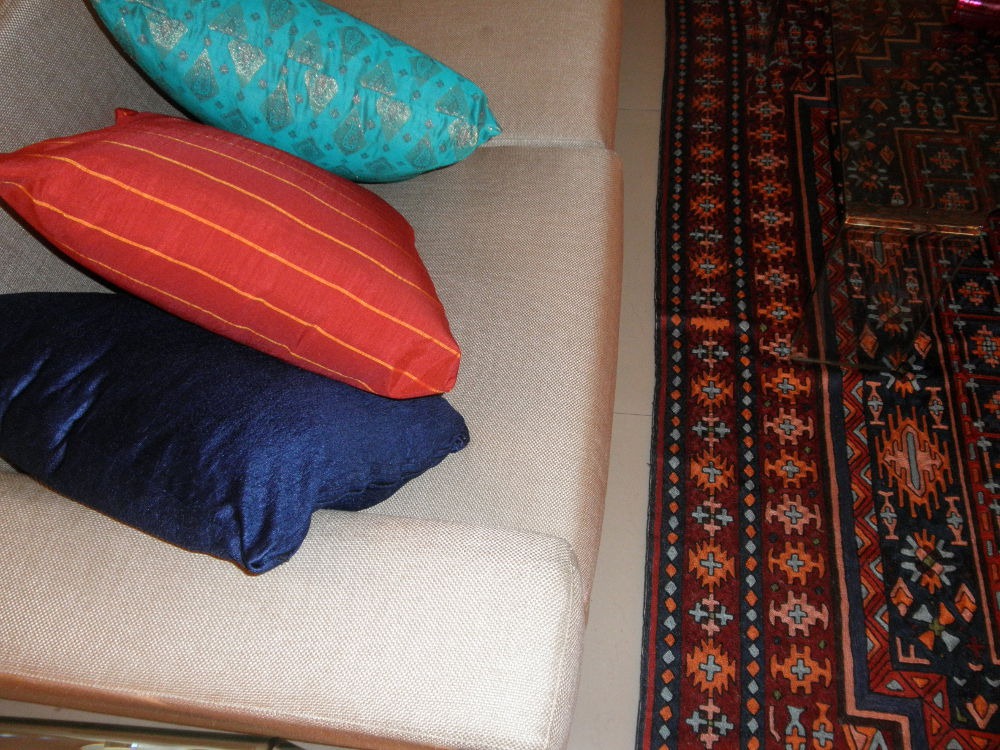
I picked the blue, red/orange stripe, and turquoise/gold from memory, and they work, even in spite of my equivocal photographic skills, and the flash-wash that makes the red pillow look paler than in real life. There are six pillows in total, two of each fabric.
Moving on, here’s progress through Row 103 of the Dozen shawl that I’m test-knitting:

It’s growing into a feral, interlaced dahlia of a design, which you can begin to see in this rough pin-out. Additional width will be more of the same.
And then there’s the Sarah Collins sampler kit, upon which I’ve started but have made no real progress:

Maybe I’ve ridden at liberty for too long, working at whim instead of direction. Maybe I’m too much of a tinkerer to do a stitched design laid out by someone else, or I have a touch of compulsive perfectionist in my soul – but for whatever reason, this kit is already driving me nuts. Don’t get me wrong, it’s a complete kit, thoughtfully laid out and as a reproduction, extremely well documented. The unruly element is me.
For example, it pains me to mindlessly duplicate the mistakes laid down by the original stitcher. See that twist column to the left of the frame? That’s verbatim to the pattern’s directions. But I tried, and tried, but just couldn’t let it sit that way. See the twist inside the frame, with the completed centers? I **had** to do it. I’ll probably pick out the offending imperfect twist and re-do it to match the edited bit.
There’s also working up the double running for this panel in two colors of sienna. The blue flower doesn’t bother me, I find that adorable. But using two threads for the framing spiral, alternating colors is maddening. It’s clear to me that dear Sarah might not have marled and finger-spun her threads properly, or perhaps ran out of one of the two shades, and that’s why the panel is done in alternating two-tone. It’s all I can do to grit my teeth and work as directed, because if I don’t, I risk running out of a color before the kit is done. Getting more matching thread, especially here, would be difficult in the extreme.
And then there’s the format of the charts. They’re huge, and orchestrate a stitch for stitch path, with every single one numbered. There are sufficient map pages in the thing to chart one’s way from Boston to Mumbai by rail (including the sunken parts via Atlantis). Paging through them is an exercise in where-the-heck-is-page-2b-left-got-to-now?” – then finding it under the sofa.
I’m also not fond of the indicated stitch logic. The paths described are not the ones I would choose. I tend to key off established bits, so that I can proof new sections against clean counts as I work. There’s too much “where no man has gone before” in this piece, with extremely long runs worked in advance of the growing body of work, and no way to confirm fidelity as one progresses.
Is there a moral to this story? Perhaps, not. But I have to admit that today’s post reveals that I’m a ruthless stickler for detail, caught up in color matching from memory, precision adherence to knitting patterns (where forays into originality are better left for after one has grokked the source design); but temperamentally incapable of similar fidelity to oh-so-obvious stitching directions. Mark it up as another character flaw, pass me a glass of wine, and move on, please.
FAR FROM A DIME A DOZEN
Well, having finished the Dragon Stole by the prolific MmarioKnits, I thought it would be helpful if I gave back a bit. So I decided to test-knit one of his newer patterns. Mmario appears to design on paper, spewing out lace patterns like rain from a garden sprinkler, in dazzling abundance. Then a coterie of the faithful test-knit the patterns. Their efforts provide the photos that accompany the designs, and they catch errors or discrepancies in the directions. I chose “Dozens” – a 12-panel shawl, for which I saw no prior testing effort. Dozens isn’t available yet on Ravelry – just on the MmarioKnits test-knitting group on Yahoo.
Here are the first 60 or so rows, roughly spread out on two circs and pinned so you can see the detail:
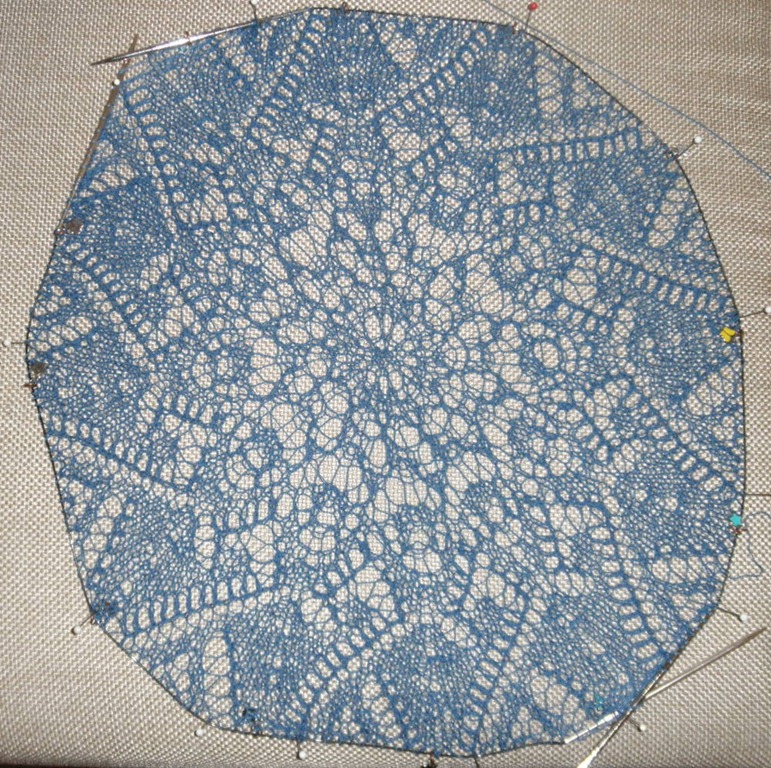
I found a correction, dutifully sent in and now present in the pattern’s master. I am hoping that I haven’t committed any mistakes yet, although I do see one awkward bit that I’m hoping will block out (the stitches are correct, just bumpy). I’m another 20 or so rows past this point now, so additional pix will follow soon.
I’m enjoying this – knitting up a “mystery project” for which I have no prior pix is fun. I find myself looking forward to seeing what each new pattern segment adds to the growing pile.
For yarn, I’m using Elann.com Peruvian Baby Lace Merino – a gift from Long Time Needlework Pal and Co-Enabler, Kathryn. The Tapestry Blue color rather more of a medium blue than the light Wedgewood it looks like in the flash photo above. I chose it because I had plenty, it’s a very nice, stretchy, uniform, two-ply laceweight, and will photograph well, unlike the mass of black and navy lace yarn I also brought. (Aside: I’m saving a huge 4189 yard hank of Jaggerspun Main Line 2/20 in black for the Sharon Miller Princess Shawl. I bought that pattern a while back, and have saved it for The Right Knitting Moment. I’ve got it here in my India survival kit, too.)
For aids, I’m working with twelve small markers, and have the PDF on my iPad, where I’m making annotations as I go using PDF Max Pro. It’s one of may PDF annotation apps. I happened to luck into it for free via the AppsGoneFree app. Other PDF reading/management apps occasionally appear there, too.
In other news, I have now golfed here in Pune. No holes or flags need fear my approach shots. The Resident Male however was quite deadly on the course this weekend past.
DRAGON DONE!
LATE BREAKING UPDATE: CHART FOR VARIANT SHOWN BELOW IS NOW AVAILABLE IN THE KNITTING PATTERNS SECTION OF STRING, ABOVE.
It’s finished. Not blocked, but done.
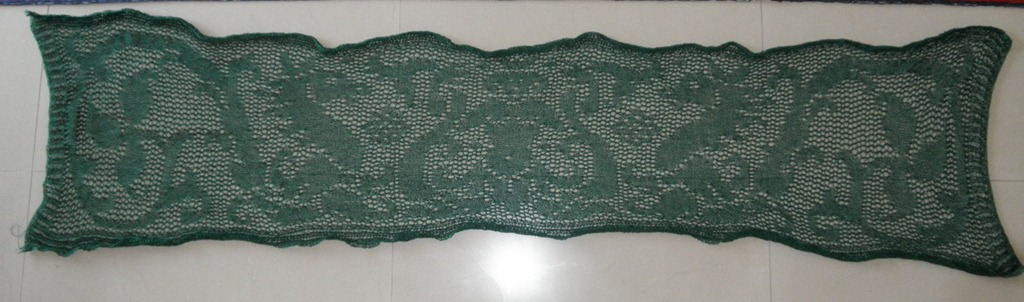
I can’t block it here – there’s no place for me to pin it out, the floors being marble and the beds being too small. I had a lot of fun with this, both working from the original MMarioKnits design, and adding in the center mermaid, from the Renaissance graph that descended to MMario, via his Victorian era source.
Finished pre-block dimension: approximately 90 inches x 22.5 inches (228.6cm x 57.2cm). With very little coaxing this will block out to at least 100 inches x 25 inches.
I can’t give an approximation of yarn consumption. I worked from a cone of Valley Yarns 8/2 Tencel. I have more than half the cone left, although I don’t have a scale to weigh it to confirm the quantity. I enjoyed the yarn – it was smooth, evenly spun, shiny and well behaved throughout. It never kinked or came off the cone in tangles. Although most people use it for weaving, I’d recommend it highly for lace knitting, for its lush, silk like luster; its handling, and finished fabric texture; and for its excellent value. I’d buy it again, for sure.
I’m not sure what’s next. I saw extremely little interest in my offer to graph up and possibly re-knit the doodle scarf. That’s a lot of work, so I will probably skip it unless there’s an outcry of desire.
I may play more with this style of filet knitting, mess with something from one of the lace books I brought with me. I may take a side trip into filet crochet, do some stitching – or I may do something else entirely. The possibilities are endless. Or at least as deep as my box of refugee’s needlework supplies. Stay tuned!
IN WHICH WE BUY RUGS
I’m sure that ever since humankind first wiggled toes on a bare floor, and decided that something colorful and soft would be nifty to stand on, no rug dealer has ever lost money on a transaction. That being said, I am quite satisfied with value we bargained for today.
Our apartment here in Pune is very white. White unadorned walls, hard white marble floors, neutral color furniture and curtains, all blend together to make the comfy but totally featureless box in which we live. I did bring bright color sheets and towels, but we certainly could use more visual contrast here. So today we went out looking for area rugs to bring some color and brightness to the place.
After a minor comedy of misunderstanding with our driver (“rug” here means bed covering or bedspread), we ended up at a store specializing in Kashmiri handcrafts, where we looked at lots of small and mid-size carpets (aka “Orientals” in local English). We ended up selecting two items, to use here and then to send home to use there. Both are about 6’ x 9’.
One is an all wool hand-knotted rug in a traditional pattern:

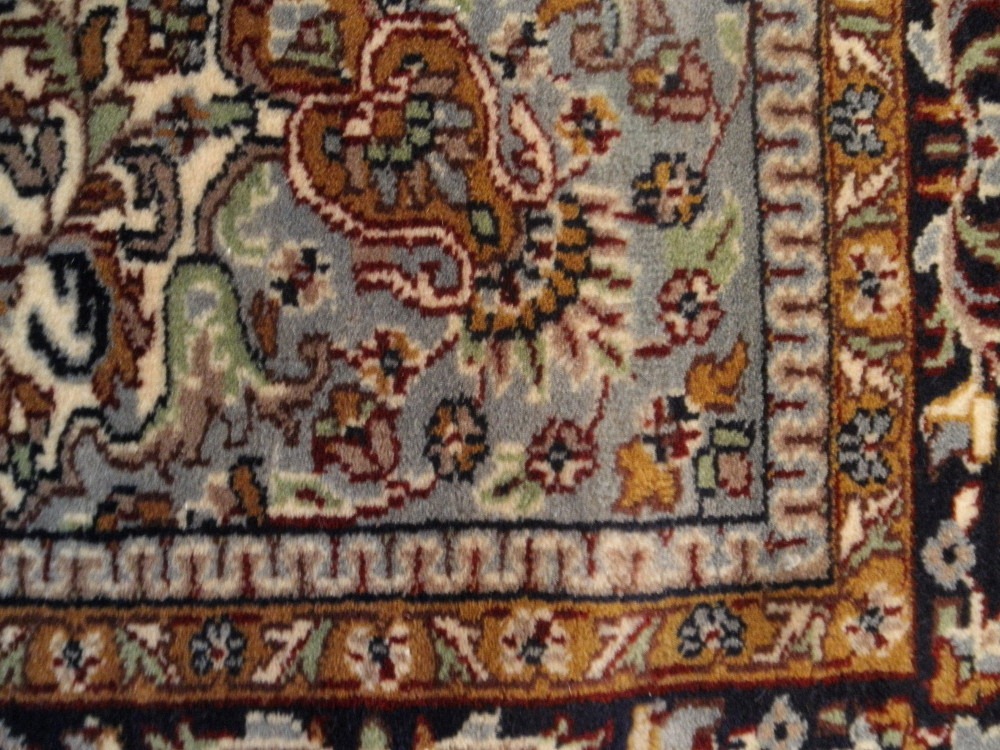
The main colors are oxblood, steel, and tan, with accents of celadon and ecru. It’s plush and thick, and a joy to walk on. I can’t remember the knot count, but from the unofficial hierarchy of all-wool rugs, this is an A-grade. There were a couple that were even finer, but not in all wool. I really like the minor variations in the pattern repeats – something that brings the design to a life not achieved by machine made rugs.
The other is a type less commonly seen in the USA. It’s all cotton, done entirely in tambour (ata needle) embroidery. The stitching is so dense that it totally covers the ground cloth with work that closely resembles chain stitch:


Also handmade, it’s backed with a second layer of heavy cotton. The colors are garnet, sapphire, gold, and orange, with accents of leaf green, baby blue, brown and white. It’s no where near as thick as the wool rug, but it shines like a jewel. It won’t last as long as the knotted rug, and isn’t suitable for heavy traffic areas or for under chairs that move around, but it’s perfect for our living/sitting area with its fixed furniture.
Next I go to a textile vendor to buy some similarly brilliant yardage, to sew new covers for the brown and ecru throw pillows on our sofa (or have them sewn by a local sewing-shop).
I feel brighter already!
BIGGER THAN A BED
And more progress on the stole. As I said before, we’re on the downhill leg of this journey – the challenges are all now put to bed, and things are just sailing along:

Here’s the whole thing, folded on the bed, just to prove that I’m not unraveling from the beginning end. This is a king-size bed, so you can imagine how long the thing is now!

I anticipate finishing up by the coming weekend, latest. Blocking however will have to wait. I’ve got no soft surfaces in this apartment large enough to do it, since pins don’t stick well in bare marble floors.
Next? Not sure. I’ve got a lot of stitching I want to do, but before that, I’ve been asked to consider doing up the pattern for the scarf I use as my avatar photo on Nimblestix and Ravelry:


To do that I’d need to roll up my sleeves and figure out what the heck I did. Also do the graphs. I adapted this from designs in the Duchrow books, and considerable reinterpretation into modern notation was necessary. But what I won’t have would be yarn quantities – the scarf is at home on the other side of the world.
So the question – would a pattern without yarn quantities be useful? Would you be interested in knitting up something like this?
SO MY STOLE DOES GROW
I’m in the home stretch now, well past the line of reflection in the center. The figures at this point are straight repeats of those already accomplished. Plus I’ve long since aged off the line by line prose instructions. It’s far easier – for me at least – to keep track of where I am and spot check my progress against a visual chart than a mass of line by line directions.
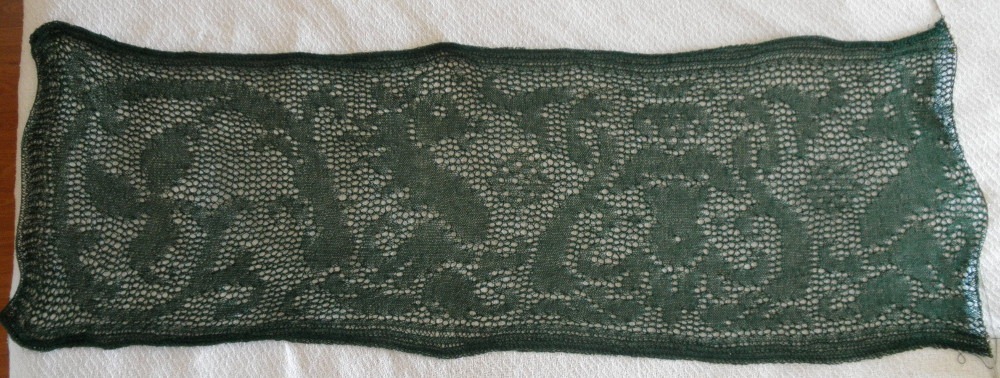
And here’s a close-up of the center mermaid for Kathryn and Hastings:

The first shot above was taken with the stole patted out on my bed. It’s worth noting that it’s a king-size bed, and the stole as it is right now stretches almost entirely across. I don’t know how I’m going to block it here because I can’t pin it to the marble floors. I might have to wait until we get a rug, provided of course, the rug is large enough.
In other news, India continues to delight and baffle me. A new found friend gave me a flyer for a western-style bakery that does home delivery. Tired of supermarket bread and my own feeble attempts at roti and parathas, we chanced it. “Look! Bagels and Danish!” Here’s what we got:
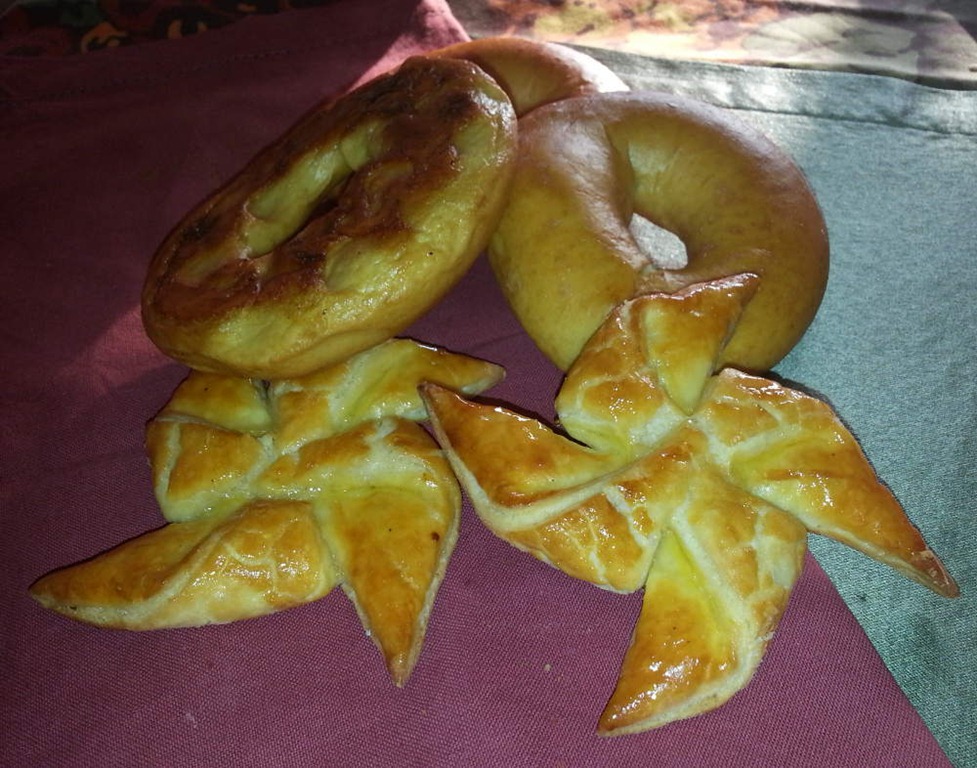
The Danish were nice – flaky, but very sweet. These are fruit. The cheese ones were also flaky, and being less sweet, even better.
The bagels though were open to wider interpretation. As a toroid breakfast bread, they were fine grained, more like a pierced Pullman loaf than a bagel, clearly made from a raised dough with more butter in it than the bagel standard. Also they were neither boiled nor crusty. However they did go nicely toasted, with butter and cheese. The verdict – o.k., certainly a better start to the morning than the local equivalent of Wonder Bread, but are perhaps an bagel incarnation informed only by pictures, conceptualized and baked by someone who has never eaten one. But labels are only labels. I say pass the “bagel” – tomorrow’s will go great with Nutella.
MORE NEW VOCABULARY
More words that though not new, are new to me as I read local newspapers and advertisements, and learn more about Pune, and India in general.
Guntha – A measure of area, about 10 x 10 meters, roughly equivalent to 1/40th of an acre. It’s common to see magazine articles noting the reservation of a certain number of gunthas, to be dedicated to parking or some other specialty use.
Dabbas – Lunch boxes. These are the Indian version of bento boxes, traditionally carried by school children or workers. There’s even a whole industry dedicated to speedy transport of dabbas from home to office workers, or to supply catered dabbas for those who need non home-cooked meals, ensuring a hot, fresh-cooked lunch when and were it is needed. Note the multiple compartments for keeping several items warm and separate until they are eaten. I’ve also seen these called tiffin boxes or tingkats.
Gutka – A word from the tabloid papers. An addictive, chewed stimulant based on betel nuts, plus other substances. Apparently there is a thriving trade in this illegally manufactured, untaxed, carcinogenic, (and often dangerously contaminated) stimulant. Every now and again there’s a piece on the arrest of a maker, transporter or gang of distributors.
Gram Panchayat – A village council, or local government body at the village or town level. Panchayat representatives are elected from panches – the village wards or districts. A proportion of each local panchayat’s seats are reserved for women representatives. Panchayats can levy taxes on some local activities, and are responsible for civic activities, including street lights, public education, drinking water, sanitation, and population records. Sadly, not all seem to serve in the public interest though, because occasional newspaper pieces talk of isolated cases of voter coercion, misapplication or misappropriation of funds, or naive choices with unforseen outcomes. Not unlike local governments in other places.
Techie – A member of the “New India” workforce, especially one working in an engineering or technical field. The tabloids especially seem to have a fascination for young professionals and their doings. Many are 20- and 30-somethings with disposable incomes, far away from the watchful eyes of their families. Not surprisingly, occasionally they or come to harm, either self inflicted through careless behavior, or through victimization; or they commit crimes of passion. These especially are reported with breathless detail.
Tatkal Tickets – These appear to be railway tickets booked in advance like airline tickets, as opposed to tickets that are purchased at the train station. There’s a surcharge for advanced purchase. And since it’s probably now clear that my new words are largely furnished by the sensational crimes section of the local papers, there are occasional pieces on folk who have figured out how to hustle the system, and scalp tickets. Photo ID is now required for passengers boarding trains with pre-paid tatkal tickets.
How do I like it here? My friend Osa was right. Every day is an opportunity for limitless learning and the development of infinite patience. Small challenges can be daunting (like finding someplace to buy the very unusual light bulbs used in the apartment) but while accomplishing these quests may take time and present transient frustration, the sense of accomplishment, and joy in new things is palpable. In short, I’m having a great time.
 String-Or-Nothing