WE ARE FIVE
As you can see, motifs continue to accumulate on North Truro:
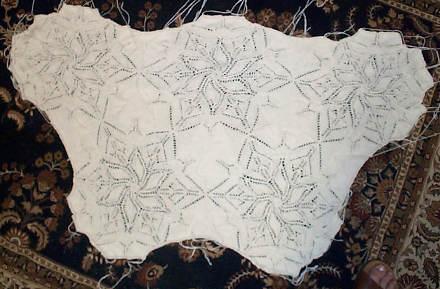
The observant will spot more evidence of my continued existence in the
photo’s lower right. Apologies for the quality of this shot. I
recently replaced the hand-me-down 1.3 mega pixel camera I had been
using with a hand-me-down 3 mega pixel camera. In theory, the best
quality setting of the latter should be better than the best quality
setting of the former. Apparently there is room for contention in
this theory. Still, you can see how the design continues to
grow. Next week’s progress shot will feature the thing on the top
of a queen size bed so you can see how far I’ve got to go.
I’m afraid that while this piece remains interesting to knit, I’m
rapidly running out of things to say about it. I don’t anticipate
any earth shaking discoveries until I get up to the bit where I have to
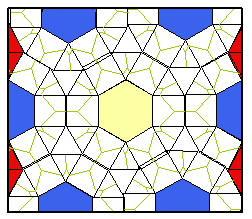
improvise half motifs to go around the edges:
Since I prefer the look of a nice straight edge and matching edging to
the rippled look of a "bare motif" spread, I’ll also have to invent
something to eke out the east/west sides. Plus the actual edging
of course. You can see the full motif smack in the center of this
layout (full yellow hex in the center). The half hexes are in
blue. They’ll pose a bit of a challenge because they’ll have to
be knit flat as opposed to in the round, but since I chart my patterns
by repeat, I don’t need to do any redrafting – just remembering the
circ/flat inversion and only working three rather than six
"petals."? The squares on the edge next to the half hexes also
need to be modified. There will be left and right halfies to
preserve the pattern’s lines. The hardest part will be the half
triangles needed to eke the thing out east and west. Fiddly but
easy to do. I never quite like the way they turn out.
Thought for the day:? Life is only as complicated as you make it.
FOUR TODAY FOR TODAY
Four motifs done. My guesstimate is that four represents about 15% of
the total finished area. That means I’m looking at something like 26 or
so in total, with some of them being halfies.
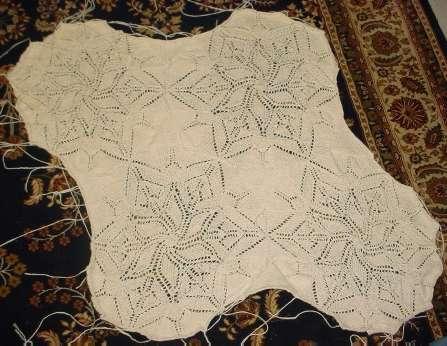
It
looks like the trillium background shapes will form rings around the
star motifs. I’m really looking forward to seeing that develop. My next
step though may be to work out the half-width motif set. That would
include a half-hex, three normal triangles, one normal square and two
half-width squares.
UPDATE – Looking for past posts here
I do try to post stuff here that I hope is useful. I also realize
that much of it might not strike a reader as being useful today, but
might stick in memory somewhere and pop up when the specific need is
encountered. I’ve gotten a couple of questions (including a
comment early today) about how to find past posts. I’ve tried to
provide tools to do that.
First, for the knitting projects and some broad subject areas, I’ve set
up category tags. You can see them in the right hand sidebar (you
might have to scroll right a bit because of an over-large graphic I
posted last week). Projects all are named something like "Project
– Lacy Scarf" and index all the posts that mention each project.
The broad subject categories also work that way. Clicking on the
"Reference Shelf" tag will bring up all the posts that I thought people
might find especially helpful, likewise "Embroidery" should find all
the posts that discuss that subject.
Some particularly popular posts have merited direct access under the
major category "References," also in the right hand sidebar. Yarn
Labels 101 and 102 for example are two posts that get lots of traffic
from people just becoming familiar with yarn labels and how to read
them.
Finally for all those search needs that keyword indexing didn’t
anticipate, there’s a search box in that same sidebar. You can
type a word in there and bring up all posts that mention it, or you can
click on the "advanced search" tag right below that box to do more
complex multi-word or time-limited searches. Typing "booties" in
the search box should find the posts I did on A. Krekel’s pattern for
booties that really do stay on.
COUNTERPANE QUESTIONS
I know I said I wasn’t going to bore anyone with further progress on my
North Truro Counterpane, but I did get to an interesting point
yesterday, and my inbox has been graced with several questions.
First, the show and tell:

As
you can see, I finished a couple more side squares of Motif #3, and
seamed in most of the other little triangles that I knit over the
weekend. That let me join #3 onto the two units I had already
completed. I like the accidental trillium flower of negative space that
forms where three motifs join. I’d love to say that was intentional,
but it wasn’t. There’s lots that science doesn’t know about this
designing stuff, yet.
Now for the mailbag:
Aren’t you going to have a bushel of ends to deal with?
Two
bushels. Even though I’m knitting the squares out from the hex center,
there’s two for the center hex, plus two for each for six squares, plus
two each for six triangles, minus one for the hex end I use to do the
first square, and one for the end that doesn’t get started at the
outset of that first square. 24 in all for each motif. As you can see
in the pix, I like to leave them long so they’re available for sewing
the motifs together. As I get further into the thing, I’ll know WHICH I
need to leave particularly long, and which I can plan to be shorter.
Still, I plan on darning in ends incrementally as I go along rather
than waiting for the end of the entire project.
Why aren’t you blocking the motifs before sewing them together?
Good
question. Sometimes I do block the motifs before I assemble them. This
time I didn’t. This particular no-name yarn and needle combo seem to
produce motifs that lie relatively flat, showing the openwork well
without the block. I suspect my squish problem WOULD be partially fixed
by blocking, but leaving the hex motif live on the circular as I finish
out the squares isn’t exactly conducive to the knit-block-assemble
production method. Plus pinning out each night’s production means
leaving the ironing board up to do the blocking, and I don’t want to
trip over it for the next umpteen months.
Are you going to leave the edges wavy?
I
could. You can see that the lower edge makes a nice gentle wave. I
could leave the thing raw, edge it with I-cord, or sew on a (yet to be
designed) complementing edge strip just as it is. But I probably won’t.
Just on the principle that the biggest fun comes from the most abstruse
and useless effort, I’ll probably do up half hexes and half squares to
produce a nice straight edge, then affix that as yet mythical edging to
it.
Lovely crib blanket! You’re nuts for spending so much effort on a baby blanket.
Huh?
This is destined to be an oversized Queen-size spread for my own bed.
(I’ve knit a blankie for each of the kids, why can’t I have one, too?)
If you think I’m addled for attempting this as a mini-throw, I’m sure
you think I’m a gibbering raving loon for doing one that big.
PLUGGING ALONG
I was busy this weekend past.
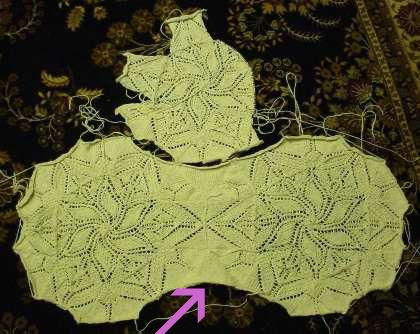
I worked out the plain triangle and made two. Both are sewn into the
growing group. One is indicated by the arrow. I do have a bit of a
scrunch problem, but probably not so much that it can’t be ignored.
The sides of my triangle are less tall than its base is wide.
Therefore, when I’m sewing the bases of the patterned triangles onto
the sides of the plain one, I have to squish them up a bit. You can see the slight rumples that result.
I do however like the way the points of the stars align. While
the orientation I tried last time had more movement in it, because the
stars were offset, this one will have less background area.

For those who have asked how I add arrows or other annotations to my
photos – I use Macromedia Fireworks to slim, retouch, or otherwise
manage my images. I cheat – the arrows are Wingding font
"letters" added with the text tool.
Shoe size chart
Some people have pointed out that their European shoe sizes are off a
bit from the chart shown yesterday. Mostly at the upper
end. The chart’s represented equivalent for US shoe sizes Women’s
9 and above seems to work out one unit larger than people are
reporting. So a 10.5 would be closer to a 42 than a
43. Grains of salt are advised.
INCHING ALONG
More bits and pieces are accumulating. You can see I’m more than
half way done with the second meta-motif. I’ve got two triangles
to sew on (I don’t actually do the stitching until the squares on both
sides of a triangle are complete.

In this photo you can better see what the motifs look like
individually. The center hex is pretty straightforward. The
triangle
is knit base to tip. The tip’s center is a textured stitch.
The
square (shown attached to the center hex at the bottom right) also
features the same textured area in the parallelograms that flank its
center spine. When the motifs are placed together, these textured
areas join up to make the star-shaped framing device that surrounds the
center hex’s flower.
Unfortunately this sort of project isn’t very good for blog progress
reporting. From here on in it’s going to be more photos of
exactly the same thing, done again and again and again and again.
You get the idea. I’ll probably mark the completion of each
meta-unit, and show a couple more photos of significant milestones –
like joining the motifs using the plain triangles I wrote about last
week, but I’ll try to avoid boring everyone with needless
repetition. Which means I’ll have to think up something else to
write about.
N. TRURO – SECOND MOTIF
As you can see, I’m making slow progress on my counterpane.

Athough you can’t read the tape measure, one meta-unit unblocked measures around 15.5 inches across.
I’ve started the second motif, and done the hex,? half of its
squares, and one triangle. Here I’ve lined up the two as I intend
to sew them together. I will need a fourth motif when I finally
get enough done. It will probably be a solid stockinette
triangle, to go in this spot:
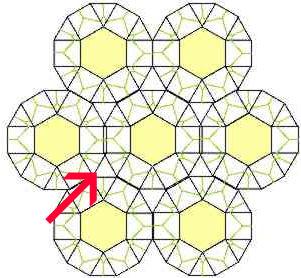
Either that or I need to engineer something with lines of YOs that match up with those on the bordering squares.
I did spend quite a bit of time trying to make a triangle knit from the
tip down that is as close as possible to the one I’ve got that’s knit
from the base up. So far no dice. I just can’t get a
congruent pattern on the rows that use YOs and double decreases in the
original. My triangles end up being rather rotund, and I lose the
lacy openness of my original. Plus the nifty lines formed by the
YOs are shifted somewhat, and no longer align with the squares when all
is to be sewn together. My counterpane will have to remain
assembled from lots of smaller pieces. Perhaps the next one I
play with will be an honest dodecagon rather than this assembled one.
And for those who have written to say that I’m a crazed loon for trying to knit this higher complexity tesselation instead of sticking to plain old squares or hexes, you’re not telling me anything new. Go play with geometry.
NORMALCY? WHAT’S THAT?
I have now survived my week from hell, managed to recuperate (somewhat); and we have returned the house to something resembling order. It’s not a very close resemblance, as this family’s housekeeping skill set is rather deficient, but horizontal surfaces can now be seen, laundry is no longer threatening to avalanche, and a machete is no longer needed to find the front door.
Add to that some progress on my counterpane:
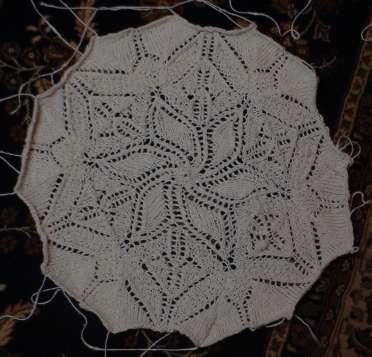
As you can see, I’ve finished the first meta-motif, including seaming in the corner triangles. It’s a bit smaller than my original estimate, but not by much. Plus it will be stretched a bit not only in the blocking, but also by the natural tension of the surrounding motifs once it is in place. One thing I’m pleased with is the lack of cupping in the center hex. Too tight blocking plus that extra seam between the bottom of the squares and the sides of the hex constrained the stretch of the thing the last time around. Working the squares directly onto live stitches around the hex appears to have eliminated that problem.
Now there’s a new thing to consider. I’ve got a dodecagon (a twelve sided figure) here. Right now the triangle units are knit base to tip. But if I figure out a way to flip the design over, it’s conceivable that I could translate the thing into a tip-out piece. AND if I can do that, it’s possible for me to add those units to the squares, already worked center out, and instead of a bunch of smaller seamed pieces, produce the twelve sided meta-unit as a single piece.
Food for thought here…
QUESTIONS – NORTH TRURO COUNTERPANE
How do you start the hexes?
There
are quite a few ways to start off a flat knit piece done both in the
round and center out. I keep gravitating back to the I-cord method.
This piece is a hex, so I start by casting on a three-stitch I-cord,
and working one round (I’d start off an octagon with four stitches). On
the second round of the I-cord, I take my first needle and knit one,
then make an increase in the space between the just worked and next
stitch. If I want a more open center I’ll do a YO. If I want a more
solidly filled center, I’ll do a make 1 lifted bar increase (a devil to
do on the second round of an I-cord). Then I’ll take another needle and
repeat the K1, increase 1 unit. And again on a third needle. Now I have
three needles in the work, each bearing two stitches, plus one in the
hand to work with. At this point I flip over and begin following my
pattern. For an octagon, I’d do much the same, but with a set of five
instead of four needles.
Why bother with the multiple units when you can just assemble the hexes into a perfectly good counterpane?
For pretty much the same reason I make cassoulet instead of being happy with franks and beans.
How big are your motifs?? How many are you planning on making?
It’s
difficult to get a gauge on this stuff, but if forced, I’d say I’m
getting approximately 6 stitches and 8 rows per inch over the
stockinette areas. Unblocked, my center most hexes are about 10 inches
across at the widest point. The squares are about 5.5 inches on a
side. The bases of the triangles are also about 5.5 inches across. One
entire meta-unit of hex surrounded by squares and triangles (unblocked)
is about 21 inches across. I haven’t measured my bed yet, but it’s only
a queen size. Given the vague bed linen sizes posted here
and there, my counterpane should be a square or a rectangle something
between 85 and 100 inches on a side. I’ll need at least 4 units across
and 5 units head to foot. Given my chosen layout, that’s about
four rows of four units, plus three rows of three units, or 28 units.
That adds up to 28 hexes plus 168 squares and 168 triangles. Plus
half hexes, and the smaller units needed to square out the edges
somewhat (they’re never going to be exactly linear), and an edging of
some unknown depth. I’m not quite sure how many of the other shapes
I’ll need yet.
Doing the same size counterpane using only the hex units would mean
making about 10 rows of 8 units, and 9 rows of 7 units – that’s 142
hexes, plus edge half hexes and a border.
This project should keep me busy for a while.
QUESTION GRAB-BAG
A few knitting and non-knitting related questions from the inbox:
How did Killer Bunnies go?
Tons of fun. We played as a mixed-age group, with the youngest
being 7. We had hoped to get the Red Expansion Pack at Puzzle Me This
in Provincetown, but they were out. We settled for Violet, the
next one in sequence. The game plays more smoothly if you add
them in order because each pack builds on the last, but we were able to
use most of the Violet cards anyway.
What size needles did you use for the two versions of your counterpane?
The old version in the heavier cotton was knit on one of my odd size
needles, it’s a set of old long steel DPNs, they’re probably antique 9s
– and just a bit larger than standard US #4s (3.5mm), but closer to #4s
than #5s (3.75mm). The new piece is knit on 3mm needles, which in
some makers’ lines is a US #2, and in some is somewhere between a US#2
and a US #3.
Did you finish that embroidery doodle while you were away?

Are you planning on assembling the counterpane in the same way as the last try?
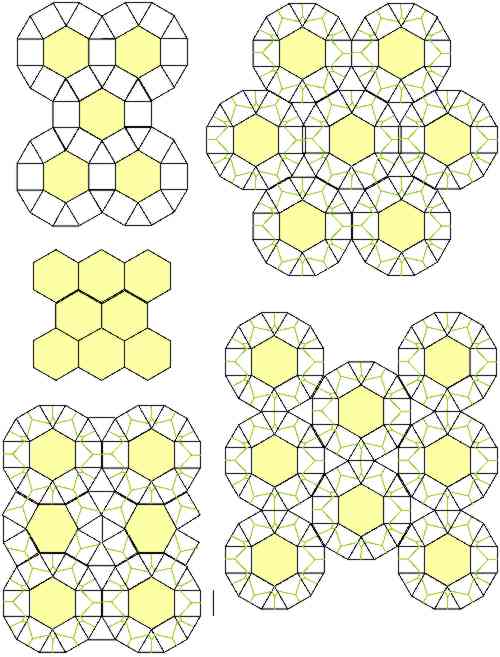
No. These units can be joined in many ways. Last time I
butted the triangles together. This time I plan to join
squares. My goal is to do the layout shown at the upper
right. Last time I used the one at the lower right. Both
use some plain solid triangles in addition to the pattern bearing units.
Where did you buy the counterpane pattern?
I didn’t. I made it up, starting with a standard spiraled
star. I added the outline-like bars to emphasize the motif, and
played with several treatments for the ground behind the star.
This one like my Mountain Laurel counterpane plays with a textured
ground and smooth star, but unlike that piece, plays a bit more with
the ground. I also wanted to do a counterpane that was an
tessellation of more interest than a flat tiled hex or a plain octagon
and hex. That’s why there are four units – the center hex, a
patterned square, a patterned triangle, and a plain triangle. The
layout above is actually an early draft showing how I played with the
concept, looking at ways in which I could use the patterned units to
extend the lines of the center hexes.
Can you send me the pattern?
Be patient. I plan on posting it to wiseNeedle this year –
probably after I’ve gotten considerably more done on the thing and have
a decent representation of the piece’s final look. I’d also like
to noodle up a complementing half hex and border.
RETURN TO REALITY
The only problem with starting out the summer with one’s vacation is that while there’s lots for the kids to look forward to in July and August, to me it feels like summer is already over.
While we had great fun on our week away, the weather wasn’t ideal. I didn’t mind the wet and cold because I was at my favorite place on earth – the beach in North Truro on Cape Cod. This is sunset over Provincetown, as seen from the deck of our room on one of the nicer days.

We had a couple of good beach days at the start of the week, then the weather turned cold and nasty. Luckily we were there with friends, and between good companionship and copiously applied wine, were able to keep both warm and entertained.
I did get in some knitting, but progress was slow. I was re-creating my North Truro counterpane pattern – invented in the very same spot – from my sketchy notes. I got off to a couple of false starts, regraphed some probelm areas, made some of the lines of the piece crisper, and played with various methods of joniing that avoid some need for seaming. Here’s the result:
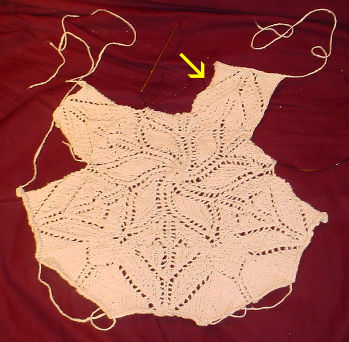
As you can see, I’m mid-motif. The initial unit is the hex in the center. I knit that starting on some 3mm DPNs, moving to a circ as it got larger. Instead of binding off, I purled my final row, and left the thing on the circ. Then I attached my yarn at what looked to be a good corner point, and holding the thing with the reverse side front, knit one side’s worth of stitches. That produced the appearance of two rounds of purl on the front at the base of my soon-to-be-knit side square. I then worked the side square out using two DPNs. I worked my side squares attached like this, one at a time. After I got a couple done, I knit a side triangle separately (it’s worked base to tip) and sewed it into place.
I also experimented with skewing the attachment of the square unit. Since it really doesn’t matter where on the center hex the sides begin and end, I knit one square on katywumpus – aligning its center to the point of the star instead of to the center of the leaf motif in between the star arms. You can see it above. It’s the lone square that I’ve pointed out with the arrow. I’ve decided I like the original orientation better and left it intact just long enough to photograph.
Well and good. Things look like they’re working out. I’ve avoided working all those squares separately and the seams joining them to the hex in the center. My bargain basement Webs-find yarn is working out well, with a very soft slubby cotton hand. I like it a lot. Compare it to my first iteration of this idea:

I don’t know if you can see it, but the older yarn is MUCH heavier. It’s a very dense cotton worsted – almost a twine. The newer yarn is a 90% cotton, 10% acrylic blend, and is somewhere between DK and sport in thickness, plus it’s much less densely structured than the older stuff. The lighter yarn drapes better, plus it shows off the motifs better. All in all, things look quite promising!
 String-Or-Nothing