SWIMMING ALONG
More progress has been made on my Two Fish blackwork piece.
I’ve gotten more questions about how I go about doing these. I’ll try to answer them here, rather than piecemeal by message. If you have additional questions, please feel free to post them in the comments. I’ll sweep up all that lands there, and then answer them in the next Fish post. First – today’s progress:
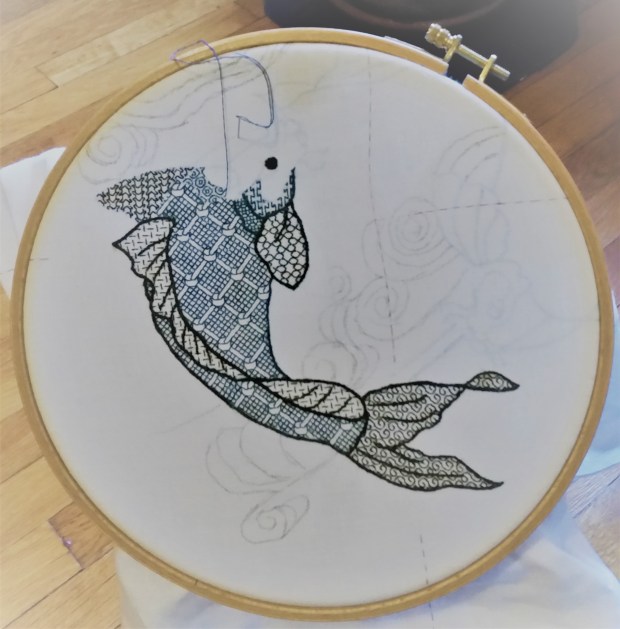
And the questions….
Where can I get this kit?
There is no kit, it’s an original composition of classic elements that I am designing on the fly. I won’t be publishing a chart for the final project, or releasing it as a kit.
Original? How?
The Resident Male had mentioned a two-fish embroidery a while back, so I started by looking at a few on-line images of swimming koi. Here’s a post about designing original projects drawn from various sources of inspiration.
Using the freeware GIMP graphics program, I adapted a couple, starting by tracing some, then merging them to blend parts together, simplifying details, changing proportions, increasing the spine curvature, and tweaking angles – until I had a fish I liked. Then I flip-mirrored it so that I had two fish circling each other. After that I added the “water lines” behind the pair – adapting them from the bit below (from a book of traditional Japanese wave and ripple designs – Ha Bun Shu, by Yusan Mori, circa 1919), also traced, augmented a bit and then enlarged.

Once I had the whole thing drawn out, I sized it up to be my desired dimension, using the GIMP resize feature, and printed it out on paper.
How did you prepare your cloth?
I selected a piece of 40-count linen, cut a square about 30% larger than my target design dimensions, hemmed all four edges, and basted guide lines to help me identify the center point. On this project I am picking out those guide lines as stitching encroaches on them. I’ve got no need to keep them intact because nothing depends on placement against them. For the record, I’m working my fills over 2×2 threads – 20 stitches per inch.
How did you get the drawing onto the cloth?
I used the poor-girl’s light table – a big window, and a bit of painters’ tape. I took my resized drawing and taped it to my dining room window, then centering the basted lines of my already-hemmed and center-identified fabric over the marked center of the on-paper design, I taped the ground cloth to the window on top of the paper pattern. This is the same method I used for my Ganesh project, although I had just Scotch Tape in India:

Then I traced the design onto the ground using a bunch of pencils I had to hand – some washable pencils intended for cloth marking, some not. I’ll probably regret not using Proper Pencils, but the urge to get going does not always wait until optimal supplies have been secured.
Did you graph out the whole design?
Nope. All I transferred to the cloth were the outlines. For inhabited blackwork (the substyle that uses outlines plus fills), I never graph out the whole project. Once the outlines are on the cloth, I work my fillings right into the spaces indicated, if needed, by looking at a sample of the design, either on another cloth or on paper.
At the time I did the tracing, I had absolutely no firm thoughts about colors, fill designs to use, thickness of outlines, or how to work the water lines. I knew I wanted to use a hand-dyed indigo silk, and possibly some couched metallic thread, but that was it.
Where are the fills from? How do you pick what fills to use?
In truth, I have no idea which fill I will use for any particular spot until I am ready to stitch it and make my selection. Most of the fills I’ll use on this piece are in Ensamplario Atlantio, my free eBook of blackwork geometrics, but I may draft up more or tweak existing ones as needed.
In this case I started with the largest area on the darker of the two fish. I wanted something vaguely reminiscent of scales, but with more interest. I thumbed through book and hit upon the knot design. For the other side of the fish, I used the same fill, but offset it, to imply movement (mating the design across the fin area would have made a flat, static composition). I wanted the tail to feel “swishy” so I chose a design with a prominent swirl. For the back fin, I chose one of the lightest fills, for contrast. The fin behind the fish uses a darker effect fill than the fin in front, again to add depth. And so on.
I try to scale the chosen fill to the size of the area where it will live. Big areas get the largest, most demonstrative fills. Small areas get smaller repeats. Sometimes though I’ll violate this, if a larger design has a smaller sub-element that will fit entirely in the current space – like picking one strawberry out of a larger repeat and using just that.
Do you ever pick a fill you regret later?
Sure. Sometimes a fill does not show to good advantage next to its neighbors. Then I pick it out and try again. But this doesn’t happen very often.
What about the outlines?
I almost always wait to embroider the outlines until all of the adjacent fills have been completed. This gives me a bit of time to be satisfied with the fills as worked, and lets me cover up the edges where fills meet. It’s MUCH easier to cover up than to work flush to a pre-stitched outline, especially when the fill may require a half-stitch at the edge for complete coverage.
The exception for this was my Forever Coif. Instead of drawing the design on my ground, I used cross stitch to lay down my outlines (based on a familiar design, charted in my New Carolingian Modelbook), and then in-filled the to-be-stitched areas with geometrics. Finally, I over-embroidered my cross stitch outlines to make them heavier and more prominent. The original cross stitching does not show:
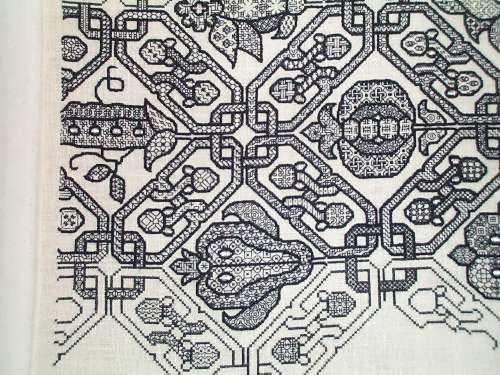
On Two Fish, I am using mostly reverse chain stitch for the outlines. The thinner accent lines inside the fins and tail are split stitch. Differences in line thickness are achieved by using different numbers of floss strands.
Color? Heresy?
Why not? This is an original, modern piece, done using styles and techniques inspired by historical stitching. There are no Embroidery Police waiting to ticket me because I am using multiple colors.
I started out intending to only use the indigo – a product dyed by a friend of mine. While I love the look, I decided I wanted to play with an additional vector of contrast, so I liberated some commercial Au Ver a Soie Soie D’Alger from my big green sampler project and began experimenting. I liked the additional depth it gave. I may do the other fish as a tonal “opposite” to this one – a traditional treatment of the two-circling-koi motif. If I do, I may swap placement of the colors as well as changing up the density of the fills, so that Fish #2 may have a less dense green body, but darker blue fins and tail.
And the wavy water lines?
Right now, I am still thinking couched metallics. I haven’t decided between gold or silver, or a mix of both. I have some nice silver passing thread brought back from my Paris trip, but nothing comparable in gold, and only a limited quantity of the Sajou stuff. So I have to find the **right** thread for them. That’s going to be tough, with no local sources. I’ll have to rely on recommendations, on-line reviews, and catalog descriptions. Suggestions will be gratefully accepted!
THE AZEMMOUR CLUSTER
Thanks to Elaine, whose comment on the Spider Flower post sent me off on a new research quest, a group that had long intrigued me has now been solidly planted.
I had seen many examples of what appeared to be a related set of stitched fragments, from many museums, collected over many decades – mostly by amateurs in the late 1800s/early 1900s. These were identifiable as being a group because of shared motifs, designs, treatments, materials and overall look. But the museum IDs and book citations were all over the place, citing individual examples as being from anywhere from the Greek Islands, to Sicily, Northern Africa (unspecified), Spain, and the Italian mainland. For example, all of the patterns on this page can be found in Lipperheide’s Muster altitalienischer Leinenstickrei, Volume 1, published in 1881, credited as Italian works. Dates also ranged widely with some examples being attributed as early as the 1500s, and others tagged as late 1800s to early 1900s. I do note however that comparing current tags to my old notes, over the last few years several museums have updated their provenance notations to locate this group in Azemmour, Morocco.
We’ve already seen the Spider Flower, this example from the Boston Museum of Fine Arts, Accession 93.208. Again, their sample is undated, and is tagged as Spanish or North African, with a note that it is “Italian embroidery.”

Here are some others of the same group. This one I tag as the Pomegranate Meander, because the ornament on the diagonals has swollen into an enormous fruit, and the center flower has shrunk down to a skeletal remainder. This sample is quoted from the Cleveland Museum of Art’s photo, and is tagged in their collection as being from Azemmur (an alternate spelling), 19th century, Accession 1929.843.
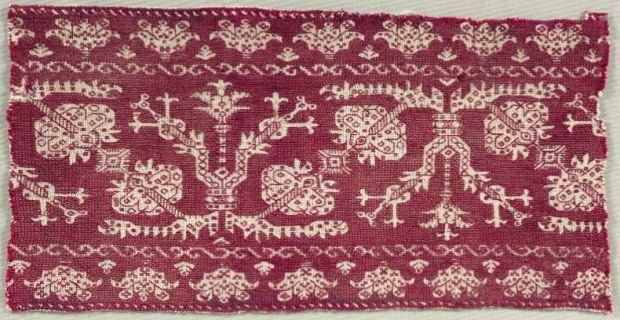
Mr. Ross has provided us with a Pomegranate sample, too. This one is also at the MFA, Accession 11.2880, called out as Spanish or Eastern, with no date.

Here’s a different member of this group. In my notes I tag it as Wide Snake Meander. This one is from the musée du quai Branly, in Paris, Accession M61.2.16, and is attributed to 17th-18th century, from Azemmour.

This design crops up not infrequently. Here’s a sample from the MFA, Accession 93.1495, no date, with Spain as provenance. Another piece collected my Mr. Ross – this is the MFA’s photo.

And another, from TextilesAsArt.com, entry 2227, they call it out as being Moroccan from Azemmour, and date it to 1650.

Here’s a sample of Wide Snakes that has a different border. This photo is quoted from the dealer RugRabbit’s website. They ID it as 17th century, Moroccan.

From the Metropolitan Museum of Art, Accession 09.50.1291, now tagged as Moroccan from Azemmour, from the 18th century.
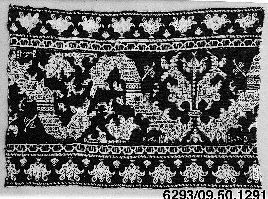
Azemmour has a second style in addition to these pieces. Birds. Paired birds with and without vases or urns, or trees in between them are extremely well represented in museum and private collections. Although paired birds are common in early modelbooks and in stitching examples throughout Europe, the Azemmour birds have a particular look, often done in two colors, with outlines in black and the voided ground in red.
Here is a particularly choice example from the Textile Museum of Canada, Accession T85.0301, dated to the 18th century (image quoted from their photo).
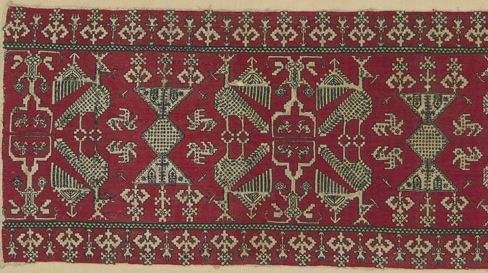
Here’s a whole flock, including MFA 16.298 (Italian or Spanish, no date), Yale University Art Gallery 1941.278 (Azimoor (another alternate spelling), 1700s), Cooper-Hewitt 1970-0-1 (No provenance, late 19th century), Philadelphia Museum of Art’s 1919-686 (Azemmour, 17th century) I’ve easily got two dozen more samples in my logs. They still turn up fairly frequently for sale in textile specialty antiques houses and even on eBay.


And these same birds make appearances on darned net, this image is from a Gros & Delettrez, a dealer in antiquities, who call it out as being from Azemmour, made in the 1800s.

Now. Where did all of these come from?
I’ve read a few accounts that claim Jewish refugees fleeing the Reconquista and Inquisition in Spain settled in and around Azemmour. It is speculated that their influence blended with the local Islamic stitching heritage, to create this local style family; one that is distinct from other Moroccan stitching styles. The Jewish link is cited by The Textile Museum of Canada. The Jewish Virtual Library notes the migration and community. The Jewish link is also mentioned here. The Textile Research Centre writes that production of Azemmour pieces died out in the mid 1900s, although recent revivals have been undertaken.
Finally, to muddy the waters further, here is an artifact that might be seen as a bridge between European/Italian voided work, and the voided work done in Azemmour. This is a strip in the collection of the Cooper-Hewitt Museum Accession 1962-58-17, attributed to 16th century Italy, and the image below is quoted from their photo. Yes, the foreground of the motifs are left quite bare compared to the ornamented Moroccan samples. But look at that design. Does it remind you of both Spider Flower and Pomegranate Meander? It should…

THE SPIDER FLOWER
Continuing…
I have no idea if this design has ever been given an official name, but it shows up with regularity in museum collections. It’s part of a larger design cluster that includes several other patterns, but more on that another day. Today is the Flower’s day. Now. Is this a 17th century design? Or is it later…
I call it “Spider Flower” because it’s characterized by a center bloom that has rather arachnid looking petals, often spiky. It can also be recognized by a simple diagonal meander (with up/down symmetry), and some sort of knot or “wing-nut” swelling ornamenting the simple meander. It’s usually accompanied by a smaller secondary border, but there is little consistency among samples on the secondary border. However, the secondary borders can help in assigning Spider Flower to the cluster I mentioned.
In addition to the general voided layout, there is often complex hatching or other ornamentation on the foreground bits. The background varies too, although it’s usually a solid color treatment – either long-armed cross stitch, or the tightly pulled mesh stitch common to strip pieces produced in Italy.
Here’s a pretty typical example:

This sample is a photo from the Boston Museum of Fine Arts, Accession 16.300. The museum calls the ground “tent stitch” but it looks more like a four-sided Italian cross stitch pulled moderately tight (the mesh effect is not very pronounced, but the coverage is there). It’s part of the MFA’s Denman Waldo Ross Collection, which means it was collected some time prior to his death in 1935. The MFA does not date this piece, and attributes it to North Africa or Spain.
Apparently, Mr. Ross liked this design. He found several examples of it. Here’s another, also from the MFA, Accession 98.204. The museum calls it out as “Spanish or Eastern,” but tags it as being Italian embroidery. Again, it’s called tent stitch, but zooming in shows that the ground is the same four-sided boxed cross stitch, pulled tight.

Nope, it’s not part of the same piece, although the similarities are clear. Not only are the secondary border and internal fills different, but the details of the voided area’s shapes are a bit different, too. Yet for all that, it’s clearly recognizable as another Spider Flower.
Mr. Ross’ third sample in the MFA’s collection. This one is Accession 93.208. Same working method, and again – the museum’s own photo. No date on this one either, although it is also called “Spanish or Eastern,” and tagged as Italian embroidery.
This one has a different and more elaborate secondary border. Also the border is asymmetrical north/south. Possibly it came from the end of a towel or cloth.
But not all of the Spider Flowers I have seen have come from the MFA. Here’s one in the holdings of the Yale University Art Gallery, accession 1939.498 – a gift of Mrs. F.M. Whitehouse in 1939. The museum dates it as being 19th century, originating in Morocco, but put a disclaimer on the page saying that the on-line documentation does not necessarily reflect their most current knowledge about the piece.
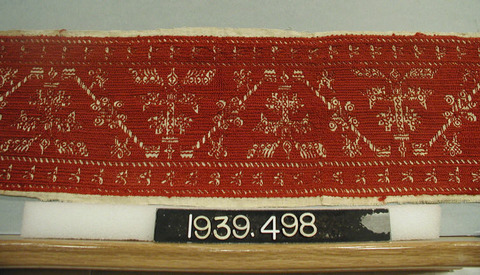
The picture is rather dark and compressed, and the work itself is heavier and less delicate than the above samples, but it’s clear that we have our Flower, along with its companion border. There are some similarities – the layout, the center flower and meander, the ornamentation inside the voided spaces; and some differences, the largest of which is the truncation of that wing-nut decorated lozenge on the meander’s center. It has lost its center barrel. As far as technique goes, I can’t say anything for certain, although given the density of the ground and its alternating left-right directionality, it might be long-armed cross stitch.
The Metropolitan Museum of Art (MET) in New York also has its own Spider Flower sample. Accession number 09.50.1375 seen below in the museum’s photo, was purchased for the museum through the Rogers Fund in 1909. This artifact is dated 16th century, and is sourced to Italy or Greece:

Companion border? Check – and again a totally different one accompanying the main design. Intensely decorated voided spaces? Check. Spindly flower, meander, and barrel/wing-nut lozenge? Yup. This one to me reads as a likely long-armed cross stitch ground, with the plaited row appearance of that stitch.
And lest you think these things were only done in red – here’s in indigo example.
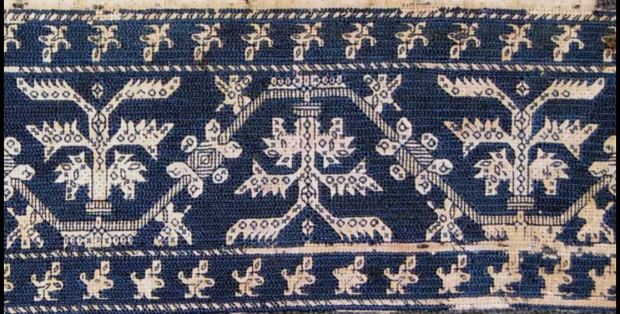
I have quoted this image from the page of Mr. R. John Howe, private collector and dealer in textiles (it’s about half-way down the very long listing), in his report on an 2010 address given by Mae Festa, a noted textile collector, at the Textile Museum in Washington, DC. Ms. Festa attributes the piece to 17th century Italy. She calls it out ias being done in cross stitches and double running stitch. I think the ground is long-armed cross stitch.
So. What can we say about the group as a whole?
Mostly that it is of an undetermined and broad Mediterranean origin, with museums placing the pattern anywhere from Spain to North Africa, to Greece – with a time stamp ranging from the 1600s to the 1800s. That’s a lot of wiggle room.
Why are the dates and places so imprecise? That “Indiana Jones” era of private collecting, for one. The identification on these bits often depended on the claims of the dealers who sold them to the original art patrons on tour. Very few of these household linen fragments have been revisited in detail since museum acquisitions, and those happened between the 1880s and the 1930s.
With no detailed analysis, I can’t second guess the experts, but comparing these to other Moroccan pieces, and to others in the design cluster, then factoring in the conservative nature of traditional stitching, I’d say that it’s not impossible that such an easy to stitch design persisted for a very long time. 1800s – possibly, but I think these are sufficiently different from clearly dated ethnographically-collected Moroccan pieces of the 1800s to warrant speculation that they were done before that (or possibly elsewhere). Early 1600s might be an optimistic stretch, though.
Why do I think this design is easy to work? You’ll see…
UNHISTORICAL FISH
Just to vex my new readership, I start a totally unhistorical stitching project. Well, not to vex anyone actually. This piece was bespoken by The Resident Male a while back. I’ve thought about it for several years, and decided to finally do it. The ultimate purpose is a piece to hang on the wall of our Cape Cod place, as part of a large collage of sea life art.
The design is based on a double-koi motif, where the fish are circling each other. I began with a clip art of a single fish, and simplified it, changing proportions and angles, and removing detail that would be obscured by my chosen stitching style. Then I mirror imaged and flipped a duplicate of my first fish, placing it opposite it’s sibling, and trying to get them more or less balanced and centered as a composition.
For the last bit – the “water lines” in the background, I thank the Public Domain Review, for posting a link to a book of traditional Japanese wave and ripple designs – Ha Bun Shu, by Yusan Mori (circa 1919). My chosen ripple was taken from page 22.
So, with my inspired-by fish, and borrowed water lines (with some of my own extensions to eke out the composition’s dimensions), I end up with this – already shown window-traced onto my prepared ground:

The ground chosen is an almost-white 40 count linen, hemmed on all four sides. I’ve marked the center with basting lines of old, non-crocking plain old sewing thread. I will be picking them out as I encroach upon them because there is no central guide purpose they serve after aligning the initial tracing. I will be using silks, mostly. Originally I thought I’d be stitching only in a hand-dyed natural indigo, colored by (and occasionally available from) my Stealth Apprentice, but last night I changed gears and have added some commercial Au Ver a Soie Soie d’Alger, in a deep green.
I will be working my two fishies in a combo of styles. The fish themselves will be done in inhabited blackwork, with fills inside strong outlines. I’ll pick the fills on whim as I go along, and possibly come up with some new ones along the way. The fish will not be direct opposites of each other – the inner detail will vary, but one will definitely be lighter (using less dense fillings) than the other, and placement of the blue and green may swap.
Right now I’m toying with doing something different for the outlines, instead of my usual plain old chain stitch. Not sure yet what, but I do want to vary the width of some of them analogous to heavier brush strokes.
The water lines will probably be done in gold or silver (maybe both), possibly simple couched strands, possibly something else. I bought some heavier metallic threads at the Sajou store in Paris, and have been hoarding them for the right project. They may well come into play here.
And the first little bit – a filling from Ensamplario Atlantio, the fourth part:
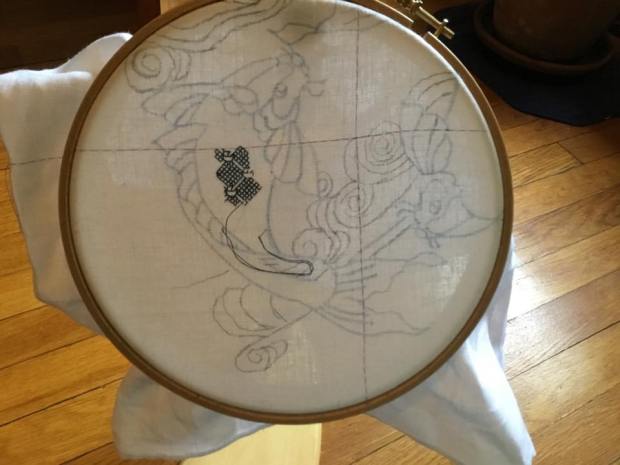
So. Do I have a plan? Kind of. But I still like the fun of designing on the fly.
MORE LONG LOST SIBLINGS
Continuing on…
Long lost siblings: pieces that appear to have been separated back in the heyday of Grand European Tour collectors, with the various parts scattered among museum collections. They are not uncommon. I know there are fans of this series out there, so here are two more pairs I believe to have been cut apart, as opposed to two executions of the same pattern from different originals. For the record, I know of no modelbook sources for either of these designs (if you do, please let me know!)
Why were these cut apart? I suspect that the European dealers who sold antique lace and stitching in the latter part of the 1800s and early 1900s were more interested in maximizing profits than in preserving artifact integrity.
The sample below is quoted from a photo of the Art Institute of Chicago’s (AIC) Accession 1907.664, attributed to Italy of the 17th century:

It’s an unusual piece, combining linear stitching and satin stitching, plus a detached buttonhole insertion to attach it to whatever it originally trimmed.
And here’s it’s sibling, in from the holdings of the Boston Museum of Fine Arts (MFA), Accession 95.1126, cited as being Italian, but not assigned date. I’ve excerpted this from the MFA’s photo of its artifact, which is in slightly better, untrimmed condition:

AIC calls out the stitches used as being back stitch, hem, satin, and split. MFA calls them line stitch (one of their names for double-running), chain stitch and laid work. Personally, I do not put much stock in museum stitch descriptions because so many of them have not been revisited since original acquisition, and so many are idiosyncratic. Without seeing the reverse, I’d posit double running or back stitch (back can look like split or chain on the reverse), and satin stitch. But however these pieces were done, differences are minute (a couple of zig-zag branches in the column headers) – it’s pretty clear to me that they were once part of the same source artifact, possibly two ends of the same cloth or towel.
Here’s another pair. We lead off the the MFA’s Accession 09.38, sadly blessed with no provenance or date. It’s described as Punti di Milano Lace – a MFA term for works with the tightly pulled mesh background, either as foreground or (as here) background, and was a gift of James William Paige, who appears to have lived up to the last quarter of the 1800s.

And here is its companion, Border from the AIC, Accession 1969.193, dated 17th century, and attributed to Italy:
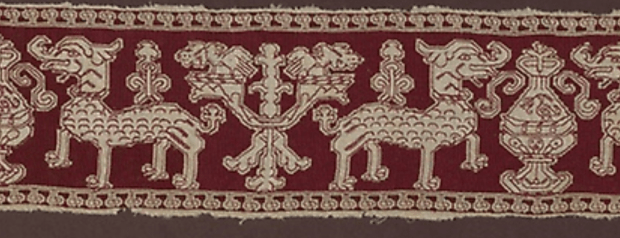
Again, two pieces I believe were once part of the same original artifact, but with so little of whatever that artifact was, it’s hard to speculate what it might have been – bed linens, valences, curtains, table spreads, towels – there’s no way of knowing.
The MFA sample came to the museum as part of the Denman Waldo Ross Collection, who collected widely in Europe and donated many artifacts to the museum in the early 1900s. The AIC piece, was given to the museum in 1969, but it’s unknown how long it was in private hands prior to that gift. It’s worth noting that Mr. Ross was part of “a prosperous Cincinnati family,” so it may not be so odd that the slightly less complete companion to the much better condition sample he gave to the MFA lingered in Ohio.
AIC calls out the working method as pulled thread work in silk, done in two-sided Italian cross stitch, plus back stitch. The MFA gives no descriptions. I’d say without seeing the reverse, back or double running, plus the tightly pulled double-sided mesh stitch are spot on.
Other things to observe in this one is the method of voiding. In some pieces, it runs all the way up to the foreground motif, with no “halo” of unworked linen between design outlines and the mesh background. This is an alternative treatment, and is present on many other artifacts, too. Having done the other, I’d say this method is slightly easier because it does not perturb the outlines of the design; and many of the challenging nooks and crannies are skipped altogether.
What are the beasts pictured? I haven’t a clue. But because squinting at the design, I can convince myself that there are tusks and very long and curled noses, I’ll go out on a limb and dub this the Elephant and Urn pattern. The urn and branching fountain thingy in between the elephants are simplified versions of a pretty standard pair of motifs, with parallels on other pieces, too. But that’s for another post…
UPDATE:
Going through my notes, what should surface, but another snippet of Elephant. This bit is undoubtedly associated with the MFA’s piece, because it was given to the Harvard Art Museum/Fogg Museum in 1916 by Mr. Ross, the same individual who donated the larger fragment to the MFA. The Harvard accession number is 1916.377, and their picture is presented below. They include no date for their entry, but agree that it is Italian.

CORNERED
Continuing on with boring embroidery posts.
A good many people will recognize this pattern.
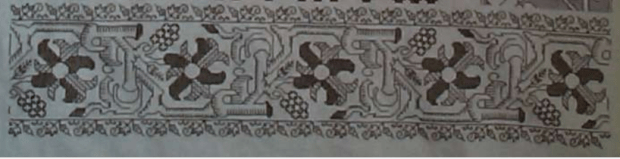
I stitched this snippet from a chart I did in TNCM (Plate 64:1). A simplified chart for the same design also exists in Pesel’s Historical Designs for Embroidery, Linen, and Cross Stitch.
The original for my graph is a handkerchief in the Victoria and Albert Museum, Accession T.133-1956. It’s current attribution is circa-1600, England, although that designation has changed over time. It used to be called out as 1580-1600. I’m delighted that museums are revisiting the dates, stitch descriptions, and materials info for their smaller textile holdings. These listings are bound to improve as the methods and technologies (and available funds) to assess them improve. I do not think that Pesel used the same artifact as her base. There are some departures in her graphing from the V&A example, and her marginal notes cite a sampler source, from 1658.
Another reason that this design is so familiar, is that the V&A handkerchief is near iconic, and shows up in several influential stitching history books, including Digby’s Elizabethan Embroidery, and King and Levy’s The Victoria and Albert Museum’s Textile Collection: Embroidery in Britain from 1200 to 1750. But in all of the secondary source representations, it is rarely shown with all four corners. In fact, it used to drive me nuts that I couldn’t see them all. But thanks to the V&A’s site archival image updates, we can enjoy completion. Here is their own photo of the entire artifact:

and a color snippet, quoted from the V&A images, for good measure, since repros in the stitching history books often show the original reds:
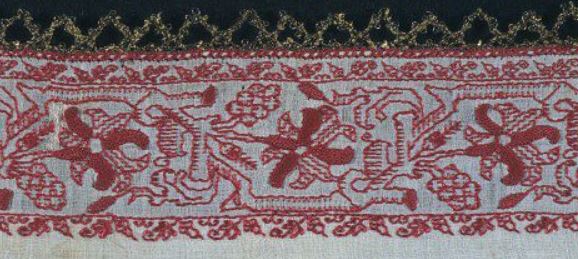
Gorgeous.
But look at the corners!
I’ve had many people ask me about how to create corners for strapwork, to go around the perimeter of linens, or to anchor a dress yoke. Much fretting over exact matches happens. Even the choice of mitering or bending the work around the angle (as opposed to butting the design up without mating the two directions) causes anxiety. In truth all of these methods appear, although the exact mitering thing is the least commonly seen.
This is one way to treat those corners. Four ways, to be exact, because no two of these corners are exact matches. And it doesn’t matter that they are not.
Numbering clockwise from the upper left, we have 1,2, then 3 and 4, respectively. I’ve taken the liberty of rotating (but not flipping) these so that they are easier to visually compare:
Upper corners, #1 and #2:


and lower corners #3 and #4:


There are three rough treatment styles. 1 and 3 are distinct, and #2 and #4 are similar but not the same. #4 has a fat twig interlace to the left of the flower, to fill in space. In #2 there was less space to fill, so that twig is smaller. The area at roughly noon above the flower is different between #2 and #4 as well. On the others, #3’s flower is squished up against the border, with no surround to its left, and all manner of arabesques fill up the extra space below the flower in #1.
It’s always a matter of personal opinion and borderline heresy to use these cues to try to deduce working method, but it’s clear while our anonymous stitcher may have had a visual guide to the strip parts of her or his design, the corners were fudged in, ad hoc. The narrow companion border’s corners – both inner and outer – are improvised, too.
If I were to be so bold as to speculate, I’d pick the lower left edge as the starting point, with the work starting at the indicated line, and progressing around the piece in the direction indicated (note that the V&A says that the monogram is EM, so that we’re actually looking at the reverse):

The stitcher worked to a convenient point to form a corner, keeping it as much in pattern as possible, turned direction, worked across the top edge, turned, and so on, until the starting point was achieved – at which point the “terminal fudge” was needed to finish the work. It’s also vaguely possible that the finished size of the piece was determined in an attempt to make the the repeats (mostly) work out, rather than the square being laid out first, and the repeats being fitted into it. At least that’s the way I – an improvisational and slightly lazy stitcher – would do it.
So. If you are making a historically inspired piece, do you need to meticulously draft out exact corners first, then follow your chart with fanatical purpose?
Not really.
Just go for it. Much as they did roughly 460 years ago.
PS: Eye training: Bonus applause to the person who spots my departure from the original in the companion border. 🙂
THE LEAFY FAMILY
I hope I’m not boring my readers (especially my knitting pals), but with just a little bit of encouragement, I’m off and running on more historical embroidery pattern families.
This one I’ve nicknamed “Oak Leaves.” It’s relatively well represented – not the design with the most extant examples, but I’ve managed to collect seven photos of artifacts displaying it, in various styles. No modelbook source (yet), and I particularly like when designs are interpreted in different ways.
As in many of these smaller fragments, museum provenances and dates are not necessarily precise. Some of these artifacts have not been revisited since they were originally donated to the hosting institutions. Putting these on a specific which-came-first timeline is problematic, especially doing so based on photos alone. However, there is a possibility here again of “separated at birth” pieces, where an original artifact was cut apart by a dealer and sold to multiple collectors.
I start with a piece given to the Cooper Hewitt by my idol, Marian Hague. She was an embroidery research expert and curator, who worked with several museums in the first half of the 20th century. Her work pairing extant pieces with modebook sources is legendary.
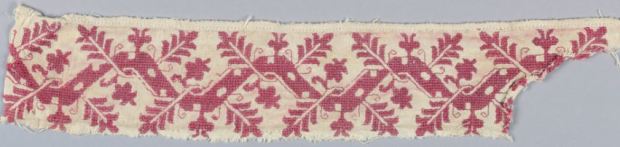
The Cooper-Hewitt citation for this piece dates it as 17th century, and of Italian origin. The museum’s accession number is 1971-50-97 and was acquired as a bequest from Ms. Hague. It displays the signature elements that make up the group – the center meander, with two heavily indented “oak” leaves sprouting left and right, overlapping the meander. A central smaller floral element in the center of each of the meander’s hump, and a secondary leafy sprout filling in the hollow of the design between the leaves. This particular piece also has voided spots along the length of the center meander.
Compare this piece from The Art Institute of Chicago:
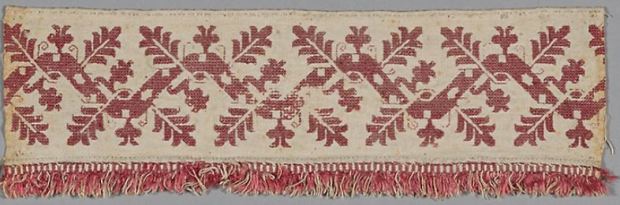
They also attribute it as 17th century, Italian. The AIC accession number is 1907.742, acquired in 1907. Although the C-H example lacks the fringed edge, the executed design of both pieces is extremely close. C-H on left, AIC on right:


Ignore minor wear and tear. The count of the leaves, voiding of the stems, method of placing and working the spots, and placement of the tendrils is the same, although some of the tendrils on the AIC sample have fallen victim to time. Therefore I opine that these two pieces may have come from the same original. That Ms. Hague’s bit is a bit more savaged is not unusual. There are other instances where she had fragments of pieces in museum collections, but usually kept the more damaged bits for her own research.
Moving on here’s a fragment from the Metropolitan Museum of Art:

The Met places it as 16th-17th century, also Italian. Its accession number there is 09.50.3806, collected in 1909. This may or may not be part of the same original as the previous two, even though it is fringed like the AIC sample. For one – it’s mirror image. That in an of itself isn’t a big difference. Photos get reversed. Designs themselves are sometimes mirror-imaged if they appear on opposite sides of a larger artifact. Tendrils are missing, but this piece appears to have undergone more wear than the other two. There are enough partial remains of the double running (or back stitch) bits to posit their existence. But while the delicate linear stitching is more prone to damage the heavier interior stitching is more durable.
Look at the little interlace where the leaf-twig emerges from beneath the meander and crosses over it (AIC on left, Met on right):


The little “eye” of filling, which done in the solid filling stitch and should remain – is missing.
Might this be part of the same original, possibly a suite of hangings, covers/cloths or bed furnishings, but of a segment done by a less attentive stitcher? Possibly. But also possibly not, especially in light of the next example.
Here’s another one with an empty “eye.” This example was found by my Stealth Apprentice, and is in the Textiles Collection of the University for the Creative Arts in Farnam.
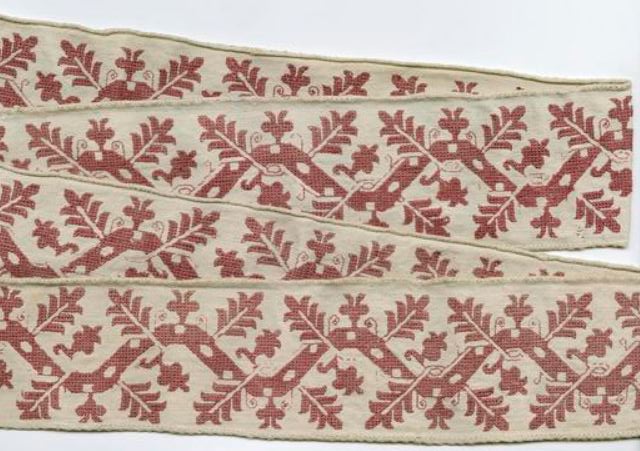
Unfortunately, the UCA gives no date or provenance for the work. Note how long this strip is, and that it’s folded – we see both sides. This might be double running and one of the double sided Italian cross stitch variants because regular long-armed cross stitch doesn’t look the same front and back. Tendrils? Check. Center meander with holes? Check. Oak leaves and supporting sprouts? Check. BUT those “eyes” – they are not worked, just as in the Met example.
OK, now we go on to other design adaptations. This voided piece from the Boston Museum of Fine Arts is undoubtedly an interpretation of the same design, but with a bit more elaboration on the stems – using twining instead of spots, and on the sprouts and leaves. It’s also doubled north/south – a very common method of taking a strip design and making it more dramatic by making it wider.

The MFA calls this piece out as being Italian, 16th-17th century, and names the technique used as “Punto di Milano.” (The MFA uses several stitch style names not commonly seen elsewhere, this is one.) The accession number is 83.236.
I am particularly intrigued by the unworked area at the upper right. The tightly overstitched pulled mesh technique used for the background is almost impossible to pick out, and even worn, leaves a very clear perturbation of the ground weave. I know this from sad experience. Even over the centuries, I have to say that the missing bit was just never worked. Which gives us an insight into working method – defining an area, then going back and filling it in.
Did this piece, in this style predate the more simplified depictions above? Again we can’t say for sure, but I tend to lean that way because the spots on the wide, plain meander to me look like the simplified descendants of the voids formed by twining stems in the MFA’s example. One person’s opinion – feel free to disagree.
Voiding. That was always done in long-armed cross stitch or the meshy stitch, right? Nope. Here’s another example of the same pattern, with an even more finely defined main twining meander, but done with a squared filling stitch. This one is also from the Metropolitan Museum of Art:

The Met lists this one as being Italian or Greek, from the 16th-17th century. It was acquired in 1909, and its accession number is 09.50.58.
This piece is my favorite of the set, both for the delicacy of the interlace and the squared ground. Obviously the tendrils are gone, as in the other voided interpretation, but it’s the same oak leaf design for sure. And did you catch the mistake? Upper right, where the meander is cut off from joining the previous repeat. That’s not wear and tear – that’s a place where stitching happened where it doesn’t appear in subsequent repeats.
And last, but not least, a pattern cousin. This one was also found by the Stealth Apprentice.

This is an Italian towel or napkin, claimed as 16th century, in the Marcus Jehn private collection. The only link I have for it is to the collector’s Pinterest board.
This is a curious piece. It’s clearly derived from the same pattern family, interpreted in a linear stitch. But the interlaces of the meander are rather heavy compared to the delicacy of the Met square-voided sample, above. The slightly fudged corner is also of interest. If I had to guess, I’d suspect that this piece was a see-me-and-copy, derived from something that looked more like the two voided examples.
So, what have we seen here? Mostly that there are design clusters that are clearly related. That there is no one canonical way in which to use these patterns – interpretations, some only a bit different, and others quite divergent, vary from artifact to artifact, even among those done in the same technique. And based on museum citations alone there’s no clear way to arrange them in parent-child relationships other than idle musing.
Most of all, I like that there is no one “right” way to stitch these designs, and that when I do my own variant, I’m adding to family that stretches back for hundreds of years.
UPDATE:
And another one of the same family surfaces! This one is the largest departure to date in terms of style, but it is clearly descended from the same pattern lineage.
Meet the Metropolitan Museum of Art’s holding #09.50.65 – entitled “Fragment,” dated to the 16th or 17th century, from Italy or Greece; added to the museum’s collection in 1909.

UPDATE UPDATE:
And another…
This one is from the Victoria and Albert Museum. It’s one piece of a composed group of borrders, displayed together. The entire group is attributed to 17th century Italy, and is cataloged together as museum number T.114-1930.

This one is sort of half-way between the versions with the heavy, abstract main trunk at the top of the page and the Met example with the squared ground. In this “missing link” you can see where the lozenge spots on the most abstract versions come from, while it still retains the coiled smaller branches of the most detailed example.
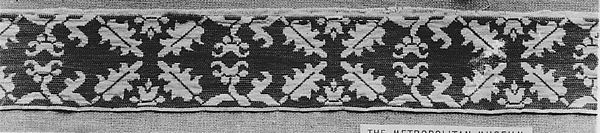
To complicate matters further, there is the fragment below, from the Met, accession 79.1.294, also sourced to 17th century Italy – Sicily in specific. Although the museum calls it a border, I don’t think it started out as one. The bottom edge is nice and neat, with a defined stitched edge, but the top piece is ragged – cut from a larger design. Now look at the V&A piece above and image it doubled, with two strips stacked one on top of another. (Doubling pattern strips this way was a very common method of achieving a deeper design.) In your thought experiment, now “cut” a section where the leaves are facing each other.
Hmmm….
Not only is this totally plausible as a strip cut off of a wider design based on our leafy friend, but the similarities to the Met’s strip are unmistakable. Again, we can prove nothing without artifact forensics on the ground and stitching thread, but I would not be surprised to find that these came from different stitched sections of the same original piece – possibly from a side strip and a wider decorated end of a towel or other cover.
THREAD THREAD
Based on questions from Elaine and others, here’s a bit more on the thread I’ve been using on both the Permissions and Trifles samplers.
As I’ve said before, my stash came from a small needlework/beading supply shop in Pune, India. It wasn’t current stock. The head clerk sent a boy scampering up into the storage attic for a VERY dusty box of odds and ends. I picked out the best colors left, avoiding pastels, and looking for what high impact/high contrast hues that still remained in quantities of 10+ skeins. I bought them all. They were very inexpensive – just a few rupees per skein. At the then-current exchange rate of 60 rupees per dollar, I think I spent less than $20.00 translated, and came away with a huge bag full, well over 200 skeins divided up among about 15 colors. Here’s just a sample:
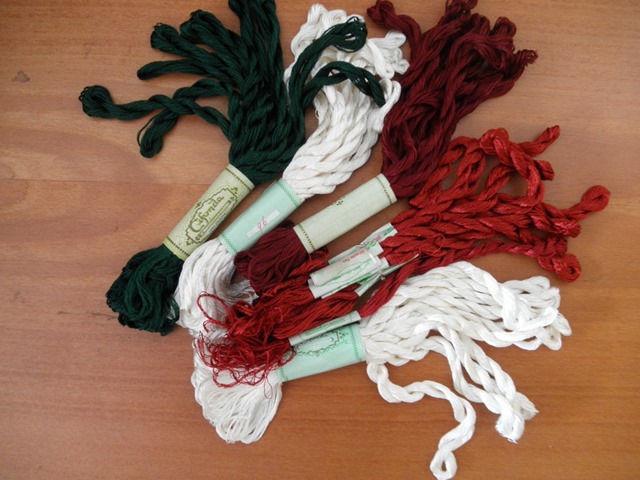

The name brand is Cifonda Art Silk. It’s not a spooled rayon intended for machine embroidery. As you can see, the put-up is more like cotton embroidery floss. And it turns out that the stuff is still being made, and is available in Australia, and even in the US – although mostly by special order.
The websites that offer this thread vary a bit in description. Some say it is a 35% silk/65% rayon blend. Others say it is all rayon. Contemporary put-ups specify 8 meter skeins. My vintage stash skeins are a bit longer, possibly 10 meters (I’ll measure tonight). The large bundles above are actually “super-packages” of ten individual skeins. You can see the bright red one at the left is broken open, with the single skein labels showing. On mine, color numbers are written on each skein by hand, not printed. There can be hue variances between the super-packages of the same color number, so I suspect that special care should be taken to buy all that’s needed at once, so that all is from the same dye lot.
Cifonda’s structure is that of standard floss – six strands of two-ply relatively loose twist. The individual strands are quite fine, two of them are roughly the equivalent of one ply of standard DMC cotton embroidery floss. The colors – especially deeper ones like red and indigo – do run when wet, although they do not crock (shed color on hands, ground cloth, or wax when stitching dry). I would not advise using this thread on clothing, table linen or other things likely to need laundering. It may be possible to set the colors before stitching using a mordant bath or long water soak, but I don’t have the experience, time, or materials quantity for experimentation.
I am pleased with the way the Cifonda looks in my work. It’s a bit shinier and finer textured than cotton floss, although it does not have the coverage of the true silk floss I’ve used (Soie d’Alger). My Cifonda is quite slippery. Two or more plies held together tend to disassociate and slide past each other for differential consumption, even when using short lengths in a small-hole needle. I tamed this by aggressive waxing – running the entire length of my threads over a block of beeswax before use. Since I’m doing linear counted work, any change in color or texture is not noticeable. Someone using this for satin stitch, long-and-short, or other surface stitches that maximize thread sheen would probably want to wax only the inch or so that threads through the needle.
Like all lightly twisted rayons, this thread does catch and shred a bit on rough skin. Care must be taken to use needles with very smooth eyes, and to hold the unworked length out of the way when taking stitches, because the stuff snags extremely easily. My own stash, well aged as it is, contains some colors that are a bit brittle. The bright yellow I’m using now, and the silver-grey I used on the last sampler are both prone to breaking under stress, and must be used in shorter lengths than the other colors.
I will continue to use up my India-souvenir thread stash, working smaller and smaller projects until it is gone. But in all probability, I will not seek out the Cifonda to replace that inventory as it is consumed.
Anyone else have experience or hints on using this rather unruly stuff?
IT ALL FALLS INTO PLACE
With an extended time sitting in one place and thinking yesterday, I’ve come to design decisions on the direction for the Permission sampler.
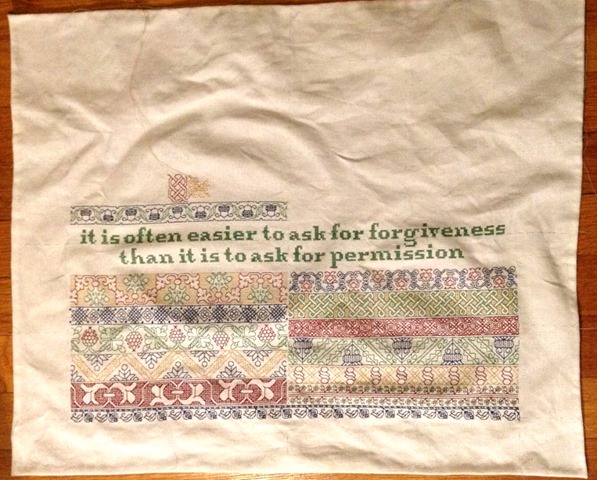
I’ve decided to do another bank of two solid columns of multicolor narrow strip bands above the motto, and finish out the top with either the same pomegranate border used at the bottom edge, or a coordinating one with pine cones, of the same size and visual density – also in the blue.
Progress is obvious since the last post. I finished the red voided buds with the grid-background at lower left, and marched the pomegranates across the entire width of the piece. I also did a quick strip of acorns over the words (aligning with the strips below), and I’ve begun on a yellow and red interlace and quaternary rose strip above that one. I’ll do a monochrome design above the red/yellow, probably green and relatively narrow.
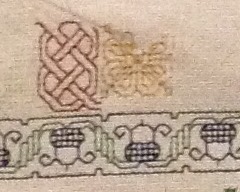

As you can see, I am just ripping along. The large stitches on this one (it’s only 30-count stitched over 2×2), plus the sit-on frame that frees the second hand to pass the needle underneath the work are helping me to set local house records for sampler production.
Am I liking the thread? Yes and no. It’s “man made silk” and at least 20 years old before I bought it. Possibly even older. It’s thin and unruly, and needs extreme waxing to make it behave. My little beeswax block is being whittled down, slowly but surely on this one. I do like the sheen of the faux silk – even waxed. What I like less is the damage of age – brittleness, and a tendency to shred. Some colors have aged better than others. For example, the yellow I am using now is very prone to breakage, and must be treated gently, stitching with very short lengths. By contrast the red and blue are horse-strong, and far less likely to snap or denature. Perhaps my yellow is “elderly” compared to the other colors. In any case, I do notice that working with it does take longer and is more fiddly due to the short lengths and stops/restarts after an inopportune Thread Damage Event.
Questions answered:
These are from my inbox, about this project or stitching in general. Feel free to post questions here or write to me – kbsalazar (at) gmail (dot) com.
1. Do you decide on your patterns before you begin?
Not really. I pick them on the fly. On some pieces I stick to a style or unified theme, but often I just thumb through looking for something that has a pleasing contrast with the designs around it; like layering a geometric next to a floral, or using something with a lot of curves next to something that’s strongly angled.
2. Do you prepare your cloth?
I do now. I’ve had some projects that might have been better composed, but because I didn’t clearly mark my margins or centers, I lost track of where I was. Now I outline my stitching area, plus it’s center and quarter-center marks both horizontally and vertically. I use a single strand of Plain Old Sewing Thread, in a light color (in this case – pastel blue), basting it in to indicate those lines. The basting itself is rather haphazard. For example, I do not bother to make my basting stitches over the same number of threads as an aid to counting later. Others do.
I also hem my cloth. I used to use other methods of fray prevention (deliberately raveling out a half inch or so, a line or two of machine stitching, serging, or in a moment of poor judgment – tape), or not bother at all. However I find that I now prefer the finished edges and mitered corners of a nice, even hand-done finger-folded hem.
3. Will you be issuing a kit for this or any of your other projects?
Probably not. Definitely not for a composed kit, complete with thread. There are too many things I want to stitch myself to sit down and figure out thread consumption, buy fabric and thread in bulk, compose the kits, and do inventory management and fulfillment. That would suck the fun out of the thing, for sure. I might consider releasing full, drafted charts for some of the smaller projects like bookcovers for small standard-size notebooks or needle case/biscornu sets, but that also would eat up time I’d rather spend on my own work, or researching and drafting up new designs. I see myself sticking mostly to reference books of patterns and designs, and leaving employment of those designs to the readers.
4. Where are the snails?
One of the folk who visit here has noticed that I put snails in almost every sampler I do. Not every single one, but I do use a variant of this design from my first book on most, especially those for family:
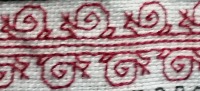

I haven’t gotten to the snails yet, but they are on the list for this project, too. Possibly next – the green strip I’m thinking of doing just above the current bit.
ANOTHER SAMPLER
This one’s a quickie – a present for Denizen (one of Younger Daughter’s pals, currently staying with us). She’s also headed off to university next year, and deserves her own bit of stitched wall art with a favorite saying.
Denizen has requested the immortal words of Admiral Grace Murray Hopper, “It is often easier to ask for forgiveness than it is to ask for permission.”
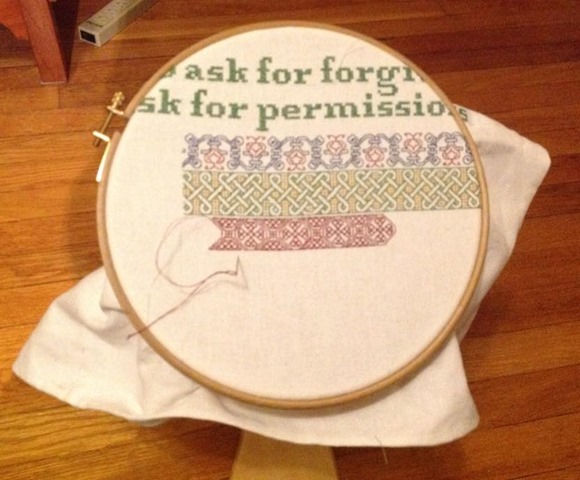
As you can see, I’ve already laid in the saying itself, using yet another of the alphabets from Ramzi’s Patternmakercharts.blogspot.com website. In this case, I’ve chosen a very simple all lower case set from Sajou #104. A fancy font would be too bombastic for this sentiment. I used plain old cross stitch (POCS) for the letters.
Ground this time is a large-as-logs 30 count even-weave linen remnant from my stash, long since disassociated from any label, vintage, or maker identification. The floss is more of my India-purchased faux silk – deep crimson, bright green, strident blue, and daffodil yellow. Patterns (so far) are all from The Second Carolingian Modelbook. Being unbound by any historical or usage constraints on this one, I’m happily playing with colors, limited only by the availability of my remaining threads. I’d like to use far more red to anchor the piece, but it’s the color of which I have the least, so I have to work it in more sparingly.
I’m also changing up the orientation and proportions of this one. Instead of long and thin like historical samplers, or portrait orientation like a standard reading page pieces I’ve stitched lately, I’m doing this one landscape – with the longer dimension east-to-west rather than north-to-south. I’ll probably run a more solid border the full width top and bottom, either POCS or long-armed cross stitch. There will be two banks of geometric bands, left and right both above and below the centered saying. Although I might mix that up with a collection of spot motifs above the saying. I haven’t decided yet.
One failure of note though. I wanted to do some Swedish Weaving stitch on this one, as a nod to the Denizen’s heritage. While that style is usually done on huck towling, it can also be done on plain tabby weave fabrics. Unfortunately, this particular ground cloth and my ultra-fine floss are a bad combo for the technique. I didn’t like the look so I picked it out and went with what I have. I’ll do a Swedish Weave project another time.
The motto took just one weekend, and at red bit is only one night’s stitching – about 2 hours worth, so I forecast that I’ll rip through this project in no time.

