NEW PROJECT, MORE MONSOON
A mixed post today. First on knitting, I’ve embarked on a quickie project – a pullover for Younger Daughter. I’m starting with this commercial pattern, the Empire Waist Top Down Pullover, from Vermont Fiber Designs (#172):

But I’m making two changes. The first is that I’m knitting it in Cascade Yarns UltraPima cotton DK. The original is written for a wool or wool blend DK. That means that the piece will be more massy and less elastic than the original designer’s intent. The other is that I’m shortening the sleeves. I’m moving the garter stitch band up somewhat, so that it aligns better with the band at the waist, and proceeding with the belled sleeves from there, so that the whole sleeve is closer to 3/4 length than back-of-knuckles length.
And here’s my initial progress on the back:

On the yarn – I like it. It’s relatively painless for a multistrand cotton DK. It isn’t splitty, and it’s a bit more forgiving in stitch irregularity appearance than is Cotton Classic, my go-to all-cotton DK. It’s also shinier than the Cotton Classic.
On the pattern – I note that the range of sizes it includes is superior, from extra small all the way up to 6X. This does make for a confusing pattern presentation though. I made a photocopy and have highlighted all of my chosen size notations. Those who struggle with tiny type will probably want to photo-enlarge this one, too. (To reassure copyright protection advocates, under Fair Use provisions I can do this provided I own the original, and either keep the resulting copy with my original, or destroy it after I’m finished. I cannot give away, sell or otherwise share the copy).
So far the pattern has presented no problems, although I would not call this a pattern for those who have not worked from an classic style one before. For example, you’ll need to know that a hypothetical direction that states something like “increase 0(2,4) stitches 0(3,1) times” means that for the smallest size, you’d increase nothing no times (in effect, skip this direction); for the middle size increase 2 stitches 3 times; for largest third size you need to increase 4 stitches 1 time. The “increase 0” direction can cause distress.
I’ll keep posting progress here as I wade deeper into the project.
On the India Travelogue side of the house, I present more monsoon scenes and contrasts. First, It’s been pretty uniformly cloudy here over the past month, with only one morning showing a breakthrough sun. But there have been many afternoons of spectacular cloudscapes. This is a view over my shoulder:

And here’s the promised view of the hills near Younger Daughter’s school, near Manas Lake in the Bhukum area on Pune’s outskirts:


Contrast this lush verdure with a dusty shot of the same area taken this past January. And January isn’t even the depths of the dry season. The driest time is May and the beginning of June, just before the rains arrive in mid-June.
MARBLE ROLLED, EDGE TREATMENTS EXPLAINED
Yaay! The lap blanket knit from Marble is finished. Well, mostly. I do have to finish off the ends and block the thing. But all of the knitting is complete, and I grafted the edging’s last four stitches to its beginning, so that the seam is unnoticeable.

Aileen in Springfield asked me how I was filling in the half-motifs, because she’s working on a modular square piece, and prefers the look of the units tipped to present as diamonds. I’ll attempt to explain, but I won’t be publishing this as a full up pattern because of general lack of interest.
My treatment includes a nifty self I-Cord edging, worked as the piece progresses. It’s a nice, robust “hem” that stands up to wear and tear nicely. Here’s how.
I started on the REVERSE of the piece, so that any ridges formed by knitting the edging on would happen on the front, the same side as the native diagonal and vertical lines of the modular squares. I needn’t have bothered with this refinement, because as you can see in the photo above, the join lines are quite indistinct. Also note the slight ruffling of the edge triangles. That should steam-block out (mostly).
Starting at Point A – the rightmost corner point of the motif at the bottom right of the blanket.
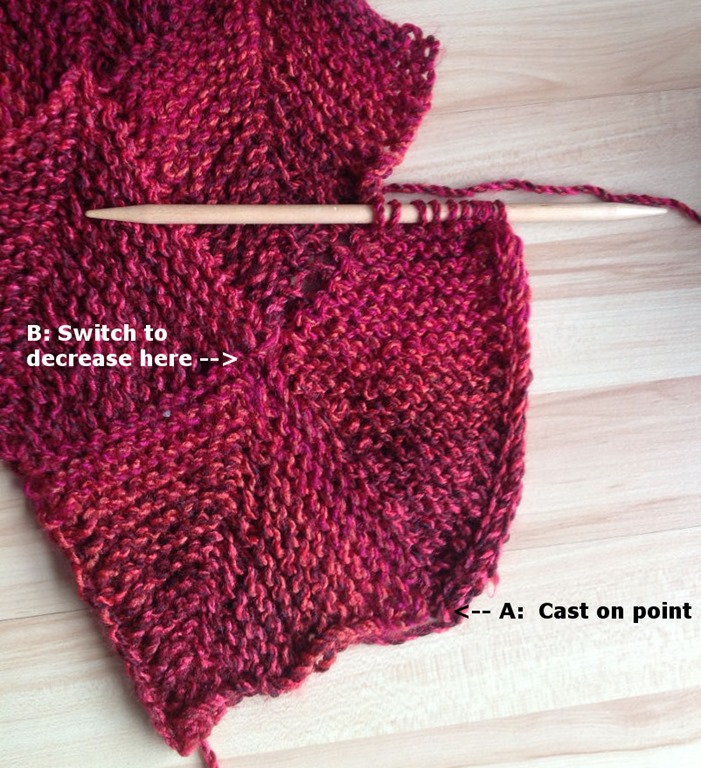
Increase progression:
Row 1: Cast on three stitches, then pick up one in the rightmost corner of the first motif.
Row 2: Slide all stitches to the right end of the needle, I-Cord style. Knit 4, and pick up one stitch in the next available selvedge stitch of the diamond motif. There should be 5 stitches on the needle.
Row 3: Flip the work over so you are working away from the main blanket. Slip the first stitch purlwise. Knit the second stitch. Slip the final three stitches one at a time, all purlwise.
Row 4: Flip the work over so you are working in from the edge, toward the main blanket. Knit the first three stitches VERY FIRMLY, pulling the yarn tight in classic I-Cord style. Knit the remaining stitches on the needle. Then pick up another stitch in the next available selvedge stitch of the diamond motif. There should be 6 stitches on the needle.
Row 5: Flip the work over again so you are working away from the main blanket. Slip the first stitch purlwise. Knit the second and third stitch. Slip the final three stitches one at a time, all purlwise.
Continue working rows 4 and 5, adding one stitch on every even row, until you have “used up” all of the available attachment points along the edge of your motif. The actual number of stitches will depend on the size of your motif. Mine was a 15×15 stitch square, so I had 14 attachment points along each diamond’s edge. After working your last Row 5 equivalent you will be ready to decrease
Decrease progression:
Row 1: Starting at the edge, working towards the main blanket. Knit the first three stitches very firmly, I-Cord style. Continue knitting across the row until only three stitches remain. Knit those three stitches together. Pick up one stitch in the first available selvedge stitch on the next motif.
Row 2: Working from the main body of the blanket back out to the edge. Slip the first stitch purlwise, knit until three stitches remain. Slip these three stitches one at a time, all purlwise.
Continue working Rows 1 and 2 of the decrease progression until you are back at the tip of Motif #2. At that point you should be down to four stitches. In the event that you have five when you reach the motif tip (which happened to me a couple of times, and I didn’t take the time to figure out why), on the last iteration of Row 2, just knit the first two stitches together instead of slipping. Fudging this way is invisible – the goal is to make sure that by the time you start down the increase section of the next motif, you begin at the point with only four stitches on the needle.
Now. How to use this same edge I-Cord idea on a straight edge? You can do it one of two ways, depending on whether you are working this at the same time as the main body, or adding it as a supplemental feature on a finished edge.
First, if you’re working a flat piece in garter stitch or stockinette and you want to add this at the same time as you are working the main body, just set aside the first three or four stitches at either end for the I-Cord curl. Or if you like, add some stitches for the treatment to your total count, but be aware that this will use more yarn and if you are working from a set pattern with a set amount, adding even six total to each row (3 left and 3 right) you will risk running out of yarn.
Once you have figured out how many to set aside or add, work each row as you usually do, BUT at the end of every row, slip your I-Cord designated stitches, and at the beginning of each row, KNIT them. You’ll notice that this edging is the same front and back, so if you are trimming both sides of your scarf or blanket, the left and right edges of your piece will look the same. This is pretty much the same thing I described as being useful for making straps for bags back in 2004, but with a whole blanket in between the I-Cord edges rather than just a couple of stitches.
If you want to add this I-Cord edge to a finished piece, it will be easier if you have worked a slip-stitch selvedge, so that the edge loops are crisply defined. But with fiddling this will also work on non-slip-stitch edges, and on cast on or bind off rows. Cast your desired number of stitches onto your needle, pick up one stitch in the body of the work to be trimmed. Flip the work over and heading back out from the body, knit the first two stitches together, then slip the rest purlwise, one at a time. Now working back from the edge towards the main body, knit the designated I-Cord stitches firmly, knit the attachment stitch, and then pick up another stitch in the main body. Continue in this manner, adding one stitch every “inwards” row, and knitting it together with the attachment stitch on the “outwards” rows. This is slightly different than the method I’ve described before for adding I-Cord to an edge, because it moves the attachment point one stitch away from the I-Cord itself, and makes a neater presentation with both sides looking more like each other.
LINES, EDGES, AND BELLS
I am back from over a week of waiting on lines at the government visa office to renew our residence paperwork. Let’s just say I’m relieved not to be up close and personal with the bureaucracy today. Sadly, I was unable to take my knitting with me to civilize all those hours. It would have helped.
Here’s my latest progress on the big blanket knit from Marble. The current state is on the left, the previous attempt is on the right.


You can see that true to my word, I’ve narrowed down the edge treatment. I’ve also eliminated the mitered corners in another bid to conserve yarn. Instead I just ran the I-cord along the edge of the corner unit diamond. Much faster and simpler that the previous treatment using short rows. In order to prevent cupping, I did do a couple of rounds of I-Cord “free” at each corner point of the diamond, to provide extra ease. I’m at roughly the same point in yarn consumption as my earlier attempt (seen on right, above), but you can see that I’m further along the march around the piece. Fingers are crossed, but with what I’ve got left, I think I’ll be able to finish. I do prefer the older treatment though, and if more yarn was available, I’d have continued with it. Those extra four stitches between the fill-in diamonds and the I-Cord, plus the thicker I-Cord and mitered corner made a smoother, more uniform presentation, and “absorbed” some of the natural rippling that happens when the fill-ins are made. So it goes…
Monsoon continues here, with heavy rain days interspersed with misty, overcast days. The humidity is through the roof. I’m experiencing a bit of climatic dissonance. We do get long periods of grey, dank skies in New England, but they are in the dead of winter, usually when temperatures are down in the low teens or below (that’s -10ºC and under for you Celsius folk), accompanied by intermittent snow. To have this many dark but warm days in a row is new to me.
In spite of the greyness, the omnipresent mud and the acne-like spread of potholes in the imperfectly footed brick surface streets, I’ve mentioned the up-side of the monsoon before. Everything is quite lush, and the city is transformed. Even the dusty, trash-strewn vacant lots in town are covered in deep growth, with occasional splashes of wildflowers. This weekend past we went to a patio restaurant, where we dined under a large open air tent. There was a large tree just outside the tent, hung with dozens of child-size umbrellas and spans of tiny bells. Rain fell throughout dinner, making music as the drops hit leaves, umbrellas and the bells.
Today we travel out into the surrounding hills where Younger Daughter’s school is. Because we went back to the US before her last semester ended, she had special dispensation to take her 9th grade finals all this week, before school resumes at the beginning of August. I’m looking forward to seeing what effect the rains have had on the countryside and hope to take pix to share. And in addition to my camera, I can bring my knitting!
AND BACK TO KNITTING
Now that the hustle of getting ready for our return is over, I have time in the evenings to sit and knit a bit.
I had planned to finish the large red throw prior to the trip, but I ran out of time. Luckily, I didn’t run out of luggage space, and I was able to take it with me:

As you can see, I have completed the center area of modular diamonds, and am now working around the edging. Or I was… More on that below.
I am trimming the thing out into a full rectangle, filling in the missing edge half-diamonds and completing it with an edging. I’m winging it, but have some notes if the world thinks it really needs yet another free pattern for a modular diamond throw. If you are part of that world, please let me know.
One thing of special note – the edging. I’ve used this before. It’s an “un-vention” – something I worked out on my own, but that I’m sure others have discovered before me. I am not a big fan of plain edges on stockinette or garter stitch. To me they look flabby and unfinished. When I do a scarf or blanket, I always try to include a lacy, hemmed or otherwise finished edge. This particular treatment is similar to an edge casing, sort of like a seam binding in sewing. It wraps the edge with I-cord, and is totally reversible (same on both sides). It’s worked at the same time as the body:
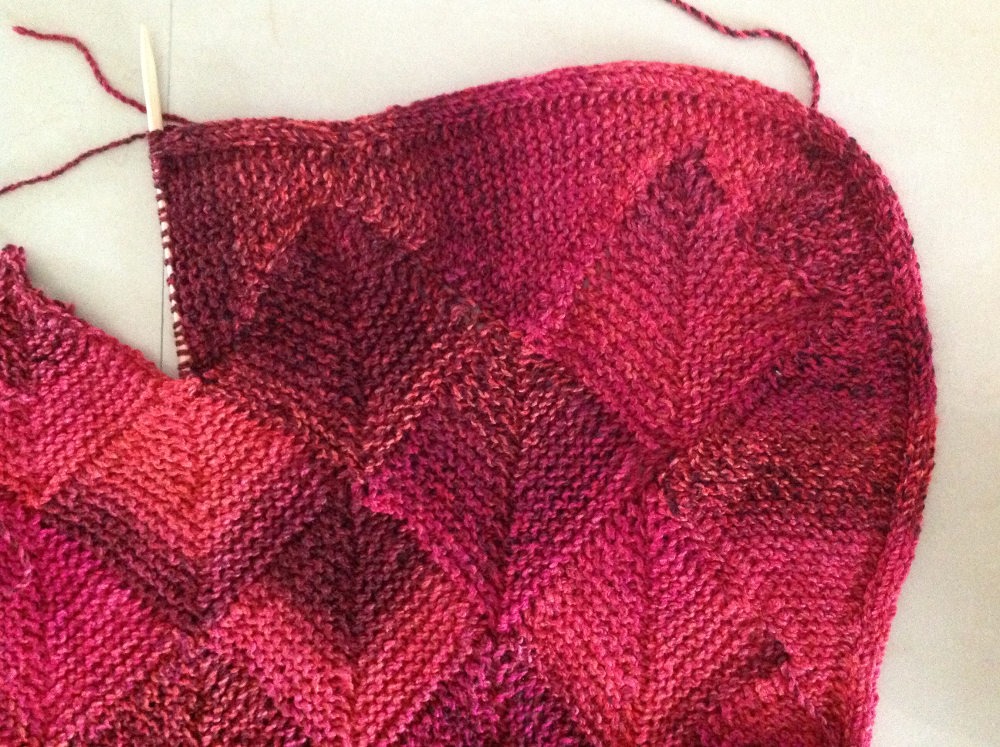
It’s particularly useful to create a “Chanel-look” professional detail on the fronts of cardigans. Buttonholes can be introduced between the edge and the main body, too. Or it can be used to create a casing for a drawstring or elastic, on the tops of bags or skirts. It can also be used on both sides of a narrow strip to create a firm strap, either to use as-is, or after fulling. (I posted about this almost 10 years ago).
How to work this edging? Very simple. Decide how many stitches wide you want it to be. Three or four is optimal, but up to six can be managed. Add that number to your total project width count. Let’s use four here for demonstration purposes:
Four-Stitch I-Cord Style Rolled Casing
- Row 1 (wrong side row): Work your project as usual until you get to the last four stitches. Bring the yarn to the front of the work. Leaving the yarn alone, slip the next four stitches as if to purl, transferring them one at a time from the left to the right needle.
- Row 2 (right side row): Just like when working I-cord, knit the first four stitches, making sure to pull the yarn very tightly to create the rolled edge effect. Then work the rest of the row as usual.
Now, what’s this about not quite working the edging on this project?
I had started it by adding five extra stitches of width on top of eking out my edge triangles, supplemented by a four-stitch rolled casing. That’s nine stitches per row extra. I got all the way around the corner, having worked that out, too, using short rows. Then I looked at how much yarn I have left – a little over 1.3 balls. It was highly probable that I’d run out before getting all the way around the blanket. With no way of getting more Marble here in India, I had to rethink.
I ripped out the whole completed edge section (two nights’ work), and began again. This time I’m using only one stitch of extra width, and I’ve cut back the casing from four to three stitches, for a total per row add of only four instead of nine:
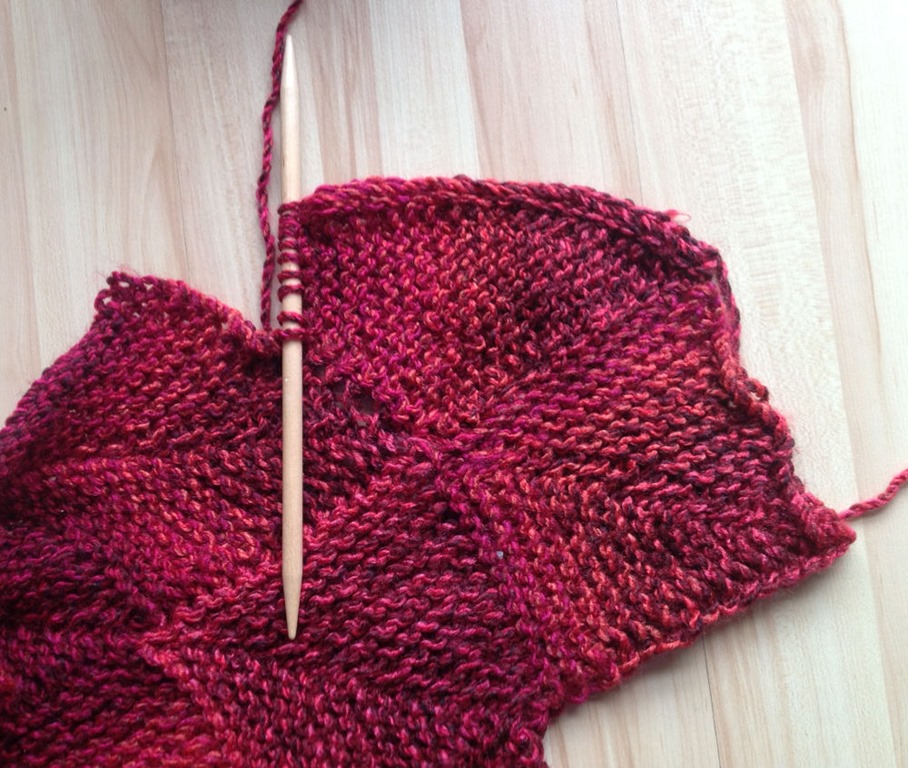
We’ll see how far I get. To be fair, I prefer the proportion of the last attempt, but it is no longer a valid option. So it goes…
If I still don’t have enough yarn, the next possibility is to rip back some of the center diamonds and make the total piece smaller. But because that’s worked on the diagonal, doing so will be a major pain.
Here’s hoping my quick fix is enough.
LOST MY MARBLES
My modular blanket in Marble continues to grow. Of course, there are the two glaring missing squares, but I can knit them separately, then sew them in:
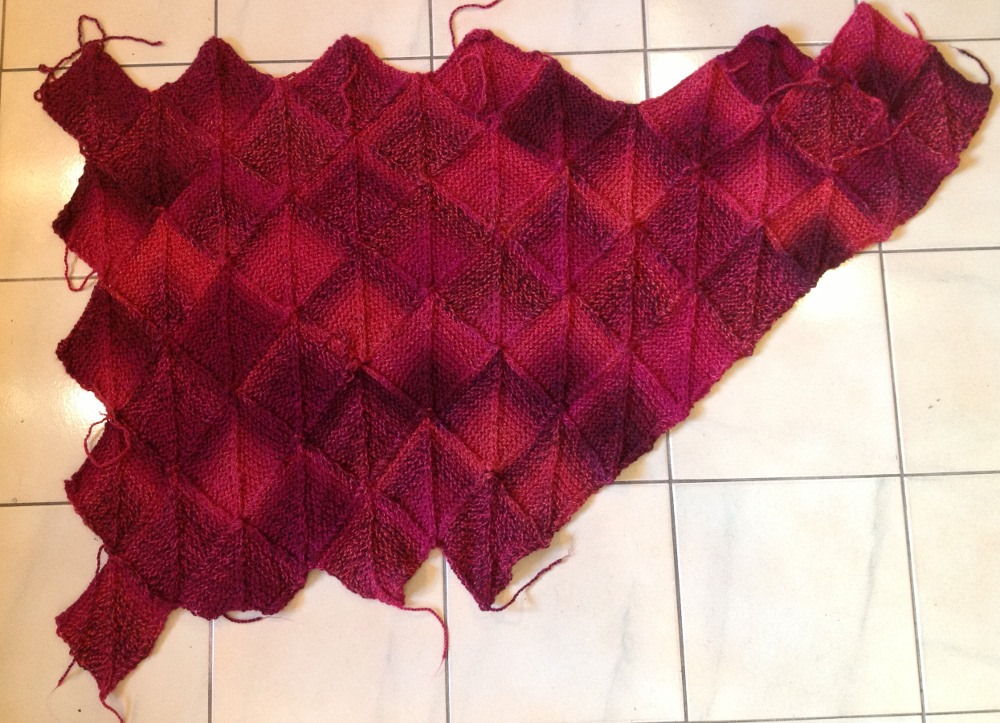
The floor is tiled in 1-foot squares, so you have an idea of the size so far. This is as large as the outside is going to get. I’m on the third of my five big balls of Marble. After I finish out the corner (and the missing blocks), I’ll do the triangles to make the thing into a nice, even rectangle. Then I’ll do some sort of banding around the edge, possibly an adaptation of one of the bias scarves so often done in long repeat variegated yarns. I’ll probably miter the corners. After that, if I have enough yarn, possibly an edging, although a simple band of I-Cord or double I-Cord may be just the ticket.
In other news, Younger Daughter is back from an early stay at Roads End Farm – heaven on earth for horse-mad girls.


This year in addition to the fun of riding and friendships, the thrice-clever Margaret taught the kids how to do needle felting. Younger Daughter has found her fiber calling:

Yesterday’s production: Stumpy pony, small dino with coffee mug, evil kitten, stubby squid, bird perched in mug handle, and tiny stegosaurus. All were done with remnants of rustic wool yarns from my stash, snipped into short lengths, and combed out somewhat using two old wire hairbrushes.
Other than that, we’re in the final throes of preparation for migration back to Pune, India.
MODULAR EXPERIMENT
A quick bit of knitting to keep the fingers occupied.
Using some of the yarn I got during the Wild & Woolly’s close-out sale, I started an improvised modular blanket. I’ve seen lots of these on line, knit in small units with a double decrease providing the shaping. Some are worked in modular style as the piece grows so there is no seaming later, others are produced one unit at a time and then stitched into the final form. Because of the directionality and relatively small width of the individual squares, they can be used to show off a gradient, long repeat, or self striping yarn.
I’m not using a pattern, I’m just noodling this out as I go, knowing that others have done so before me. This isn’t invention, it’s reverse engineering on the fly.

I chose the simplest of shapes – the square. It’s fifteen stitches on a side, worked in garter stitch, with a center double decrease providing the fish-scale or tree-leaf spine. I also chose to use the modular knit-on style.
I started by making two single unit squares (the rightmost two on the bottom row). Then I made the dark top square just underneath the needle, starting it by picking up stitches along the top edges of the two established squares. Having established a diagonal direction of working, I then picked up half of the stitches to make the middle square on the right edge, casting on the remaining half. When I finished that one I broke the yarn and started another diagonal row of squares to the left of the finished ones. You can see that I’m mid-way through yet another diagonal run right now.
I’m using JC Brett Marble Chunky, a very soft all-acrylic that comes in large 200g/341 yard (312m) puffballs. It’s slightly reminiscent of Lion Homespun (also made in Turkey), but in nicer colors, and without the annoying thread binder that tortures Homespun into its crinkly shape. Marble is machine wash in cool water. I’d dry it flat to keep its texture.
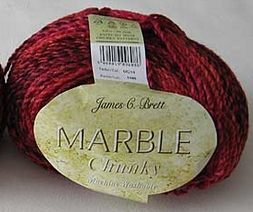
I’m working on US #11 (8mm) needles in order to get a nice drape on the finished item. It’s a quick knit – about 15 minutes per square, so this should move along at a good clip. The yarn is interesting, with the shading of the two constituent plies meandering from rose to deep maroon, with side trips that introduce a little bit of orange and purple. I like the loft and texture of the finished garter stitch on the #11s. I had tried this on smaller needles (the label recommends 6mm – US #10, but the fabric was too stiff for a blanket, although adequate for a sweater). However, I am not fond of the yarn’s tendency to shred and split. It’s relatively softly spun, and needle tips – even massive #11 needle tips – catch on stray bits as I work. This makes ripping back difficult, especially on the center double decrease (slip 2 tog knitwise, k1, pass slipped stitches over). Still, the annoyance is mostly passed, now that I’ve decided on what to do with the stuff, and what size needles to use.
As usual, I’m bungee-jumping here. The particulars are being decided upon as I go. I’m not sure how big the final piece will be, or whether I’ll stick with the established pattern of squares throughout, or even how big this center area (if it ends up being just a center area) might be in relation to any framing or edging elements. I may add edge triangles to norm the zig-zag sides, then do something else for an edging. There are several possibilities once the thing is a nice, even rectangle:
- A couple of rounds of concentric I-cord, or perhaps double I-cord
- Another round of some type of modular units
- Narrow strips knit perpendicular to the blanket’s body, so that the yarn’s gradients show well, probably with mitered corners, just for fun.
- Some kind of edging that uses garter texture and diagonals, to echo what will be happening in the center area.
Why a blanket now, and not continued work on the lace-in-process? Well first, new yarn burns a hole in one’s pocket with an urge to cast on SOMETHING. Of the yarns I’ve gotten at the sale, this is the only project that would be quick enough to complete before my return to India, and all of the yarns I’ve gotten are too massy to fit into my luggage. Also, aside from three warm days, it’s been rather cool here for spring in Massachusetts. A nice, cozy throw just appealed to me.
Finally, the last point of pondering… ANOTHER blanket? Who’s going to get this one? Younger Daughter has piped up, so it may end up being hers.
CHECKING IN
Where have I been? In Pune, but now home in the US for a brief visit. What have I been doing? Mostly wallowing in ennui. For whatever reason, I have not been motivated to do much, not working on projects, researching, or writing here.
I can report that aside from the transoceanic trip, we did do one major thing. We hosted a “happy hour” party for 25 of The Resident Male’s coworkers, holding it at the apartment. I did all of the prep and cooking. I made samosas, falafel, hummus, guacamole, and Chinese scallion pancakes (adding some minced hot peppers to the scallions). I also improvised a mixed olive salad, and paneer with a Thai-style peanut sauce. Everyone had a good time, and using consumption as a barometer – the snacks were well received. The scallion pancakes in particular were prime, and a do-again, for sure!
There is some minimal progress on my latest shawl. I test-knit a new MMarioKnits product, but others were far speedier than me. Most of the corrections I found were posted by others, and my finished project was not completed in time for photography for the cover of the pattern. The main reason for this was a major lace disaster. While photographing the piece, I managed to drop upwards of 90 stitches, and needed to ravel back to a solid point and re-knit. After coming in so slowly for completion, I decided to punt the official as-written, minimal bind-off treatment, and add a knit-on lace edging. I selected a simple one from Sharon Miller’s Heirloom Knitting, picked both for complimenting the lines of the shawl’s main motifs, and for being a multiple of 12 rows, and began. I’m about two-thirds of the way around my circumference, and hope to be done soon.

However, just because I’ve been a slouching, IPad/browser game playing slacker, doesn’t mean the rest of the world stands still.
I’ve said before that I get an enormous kick out of seeing what people do with the patterns and designs I post. Occasionally, folk write to me to ask questions, or send me photos. Other times, I track links to my pages back to the point of origin. If I stumble across something I ask the owner if I can repost their work here, with links or attributions as they desire. Here are the products of two people who sent me pix of their stitching this month.
Elaine from Australia delighted me with these two projects that include filling motifs from Ensamplario Atlantio:
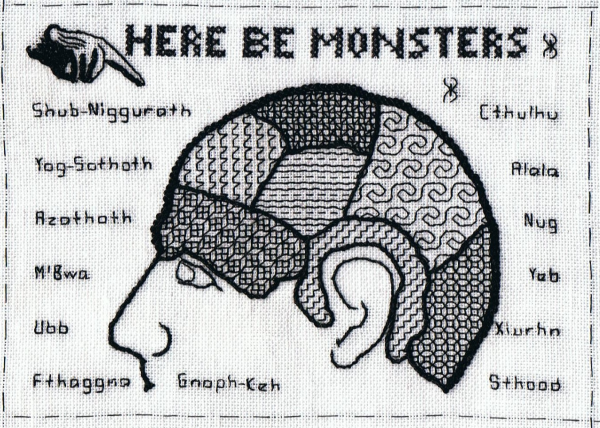

Both were presents for friends. I’m not sure which one I like more – the piece for the Kiwi audiophile, or the one for the Lovecraft aficionado.
Meanwhile, Jordana in New York used two of the Ensamplario designs for the cover of a charming two-sided needle case. Here are her photos of the work in progress, and the finished item:
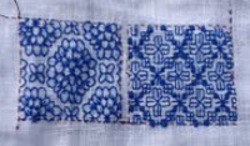
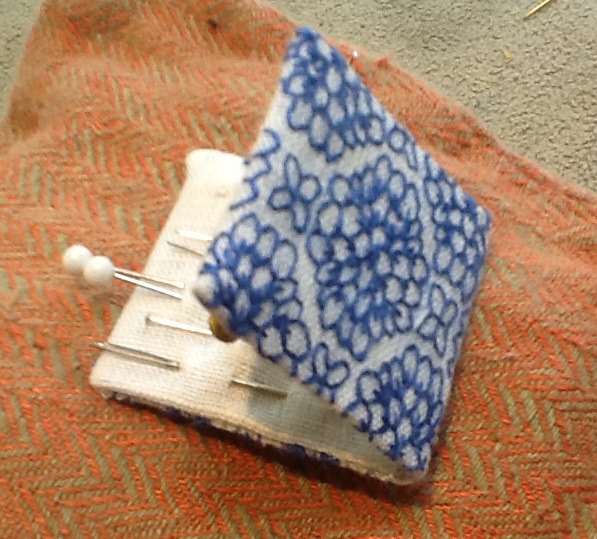
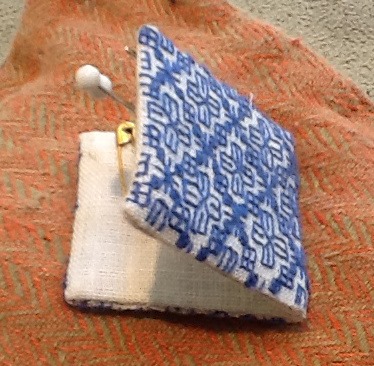
Well done to Elaine and Jordana! Special thanks to both of them for making my day!
157 AND COUNTING
Well, here I am on row 157 of Dozen, with about another 20 or so to go.

It’s a wild zaggedy thing, for sure. I also have to say that this is the last picture I’ll be posting of the thing spread out until I’m all finished and bound off. I lost 30 or so stitches in pinning this, and am not relishing going back the five or six rounds I need to now, in order to rescue them.
The directions end with a plain bind-off. I’m not going to do that. Instead, I’m planning on knitting an edging onto the live stitches. Which one, I’m not sure yet. It needs a very solid element in order to frame all this wild zappage, along with some sort of coordinating triangle or dag to carry the theme forward. I may end up having to cobble something together, or design my own to work with the last row’s stitch count.
Am I pleased with the result so far? Yes and no. I’m having fun knitting this, but I have to say that I now that I see it all expanded, I think that the outermost 20 or so rounds shown above are too textured, and detract from the star-like center.
Off to perform CPR on those 30 stitches…
PRECISION IN ALL THINGS?
First, for Davey – the wildly loud sofa pillow covers to coordinate with the wildly loud rug:
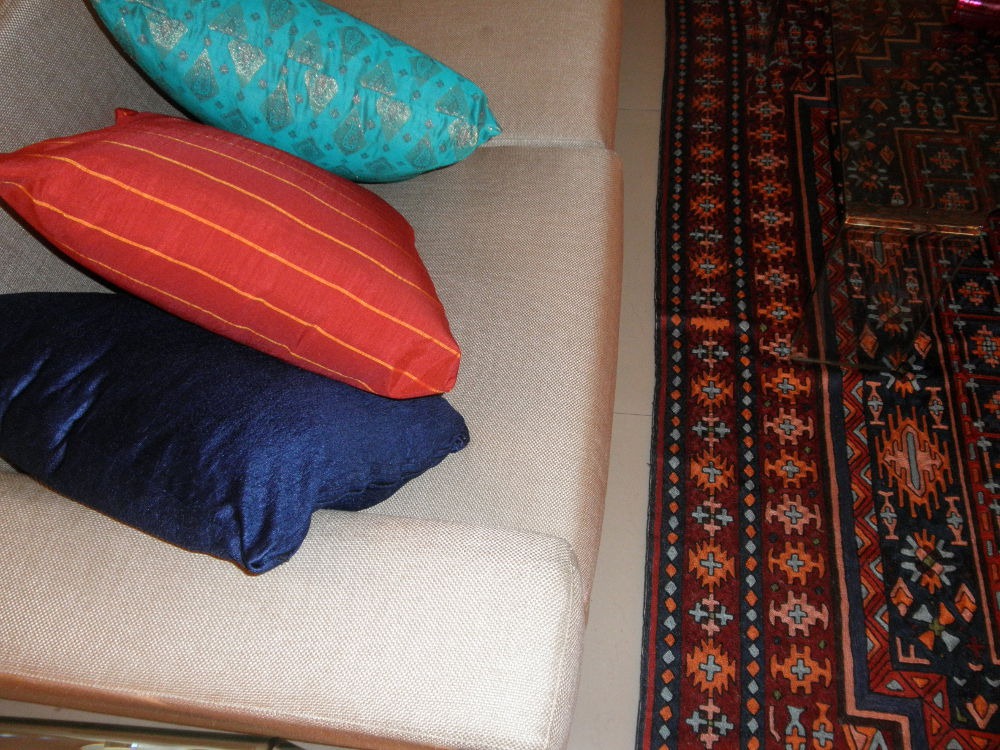
I picked the blue, red/orange stripe, and turquoise/gold from memory, and they work, even in spite of my equivocal photographic skills, and the flash-wash that makes the red pillow look paler than in real life. There are six pillows in total, two of each fabric.
Moving on, here’s progress through Row 103 of the Dozen shawl that I’m test-knitting:

It’s growing into a feral, interlaced dahlia of a design, which you can begin to see in this rough pin-out. Additional width will be more of the same.
And then there’s the Sarah Collins sampler kit, upon which I’ve started but have made no real progress:

Maybe I’ve ridden at liberty for too long, working at whim instead of direction. Maybe I’m too much of a tinkerer to do a stitched design laid out by someone else, or I have a touch of compulsive perfectionist in my soul – but for whatever reason, this kit is already driving me nuts. Don’t get me wrong, it’s a complete kit, thoughtfully laid out and as a reproduction, extremely well documented. The unruly element is me.
For example, it pains me to mindlessly duplicate the mistakes laid down by the original stitcher. See that twist column to the left of the frame? That’s verbatim to the pattern’s directions. But I tried, and tried, but just couldn’t let it sit that way. See the twist inside the frame, with the completed centers? I **had** to do it. I’ll probably pick out the offending imperfect twist and re-do it to match the edited bit.
There’s also working up the double running for this panel in two colors of sienna. The blue flower doesn’t bother me, I find that adorable. But using two threads for the framing spiral, alternating colors is maddening. It’s clear to me that dear Sarah might not have marled and finger-spun her threads properly, or perhaps ran out of one of the two shades, and that’s why the panel is done in alternating two-tone. It’s all I can do to grit my teeth and work as directed, because if I don’t, I risk running out of a color before the kit is done. Getting more matching thread, especially here, would be difficult in the extreme.
And then there’s the format of the charts. They’re huge, and orchestrate a stitch for stitch path, with every single one numbered. There are sufficient map pages in the thing to chart one’s way from Boston to Mumbai by rail (including the sunken parts via Atlantis). Paging through them is an exercise in where-the-heck-is-page-2b-left-got-to-now?” – then finding it under the sofa.
I’m also not fond of the indicated stitch logic. The paths described are not the ones I would choose. I tend to key off established bits, so that I can proof new sections against clean counts as I work. There’s too much “where no man has gone before” in this piece, with extremely long runs worked in advance of the growing body of work, and no way to confirm fidelity as one progresses.
Is there a moral to this story? Perhaps, not. But I have to admit that today’s post reveals that I’m a ruthless stickler for detail, caught up in color matching from memory, precision adherence to knitting patterns (where forays into originality are better left for after one has grokked the source design); but temperamentally incapable of similar fidelity to oh-so-obvious stitching directions. Mark it up as another character flaw, pass me a glass of wine, and move on, please.
FAR FROM A DIME A DOZEN
Well, having finished the Dragon Stole by the prolific MmarioKnits, I thought it would be helpful if I gave back a bit. So I decided to test-knit one of his newer patterns. Mmario appears to design on paper, spewing out lace patterns like rain from a garden sprinkler, in dazzling abundance. Then a coterie of the faithful test-knit the patterns. Their efforts provide the photos that accompany the designs, and they catch errors or discrepancies in the directions. I chose “Dozens” – a 12-panel shawl, for which I saw no prior testing effort. Dozens isn’t available yet on Ravelry – just on the MmarioKnits test-knitting group on Yahoo.
Here are the first 60 or so rows, roughly spread out on two circs and pinned so you can see the detail:
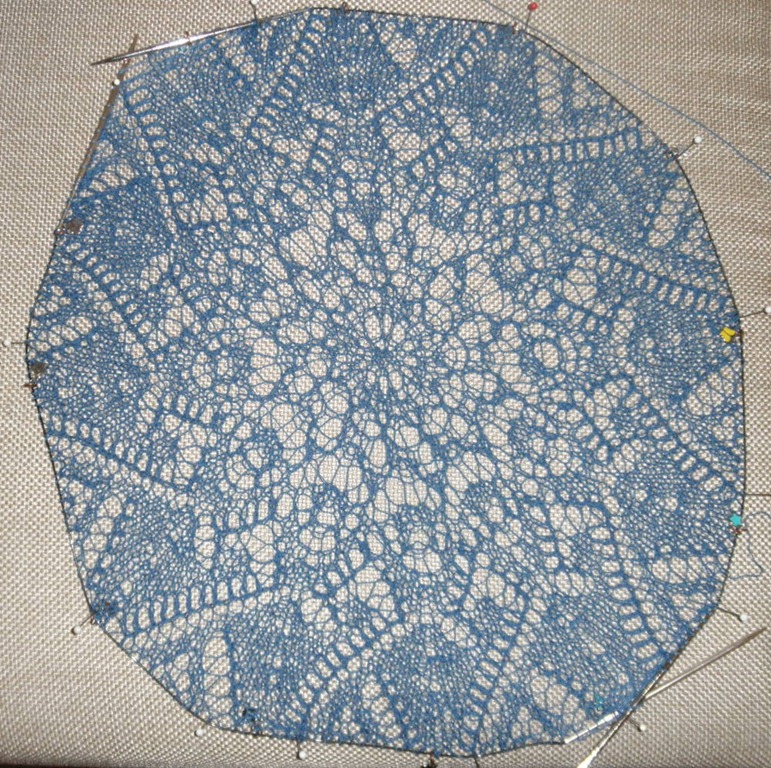
I found a correction, dutifully sent in and now present in the pattern’s master. I am hoping that I haven’t committed any mistakes yet, although I do see one awkward bit that I’m hoping will block out (the stitches are correct, just bumpy). I’m another 20 or so rows past this point now, so additional pix will follow soon.
I’m enjoying this – knitting up a “mystery project” for which I have no prior pix is fun. I find myself looking forward to seeing what each new pattern segment adds to the growing pile.
For yarn, I’m using Elann.com Peruvian Baby Lace Merino – a gift from Long Time Needlework Pal and Co-Enabler, Kathryn. The Tapestry Blue color rather more of a medium blue than the light Wedgewood it looks like in the flash photo above. I chose it because I had plenty, it’s a very nice, stretchy, uniform, two-ply laceweight, and will photograph well, unlike the mass of black and navy lace yarn I also brought. (Aside: I’m saving a huge 4189 yard hank of Jaggerspun Main Line 2/20 in black for the Sharon Miller Princess Shawl. I bought that pattern a while back, and have saved it for The Right Knitting Moment. I’ve got it here in my India survival kit, too.)
For aids, I’m working with twelve small markers, and have the PDF on my iPad, where I’m making annotations as I go using PDF Max Pro. It’s one of may PDF annotation apps. I happened to luck into it for free via the AppsGoneFree app. Other PDF reading/management apps occasionally appear there, too.
In other news, I have now golfed here in Pune. No holes or flags need fear my approach shots. The Resident Male however was quite deadly on the course this weekend past.
 String-Or-Nothing