A SPANISH GENTLEMAN AND HIS COLLAR
Once again discussions on Facebook have brought a portrait to my attention. Elspeth over at Elizabethan Costume has found something I’ve been seeking for a long time. An portrait of an individual with a Spanish name, with a sitter that is wearing what we would describe as blackwork.
While 19th and 20th century discussions of blackwork in the Tudor period often call it Spanish Blackwork, and offer “Spanish Stitch” as another name for double running. But there are very few portraits of Iberian individuals wearing it, as one might think there would be if the folk attribution of Catherine of Aragon’s introduction of a style already popular in her homeland was to be corroborated. This portrait, dated 1530-1532 is by Jan Gossaert, and is part of the J. Paul Getty Museum’s collection, accession 88.PB.43. It depicts Francisco de los Cobos y Molina, who served in Charles V’s Holy Roman Empire court as a trusted secretary and advisor. The Morgan Library and Museum notes the absolute identification of the sitter. Note that shortly after this was painted, Catherine far away in her English court was only a year away from Henry’s declaration that their marriage was invalid (1533) and her subsequent sequestration.
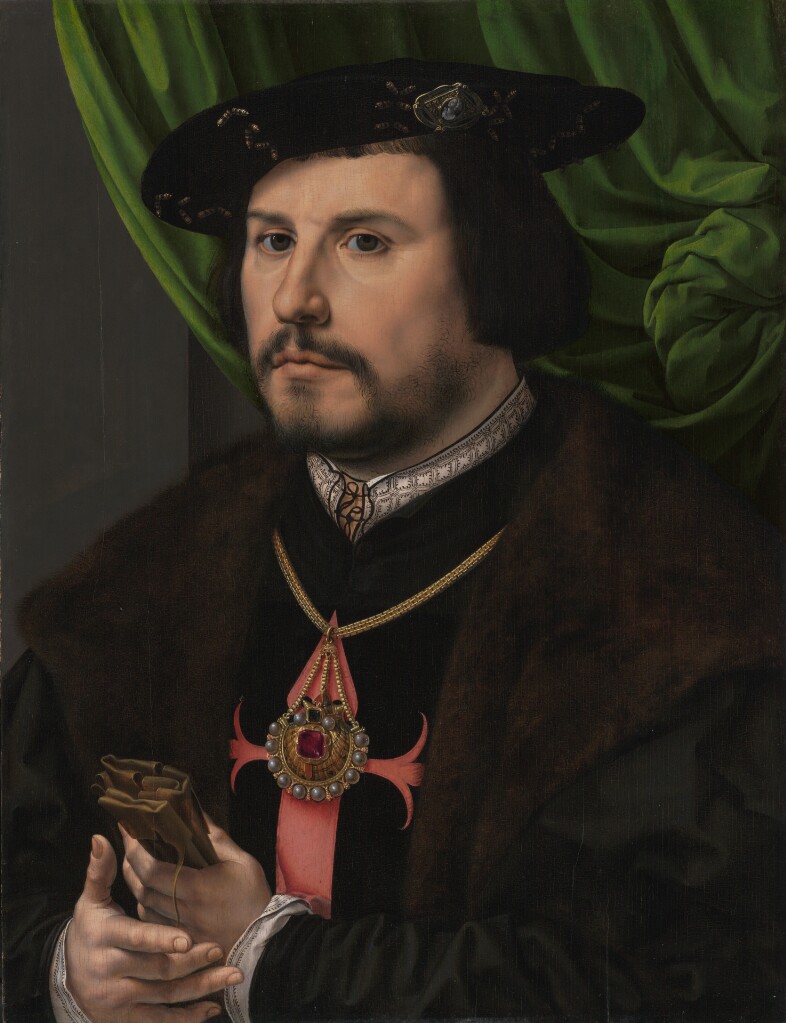
There are higher resolution pictures at the museum link, above.
To say thank you to Elspeth and to spread my joy in finding a heretofore unknown bit of delight, I share a graph for that collar.
Click here for a full size downloadable PDF of the pattern below.

Now. How “authentic” is my representation?
I’d say it’s no more than an honest representation. Remember that the original I am working from is a painting. The painter did his best to capture the alignment of the verticals with the horizontal interfaces, but he fudged almost all of them. What I’ve done is to show the design elements in as close to the original proportions as I could manage, with the correct number of “pips” inside the boxes formed by the repeat, and represent as well as I could the marching row of them more or less evenly spaced across the top edge of the collar band. Like the painter, I have fudged the geometry of the thing to make it fit. And of course the nature of those pips is open to interpretation. Little hoof-like triangles? A three pronged fork, bent to one side? Should the ones in the square be closer to each other than I show? Should the middle one of each box side be taller? All of these would be as valid as what I show. After all, a tiny blob of paint can be seen in many ways.
I will be adding this pattern to the Embroidery Patterns page here at String, so it can be easily found in the future. If you choose to try out this design, please feel free to share a photo. I do so enjoy seeing what mischief these doodles attempt out there in the wide, wide world.
UP CLOSE AND PERSONAL!
Yesterday a friend and I went to the Boston Museum of Fine Arts, in specific to see the “Strong Women in Renaissance Italy” exhibit. We also took in “Fashioned by Sargent”, and wandered at will and whim through other halls, especially those in the new wing. All in all, it was a splendid day out, full of fascinating things to see and discuss, in excellent company. This post focuses on the Strong Women exhibit. I enjoyed the Sargent exhibit, too, but I took fewer photos. If my friend has more than I do, I might do a follow on about it though.
My main motivating reason to go was that the Renaissance exhibit included an artifact I’ve written about before. On loan from the Jewish Museum in New York is Honorata Foa’s red countwork Torah binder. Here is a photo I took at the MFA, of a bit that’s folded under in the official Jewish Museum photo linked above.

And an ultra-closeup. Note that the work is stitched over a grid of 3×3 threads.
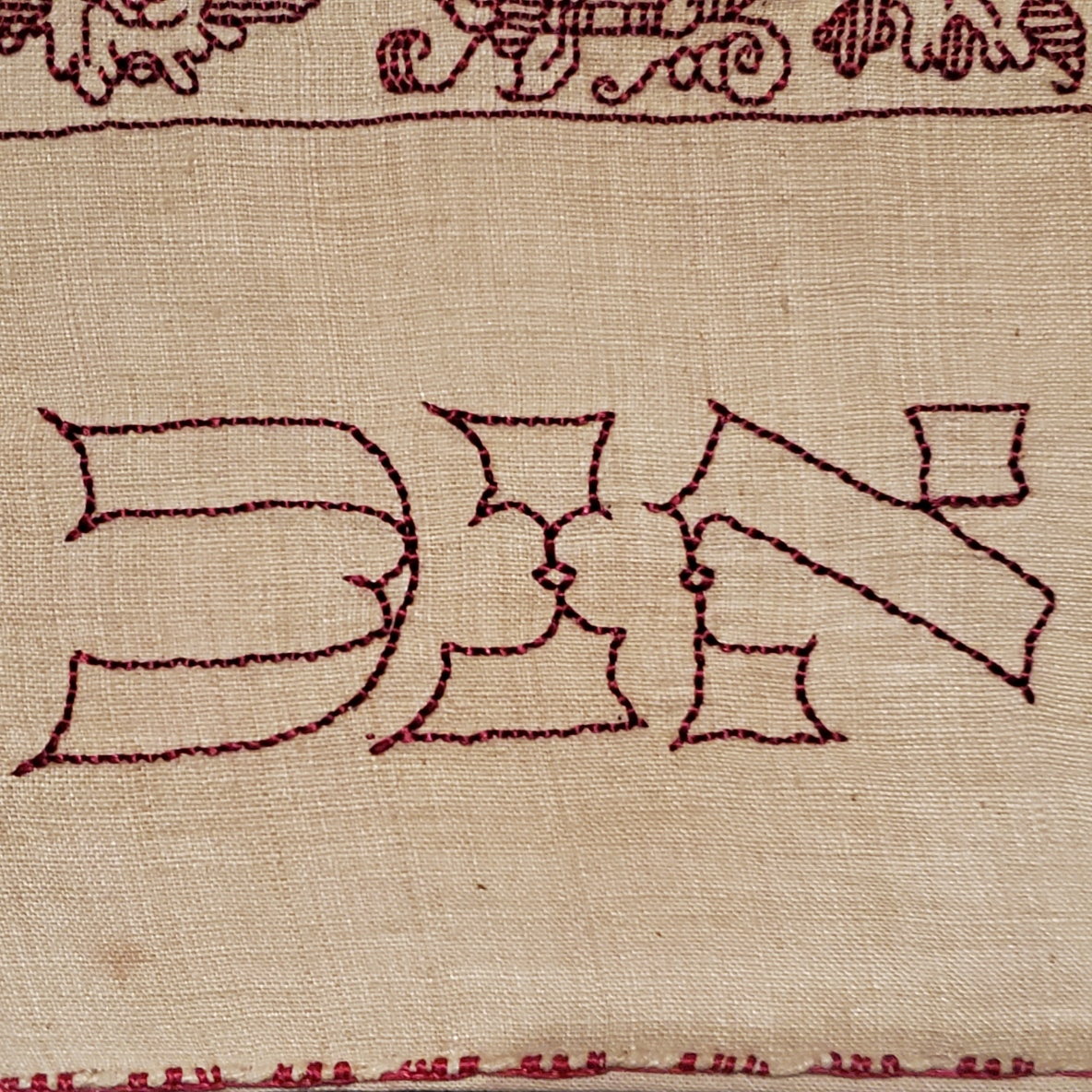
Compare the original to my rendition, stitched on a big-as-logs, known thread count of 32 threads per inch, over 2×2 – 16 stitches per inch. Yes, I brought it with me, and photographed it held up to the glass display case.
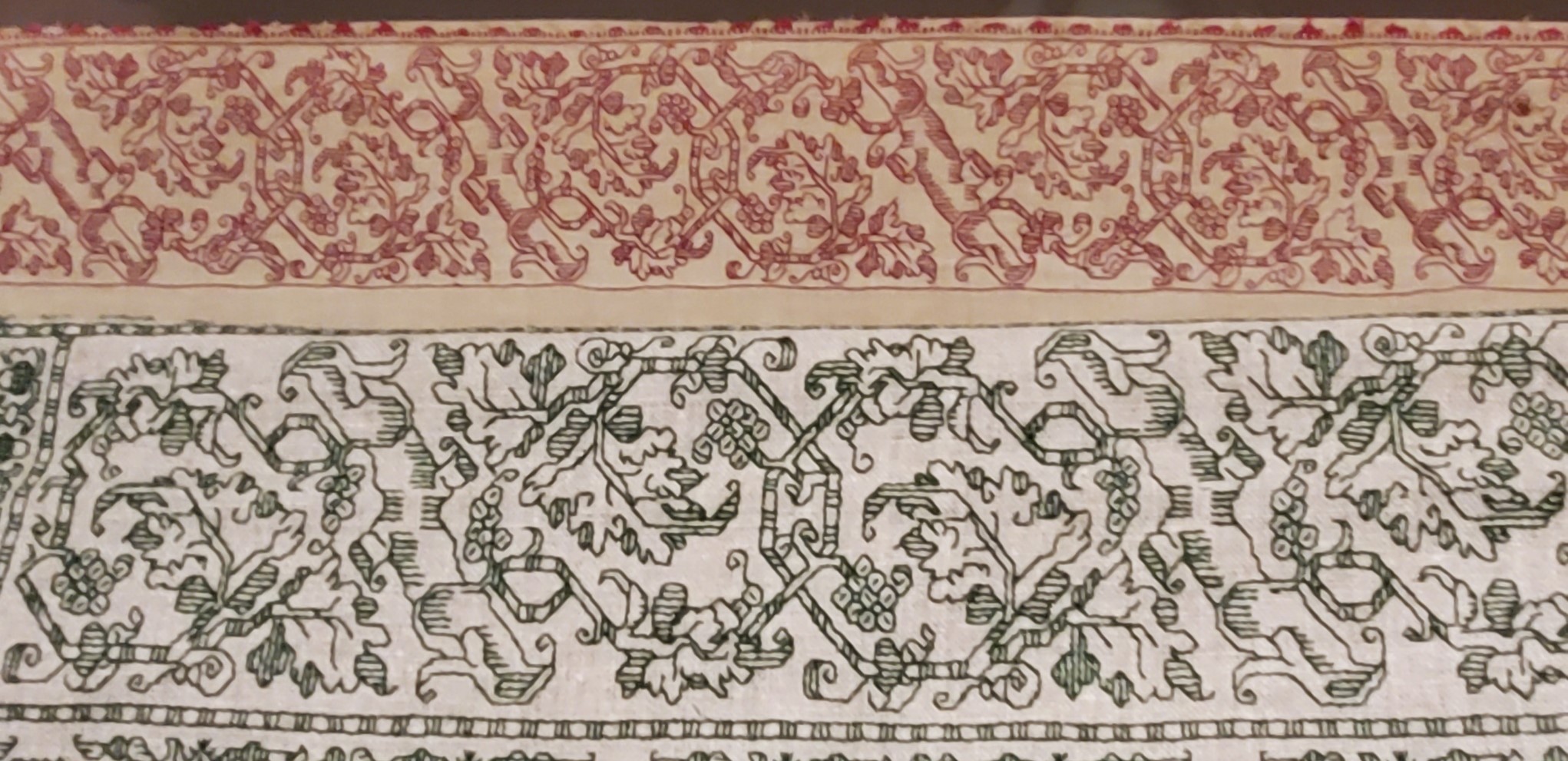
Given the difference in scale of the two, and allowing for the inch or so of distance between them, a rough eyeball estimate is that the ground for the Foa original is about the equivalent of the 72-ish count linen we all used for the Unstitched Coif project. I also think that the weave on the Foa original is ever so slightly more compressed east-west than it is north-south. making the diagonals a tiny bit more upright than they are on my version. Fascinating stuff!
Now that I see the structure, scale and alignment of the Hebrew letters, I am beginning to think that they were written out and then over stitched, conforming as much as possible to the 3 over 3 rubric, as opposed to the regular countwork of the foliate strapwork above them. For one, they don’t inhabit the same baseline. And they do seem to employ improvised angles and variant stitch lengths, although they were clearly done by someone with a skilled hand who took pains to keep stitch length as uniform as possible over those variant angles. Even so, I may be able to improvise a full alphabet of them, adapting the missing letters from the forms of those that are displayed and known. Another to-do for my ever-growing list…
The Foa Torah Binder was not the only fascinating bit of needlework or textiles on display. On the non-stitched side, there were two long lengths of sumptuous silk velvet brocade, one with a manipulated texture (possibly stamped to create highlights and shadows). What struck me the most was the scale of the patterns. The pomegranate like flower units were as big as turkey platters – far larger even than the legendary motif on the front and center of the famous Eleanor of Toledo portrait:
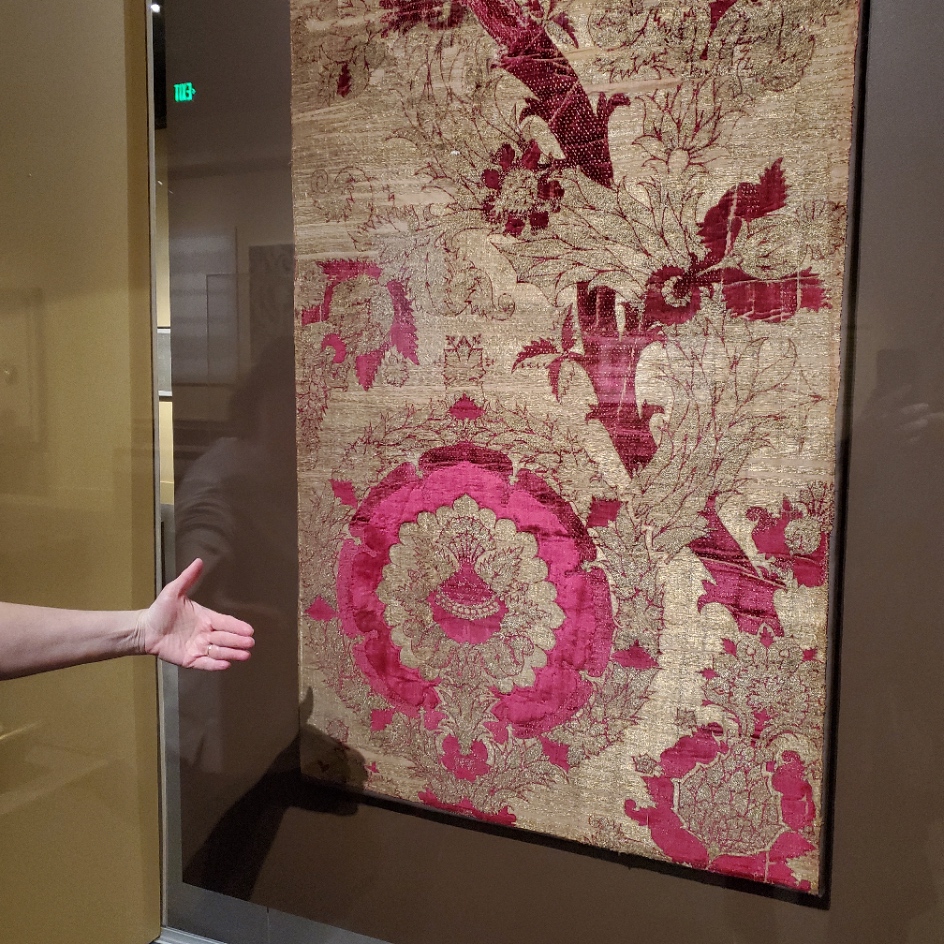

The red one on the left was credited as “Length of Velvet”, from Florence, circa 1450-1500. MFA accession 31.140. The helping hand for scale was provided by my friend. The one of the right is “Length of Velvet”, possibly from Venice, 15th century. MFA accession 58.22. The photo at the museum link is closer to the color (the gallery was dark) and shows off the highlights and shadows impressed into the velvet. Those aren’t two colors, they are the product of some sort of manipulation of the nap. It’s not shorter in the lighter sections, it looks like it’s all the same length, but some just catches the light differently, which is what made me think that it might have been heat/water manipulated with carved blocks. But that’s just the idle speculation of someone who knows nothing about fabric manipulation techniques.
There was another counted piece. It can be difficult to judge the size of these from on line museum photo collections. Even when the dimensions are given, sometimes it just doesn’t input.

Photo above shamelessly borrowed from the museum page, where they describe it as a towel. The object’s name is a purported description of the stitches used. Punto Scritto and Punto a Spina Pesce MFA Accession 83.242, Italian, 16th century. Towel size? Nope. Tablecloth to seat 8 size. Wow.
Here are my photos.
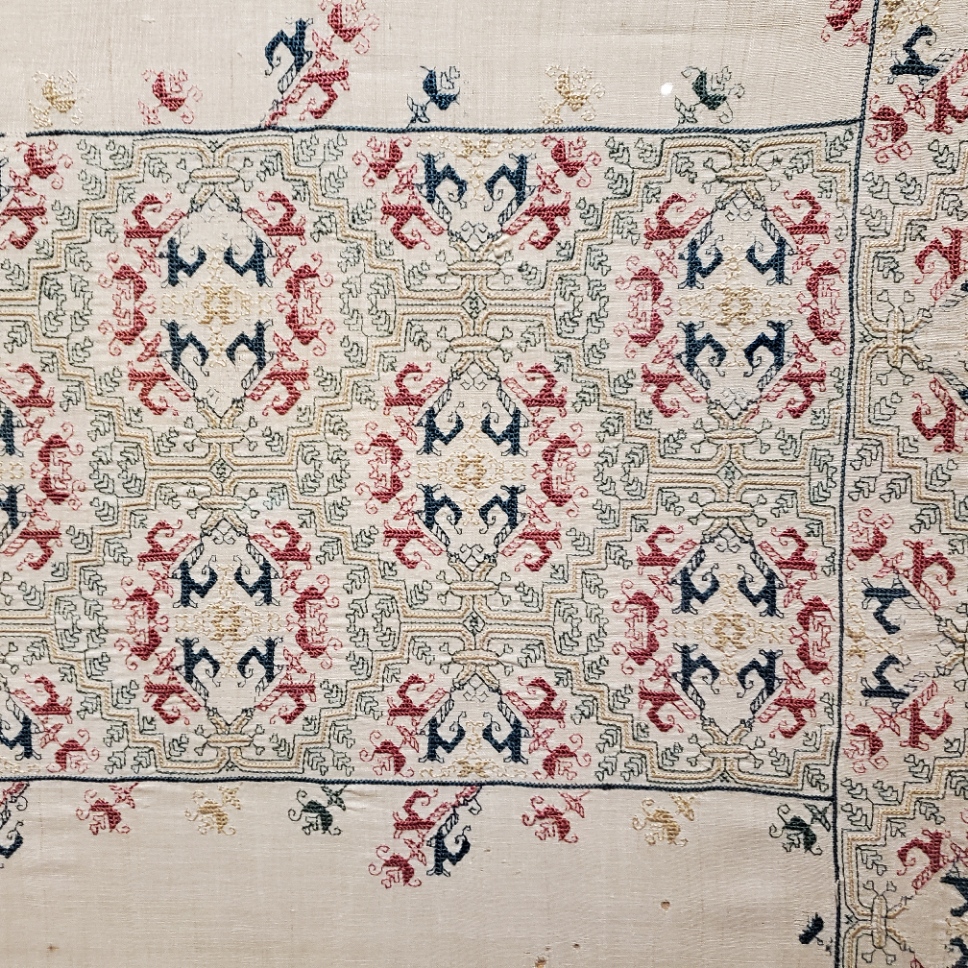

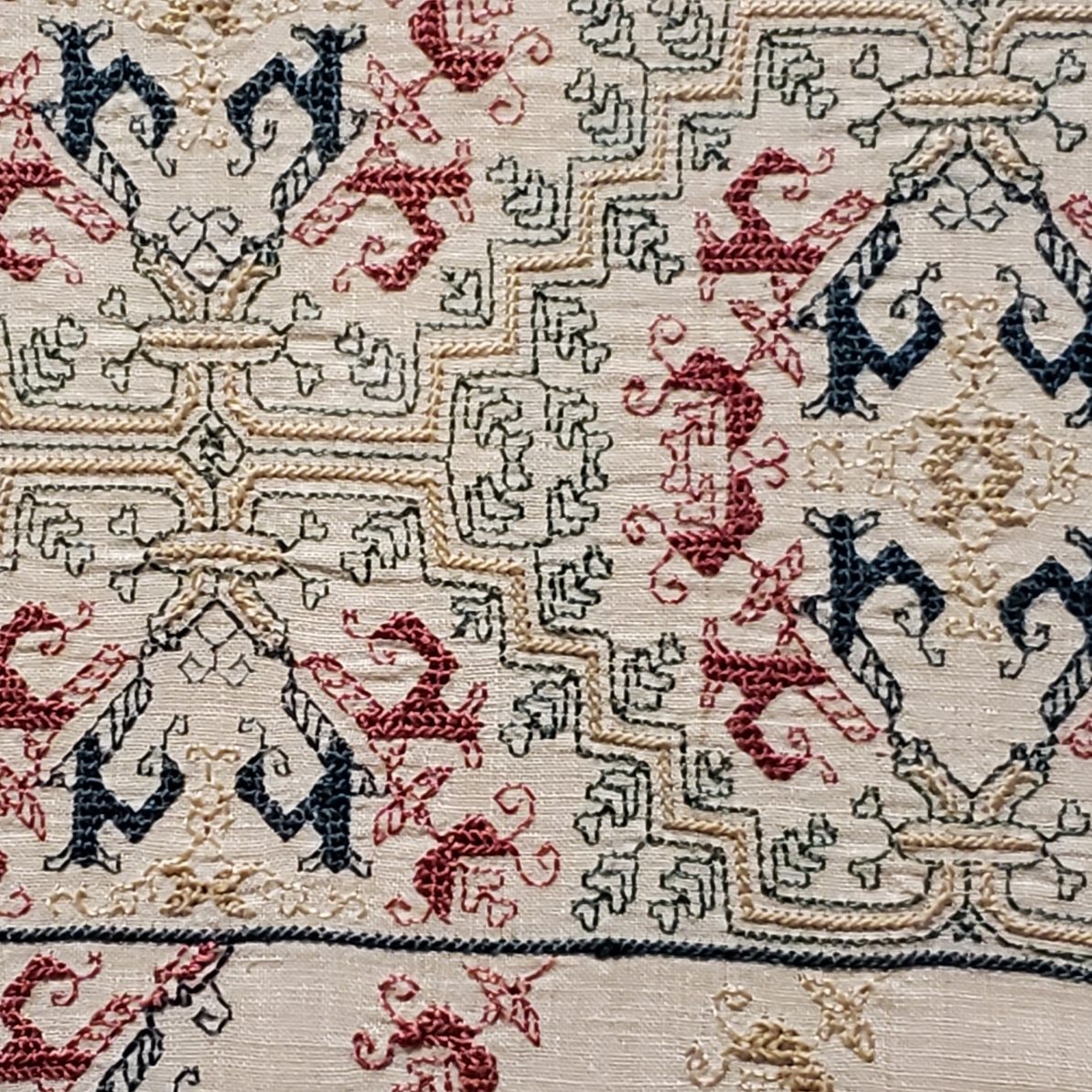


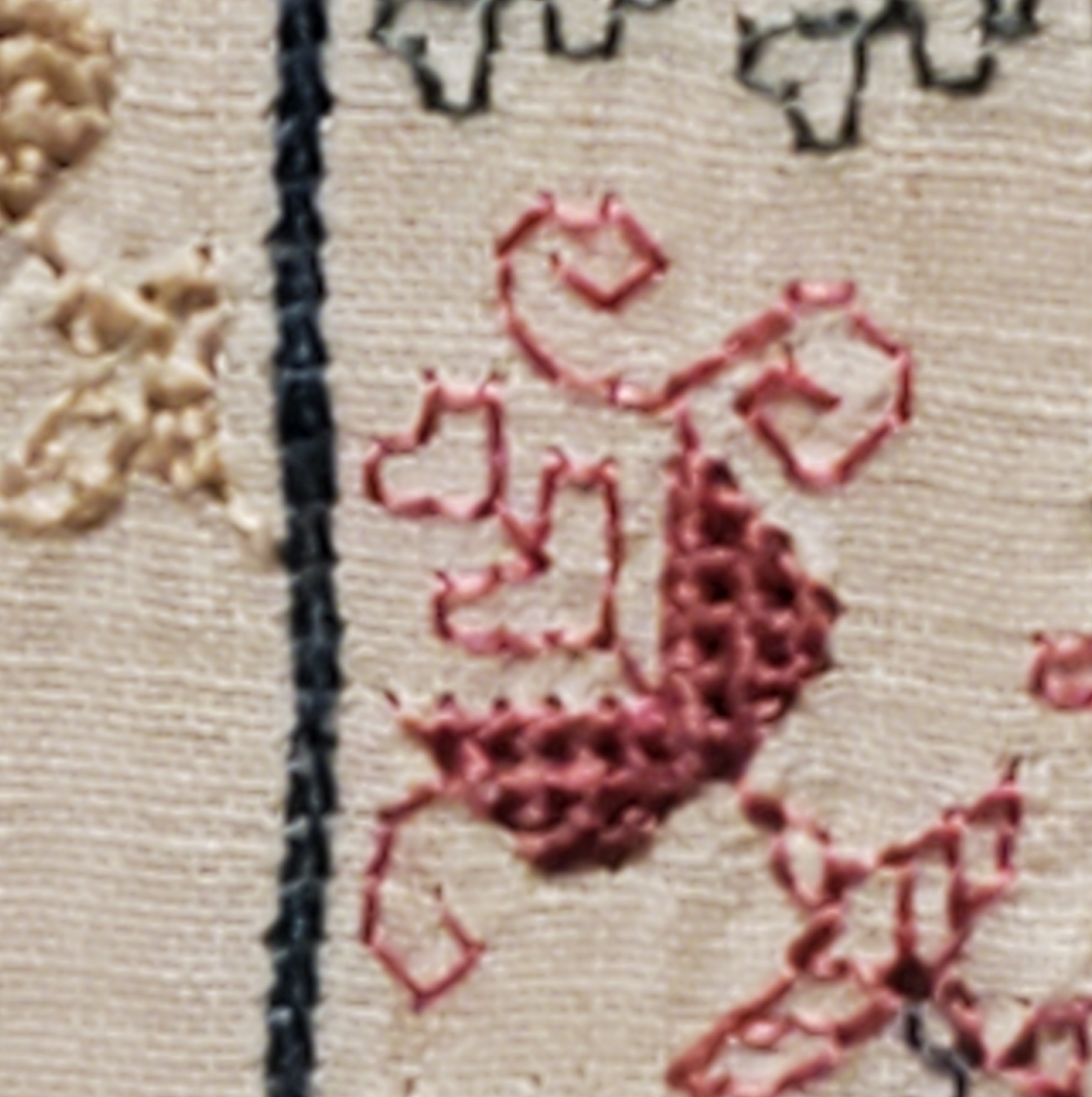
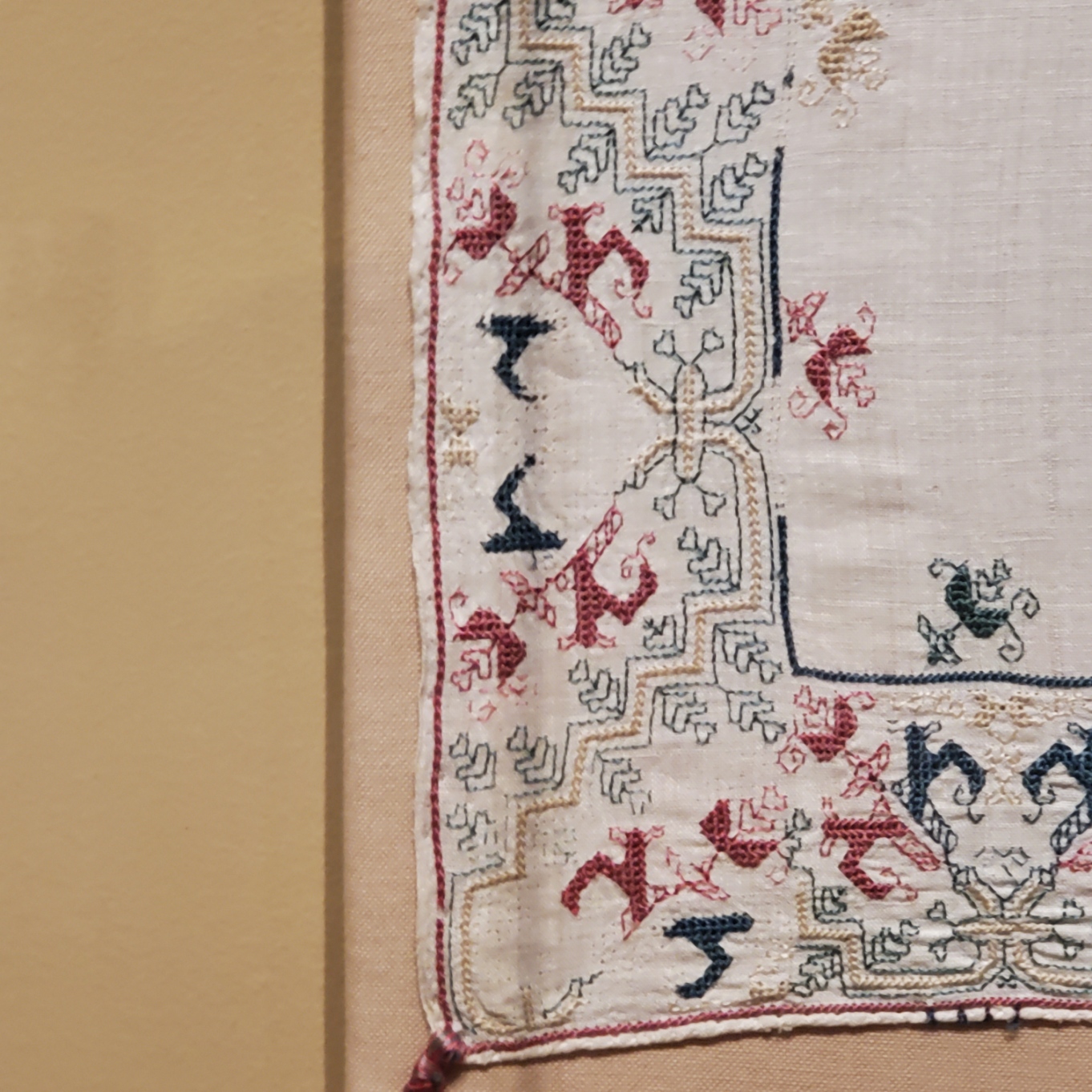
Punto Scritto is another name for double running stitch. That’s ok. Punto a Spina Pesce has been used by the museum to describe some but not all Italian works featuring a variant long armed cross stitch. I think I can see that in the solid, heavier green and yellow lines.
Without having seen the backs, which would clarify this, I suspect that Punto a Spina Pesce (fishbone stitch), is the version of long armed cross stitch that is done by taking stitches with the needle parallel to the direction of stitching as one moves down the row, rather than the one where the needle is held vertically as one works. While the front of both is almost identical, the appearance of the reverse differs, with the horizontal-needle one being formed similar to the way stitches in herringbone are worked. The horizontal method leaves long parallel traces that align with the row-like appearance of the front. If multiple rows are worked this way, there are raised welts in all but the first and last row because the thread on the back is double layered as each consecutive row is added. In the latter there are also parallel lines on the back, but they are perpendicular to the direction of the stitching and overlapping threads on the back are also vertical. As to which one is “correct” – both seem to exist in the folk tradition, so pop some popcorn and sit back to watch the proponents of each fight it out.
A third technique is used. The colored buds are filled in using what I call “Meshy” – the drawn work stitch based on double sided boxed cross stitch that totally covers the ground, and is pulled tightly enough to look like a mesh net of squares. That’s most often employed as a ground stitch in voided work, but it is not uncommon in foreground use, as well. This one is on my charting list, too.
One last thought on this piece – it reminds me a bit of a strip I charted and stitched up a while back, as part of my big blackwork sampler. The source for that one is here, Metropolitan Museum of Art, Accession 79.1.13, Strip, Italian, 16th century but the photo below is of my work.

There were more stitched pieces in the room, but the only other charted one was this adorable chubby unicorn piece in drawn thread. It’s tons of fun to stumble across things I’ve got in my research notes, but never seen in person. This one is MFA’s “Lace”, 16th century Italian, Accession 43.237. Long shot below borrowed from their site.

The museum chose to display this one scrolled, like they did the Torah Binder, so that only a portion was visible. Here are my three shots, left, right, and center.


Yes, there are many ways to achieve this look. But squinting closely one can see that no threads were picked from the work as in withdrawn thread work. There are neat little bundles of three threads where the solid areas meet the mesh ground. (Easier to see in the flesh than in my photo though).

It’s clear that this piece was cut from a larger cloth. I wouldn’t be surprised to find another fragment of it in another museum collection someday. That’s not uncommon. But for now, chubby unicorns, their big quaternary star and attendant scrawny vegetation are also on my to-chart list. But I am curious about the ornament above them.
Now there were lots of other items on display in this exhibit, most of which I’ve seen in the BMFA’s on line photo collection – other stitchery, several modelbooks (all open to needle lace pages), lots of ceramics, and many paintings. Some of which from the “back stacks” – items not on usual display. It was grand to see them out and being admired. I admit I did not download the guided tour and didn’t buy the accompanying $45 book, but while there were lots of women depicted in these massed works, there were very few historical individuals described or shown.
I was hoping to learn more about (for example) what individual female members of the Italian mercantile nobility actually did, beyond being married for political alliances. There were a few portraits, but not much of the story behind the sitters’ identities (if known at all) was presented in the in-room captions. There was a smattering of works by female artists, but the majority of pieces were by men, depicting saints, virtues, and ideals – laudable and arguably strong, but not the personal presence I had hoped for. All in all it was a lovely exhibit, with tons of pieces that were interesting in and of themselves, but as an exhibit showing the power and reach of Renaissance Italian women, it came off more as an assemblage of things from their time, rather than a documentation of their lives, ambitions, and accomplishments.
UNSTITCHED COIF – FINISH. THE FILLS
As promised here’s the breakdown of the design, motif by motif – a guided tour of what I was thinking or not thinking about. This is turning out to be way longer than I expected. Feel free to scroll down to the eye candy and ignore the prose.
First, on the general aesthetics, I already confessed yesterday that this piece is a departure from the strictly historical, using stitches, materials, and fills that have no specific point source in a particular artifact contemporary (or near contemporary) with the original Victoria and Albert Museum piece of ink-drawn linen. But in spite of that I’ve tried to stick to general aesthetic. It was a time of “more is more.” Pieces like this coif were status items that proclaimed the wearer’s wealth. I heard Thistle Thread’s Tricia Wilson Nguyen lecture at Winterthur about how copious precious metal spangles, threads, and even lace served as walking bank accounts, shouting prosperity but still being available as liquid capital to an owner whose fortunes dipped so low that reaching for a scissors to snip off a bit for ready cash was a welcome option. To that end, I’ve doubled down on the gold accents. But not being as flush as landed gentry from the late 1500s, I’ve used imitation gold thread and gold tone mylar rounds.
I’ve also tried to emulate the more lush aspects of some historical blackwork pieces, that created depth and shaded nuance by using fills of different visual density, augmenting the effect with raised outlines. I would have liked to use a plaited stitch for the stems, but it’s clear that the original artisan didn’t leave room for them, so I settled on outlines that were markedly heavier than the fills, topped off by a whole-piece outline that was even thicker and more dimensional.
I also like the difference in blacks used. The fills in the thin modern-dyed spun silk single strand are dark enough to look lacy and contrast well with the ground. The outlines, done in the boutique, small batch historically dyed double strand (also spun) are a much softer black. In some places the black takes on a reddish or brownish tinge, or moderates to an even less dense charcoal. If they were as deeply toned as the fills I think that each leaf, petal, or wing would present more as a grey-scale visual mass rather than letting the fills speak louder than the outlines. Finally the deeply black modern dyed but glossier reeled filament silk used in the perimeter then echoes the black of the fills, and makes a world of difference to the piece, pulling it all together. All black, all different, and all contrasting with each other.
On planning and fill selection, I winged it. I didn’t sit down and plan anything. I picked fills on the fly, with only a vague idea of where I would put dense, sparse, and intermediate fills as I began each sprig or group. Some succeeded quite nicely, others I would re-do differently had I the chance. Would I ever sit down and plan an entire project’s density/darkness/shading map ahead of time to avoid this? Probably not. It’s more fun to bungee-jump stitch.
On to the piece. First a quick recap of the whole item:

On this whole coif shot I can see three center circles of motion in the design, one surrounding each rose, and one surrounding the two centermost unique motifs – the borage flower/strawberry pair. The rest of the flowers are surrounding those elements. Maybe I see them because I’ve been staring at the thing for so long, or maybe my admittedly ornate but heavily outlined rendition with the gold whipped stems sinking into the background pulls those surrounds forward. When the exhibit comes around and I can see all the other pieces it will be interesting to see what other symmetries they accentuate.
We’ll start at the upper left. Although I began at the lower right, it’s easier to walk across starting at this point. I give fill counts and cite the number of fills I used from the project’s official website. Now some of the ones in my doodle notebooks duplicate or near duplicate those (we were after all mining very similar sources), so I apologize if any double-listed ones ended up in the wrong pile.
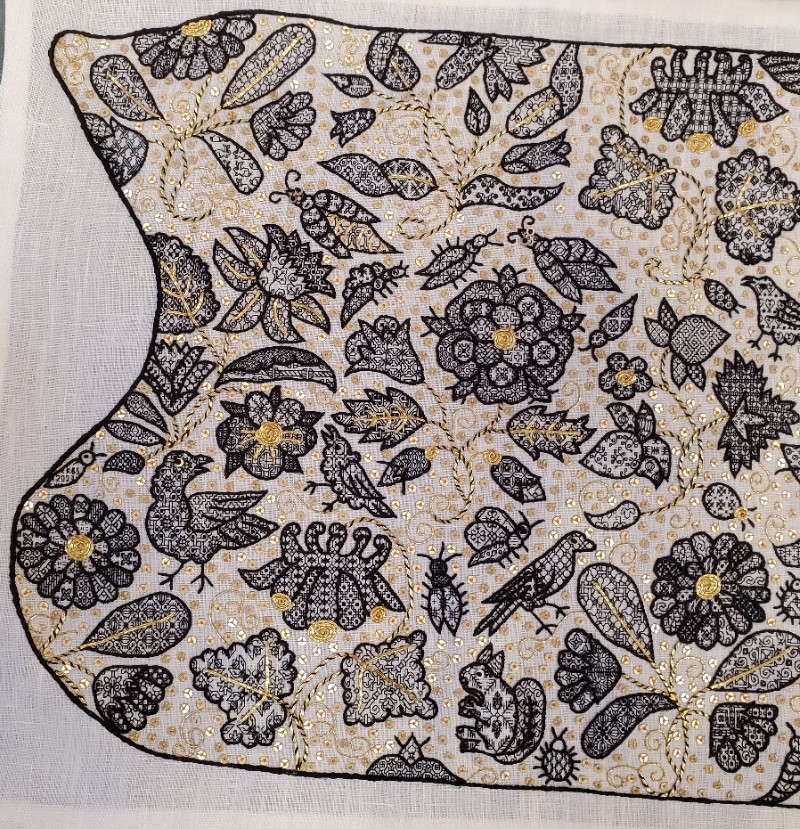
The first motif in the upper left I have been told is a marigold, one of six on the piece. It’s truncated at the edge by the indent. The marigolds were especially hard to work because those little jelly bean spaces of their petals were so tiny that most of the fills I had included repeats too large to be useful for them. I tended to use four repeats in the outer petal ring, repeating the sequence four times. The inner ring used different fills, usually two. Fourteen fills in this motif, twelve are mine, including the bunny rabbits. The other two are from the collections redacted by Toni Buckby, our Fearless Leader, and are available at the Unstitched Coif project website.
Immediately to right of the partial marigold in the corner is a truncated carnation or gillyflower (hard to tell them apart). Three of these are here, but only one isn’t cut by the perimeter. At this point, relatively late in my stitching I went out on the hunt for additional fills, and redacted a couple of pages of them for the upcoming third Ensamplario Atlantio volume. One of particular note is the leaf at the lower right, with that flying chevron shape, one of several I drafted up from a photo of a blackwork sampler, “Detached Geometric Patterns and Italianate Border Designs with Alphabet” 1697. National Trust Collections, Montacute House, Somerset, NT 597706. The twist and box of the sepal is from the same source. Yes, I know they are later than the coif’s original. Since by definition anything I doodle is even later still, I didn’t see the harm it using them. 18 fills total in this sprig, six from Toni’s redactions, two from mine, and ten of my own doodles.
Next to the right on this photo cut is a columbine. It’s barely snipped, and one of three on the piece. The large leaves made good showcases for some of the bigger repeats, even with the gold overstitching. As a result on this sprig we’ve got only five fills, two of which are from Toni’s pages. On this motif as on all of them, I tried to use fills of contrasting effect. Here in the flower we have the very strong linear grid of the main pattern, paired with the angular acorn spot motif. This flower is also an example of introducing movement or syncopation by NOT using the same grid for adjacent motifs.
Back to the left edge now. This sprig includes a narcissus or daffodil, plus a viola and something indeterminant, possibly a blossoming narcissus, all on one stem. Leaves are also of multiple forms. There are only two of this hybrid sprig on the piece, both nipped by their respective edges. All those little areas add up to 19 fills on this one. I’m particularly happy with the density effects I got on this one, with the narcissus throat, the leaf curl, and the viola sepals bringing darker depth. I did try to find two patterns of similar density for the lower petals on the narcissus, too. I have to look closely to remind myself that they are two petals of one design and three of another.
Next over is the rose. I’ll come back to the bugs that surround it. There are two roses on the coif, and two tiny partial bits on the lower edge. In truth, I’m not enthused about the way the big flower turned out. I like the sepals and the outer ring of petals (three fills, all of the same tone), but the inner rings aren’t well differentiated – although I used one fill for all five of the middle ring and that isn’t bad, that inner ring with its three fills is rather boring. Were I to do it over again I’d make some different choices here. I used sixteen fills in all for this sprig, including two of Toni’s set.
The creatures dancing “ring around the rosie” includes seven bugs and two birds. Visually they do make a circle around the rose, with one larger bug flying off above the narcissus. Here I spy a mistake, and the thing being in transit right now, it’s too late to fix. I meant to go back and add little gold stripes to the body of the bug to the upper right of the rose. Those tiny bits of couching were the ones I liked least to do. So it goes.
Like the marigold petals, the body parts of all the coif’s bugs were a challenge. Some are so tiny that it’s hard to squeeze anything resembling a pattern into them. I doodled on those, but I tried hard to make the doodles unique. In a couple of cases I found I had made a duplicate of a pattern stitched before, and went back to make modifications to one of the inadvertent pair. All of the large bugs with sequin eyes have a feature in common. Although it’s hard to see because of the stripes, I used the same pattern for both of their wings, but rotated it 90-degrees to give them extra movement. I have found no historical precedent for using directional fillings this way. Taken as a group, there are 27 fills among all of these bugs and birds, four of which are from Toni’s pages.
Reading across, the strawberries are next. (I’ll cover the bird to its right in the next post). There is only one strawberry sprig on the project, and it’s another challenge because of the small petal and sepal spaces. This is another motif I count as only a partial success. I like the top strawberry, flower, and leaf, but I think I should have chosen differently for the lower strawberry. Possibly working the sepals for the second one and that leafy whatever that terminates the sprig both darker. That would have made the lighter fill in the bottom bud a bit more congruent. Thirteen fills in all, four of them from Toni.
Back to the left hand edge of the photo, below the narcissus/viola stem are the large bird, and the second marigold (cut off at the edge). There’s also a tiny bug above the marigold in which I worked “KBS 2023” as my signature. This flower was my finishing point – the last one stitched. Most of the fills in the petals were improvised on the spot. The bird carries an interlace and star I remember doing on my first large piece of blackwork, an underskirt forepart, back in 1976. That piece however was worked on a ground that was about 28 count (14 stitches per inch), not 72 count (36 stitches per inch). You may even recognize some of the other fills I reused on the coif in the snippet below. Vital stats on Marigold #2 – 12 fills for the whole sprig including the large bird, one of which is Toni’s.
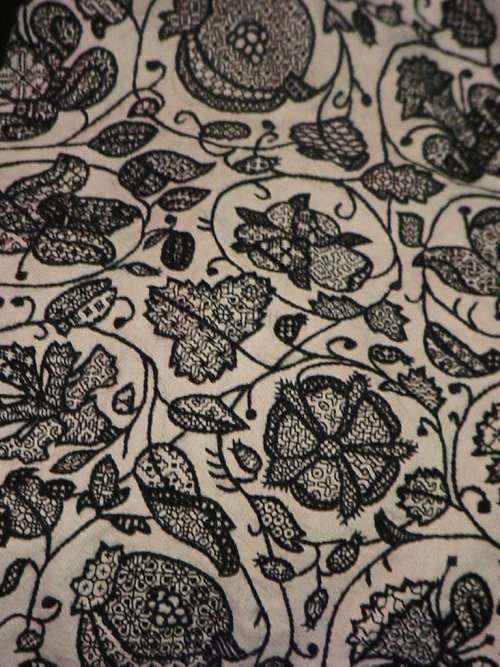
The second columbine, to the right of the bird, grows from the bottom edge of the coif. I wonder how many people will look closely enough at the leaf on the left to realize that it’s bugs. I was thinking bees, but I’ve been told they read more like flies, and “ick.” There are four fills in this sprig, one of which is Toni’s.
Adjacent to the right we find Needles the Squirrel, his friend the round bug, and one of those rose snippets. I group them together for convenience. Needles’ pine spray fill is mine, and came about during discussions on line and in the Unstitched Coif group’s Zoom meet-ups. Someone mentioned using an acorn fill for their squirrel, but UK folk were quick to point out that the indigenous Red Squirrel, who preferentially dines on pine nuts, was deeply endangered by the invasive Grey Squirrel, who prefers acorns. So I doodled up the spray, shared it with the group, and used it on mine, bestowing the appropriate name. I’ll find out in December if anyone else used this fill. I also did the directional shift in Needles’ ears. There are only six fills in this group.
Marigold #3 is in the right corner of this photo. He’s also rather a mess. I should have picked two dark and two light fills for the outer ring of petals, instead of one dark one and three intermediates. I did rotate the direction of the fills around the circumference. Oh, the snails? A variant of those snails with their wrong-way curled shell is on the majority of my blackwork pieces. Not quite a signature, but not far from one, either. There are 17 fills in this sprig, one from Toni.
On to the center of the piece.

Back up to the top of the center strip. Here we have the sadly bisected bird, with the fourth marigold to its right. Although the petals are a bit uneven, I did try something specific with this one, using two fills in of similar density in the center ring, and four also similarly sparse fills in the outer ring. I count this one as a success. Together these two motifs contain 13 fills, two of which come from Toni’s pages.
Below the marigold is the singular borage flower. There’s only the one, and he’s at the center of it all. I will cover the caterpillar later. He’s one of my favorites in the piece. I especially want to call out the tiny paisley at the bottom of the stem. The fill there is one that Toni redacted from a coif, V&A Accession T. 12.1948. It is very unusual fill, with the exception of a few that use a circle of stitches radiating from a center hole sunburst style, it is the ONLY historical fill I have seen that uses the “knight’s move” stitch – two units by one unit, to produce a 30-degree angle. Knight’s move stitches are very common in modern blackwork, but exceedingly rare in historical pieces. Knowing this I’ve drafted up hundreds of fills and in keeping with this paucity, have only included them on three or four of the most egregiously modern. The little stirrups in that paisley open up a whole new world of possibilities. Borage contains 11 fills. Five of them including the stirrups are Toni’s.
At the bottom below the borage is Carnation #2, attended by four insects. I am also fond of this one, especially the long skinny bud on the lower left. That striped lozenge filling is one of Toni’s and I adore it. With all the folded leaves there was ample space to play with density, and it was fun to pick these fills on the fly. All the more so because the combos worked. The insects, from lower left, a caterpillar or worm, an amply legged spider, a moth, and a beetle, are a playful way of rounding out the space between the center and the side areas, the latter being (mostly) mirrored near-repeats. This group holds a whopping 23 fills, nine of them from Toni’s redaction page.

And back up to the top we go. Carnation #3, another truncated motif. Like the last carnation this one had a lot of play for contrast. It was actually among the earlier sprigs I stitched because I began upside down in what is now the upper right hand corner. This is the motif on which I began to get a better feel for the size of the repeats in the fills and how that size related to the dimensions of the shape to be filled. There are 19 fills in this one, including two of Toni’s.
Below this last carnation is Rose #2 and its bug and bird armada. Don’t worry, I am not double counting the moth I included with Carnation #2. I like this rose slightly better than the other one, but don’t count either one as a stunning success. I may excerpt the rose and try again. In any case you can see that I’ve hit full stride here in using fills of various repeat sizes.
For the most part I stitch fills then go back and outline them when the motif is complete. I have always found that to be a forgiving way of working that allows fig-leafing of the fills’ often all to ragged edges. But on the caterpillar (my favorite insect on the coif) I started at the head, stitched its fill, and then outlined it. I continued in this manner segment by segment. I did this because I knew if I waited until the end, my divisions between the body segments would get muddy. I wanted to make sure that the little center divots that ran down his back were seen. I probably wouldn’t have attempted this if I hadn’t seen others in the Unstitched Coif group Zoom meetings working up all of their outlines, then going back and adding fills.
Rose #2 and accompanying critters used 31 fills, including six from Toni’s pages.
Below and a bit to the right of the rose is Columbine #3, and a partial rose. There’s also a lump from which the columbine sprouts, but that may be a mistaken interpretation on my part. Perhaps that was supposed to be an arched stem. Maybe yes, and maybe no. I spent a lot of time dithering about how to handle the columbines. Those curly narrow top protrusions in particular limited the size of the repeats that could fill them effectively, especially if I wanted to play up the contrast between the gold topped and plain petals. The circle fill (one of Toni’s) worked nicely and set the tone for my later choices. In this grouping there are nine fills, including Toni’s circles.
Back up to the top for Marigold #5, which happens to be the first bit I stitched. The leaf with the larger butterflies was the first fill I did. When I started I thought that stitching over 2×2 threads might be problematic, so I worked this one over 3×3. However my eye and hand are SO attuned to 2×2 that it was clear that the new count would drive me to distraction, so I quickly switched to my standard. But I didn’t pick out the errant leaf. I doubt if I hadn’t mentioned it you would have noticed. In any case you can see that I was very tentative on fill repeat size on this first flower. For example, I could have used much larger repeats in the leaves. Still this was the try-out. I beta tested using fills aligned in radial directions, the gold center coil (here only a half), veining and stems in couched gold double strand, and curls in couched single strand. And adding spangles. Once they were in I noted how the stems disappeared, so I went back and whipped them with black to make them stand out a bit from the background. This sprig uses 15 fills.
Below the marigold is the second Daffodil/Narcissus and Viola sprig. I’m generally pleased with it, although I wish I had saved the feather fill for one of the birds. You will note that I take no special care in always whipping the stems in the same direction. I did them in the most convenient/least awkward direction because needle manipulation to avoid catching previously laid down work was very important. As I went on I destroyed most of the sequin/French knot eyes and some of the smaller couched gold bits by snagging them with my needle tip or smashing them with ham-handed stitching. I ended the project by replacing all of the eyes. There are 19 fills in this motif, two of which are from Toni’s pages.
Last but not least we have yet another marigold, Marigold #6 with bird, bug, and bits. I confess that the marigold was my least favorite to work, even by the time I did this one – only the second one I stitched. That little intrusion below the bud may also be a vagrant bit of curl or stem, but I filled it in anyway. This bird has the first sequin/french knot eye I did. I also experimented with three sizes of little seed beads, but decided that they were too dimensional and/or just too big for this use (the paillettes I used are only 2mm across). Our final motif has 19 fills, including one from Toni’s page.
That ends the guided tour. The total count of unique fills on this piece is 274. 51 of them are from the pages of fills redacted by our Fearless Leader, Toni, and posted on the project’s home website. The remaining 223 are mine, mostly taken from my Ensamplario Atlantio series.
Would I ever attempt something like this again? In a heartbeat. BUT I will never do another piece of this size and stitch count to deadline. While it was intensely fun every minute of the roughly 900 hours I was stitching, I prefer to stretch those hours out over a longer time period. Intense thanks to Toni and my fellow Unstitched Coif participants, for the opportunity, the learning experience, the encouragement, and the camaraderie. I am looking forward to the December exhibit, and to meeting as many of you as possible, in person.
When the flyer for the exhibit is released I will post it here on String, on Facebook, Instagram, and Linked In. In the mean time, reserve the date – it will be on December 18 through the 24th, at the Bloc Gallery, Sheffield Museums, Sheffield, UK.
UNSTITCHED COIF – FINISH! MATERIALS AND TECHNIQUES
here have I been these past weeks? Stitching away in a sweatshop of my own making. That may sound tedious, but it was actually tons of fun. I had to drone away with intent to meet the completion deadline for the Unstitched Coif project. I’ve completed the embroidery, including some small repairs. All that’s left is neatening up the back a bit, hemming to final size, and shipping.
This is the first of two posts on finish. The next one will present details and commentary, motif by motif. But I still have work to do before mailing, so that will have to wait for another morning.

Yes, that little dip in the upper left is in the original, too. And yes, it does bother me, but (near) verbatim is near verbatim, so I kept it instead of extrapolating what should have been there.
Materials:
- 2.25 spools of Au Ver a Soie’s Soie Surfine spun silk for the fillings, purchased from Needle in a Haystack.
- 1.3 hanks of Golden Schelle’s black four-ply spun silk embroidery floss for the motif outlines. It’s worth noting that this is a hand-dyed product, prepared from a historically documented iron/tannin recipe, and in 500 years will probably have eaten itself to death, exactly as black threads in museum artifacts from the 1500s have deteriorated over time. I love the minor color variation and soft black produced by their small-batch method.
- About 0.25 hank of Tied to History’s Allori Bella silk in black – a reeled filament silk for the heavy perimeter outline. This one claims to be four-ply but is hard to separate. Each ply appeared to be made of three strands. I ended up using two of these constituent strands at a time, which means I got six working threads out of a length of the four-ply.
- About 0.25 of a hank of Japanese Gold #5, from the Japanese Embroidery Center in Atlanta, Georgia.
- One skein of six-strand Cifonda Art Silk (probably rayon) in a light gold color. I bought this in India, as part of a large lot for short money.
- 1.9 strings of 2mm gold tone paillettes, from General Bead. The description says there are 1000 spangles per string. I doubt that. Probably more like 500. Still, that’s a lot of spangles.
- John James needles – #12 beading needles (outlines, spangles, couching), and #10 blunt point beading needles (fills, whipping). The #12s were labeled as being blunt points, too, but they wre far sharper than the #10s. Many of the #10s, because I kept bending them as I worked, and a bent needle is harder to aim accurately.
- Mani di Fati’s 72×74 count linen – as recommended by our Fearless Leader, Toni Buckby.
- Toni’s elegant rendition of the Victoria and Albert Museum’s “Unstitched Coif”, Accession T.844-1974, shared at this link by her special permission.
Stitches Used:
- Fills – mostly double running stitch, with occasional digressions into “Heresy Stitch” (aka half back stitch), back stitch, and wild improvisation when lack of real estate and undulating edges required shoehorning motifs into tiny spaces. With one exception they are all done over 2×2 threads. When I started I thought that over 3×3 might be better, but my brain and hands are so trained to work 2×2 that it drove me nuts, so I reverted to the smaller size. But I didn’t bother ripping out the completed bit. Have fun hunting for it.
- Motif outlines – Reverse chain. A probable departure from historical usage. Carey, in her excellent book Elizabethan Stitches calls out twisted reverse chain as having documented use in 16th century historical artifacts, but mentions plain old reverse chain as having no provenance in that time. Which does seem very odd to me.
- Leaf veins and other gold details overlaid on top of black stitching – Simple couching over a double strand of the gold. Ends plunged. Plunging is another deviation from the historical. I have been schooled now by several people that is a practice common to the mid 1800s, and not before. In the 1580s gold ends were neatly tucked under. Look at all the gold I used, and especially at the short lengths. I voted to save my sanity.
- Stems – Also simple couching, but whipped with two strands of the black Soie Surfine. Where the stem extends a leaf vein, a single line of couching was laid down, but only the stem part was whipped. I began doing this after I finished the first flower, complete with background spangles, and the stems disappeared in the riot of gold.
- Spangles – I affixed my paillettes with three straight stitches each, hopping all over like a water drop on a griddle. Since I almost never strand over this was painful to do, but the ground’s dense weave and light color of the Art Silk convinced me that unless the piece was backlit, it would not be seen. Again, a sanity move.
- Perimeter outline – Yet another historical departure. I originally wanted to do this in Ladder Stitch, but the Allori silk isn’t robust enough to display stitch detail, and the modern severe blackest-black color makes such attempts moot. So I went for double reverse chain, also called Heavy Chain in the RSN’s on line stitch reference, worked as close and small as I could to make a fluid, heavily raised dense line.
Fill Sources:
I used two sources. One is the set of sourced historical redactions Toni provided on the group’s official website. They represent about 18% of the designs I used.
But now is true confessions time, and certainly not a surprise to those who know me, although I’ve avoided mentioning this in our group’s Zoom meetings. About 82% are from my own free books – Ensamplario Atlantio, Volumes I and II, along with the not-yet released Volume III that I am working on right now. (I was circumspect because this project is Toni’s. I’m just one of the foot soldiers. The glory and renown belong to the general.) My 82% includes an estimated 2% on-the spot improvs I came up with to get out of a jam.
Why a jam? Because early on in this project I declared that I would not be repeating fills between motifs. A flower could have multiple petals in the same pattern, or a bug might have matching wings in a single pattern, but once that pattern hit the cloth and the motif was completed, it was “burned” and not used again on the rest of the piece. That made some anxious moments because there are A LOT of shapes to fill, especially small jelly bean sized ones. More than once I made an inadvertent duplication and rather than ripping out the work, had to mod the second showing so it would be distinct. Or I had to fill a particularly challenging tiny spot, and just winged it because nothing I had would show well there.
What’s Left to Do:
Taming this shameful back. Mostly tacking down those annoyingly fraying gold ends, to the best of my ability. Then hemming to the final dimensions required for display. Nothing fancy, no drawn work hems or anything like that.
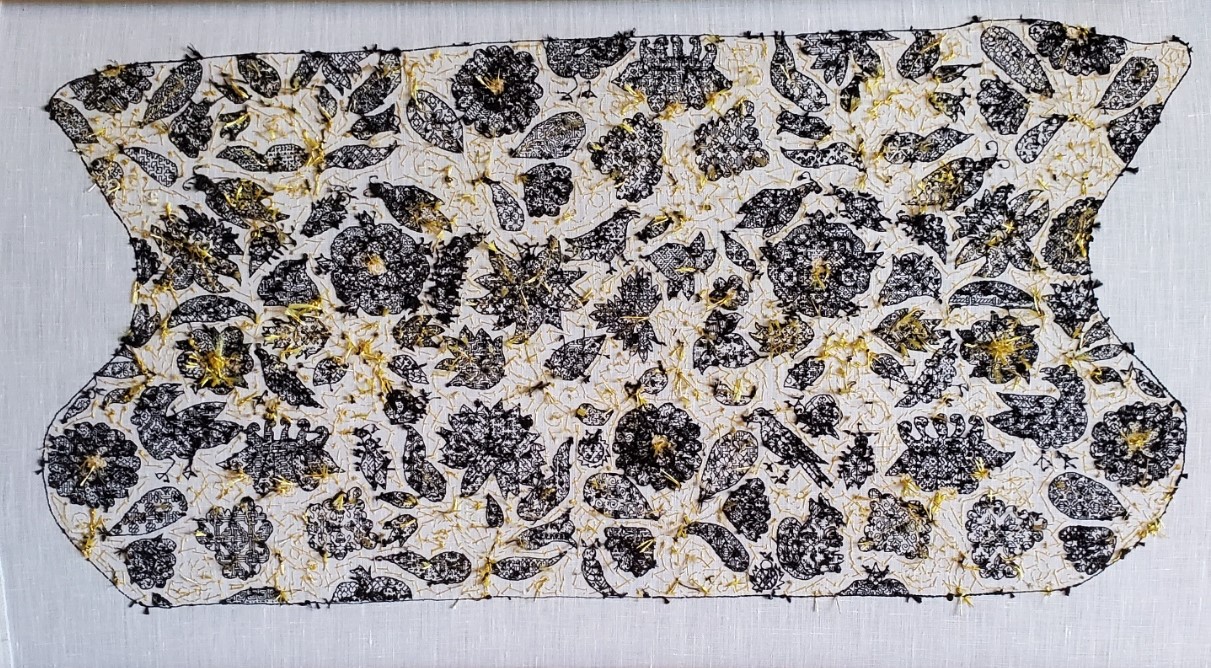
And of course the second post in this series. But for now, off to lion tame my dandelion mat of frizzy gold ends.
HALF A BIRD AND MORE ON WORKING METHOD
This poor little bird at the top had the bad happenstance of appearing on the edge line of the Unstitched Coif outline cartoon. He’s been horizontally bisected. I felt bad for him so I used an especially playful fill on his body.

Obviously I’m still soldiering on.

No doubt about it, 2×2 countwork on 70+ thread per inch linen moves along slowly. But I am about to hit two major milestones. The first is 50% completion. That’s just a couple of flower sprigs away. The second is consumption of my first full 100 meter spool of Au Ver a Soie’s Soie Surfine – the ultra-fine silk I am using for the fills. I have more than enough in reserve to continue on, so no supply side worries loom.
I’m now pretty well adapted to the magnifiers, but even so a forehead break every 20 minutes or so is needed. The headband mount stays seated in my optimum viewing range longer and and accommodates use of my usual bifocals, much better than using the glasses frame “arms.” Neither is comfortable, but I’ll pick discomfort + better sight every time.
I do wish that the magnifier would eat batteries more slowly. I only use the supplemental LEDs on the magnifier when working actual countwork in suboptimal light conditions. I don’t need the extra illumination when working the outlines or doing the goldwork and spangles. But even so, one set of three tiny coin batteries lasts for only about four days of stitching – roughly 14 to 16 hours. If I had a do-over I’d buy something with the same magnification levels, but that came equipped with a rechargeable light source. It would be very handy to plug it in each night and be ready for the next day’s stitching.
I still haven’t repeated fills between sprigs or insects (with one tiny exception). Folk have asked where I’ve gotten them, and how I use them (planning/choice and execution).
The sources for the fills I’ve used include the set painstakingly drafted out by our Fearless Leader, from close observation of select Actual Artifacts in the Victoria & Albert Museum’s collection. She has provided them as part of the tool set for this project. But I have to admit that the overwhelming majority of the fills I have used come from my own doodle notebooks, including the Ensamplario Atlantio series. Others I’ve improvised as I stitched, noodling up something unique to fill a difficult to render petal or bug body segment.
I reiterate that I am not sitting down and planning placements ahead of time. Nor am I drawing out the shapes on paper, then penciling in fills and stitching from those plans. I’m deciding on them as I come upon the spaces. Occasionally I get to a flower and say, “Hmm. Six segments, I can do six fills, three fills twice, or two fills three times.” Then I pick a treatment, and go looking for the first fill. In general I start with the largest segment of the design, pick something demonstrative for that space – roughly centering placement of the design by eye and working out from there; then select designs for the accompanying spaces to contrast or compliment. Take the Borage flower, for example:
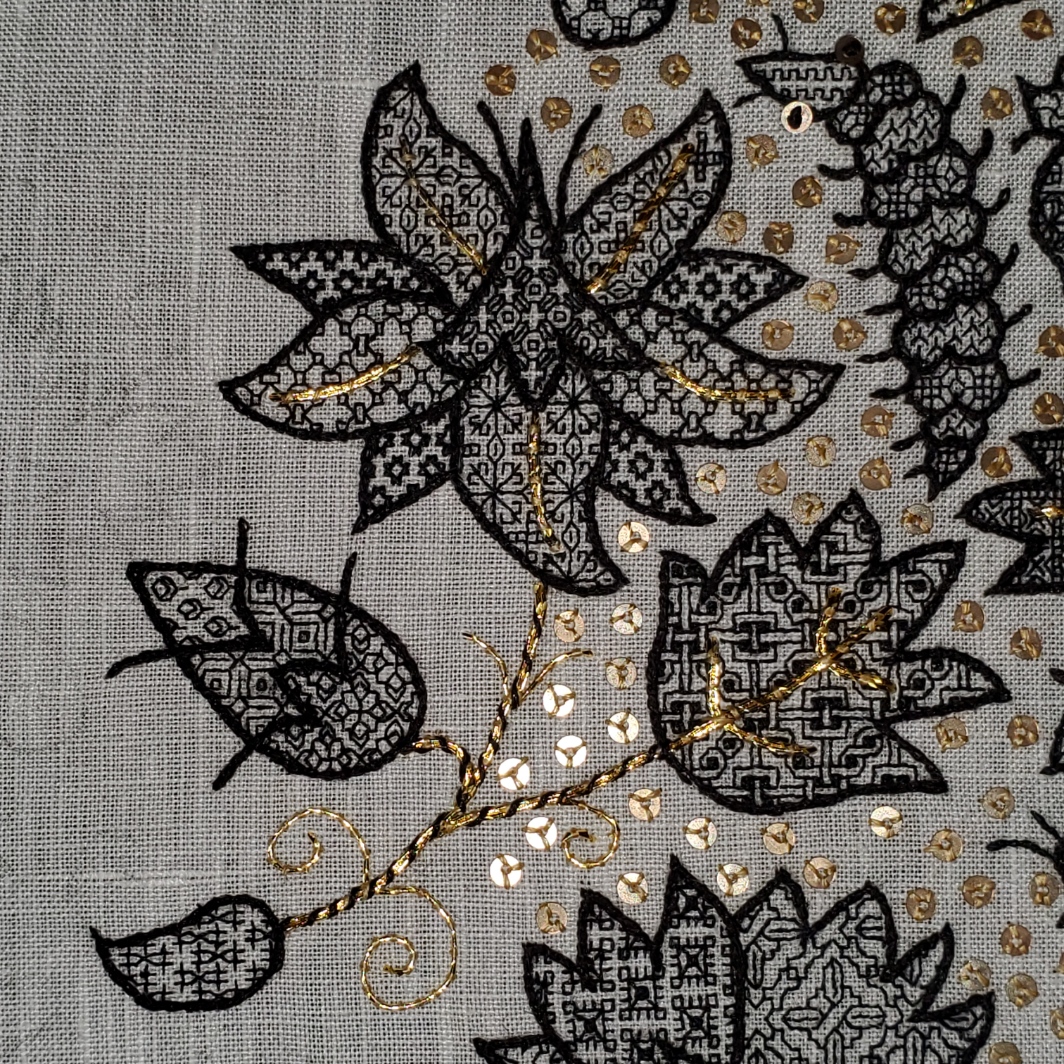
I started this one by doing the big leaf with the interlace fill. That one is from my doodle notebooks. It’s a grand fellow, and one of my favorites. I was waiting for a suitably large space to use it, so in it went. And no, I didn’t mind that it would be partly overworked with gold for the veins. It’s bold enough to stand up to that treatment.
Next I turned to the flower itself, starting with the largest downward extending petal in the center. I used one of the fills provided by the project leader, graphed from V&A accession T.230-1929, a sampler of fill designs. It’s six from the end on this page. It’s repeat is smaller than that in the leaf, but it still needs room to play. I also chose it because I liked the way its spiky linearity contrasted with the closed, boxy interlace nearby.
While I was working the first petal, I decided to divide the flower into a set of three petals, two petals, and four petal/sepals, and shade them so the set of four would be the darkest, and “recede” to the back. I worked the other two petals of the three-set with the same design I just completed, then went looking for a lighter, less dense one for the two-set, ending up with another from my doodle notebooks. It’s light and airy, and quite quick to stitch up. Although it uses a lot of lines and has squares, it is a nice complementing contrast with the first design, and it had enough space to let the design show. It was clear with these five petals done that the four-set would need to be significantly darker and smaller, but I didn’t want to do a tiny repeat because I’m saving those for the many-tiny-petals Marigold flowers. I found a small, dense one, again from my doodles.
With all of the petals done, I thought that a darker center “cone” was in order. I pawed through the project collections and my notebooks but didn’t see anything tasty, so I just improvised this final fill, starting with the familiar cross and circle base, and adding detail until I got the density I wanted. (I did add it to my current notes, though.) The feel of it is almost the opposite of the star-like fill I used in the four-set petal/sepals. Once the final fill was completed, I went back and worked the black raised outline in reverse chain, using two separable strands of a thicker four-strand silk floss, hand dyed by a friend of mine (a softer black from a historically accurate iron/tannin recipe).
On to the bud. All three of the designs I used in it are from my notebooks, although the bud design is very common, and a feather-line variant of it is in the project’s collection of designs from V&A Accession T.82-1924 (a cushion cover). Again, I picked three in ascending density from the base to the bud tip, looking for ones that contrasted both in tonal value and in composition. As per usual, the outlines were last.
The small paisley at the sprig’s base was last. Originally I had intended to use its fill elsewhere, but I decided to employ it as a stand-alone because it is Very Special. It’s from the project collections, drawn from V&A Accession T.12-1948 (a coif) by our Fearless Leader. It’s third from the end on this page.
It’s special because of the stitches used to form the center X in the double stirrup shaped motifs. Those are two 1 unit by 2 unit stitches, crossing in the center. I call them “knight’s move” stitches. They are vanishingly rare in historical count work, appearing most often as a component of eyelet type constructs, where many stitches radiate from a single center hole. But stand-alone? This is the FIRST time I’ve encountered one on an actual artifact or contemporary pattern graph. Yes, they are quite common in modern blackwork and strapwork because they add an angle to the designer’s toolbox. It’s a very useful and graceful angle that many designers employ to excellent effect (especially Banu Demirel of Seba Designs), but to my eye, they produce a different overall look and are a clear marker of modern design. So finding one here was like being slapped Monty Python style, with a flounder.
I shared the observation with our group leader, who I am sure is now on the lookout for other knight’s move examples. Until there’s a whole vocabulary of them though, I will view this fill as the exception that proves the rule, and continue to eschew anything but 45- 90- and 180- degree angles in my own design work.
Once all of the fills and their black outlines were done, I added the gold. First I couched down the doubled gold of the flower’s petal lines. Then doubled gold for the leaf veins/stems. I affix them all with small stitches of gold color faux silk. Leaf veins that meet up with stems are done as one length, with that center line being laid down first. I add the “crossbars” by teasing them underneath the centerline using a tiny thread crochet hook, then couching down their arms. Once all he double-strand work is done I add the single-strand gold curls. The final step is to whip JUST the stem portions of the sprig with two strands of the same Soie Surfine I am using single stranded for the fills. Those black stitches are not structural. They are just for effect, binding the flowers and leaves together and uniting the sprig and make it stand out from the ever encroaching flood of paillettes/spangles.
And yes, I will go back and add the gold curl at the tip of the paisley. But it encroaches too closely on neighboring design elements, and I don’t want to catch it as I stitch those. So it will be added later.
I hope this answers the questions about my “bungee jump” approach to this large and complex project. As with any such banquet, taking lots of small bites is a fun way to graze across the entire spread.
CRAWLING ALONG
My sort-of-weekly progress and lessons learned post about my Unstitched Coif entry. So you can see what’s new, I post the last general update photo alongside the new one:


I’ve added the rose, several bugs and a couple of leaves, a partial rose at the bottom edge, worked more of the stems and curls in gold, and seeded in more of the sequins once surrounding motifs were defined. I’m working on another leaf right now. And this means that I am almost finished with the first of the three tiled pattern print-outs. I’ll be moving onto the center sheet in the next day or so.
Obviously I am determined to make that completion deadline. I’ve been trying to stitch at least four hours per day, sometimes more if I can. Although we absconded to our place on Cape Cod for a long weekend, and I took my stitching with me. And there I had a grand time sitting out on our deck, working away in shaded sunshine and light airy breeze. Not too hot, and not too windy. (Thanks to the Resident Male for these live action photos).

It’s a bit easier to see in the following photo – I keep my left hand underneath and my right hand on top. I’m right hand dominant, but probably less so than many right-handers. My left is quite well trained at this point.

You can also see the magnifiers. I’ve found that they get less tangled in my hair if I wear them over a kerchief, rather than putting the headband directly over my pinned up braids. Yes, that’s one of the blackwork forehead cloths I stitched several years ago. It has worn like iron, surviving many washes, but I do now understand why forehead cloths are so often found bereft of their strings. This is the thing now, on its second set of strings (strips of linen, double folded and hand sewn), and this set is beginning to fray. Also note how the formerly crisp on grain right-angle triangle has changed shape under the stress of being worn. Another feature often seen in museum examples. More on the ones I made and the one I interrupted to do this blackwork project here.

In any case back to the Coif project.
As I’ve written before, stitching outside in bright but not direct light is amazingly better than stitching under the best available indoor lighting. A full spectrum lamp comes close, but even that can’t equal the absolute clarity evoked by outdoor ambient light. I will be working on my porches back at home, front or back, weather and heat willing for the best part of the day from now on.
The second thing is that hideous, tattered dark color pillowcase, pinned on to the top edge of my work, and hanging down behind. I have two – both way to destroyed for their original use. I use them as a double layer travel cover for this frame when I take it along with me. The travel cover I sewed is too small for this frame at max extension with lacing.
The reason it’s there is to limit light shining through the work. Unneeded light includes reflected light outdoors, light from the TV (often on while I stitch when I work indoors), or from other window or artificial sources when I am trying to stitch with my full spectrum light over my shoulder. Even outdoors with the sun behind me, having the dark “curtain” behind the work makes it just a tad easier to see the threads and aim accordingly.
I finish up with a detail shot of the creeping caterpillar. He’s my favorite insect on the piece, but he was surprisingly tough to do. There isn’t a lot of real estate in those heart-shaped body segments. I tried to find fill patterns that would contrast nicely both in tone and “spikey-ness”, and still be somewhat distinguishable in those tiny areas. I ended up using three – one for the face, and two alternating, for the rest of the body. The eyes are always fun. Where possible I’ve been using the same 2mm paillettes that spangle the ground for eyes, held on with French knots. Do you feel seen?
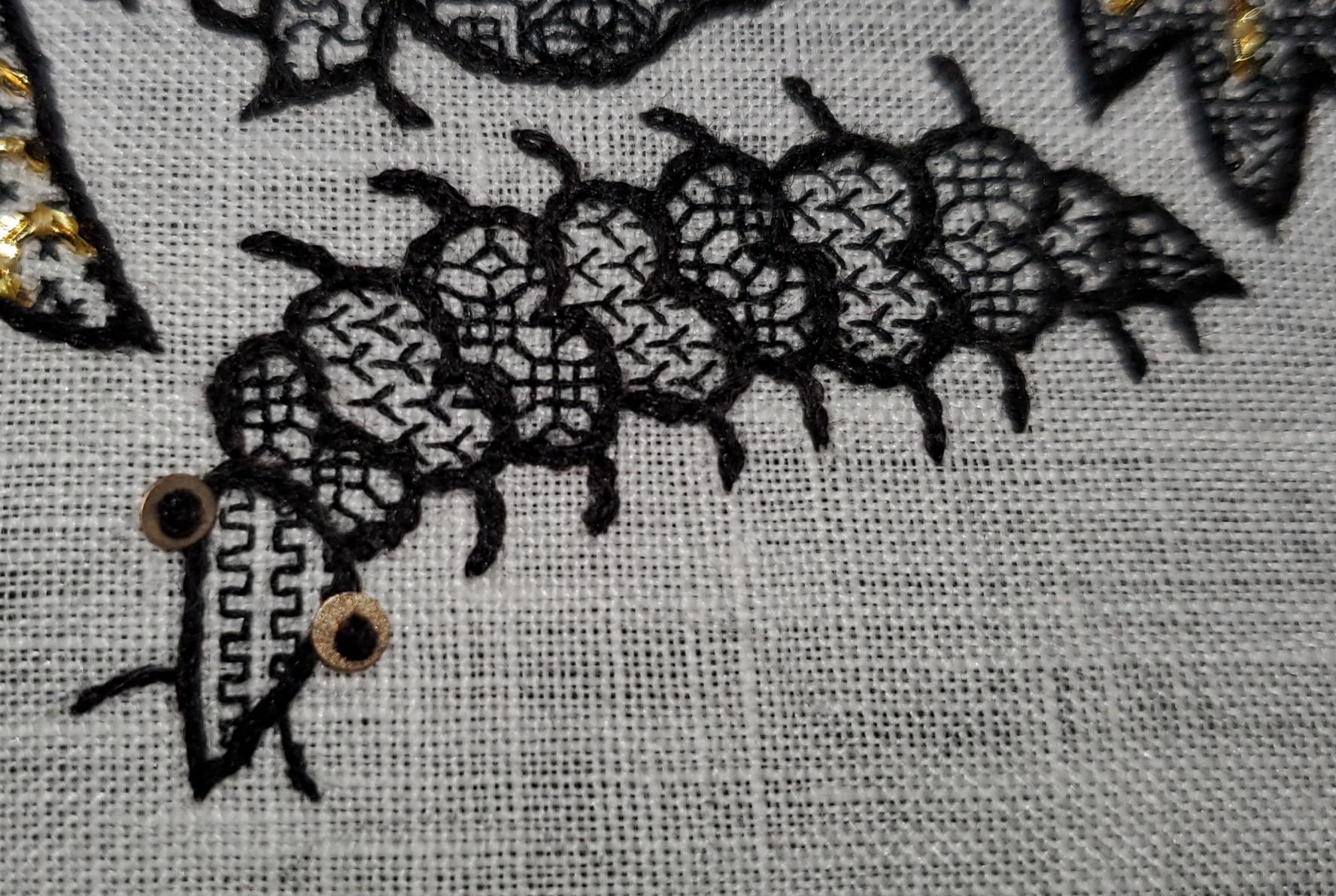
For the record, with one unconscious lapse (a repeat of plain squared fill in two tiny places), I have NOT yet duplicated a fill between design elements. A fill might appear twice in the same flower, creature, or leaf, but once that design element is done, I consider its fills “burned” and will try very hard not to use any of them again. That means even if a bug or flower repeats in the drawing, each iteration will have its own unique look. Or so I hope…
ENSAMPLARIO ATLANTIO – UPDATED
Back in 2011 I issued Ensamplario Atlantio – my first doodle notebook full of fill designs for inhabited blackwork. Many of those designs are also suitable for use as an all-over design or strip pattern. Back then many people had to cope with bandwidth restrictions which made downloading a larger file problematic. So I cut the book up into four pieces to mitigate the problem. Now in 2023, that need has passed.
I’ve taken the original book, corrected some mistakes and typos, added four new pages (24 individual designs), and stitched it back into one single file. Ensamplario Atlantio, Second Edition is now up and available for free download. Having the thing in one piece should make using it easier. And it will make keeping track of it easier for me.
So please click here to download and enjoy!
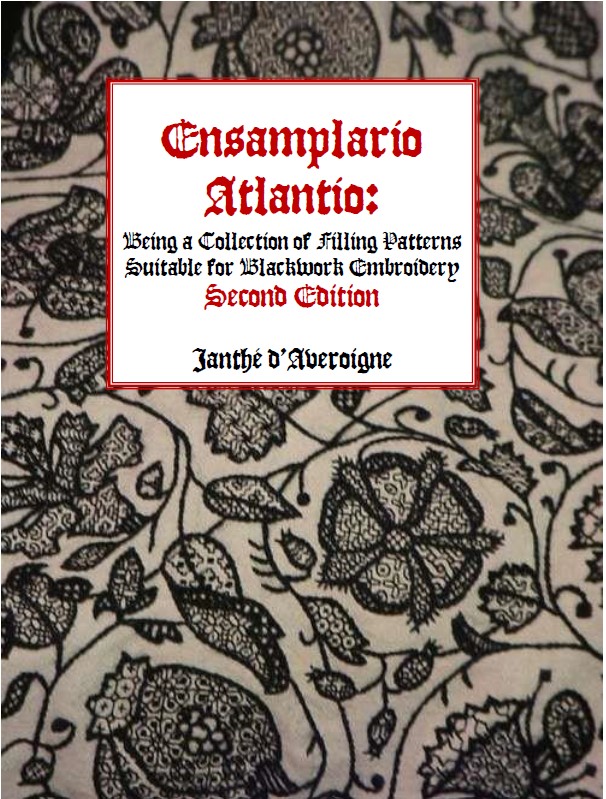
The sequel, Ensamplario Atlantio Volume II, with 200 more patterns including fills, bands, and yoke designs is also still available as a free download.
THE UNSTITCHED COIF TAKES A ROAD TRIP
Obviously I am still working on the Unstitched Coif project, and have a bit of progress over the past week or so. I might have had more, but we went to visit family in Buffalo, New York (about a 7.5 hour drive from Boston if you make no stops), and were too busy over the five days for me to steal more than an hour or two to stitch. We did have a great time, and got lots done – just not stitchy stuff.
I will report though that working outside in bright sunlight, even when sitting in the shade is the best illumination I’ve found. For those who look at fine stitching and wonder how folk in the pre-indoor lighting eras did it by firelight, candlelight, or tucked up next to a window, I would suggest that relying on natural sunshine is not a handicap at all, although it is time-limited by its very nature.

Yes, I am sitting in my mother-in-law’s garden, working the design upside-down. It’s upside-down for no other reason than when I first put my frame in the stand it happened to be in that orientation. I’ve just continued on that way. When work on the next vertical swath I may flip it over, but for now I’m just marching to the edge, which is now only a few design elements away.
Here are two clear progress shots, first showing the whole area I’ve done (about half of the first pattern sheet as displayed magnet-tacked to my work, above). Plus a detail shot of the latest bits.


A second, larger bird has joined the first, along with the multi-petal flower with its leaf, the rather odd looking columbine (the bit with the three gold petal ends) and some of the foliage, curls, and spangles that surround them. I’m now working on the first of two large grape leaves below the columbine. This area features some larger shapes to fill and I am having lots of fun with them by using some larger, more complex fills. The interlace currently being worked in the grape leaf looks complicated, but once the rhythm of the thing is started, it’s really quite logical.
And I am still on target for not repeating a fill between units. With one tiny exception, while the same fill design may appear more than once in a pattern element like a flower or a bug where a design may inhabit more than one petal or body segment, once that element is done I consider that fill to be “burned” and have not repeated it again. I suspect this will be more of a challenge as I move along, especially in the smallest spaces where there is little play for the more complex repeats.
In any case, I wish I were further along, but I’m also pleased with the progress to date. Gotta stitch faster, I guess…
FIRST BUGS, NOW BIRDS
I’m edging into a new neighborhood on the Unstitched Coif Project. This one is inhabited by birds. The first one is stitched and I’m thinking on the fills for the second. You can see him at the center bottom of the piece, now presented in the correct orientation.

I think he looks a bit like a tiny raven, A slightly confused one at that. I could not resist the visual pun of using the feather fill from the collection presented at the official website for his body. You can make out another oddly shaped bird sketched in below and to the right of the pansy/viola flower.
All in all, I’m pleased with the way this is turning out, although like all participants, I wish my project was proceeding faster. Working so tiny is taxing. Mr. Raven for instance took about four hours to complete, counting the fills, outlining, sequin eye, and couched gold feet.
My game of not repeating fills between units is still afoot, although I am finding it harder and harder to find or devise fills for the particularly tiny areas, like the sepal-leaves on the pansy. And I have to go back and add lighter gold banding the the wings of the big bug.
One more challenge is that of adding the overstitched elements – the couched vein leaves and feather markings on Mr. Raven. I do the fills first, then neaten up their edges with the heavier outlines. But the fills obscure the placement of the overstitching. I do that by eye, referring to a printout of the master design. I’ve mentioned before that others do the outlines first, but with the heavy, embossed reverse chain stitch, working inside tiny spaces would be extremely difficult. I leave that to those who are using outline stitch, freehand fills, and speckling.
Today’s agenda will be filling out the spray of leaves at the (now) right edge, adding the gold stems to it, and flooding the few newly surrounded white space areas with spangles.
In other news, last weekend I visited Younger Spawn and surrendered the bespoken Eyeball Bolster Cushion, seen here in its forever home, on the target low back mid-century modern sofa for which it was designed. A perfect fit. The recipient was totally thrilled.

The sharp-eyed will spot my stitching set up near the sunny window. I added a hex wrench to my stitching kit, and can take the thing including the disassembled stand with me when I am on walkabout.
While I was out in Spawn’s neighborhood we went to a garden center/plant nursery. Spawn added to the resident collection of exotic houseplants that make the apartment a livable and calming oasis. I noticed that the prices for large, healthy outdoor plants were much lower there in the suburban Albany/Troy New York area than they are here in the outskirts of Boston, so I bought some plants to augment my growing perennial collection. Here they are, just before I plonked them into their spots.
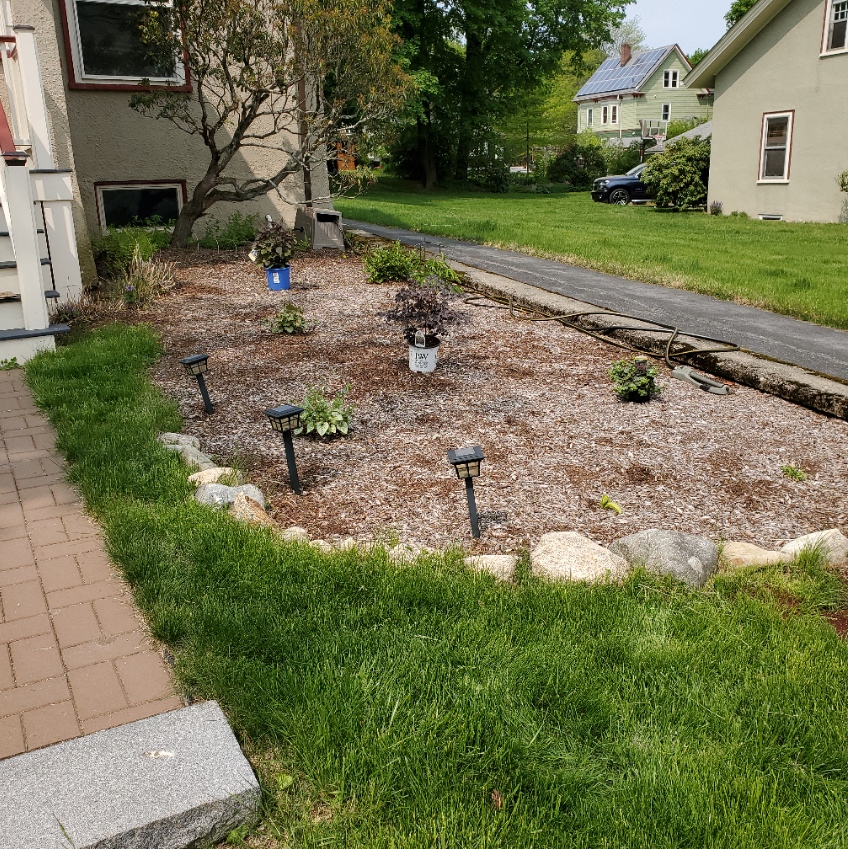
The big blue pot in back is a Chocolate Eupatorium (aka Joe Pye Weed). It’s a fall bloomer, with white flowers. The white pot in the middle is a red-leafed Astilbe variant, with purple/red flowers in mid to late summer. And the little guy over near the hose is a low-growing creeping sedum, that blooms purple in the fall. They join the transplanted peony, curly leafed Hosta, lemon Hosta, pink Astilbe, and two types of Brunnera (one red leaf, one green) that survived last year’s drought and fierce heat that doomed my Aconitum (wolfbane), and Hellebore. A less poisonous garden this year, but one I hope will outlive my ungentle care.
PRICE ALERT
One last thing – if you are interested in buying my pattern collection The Second Carolingian Modelbook, you may want to do so before 30 June. Amazon Kindle is raising print fees, and because the thing is on a razor thin margin, I will be forced to raise the price. I am sorry for this. I tried hard to keep it under $30.00 US per copy, and it will remain so until the end of June, but after than the price will be going up.

AND WE HAVE THE FIRST BUG!
Not to worry, it’s not a computer or programming glitch. It’s completion of the first bug on my rendition of the Unstitched Coif project. The bugs, birds and other inhabitants of this flowery sprawl are especially fun to work.
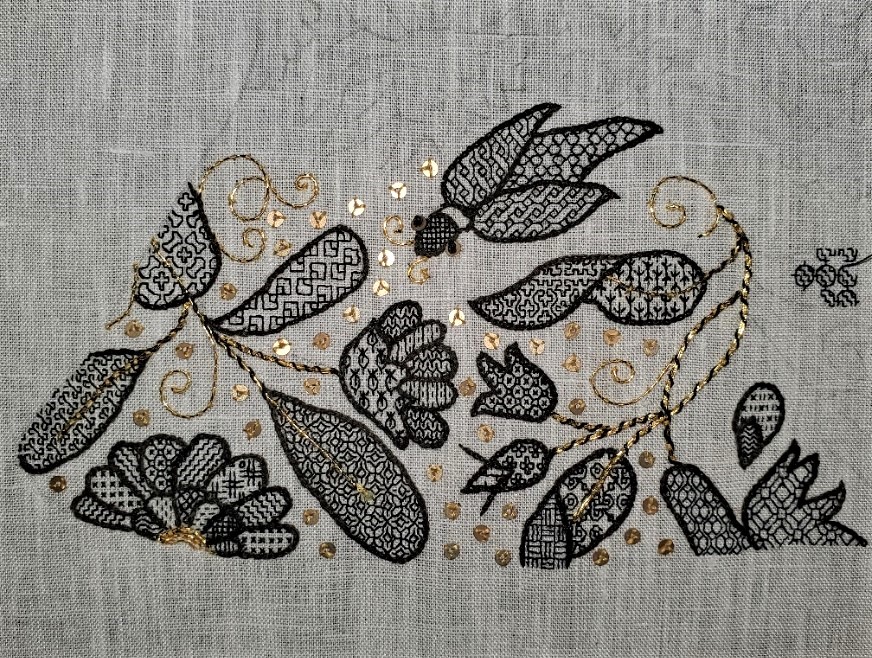
I may add a tiny motif in his “collar,” it seems a bit bare; and I may go back and darken up the bug body to get better contrast against the wings. But I do like the opposing directionality of the coil pattern on the wings. I am also still debating the density of the paillette spangles. Thinking on their original use, to provide both sparkle in dim interiors and by candlelight, and to signal the wealth of the wearer, packing them in for max bling seems right. However I know to modern eyes the look in full artificial light is cluttered, and I’ve gotten feedback accordingly. We’ll see.
As to new bits in execution – the bug’s eyes are also the same 2mm paillettes, but instead of being affixed with three little gold color faux silk stitches, they are held on with large French knots in the center. I thought about using beads, I have a large seed bead stash that I’ve kept since the 1960s. It came to me jumbled, and my sisters helped sort some of it out. I picked out three candidate colors – black glass, clear glass with gold foil centers, and an opalescent black/metallic glass, and have been experimenting with them both with and without the spangles underneath. You can see below how much better the flat spangle and French knot looks.


I haven’t ruled out using beads yet. There are some bugs with especially tiny faces. I might use them for the eyes of those. They are ever so slightly smaller than the paillettes, but not by much. But French knots may be the solution there, too.
In other developments, my kit has expanded. Thanks to the insight and generosity of long time friend and needlework confidante Kathryn Goodwyn (who took pity on me and came to the rescue) I now have a small clip on light for supplemental illumination. Kathryn says she found it in a Dollar Store (a low price bargain outlet for my UK visitors). I will probably jury rig a thin wooden yardstick across the top edge of my frame later on, as I get closer to the center of the piece and need the extra light there.

Another materials improvement to report. I have switched threads for the fills. I had been using YLI 100, doubled. One strand was too thin, but two looked a bit muddy. I am now using Au Ver à Soie’s Soie Surfine and I like the line and angles better. I won’t tell you when/where I switched, and I don’t think you’ll be able to spot it. Although the two approaches are very close in total width, the Surfine does stitch more smoothly and works up more evenly.
In addition, I attended the first Zoom meet-up for the project yesterday. Toni Buckby, our Fearless Leader did a great thumbnail intro to blackwork in general. its stylistic evolution over time, and the coif project in specific. We were truly inspired to plunge on in, or continue depending on our start status. There were enthusiastic folk in attendance from the UK, US, Canada, and New Zealand (that individual is truly dedicated, considering that it was 1:00am there at the time). It was fun to meet up, share questions, and generally get to know each other.
As promised, I did ask about plans to make the drawing of the coif accessible at the project website. Ms. Buckby assured us that it will be, although the website is still under construction, and it isn’t there right now. But if you do pop by, you’ll see a few of the V&A’s fantastic collection of blackwork artifacts, plus her invaluable hand drawn charts for the specific geometric fills used on them.
I admit the large cushion (V&A Accession T.81-1924) at the top of the official project page brings back wonderful memories.
A blurry image of that artifact was the first bit of blackwork I stumbled across, in Mary Thomas’s Embroidery Book. I was smitten, and shortly thereafter I had need of a special gift for he who would eventually become my Resident Male. Although I had already graphed up and stitched a number of sampler bands from book photos, I took the plunge into blackwork with no guidance other than Mary Thomas, and produced this. It’s now very well worn, and the needle lace around the edges is quite frayed, but for something stitched in the spring of 1975, on muslin, using mostly the wrong stitches, it’s not entirely discreditable.
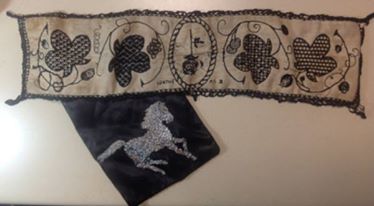
After that there my fate was sealed.


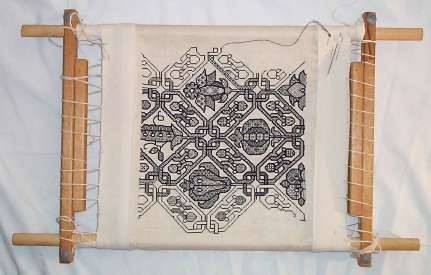
My blackwork underskirt forepart (left and centers) – stitched in Fall 1976-Spring 1977. My Forever Coif, started in Spring 1990 and still unfinished.
 String-Or-Nothing