PAST PROJECTS AND LESSONS LEARNED – PART 2
Thanks, all for the kind reaction to the last post in this omnibus series. Thus emboldened, I blather on.
The New Carolingian Modelbook came out in 1995. As mentioned before, it started as my working notebook collections of designs redacted from book photos, microfilms of early modelbooks, and sketches of artifacts, then grew from there. Although it was well received, I didn’t get much recompense for my 13 years of work – the publisher only paid royalties on the first 250 books out of 2,000, and ran off with the rest. But I didn’t stop collecting patterns. As originals and artifact photos became increasingly accessible, I kept at it, trying to transcribe designs, norm repeats (artifacts rarely are stitch perfect, and often need to be averaged out – blending all variants and mistakes into one representation), and most of all – collect specific citations and links. This material is the core of my ever-forthcoming The Second Carolingian Modelbook. And along the way, starting around 2010, I couldn’t resist trying out what I had found.
We left off last in the 1990s at the start of my blogging career, so my projects are a bit better documented. As before, I zigzagged between knitting, crochet. I tended to knit more around the time my two spawn were born, and for a while thereafter, and then return to stitching when they were around kindergarten age. For most of the early 2000s I was consumed by knitting and with running the wiseNeedle website with its collection of crowd-sourced yarn reviews. But eventually I began stitching again.
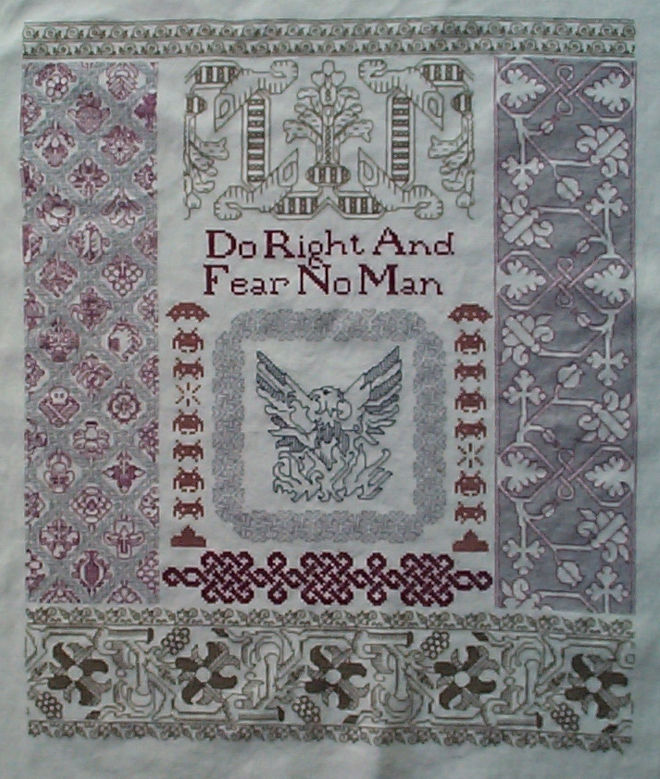
Elder Daughter went off to college in 2009, equipped with this bit of parental nagging. It is about 14.5 x 18 inches, worked on 30 count linen in Danish Flower Thread. Note the debut of the little skull and bones hiding amid the flowers from my Buttery interlace. The graph for the center phoenix is also here.
Lessons Learned: Around the time this was done with the help of Elder Daughter and others, I had figured out a new software solution for linear graphing because the method used for the phoenix wasn’t suitable for publication, and the hardware/software used for my previous work was now obsolete/unavailable. I started consolidating my doodles from various notebooks, backs of envelopes, and marginalia to better learn the methods and quirks of my GIMP-based custom drafting solution. Those experimental notes are what became Ensamplario Atlantio, and all graphs/charts I’ve done since have used the GIMP drafting method.
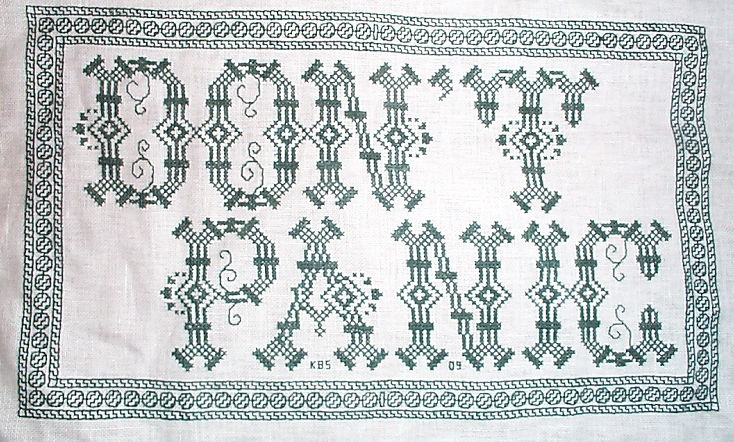
Fresh off the last piece I still had the itch to stitch. I did this part in homage to the Hitchikers’ Guide, part as appropriate decor for my office workspace (by trade I’m a proposal manager in high tech – deadlines and panic are my stock in trade). And possibly part because as parent of a new college student let loose on the world, I needed reassurance. It’s about 8 inches across, and was done in DMC cotton floss on 32 count cotton/linen blend. The bead border chart has been up on String for a long time, but I’ve also recently released a free full-graph pattern for this piece. Enjoy!
Lessons Learned: I was still experimenting with graphing out the lettered part ahead of time. Previously I had just guessed. This was also the first piece with a border I started in the corners rather than at the center, so that any “fudging” could happen in the center. While the north south bits of the frame worked out evenly, you can see the improvised bar in the center I inserted when it became clear that my bead repeat would not fit. And I bet you would never have noticed it if I hadn’t pointed it out.


Continuing the SF theme into 2010, I did this piece, featuring a quotation from noted author Arthur C. Clarke. It’s the first one to have designs from The Second Carolingian Modelbook (T2CM) on it, along with patterns from my earlier books. The new bits include all the full width designs between “ADVANCED” and the adaptation of Bostocke’s strawberries at the bottom. The narrow bands left and right of the wreath and column are a mix of older and newer designs. This one also hangs in my workspace now, to the confusion of my (mostly non-SF loving) coworkers.
Lessons Learned: I had a lot of fun with this one. I played with multiple thicknesses of thread and density of design, along with the two colors, and enjoyed balancing the effects that could be achieved with that limited group of variables. The strips are a mix of one and two strands of standard DMC floss. The solid ground voided strips are all in LACS, as is the foreground stitched daSera repeat from TNCM at the very top. I was particularly pleased with the hops panel shown in the detail. The design was done in two strands, but the (non historical) ground behind it – the diagonals worked mirrored – was done in single strand.
By 2012 I was full throttle on pulling together a sequel to TNCM. Drafting and writing for The Second Carolingian Modelbook (T2CM) was off and running. And of course I had to playtest the designs as I went along. Most of these (with three exceptions I worked from Lipperheide) are in the sequel. The big black sampler is done in silk on 36 count linen. The stitching area is about 24 inches across. Understandably it took me about 13 months to finish, and will be on the cover of T2CM. It was an eventful year, that included Younger Spawn’s appendix adventure, and the demise of my all-volunteer wiseNeedle independent website, out-competed by Ravelry and other paid-advertiser info sources.
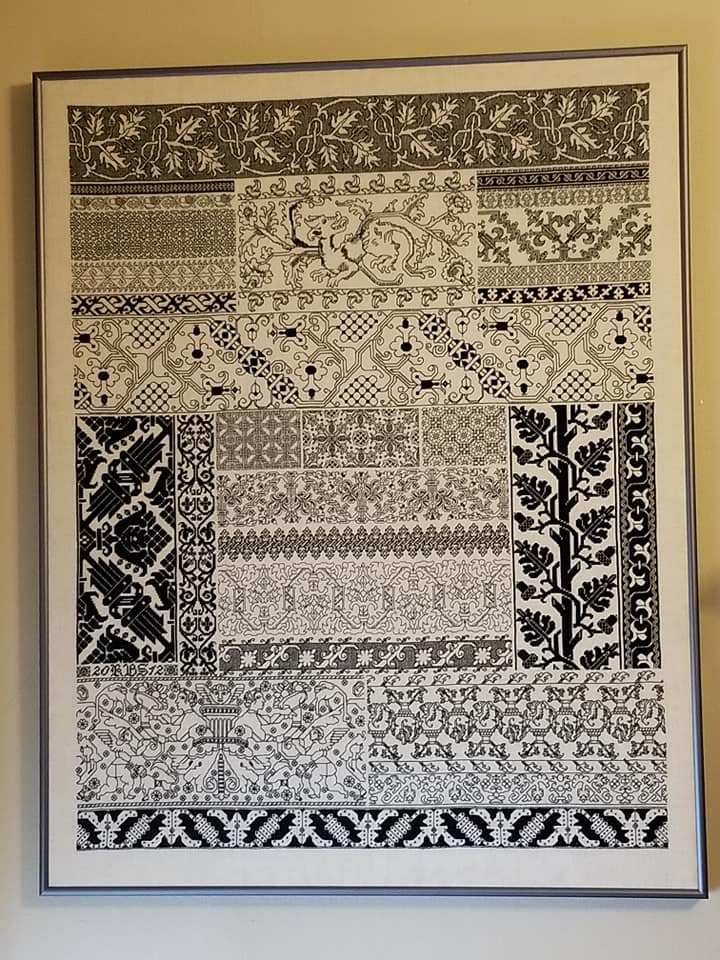
No new stitches to speak of in this one but I did use long armed cross stitch on the panel at the very bottom, the oak leaf and acorn bit, and in the spot fillings for the “beads” in the wide meander just below the lion/dragon beastie. The texture it produces when massed has a very plaited appearance compared to plain old cross stitch.
Lessons Learned: Composition and balance work better if you impose a tiny bit of order on the chaos. I basted in several guidelines, dividing my total piece up into several zones. Although I picked them on the fly with no real advance planning, worked my individual panels and strips inside those zones, making sure to ground the piece at the top, bottom, left and right with darker, denser designs.

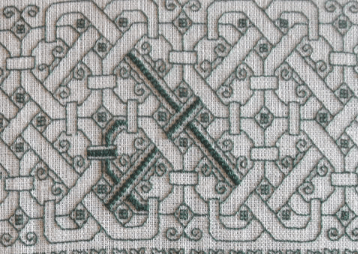

2012 marked the start of Big Green, done in silk on 50 count linen. Unlike the ones above, he is still unfinished. The designs on this one are entirely from T2CM. I WILL go back and finish this piece, but other things have gotten in the way. I took it with us for our sojurn in India, but between the heat and lack of a good spot to sit and stitch, I never got much further on it. Also the meshy technique is amazingly time consuming. One two-hour evening will produce a patch about the size of a quarter. One thing to note about the meshy stitch – I now know why it has survived on so many pieces even when the surrounding linen is long gone. It’s amazingly dense, near indestructible, and I can say truthfully – impossible to pick out. By contrast surface voided work is fragile, catching and degrading with abrasion, washing and wear.
Lessons Learned: I have been using this piece to experiment with stitching techniques. The interlace (first detail) uses Montenegrin Stitch. The straight runs were pretty easy, but without the most excellent Autopsy of the Montenegrin Stitch by Amy Mitten, the bendy bits would have driven me insane to figure out. And the big voided repeat where I stalled out (a stitching family I’ve nicknamed “The Lettuce Repeat”) is done in the tightly pulled meshy technique so common among voided artifacts. I had first tried out a different pulled thread technique for the topmost design, but the effect was nowhere near that of the historical pieces. But at maximum tension Italian Four Sided Stitch, based on the technique in Christie’s Samplers and Stitches (1920) was spot on. But it has to be done in silk because cotton isn’t strong enough to stand up to the force required to achieve the solid mesh. (My previous reference to the stitch was based on another edition of Christie’s work, now no longer accessible on line). And it’s (relatively) easy to hide ends while working it – burying them in spots that will be totally overworked later.

That 2013/2014 stay in India necessitated a scouting run to find housing and schools in May of 2012. I needed something small and portable to do on that trip, so the first two book covers were born. I worked these from T2CM patterns on 30 count linen/cotton blend, using DMC floss. They were small Moleskine-look-alikes, and were donated to the SCA East Kingdom’s largess program, to be given as small gifts by the seated royalty. Although I put notes in each one hoping that the recipients would get in touch, I have no idea where these ended up. Still, they were quick stitch pieces and fun.
Lessons Learned: While I have always known that stitching is a wonderful icebreaker, especially during International travel, at this point I had no idea that Kasuthi existed. It’s a traditional Indian stitching style and very close cousin to Blackwork’s precursors. A lady in Mumbai airport remarked on the black and red book and asked where I had learned to do it. That sparked yet another flurry of research.

Most of my production in India was knitted, largely lacy pieces. I did a couple of test knits of pieces designed by the generous and well-followed MMario, now of blessed memory, and a couple of other bits of my own design. I had many knitpals in Pune, whom I had “met” via Ravelry prior to our arrival. That kept me more or less in that craft, but I did do some small excursions into stitching. One was the red Ganesh cloth, above. I stitched it in 2013 as a new-house gift for the parents of our driver, Rupesh. I do hope it has brought the family the intended luck. This one is pretty well documented here on String, including the source of the outlines and Ensamplario Atlantio fill numbers for all of the motifs I used. It’s done on a not-so-even weave 32 count cotton/linen blend, in DMC floss.
Lessons Learned: The Italian hem stitching I used to finish off the cloth neatly actually took more time to do than Lord Ganesh himself. But I liked it, and filed that family of stitching away for future reference. Someday.

In 2013 I tried my hand at Kasuthi. This little motif is a traditional one, and is worked entirely in double sided double running stitch. It’s on a relatively coarse 28 count cotton, also in DMC floss. My main reference for Kasuthi was Karnataki Kashida by Anita Chawadapurkar and Menaka Prakashan. It’s in Marathi, but friends helped out by reading bits to me in translation. Here’s a post I did on the style.
Lessons Learned: I had originally intended on making a set of napkins, but when I washed this piece, the oh so carefully ended off threads, so well buried and invisible here, did fluff up a bit. So I scotched that idea.

Also in India, just before we left in 2014, I started this piece, with the intent to make a pouch for my stitching tools. The cloth is a standard linen dish towel, bought at a local supermarket. The thread is also linen. It remains unfinished.
Lessons Learned: While this ground started out as a very stitch-able 32 count more or less even weave, tossing it in the washing machine shrank it in unexpected ways. The threads in one direction ended up being about 30 across. Those in the other direction ended up something closer to 42, so the dimensions of the thing deformed. But undaunted I tried to stitch anyway, working over 2×3 threads. But the smaller threads were very hard to see, and the linen thread frayed beyond belief (this was before I learned to use beeswax). It sits in my Chest of Stitching Horrors(tm), never to be completed.
This takes me up to around the time we returned from India, in 2014. And I’m not done yet. If interest has continued, I will do one more of these, to finish out up to the most current things on my frames.
PAST PROJECTS AND LESSONS LEARNED – PART 1
This post is to answer Susan and Michelle, who asked how long I’ve been doing counted stitching and blackwork, and who wanted to see some of my other pieces.
At the risk of tooting my own horn, here’s the story. More or less. Over the years, I’ve cobbled together a few publications (some still unfinished); given away many pieces; started more projects than I’ve completed; and wandered away to and back from knitting and crochet. Please indulge me as I reminisce. I promise to put in lessons-learned as I go along to make it bearable.
All of these are original compositions of found and/or original motifs. I haven’t done a counted work kit or pattern designed by someone else since I was 12. It looks like I don’t often finish, which while it has some truth to it, I’ve given away many of the completed pieces, so what I have in my stash to show off are the unfinished bits.
The first counted project I did that’s not plain old cross stitch and is in the greater continuum that includes blackwork (that I still have) is a sorry, unfinished sampler I began in high school, circa 1973/74, continuing on and off up to January 1975. There are double running bits in it – among the very first I ever did. Most of the designs I cribbed from photos of band samplers and traditional pieces – taking magnifying glasses to the teeny and blurry photos of historical or ethnographic pieces in general survey embroidery books and books on samplers. It’s probably on 28 count even weave, using Coats & Clarks floss. Colors were haphazard at best – I used what I had at the time, and din’t plan much in advance.

Lesson Learned: A glimmer of the sad truth that while I am a starter, it’s much harder to be a finisher. I suppose I could go back and add in the tree and animals I originally intended. But there are so many other things I want to finish off first.
By the spring of my freshman semester, I found the SCA – an organization that advocates the hands-on exploration of the arts, sciences, and entertainments of pre-1600 cultures. That put the nail in this piece (being a mishmash of post 1600 band sampler patterns), but I found an inspiration. I had need to make a favor for a certain individual with a Spanish persona. So I zigged sideways and back in time a bit to blackwork, stitched over the summer of 1975. It’s the project that killed the sampler, above.

The only information I had on blackwork during the summer I stitched this was a tiny thumbnail photo of the Faulklands Cushion in Mary Thomas’ Book of Embroidery. I drew the leaf shapes and my device, and did diapered fillings freehand, on muslin. There’s also a bit of needle lace around the edge, with points at the corners – everything now dirtied and tattered by use. (The silver horse is couched and surface stitched – it’s a pouch, also a present for the same person.)
Lessons Learned: In retrospect – research. Learn and do, not the other way around. There is a lot about this piece that’s flat out wrong, but my heart was in the right place (and also properly given). Also far more people were interested in learning how to do blackwork than the couching, or in a bit of needle lace I was also working at the same time.
The next bit of blackwork I did was after I did a bit more investigation into the style, both for my own edification, and because I wanted to encourage others to do historical stitching, and to do that, I needed to know more about it first. This piece started out as a cushion cover or possibly a tablecloth but within three days of the start, turned into an underskirt for my coronation dress (started just before the crown tourney, October 1976, worn in April 1977). Major thanks for the inspiration to do this piece go to Mistress Kathryn Goodwyn, who gave me Bath’s Embroidery Masterworks book, which in turn furnished the rough outline of the coiling fruits, flowers, and leaves.

The original dress is long gone, but I still have this Melton wool monstrosity with the entire panel – still a squared off (I never cut off the side bits). There are some small stitched areas you can’t see here, hidden inside the skirt, but the piece was never completed as a full rectangle. It’s worked on a sale faux linen coarse weave tablecloth my mother found on a department store sale table. Probably at something like 30 threads per inch (about 15 stitches per inch). This one is more accurate – diapered fills on the count, heavy twisted chain stitch outlines, satin stitched berries.
A bonus – I wrote a paper on the style and also submitted the piece for credit in my Sophomore year art history course, so not only did I have an SCA coronation dress, I got two As for it in mundane life.
Lessons learned: Stitching to deadline does suck some of the fun out of the project. My double-deadline (our coronation and the associated schoolwork) come to mind every time I look at it. It’s also an excellent reference piece, because I can look at each leaf and know exactly which class and lecture I was sitting through while I was stitching it.
The next thing I attempted was a coif, circa 1979 or so. For some unknown reason I wanted to use muslin as a ground. It’s about 70 or so threads per inch, done with super fine handsewing thread – roughly 35 stitches per inch. I never finished (obviously). This little bit was donated to the East Kingdom Doll Project to better equip my tiny effigy.

Lessons Learned: It’s good to be ambitious, but to be overly so isn’t worth the effort. The teeny-tiny stitching here is largely wasted. At this scale it’s so small that one has to be six inches away to make out any detail.
After this came a series of small pieces, given as gifts, plus works in other embroidery styles. I also issued two booklets of designs for blackwork, hand drawn and photocopied. And I learned to knit. The next piece I still have is this sampler, made circa 1983, in part to remember my father and his favorite saying. It’s DMC floss on a plain linen table runner found in a church rummage sale discard bin.

Many of the designs on this one were in my hand-drawn booklets. But shortly after this I became increasingly rigorous in my documentation. My early notes were lost in an apartment move, and I had to begin again from scratch. This collection bridges that period and moves from my rather more scattered previous inquiries to more of what I am doing now. Note that the sunflowers and hearts on my ’74 piece are here again, just above my signature. There are also four designs on this that I sketched from a missionary’s collection of Chinese designs, collected in the 1890s. I ran across those notes while working as an intern at the Harvard Peabody Museum, circa 1977-1978. A few of the better documented bits made the cut and ended up in The New Carolingian Modelbook (TNCM).
Lessons Learned: Large and done on the fly (added design by design, with little advance planning) I discovered I liked the adventure of “bungie-jump stitching.” Looking back now I am not entirely pleased with the balance of the composition. But it includes a few well-loved motifs and still hangs proudly on my wall.
Next up were a few play test pieces of the designs that were in my earlier hand-drawn booklets that later became the core of TNCM. These were done in the 1980s and 1990s.
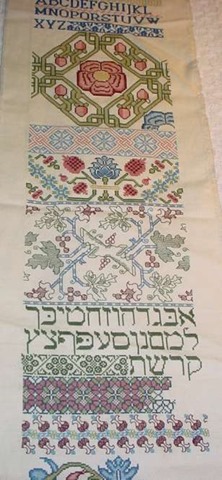
The piece above is a bit from a sampler intended as a wedding present for a friend whose engagement sadly ended before the sampler was finished (circa 1985). It’s done in DMC cotton on 32 count linen. I still have it and it’s still not complete, due to some vague association with the unfortunate end of the inspiring romance, and not wanting to tempt fate.
Lesson learned: Don’t pour effort into something that depends entirely on circumstances out of your control. Also, picking a limited color set and sticking with it provides a lot of unity in what might otherwise be a very scattershot work.
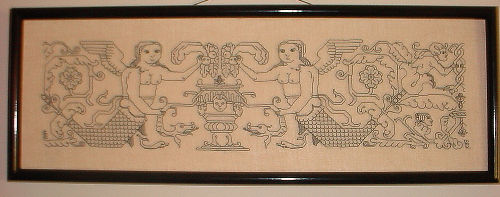
These shameless mermaids that got an honorable mention award at Woodlawn Plantation. I stitched them in 1988, Au Ver a Soie Silk on 36 count linen. I like that I didn’t center the motif on this one.
Lesson learned: It’s surprising what will offend people. The prize committee pinned the ribbon over the bust of one of the mermaids, and put a post-it note over the other. And then hung the thing alllll the way up near the ceiling of the main room, where no one could peek under.
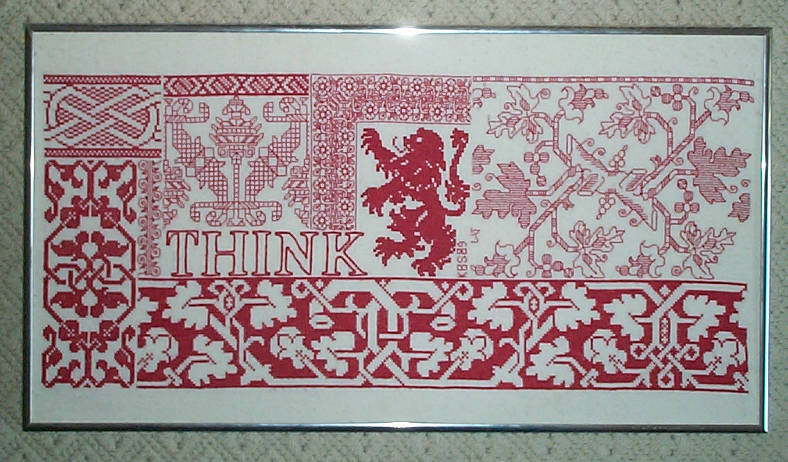
“Think.” Done for the husband in 1989. DMC on 32 count linen around 1989. The leafy log panel (in TNCM) looks familiar? Scroll up – it’s also on the wedding sampler, but there in multicolor.
Lesson Learned: Visual density of small designs can be overwhelming. I always loved my original briar rose tangle – the corner design surrounding the lion, but only on paper. I’ve never been happy with it stitched up. The detail is entirely lost.
Circa 1990 or so I began work on my Forever Coif. Silk and silver, on 50 count. It’s still on the frame. It was intended to go with a reworked dress that featured the underskirt panel shown up at the top of this tirade. But it was not to be.


The fruits and flowers in the standard strawberry frame are original. I’ve lost the notebook where I had additional motifs doodled up. To finish I will have to think up new ones.
Lesson Learned: I’m still lousy at finishing. Eventually I will. But not as a coif – probably just as a rectangle, and wall-mount. Also, don’t design in a medium that doesn’t allow easy back-up. After this project I switched to drafting on the computer, exclusively.

“Do not Meddle in the Affairs of Wizards, for they are Subtle and Quick to Anger.” For the husband, in 1995. DMC on 36 count linen One of my faves, with several TNCM designs. This is also the first piece I did that used long-armed cross stitch (LACS) both for foreground in the daSera knot in the center, and background on the bottom motif that looks like an S designed by a Renaissance era Dr. Seuss. More reuse of bits on this one, too, including a scalloped edging (below “wizard”) that’s also on the very first piece on this page.
Lesson Learned: People are easily mystified when you break your words up in a non-standard manner. Also, LACS is lots more fun than plain old cross stitch.
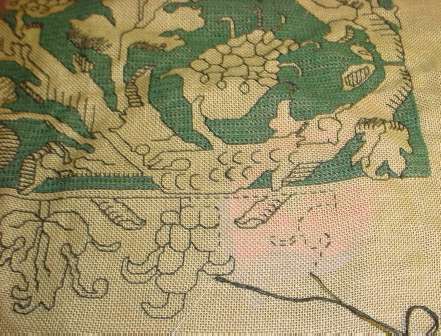
Partially finished shot of a large leafy repeat that’s shown in TNCM. I did finish this but have no pix of the final object. Given to a dear friend after completion circa 1996. Danish Flower Thread on 38 count linen, and more LACS.
Lesson Learned; Take more photos.


Two “try out” pieces, just playing with no intent to finish either one. Upper one in linen thread, lower one in Danish Flower Thread on 38 count linen. The grounds on the voided strips are all long-armed cross stitch.
Lessons Learned: A lot. Neither of these grounds are true even weave. I was playing with how skew weaves distort designs. The one on the bottom is counted over 3×2 threads to make up for it.
This just takes me up to 1998 or so and I’ve skipped lots of pieces for which I have no photos, but this post is getting long. I guess the main lesson learned is that practice and perseverance help in any pursuit, even the most trivial. If people are interested, I’ll keep going.
DETERMINING THREAD COUNTS OF SMALL-GAUGE LINENS
Lately I’ve been seeing discussion of linen, and whether or not it has to be even weave, sold specifically for counted thread work to be suitable for blackwork, cross stitch or other forms of grid-aligned stitchery. I maintain that while that does make things easier, and guarantees a certain precision look, it may not always be needed. Here’s a sample of a not-quite even weave being used for double running stitch.

First thanks to My Stealth Apprentice for the lovely linen remnant I’m using.
While it looks pretty uniform, it’s not. Up close you can see that the thread count is not even in both directions. Also you can see the combo of thin and thick threads that I admit can make stitching a challenge. But you can also see that both circumstances don’t quite matter as much as one might think.
My own counts, estimated by trying to take measurements between two pins placed an inch apart have been off up until now. But totally by accident, I’ve hit on a better way to calculate thread count, and it happened by using a standard US penny as a reference point to show relative scale.
The penny is three quarters of an inch across by specification. By taking a zoom-in photo, then counting the threads it obscures, we get a vertical thread count of about 33 threads in 3/4″ (counting the threads “tall”), and a horizontal count of about 25 threads in 3/4″ (counting the threads “wide”). A bit of math – multiplying both values by 1.33 – and that works out to a thread count of about 43.9 x 33.25 threads per inch. Not even weave in the least. But I can still work a (slightly squashed) rendition of the design on it. It’s distorted, but in a way that would not be apparent if this was to be done entirely as a strip.
However, I AM working this design as a frame around my central motif, complete with corners, so the skeleton dance will appear rotated to fit all four sides. Just as this bit is slightly squashed north-south, when I get to the side 90-degrees from this, the design will be squashed east-west – making my bony bois and pomegranates taller and thinner than they will appear here.
Optimal? Maybe some folks would object. But I am betting that it will still look good.
Oh, and add a penny (or any other coin or flat object with fixed and known dimensions) to your stitching gadget box, along with your phone’s camera. It’s much easier than those pins…
LETTERING COMPLETE – ON TO THE DANCE
I’ve been working away on my admittedly odd fandom sampler, and have finished the motto.

US penny provided for scale.
With more precise counting, the ground cloth is approximately 46-48 threads per inch but isn’t exactly even weave, so the piece is roughly 23 x 24 stitches per inch, with small variations for slubs or skinny threads. But that’s ok.
As for what this rather curious saying in the equally curious and difficult to decipher font says, it’s “Lucus orthai ta.” It’s a saying in an alien language that figures in The Resident Male’s forthcoming book. It translates to “Life’ll kill ya,” and so was fitting to be something ringed round with the skeletons from my Dance pattern page.
Having finished with the plain old cross stitch part, now comes the fun stuff. In an unusual move for me, I’ve graphed out an adaptation of the Dance strip and corner, specific for this piece. I usually don’t bother, but in this case I wanted to be sure that everything was centered. You can see just above the “LUC” I’ve begun a course of the innermost edge of the wide border. It’s mirrored at the center point, over the C. I did this so that my corners would meet up perfectly. Now of course as I go on we’ll see how well I have been ensnared by hubris. But for now, I can hope. Also consult my pattern graph.
Oh. And for the strip across the top, the skeletons will be upside down. You have been warned.
Questions about materials or technique? Comments on the futility of producing a tribute to an as-yet unpublished book? Desire to read the first book in the series? Post your queries here and I’ll try to answer.
AFTERMATH OF A WINDY DAY
Yesterday was windy. Really, really windy. My neighborhood was hit by several amazingly strong downbursts that felled more than several trees. While a big chunk of the two trees in the corner of our lot fell victim, we were lucky in that there were no injuries, nor was there any major damage to any houses or cars. Note that the wind was SO loud when this happened we did not hear the crash. I felt a tremor through the floor, and went to look out of the window, having no clue as to the cause. This is what I saw:

Yes, my neighbor’s empty shed was dented a bit, and the rather iffy fence between our properties took some additional damage, but for such a large pile of downed wood, we came off quite lightly.
Today the tree crew is here. They are removing the debris, and trimming up the larger of the two maples involved in an effort to preserve it. Sadly, the slightly smaller (but still quite large) maple in front of the corner tree is too shredded to save. It’s only got two remaining tufts in its crown – not enough to keep it going. So, compromised as it is, it’s coming down today, in a deliberate rather than wind-wild bit of destruction.
First – how to remove half-a-tree, splayed across two properties, and precariously balanced?
From above.
This aeronaut descended on the boom crane, affixed the lift straps to the main segment, and up they went. Once the limb was off the ground and over a safe spot, he lowered himself down by rope, and the crane lifted the thing up and over my neighbor’s house to dangle in their front yard.


Then the ground crew cut the “fingers” off the suspended “hand” and fed them into the chipper/disposal truck. In the mean time, other guys in the back yard hauled the smaller stuff away.

After this debris was cleared, it was time to prune back the shattered limb of the larger maple, and to remove the smaller one (seen next to the hard-hatted fellow in the photo above).
The result. One sadly halved corner tree, and one stump.
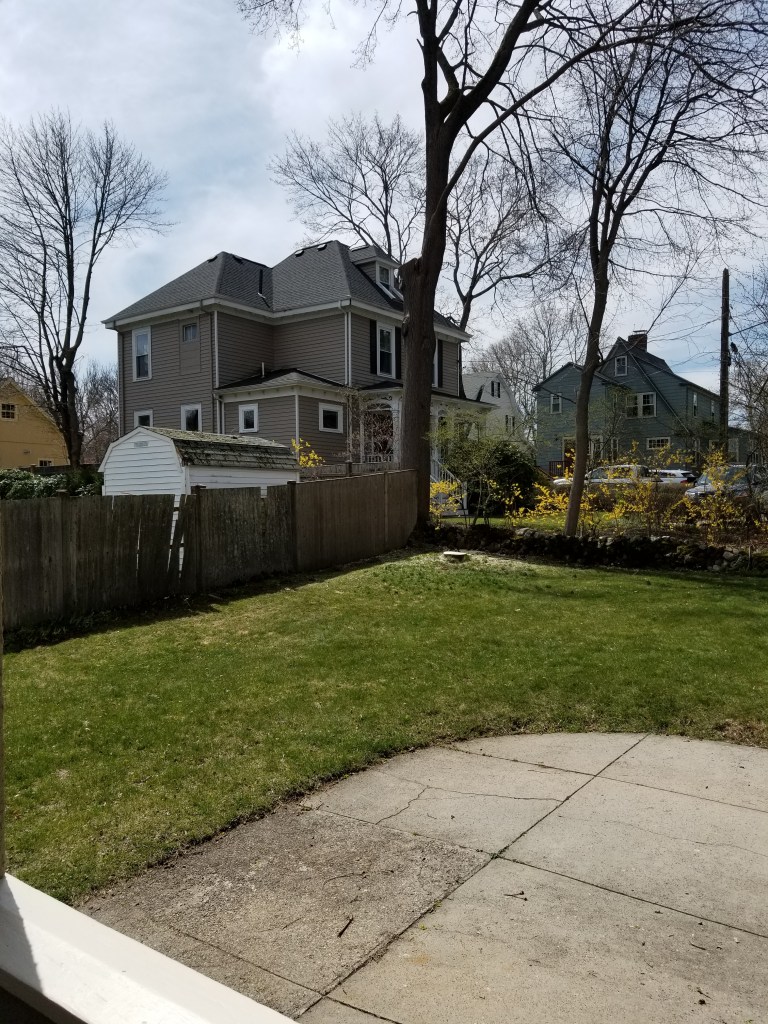
It’s going to be a lot sunnier in our yard from now on. And that corner now cries out for a large shrub of some type – preferably with nice, dense leaves, for privacy. I also suspect that negotiation with the neighbor to the side will lead to the elimination or replacement of the falling fence. There’s also that stump to deal with…
Oh. And to prove that progress indoors is happening, too – here’s the latest on my Lucus Orthai Ta sampler, that will bear my dancing skeletons edging:

I’m just beginning the L, having finished UCU. On the second line TH and part of the A are complete. You can also spy a tiny bit of the innermost band of the edging above the UC. It’s mirrored at the centerpoint – its rightmost edge in the snippet worked so far. More on that as the piece grows, but first I have to complete the letters in cross stitch. Like finishing up a dreaded dish for dinner, before getting dessert.
STAYING BUSY
What have I been doing of late? Well, being lucky, I can work from home, so that’s been taking up most time, especially with major deadlines in the past week. In the time that’s left over, I have to stay busy, and not as a sacrifice to the “cult of productivity.” Mostly because unless my hands are occupied, my thoughts wander to dark places.
I have subdued a reluctant sewing machine and run up some face masks for my family:

I’ve been knitting a pair of socks from a gorgeous ball of yarn I had put away as being “too good for socks.” Well, I deserve nice things, too.

I’ve done some casual research, and found another rendition of The Old Castle design, dated to 1590-1610. I added it to my round-up of the designs in that family.
And I’ve embarked on a new stitching project. It’s a curious one that has no short explanation behind it, and in a way – it’s the ultimate FanGirl project.
As I’ve mentioned before, The Resident Male (pictured above) writes prime SF/fantasy. He is currently working on the second book in his Blair and Terendurr series. One of the delights of living with an author is that you get to read the output long before it escapes into the wide, wide world. And if you are really lucky, parts are read out loud to you as they are completed.
One of the stories in the forthcoming second book features a rather unusual band of confederates. I can’t go into more detail because I don’t want to post spoilers. But they have a motto in an other-worldly language, “Lucus Orthai Ta,” which translates roughly to “Life’ll kill ya.” I thought it would be fitting as his #1 fan to make a present for my author: an embroidery of this phrase, framed with The Dance border I posted here last week.
I started by combing through my usual haunt for unusual alphabets, Ramzi’s Patternmaker Charts collection of near 100 year old Alexandre, Sajou and other pattern booklets and leporellos, The one I picked is the third one on this page. They don’t get much more baroque or difficult to read than that set of squiggles. Perfect for an alien language.
And so I present the start – working out from the center and in cross stitch for the lettering, on 44 count almost-evenweave linen in “art silk,” it will take me a while to get to my skeleton army in double running stitch. But I will…

As for the story, you are just going to have to wait for him to complete the second book. It will be worth the wait!
BOOKMAKING 110: THE GRAND FINALE
And just like that, the cover is finished and mounted on the target book:

And pix of the thing off the book, Here’s the outside, with everything finished off and sewn flat:

And the inside (with my reverse in all its messy splendor):
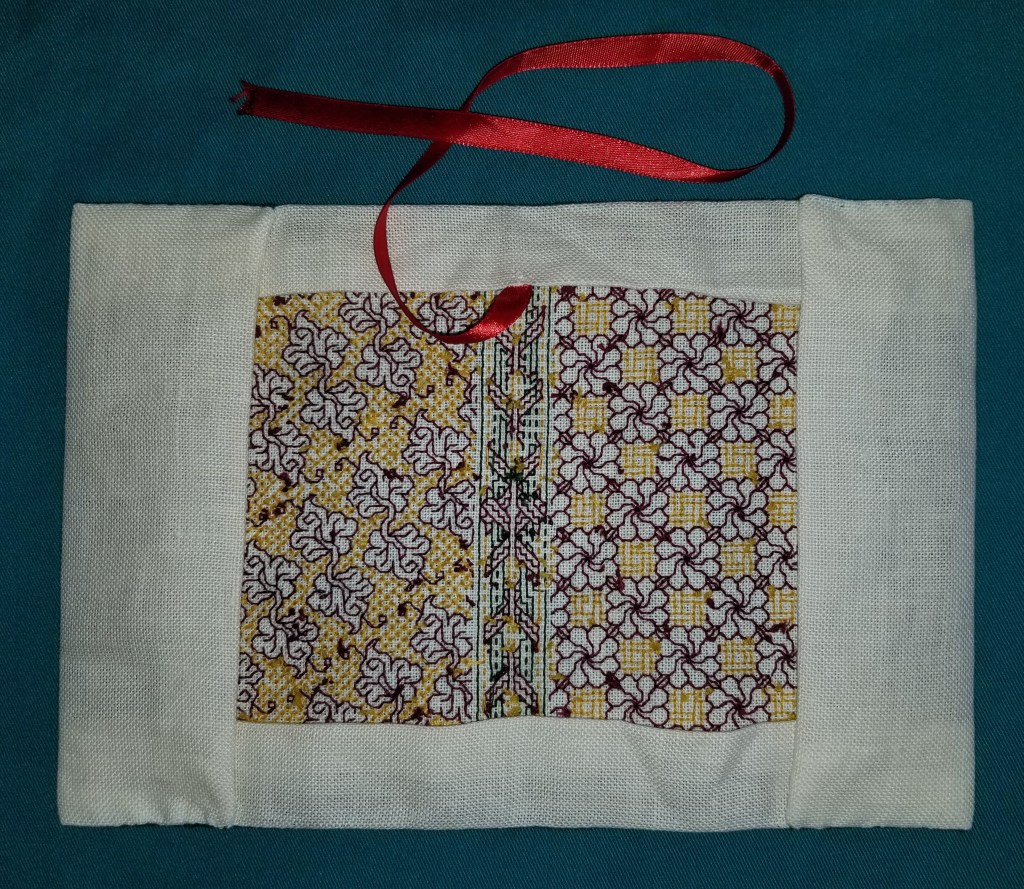
To clarify what was done:

- As shown above, first I folded in the top and bottom flaps, but I didn’t bother to hem them – I just made sure that the raw edges were covered. There will be no wear and tear on these flaps, so there was no need to protect them further.
- Then I folded in the left and right flaps. BUT in this case, because the book covers may slide in and out of the stitched jacket (if the recipient decides to feature the other side as the front cover, or ever replaces the book itself) – I did hem them for stability.
- The next step was to stitch the placeholder ribbon to the underside of the top flap. I left it extra long, so that it could be fished out and used, no matter which of the two sides of the embroidered jacket were deemed to be the official front.
- After all four flaps were prepped I stitched the edges of the left and right flaps to the top and bottom edges of the book cover’s front.
Now that last step can be done in several ways. The easiest is a simple whip stitch or invisible hem. But I never take the easy way out. Instead, I went back and extended the green double running line that defines the top and bottom edge of my stitched area out along my fold. I couldn’t put the thing back into the frame, so I did it in hand. Then having two green lines established, I used the same green embroidery floss to work them together, following (more or less) the logic that people who make biscornu use to seam together the two squares that form their curious little pincushions. A good tutorial for that is here.

The image above shows my wobbly last minute double running stitches, and how I united them front and back to make a heavier edge seam.
Finally, having done all of the finishing work, I slid the book’s own covers into the flaps of my stitched jacket. Here you see them in place, with the handy help of a large corkscrew, since I was running out of hands to hold everything in place.
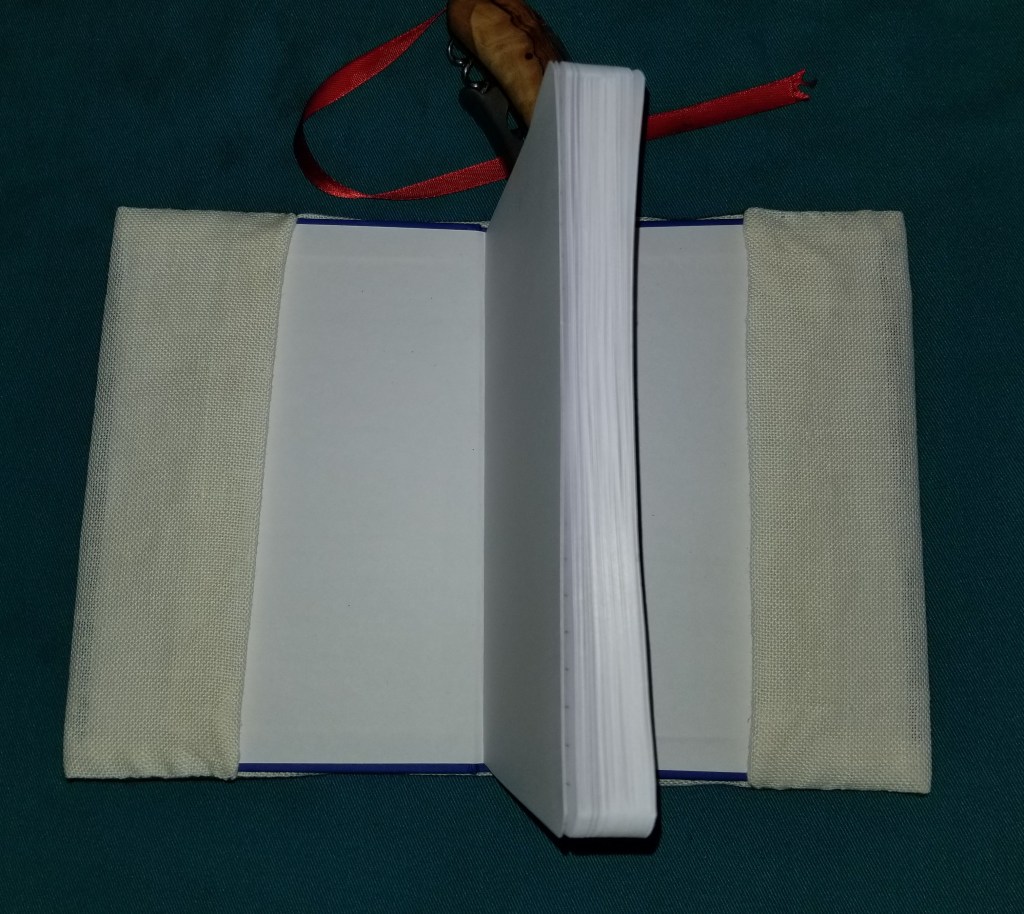
And so, taaa daah! A small book with a nifty cover. A stitched project that doesn’t take up wall space, that can be adapted to any size book you have on hand. Embellish a devotional book that means a lot to you; or at the other end of the spectrum, disguise a racy novel for discrete subway reading. Use any pattern that tickles your fancy. Or several if that’s what speaks to you. But whatever you do – enjoy, be creative, and feel the pride in coming up with something that’s specifically and personally meaningful to you.
This concludes my stitched book jacket tutorial. Please post questions if you have them – I’ll do my best to answer.
THE DANCE
UPDATE: The Dance is now available as an easy PDF download via the Embroidery Patterns tab, above.
More free patterns. My stress abatement in this time is to doodle and design in addition to working on my own stitching and knitting. The designs below will eventually be part of a future work, but for now, I am sharing it as a broadside, so others whose stress abatement is stitching have ample food.
But before I present the pattern, some discussion. The main strip in this broadside mini-collection started out as a special request for a Danse Macabre design. I did it up, with some personally significant secondary motifs also requested, and delighted the recipient. But I wanted to play with it a bit more. I’ve changed it up somewhat, removed or changed the personal bits, and added a corner and secondary framing strips. And then having a partially empty page and an abhorrence of wasted space I just kept going, adding an unrelated border pair featuring swords and dart-like shapes, and as a lagniappe, a lemon meander. All are of my own design. The inspiration for the main strip will be evident in a moment.
Back to the Danse Macabre – that’s an allegory image from the 1400s and early 1500s. It’s something that appears in both religious and secular works, and is usually interpreted as a strong caution that no matter one’s station in life, wealth, or age – life is fragile, and all should be mindful of both mortality and the transitory nature of human vanity and pleasures.

But I have to say that I reject that morbid and moribund classical framing.
Instead, and in the current context, I look around. I hear about neighbors doing what they can to help each other. I read about people with talents – musicians, actors, artists of all levels of fame and proficiency – sharing what they can of themselves to enhearten, inspire, and entertain a frightened world. I witness the bravery of front line first responders and medical personnel, and the selflessness of many people in vital industries. I see many more small acts of kindness than I do malevolent and spiteful actions (although those latter ones do affect far more people proportionally per incident).
Now I see those dancing skeletons differently. They dance in defiance of mortality. They celebrate life in the face of danger and death. Living for others, to protect the lives of others, is the ultimate act of rebellion against an implacable enemy.
So, for all reading this, don’t break discipline. Keep away from others as much as possible. Heed the calls to do your part for community health. And if you are so inclined, feel free to stitch my Dance, with the joy with which I present it.

I make this file freely available for YOUR OWN PERSONAL, NON-COMMERCIAL USE. (NOTE: CHART IMAGE UPDATED ON 22 APRIL 2020)
As with my other offerings of late, this is “good-deed-ware.” Pay this gift forward by helping out someone else in need; phoning or getting in touch with a family member, friend or neighbor who could use a cheerful contact; volunteering time or effort; or if you can afford it – donating to one of the many local relief charities or food banks that are helping those displaced from work.
Finally, some notes on the patterns. In true historical style, the lesser framing borders have absolutely NO count relationship to their larger main motifs. This means that a square or rectangle of the Dance, which will meet up neatly at the corners provided full iterations of the repeat are used, will NOT be neatly framed by the plume flower or inner band, with the corner of the plume band guaranteed to present as shown. The same thing goes for the swords and companion darts. THEREFORE, I strongly suggest working the main band first to establish the width of your project. Then starting the companion border from the corners, and working it towards the center MIRRORING the corners and the direction of the plumes (or darts). When you get to the center of the work, fudge it.
The easiest way to fudge is to stop with the last full presentation of the plume or dart, symmetrically on the left and right of the center, then place a box in the “leftover” area around the center line. You can fill that box with your signature or a date. Or you can design a little supplemental motif to fill that space. And if all else fails, write to me or comment below with your problem area’s count, and I’ll see if I can help.
Stay safe and stay busy. And above all stay well!
HARSH LANGUAGE FOR HARSH TIMES
UPDATE: This pattern is now available as an easy-download PDF file, via the Embroidery Patterns tab, above.
I start with a gallery of finishes. Sanity saved! Smiles spread! (Think what you must about the phrasing – I’m happy that my goal of preserving both have been achieved).
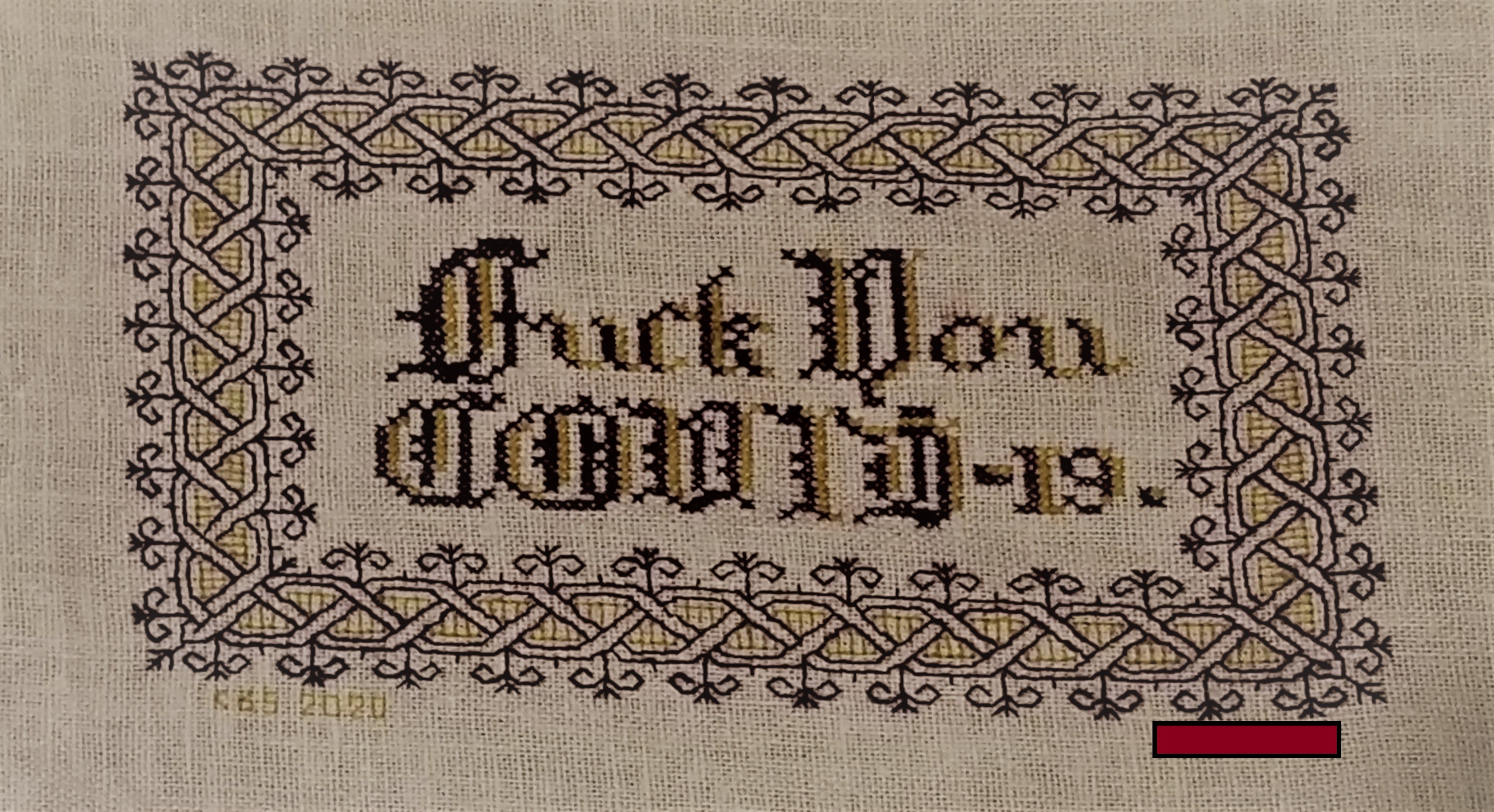
My own finish. Naturally dyed claret and mustard yellow wool on linen/cotton blend. I played with the color placement and letter forms a bit, since I can’t do anything verbatim these days.

Photo (c) 2020 by Madeline Keller-King, reproduced here by permission

Photo (c) 2020 by Breen Pat, reproduced here by permission
A couple of days ago I posted the design for my “Don’t Panic” piece, which has become shockingly relevant.
Friend Edith points out that harsh times call for harsh language, and that while some people might be soothed by a gentle statement, more strident expression suits many others.
Therefore for Friend Edith, and in the spirit of Dame Judy Dench, who is famed for stitching up provocative statements, I make this chart freely available for YOUR OWN PERSONAL, NON-COMMERCIAL USE.
Consider it as “good-deed-ware.” It’s tough out there right now. Pay this gift forward by helping out someone else in need; phoning or getting in touch with a family member, friend or neighbor who could use a cheerful contact; volunteering time or effort; or if you can afford it – donating to one of the many local relief charities or food banks that are helping those displaced from work right now.

Right-click on the image above to save it as a JPG.
This piece is intended to be done in cross stitch (the lettering), and double-running or back stitch (the frame). While it’s shown in black and red, use one color if you like, or substitute in as many other colors as you wish.
The source for the lettering is yet another of the offerings in Ramzi’s Patternmakercharts.blogspot.com collection. The border is from my recently released Ensamplario Atlantio II, a free collection of linear designs – mostly blackwork fills and borders.
Thank you Edith! Your inspiration and request will brighten the hearts of many, while rendering their walls cheekily NSFW.
(And there goes my PG blog rating, and any remaining shreds of reputation for gentility. But it’s worth it if someone smiles.)
BOOKMAKING 109: STITCHING FINISHED, ON TO ASSEMBLY STEP ONE
I’ve finished all of the stitching on the book cover project, now on to turning the flat piece of cloth into the finished item.
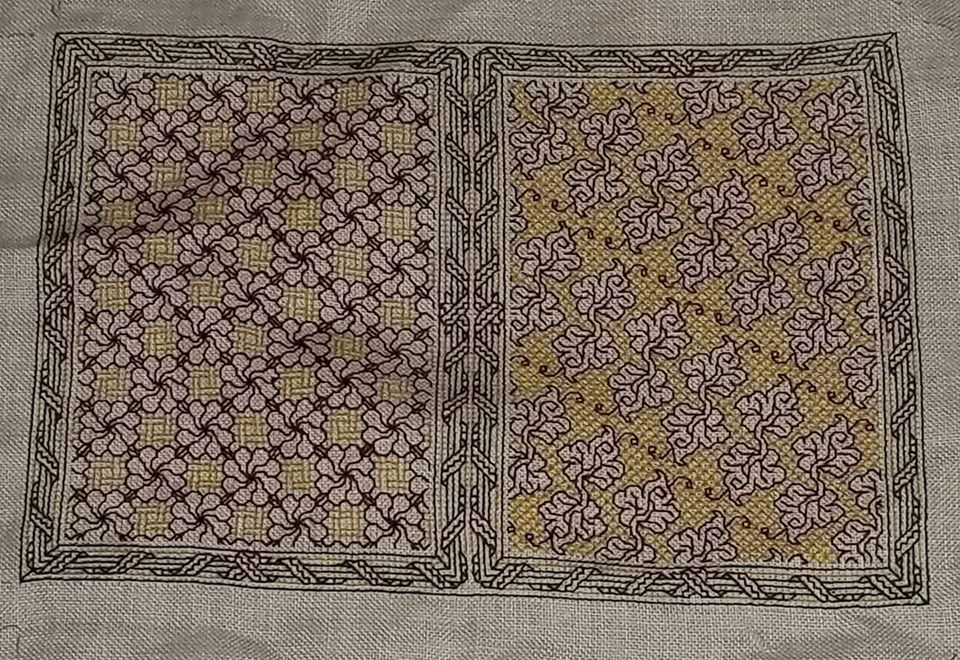
Although I am a teensy bit disappointed that my centering efforts on the leafy side did not pan out, I think you can see that my guess was correct. Given the eccentric nature of this slow-descent repeat, it’s not obvious at all.
An interesting thing happened – density of color. The yellow used on the front and the back are the same – same color number, even the same skein. But the diagonal diamond voided fill used behind the leaves is more dense than the lattice weave used with the swirly flowers. And the swirly flowers, having nice dense centers and connector leaves show the red as being more intense, too. The colors present differently depending on the stitching designs chosen. Close diagonals will appear visually more dense and darker than stitches done “with the weave” – horizontally or vertically.
While density differences do manifest in monochrome, they mostly present as grey scale from a distance, or in some blackwork substyles – something akin to the cross-hatched lines that are used to indicate depth and shadow. But in polychrome it works a bit differently. Individual colors – the same colors in fact – will pop or recede, or even intensify, depending on the closeness and orientation of the line segments on which they are used.
Making up the Book Cover
Well, for me at least the fun part is over. Now for the less interesting but no less exacting half of the project – turning this flat piece of cloth into a book jacket.

As you recall, we have the flaps all neatly defined by basted lines. These I will just turn over, not bothering to finish off the raw edges. They will be well concealed once the thing is sewn together, plus the added bulk of a turned or rolled hem would distort the lie of the stitched part of the cover.
First I flipped the thing over, with the “good side” down, so I could fold my flaps to the back. I set the creases along the stitching lines and the basted guide lines, setting them with my iron. It’s easier to do if you finger-press first to get the precise fold line, then follow the finger-pressed creases up with a warm iron. (Ignore the blue ironing board cover stained with the ghosts of projects long past).
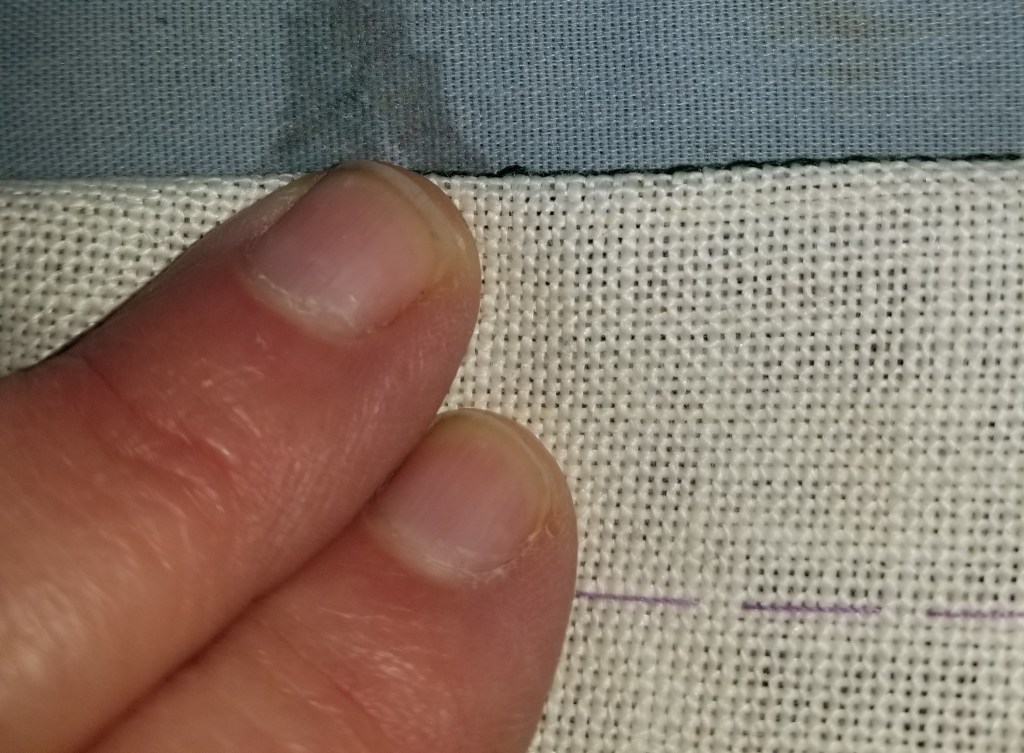
I started by setting the folds on the top and bottom edge, and then the left and right sides.

Then I trimmed off some of the excess fabric at the top and bottom. I didn’t bother trimming the left and right because there really wasn’t much to trim.
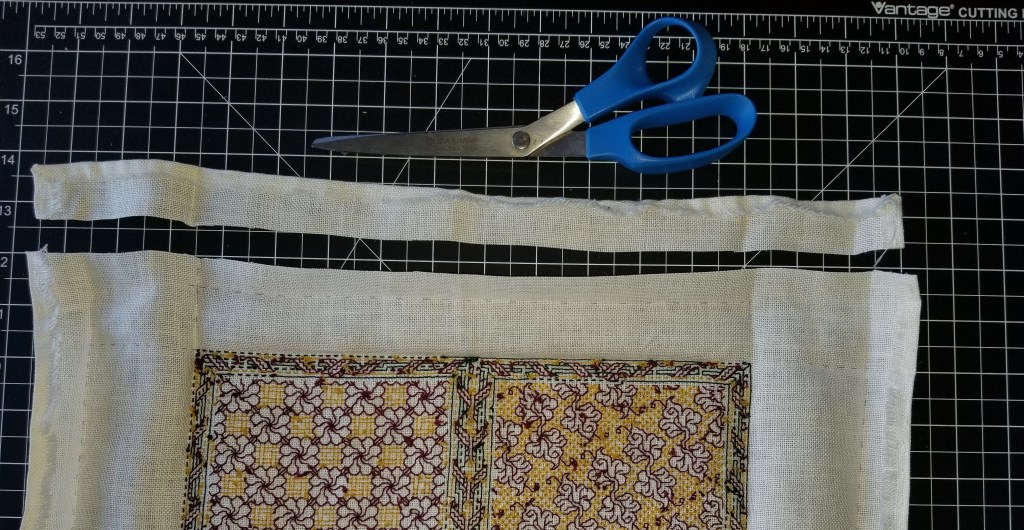
The next step was to fold everything in, and remove some of the bulk in the corners – note that I did not trim it all.

At this point with lots of nice, crisp creases in place, and no further need for the markings, I teased out all remaining bits of lavender basting thread.
On to the corners, to make them a bit sharp. There are other ways to do this, but origami-style “squash folding” to make a mitered corner is the simplest. I folded the corners in, ironed in the creases and pinned them for hand-tacking. And while I had the pin ball out (the needle-felted pin-puff is a treasured gift, made by Younger Spawn), I pinned the flaps to the body, although I will NOT be stitching them down..

And the last bit of prep was the stash-dive for a bit of red ribbon. That I will sew to the inside of the cover. It’s just long enough so it can be teased out to either the top or bottom, and will serve as an effective placemarker regardless of whether my recipient chooses the flower or the leafy side as the front cover.
Now off to do all of the tacking. The next post will cover sewing the end flaps in, to make the pockets into which the book covers will be slid. Before writing that bit up I want to experiment a bit, because I’d like those seams to be neat, and if possible – visible, and in green. We’ll see if that works out or if I punt and just stitch in the plain white sewing thread I am using for tacking and affixing the ribbon.
 String-Or-Nothing