BLACKWORK/STRAPWORK RESOURCES HERE ON STRING
NOTE: UPDATED TO BE CURRENT THROUGH 15 JULY 2025
Blackwork embroidery seems to be having an Official Moment right now, with tons of new interest. I’ve got a lot of resources here that might be useful to folk beginning or continuing their journeys, but it’s not well indexed. So I post this round-up of on site resources in the hope of lending a hand. And to be able to point to the whole set if asked. Image at the end for the eye candy effect. List below has been updated since it was originally posted.
Technique and Tools
- Double Running Stitch Logic. One of many times I’ve tried to explain double running stitch and two-sided work. This post led to the tutorial series listed below.
- Assorted Blackwork Hints. Answers to questions about my working methods. Making mistakes; guidelines; where to start; simple tracing using “the poor person’s light box”; multicolor; equipment hints (frames, needles, wax); and a list of tricks for path planning in double running logic.
- Blackwork Thread Thickness and Grounds. One strand or two for double running? Why is it sometimes hard to keep your lines straight and even.
- Blackwork Heresy. Back stitch, double running, and the hybrid that floats between them, which I nicknamed “Heresy Stitch.” Useful but not something I’ve documented in historical works. Can be easier for people who get lost when working double running, and saves thread when compared to back stitch.
- What Makes a Blackwork Pattern Difficult? Cautions and mitigations for three challenges, that might help simplify those trouble spots.
- On Charting. How to look at a photo and then translate the design to paper.
- Determining the Thread Count of Small-Gauge Linens. How to use a penny (or other tiny thing with a known and stable diameter) plus a cell phone camera to figure out the count of a hard-to-see ground.
- Cornered Again. One way to handle placement of bands on a band sampler and a wrap around frame edging, with minimal advanced planning.
- Filling In. More questions from the mailbag, including some unusual names for stitch techniques that appear in museum annotations.
- Proofing. How I check alignment as I stitch, to make sure I’m not wandering off count.
- Turning a Strip Repeat into an All-over. This one also belongs under the free linear stitch patterns heading below. A couple of ways to make a single width strip into a double, and how I ended up turning it into a Green Man square.
- Travel Cover for a Flat Frame. How I made mine, and how you can make one, too.
- Hoops! Sizes, thicknesses, wrapping, and more.
- Working on skew counts (non-evenweave linens). An aside in the discussion of a past project, but lots of tech info here.
- Typography in embroidery design. Choose your typefaces carefully!
- The Buzz on Beeswax. Why I am such a fan of using it in blackwork.
Inspiration
- Elizabethan Blackwork Smock. Photos of the famous Victoria & Albert Museum smock (1575-1585), Accession T.113 through 118-1997, plus my redaction of some of the fills used on it.
- Blackwork Inspiration. Some sources for folk looking for project ideas for original pieces of contemporary blackwork
- Digression – Blackwork Embroidery. Lots of links to portraits and other artworks showing blackwork. Some of them might still work.
- More Inspiration from Historical Sources. Another link roundup of countwork appearing in paintings and portraits. Some of these links may still be live, too.
- Forehead cloths. The coif’s companion. Much easier to wear in modern context (see Bragging, below).
- Ironwork at the V&A. These pieces sing “outline potential” to me.
Voided Works
- Voided Grounds. A roundup of various treatments for voided work, where the background is overstitched but the foreground remains (mostly) unworked. This is the style that was reborn in the 1800s as Assisi work, and is also known as reserva stitching.
- Voided Pieces and Outlines. Do historical voided pieces always sport outlines? Were they done first? Were they always on the count?
- Voided Narrative Panels. A style cluster of voided works probably done by drawing the foreground designs freehand, then working the background up to those lines.
- Meshy! Working that hard-pulled mesh like voided style that totally encapsulates the ground fabric’s threads.
History, Speculation, Pattern Clusters, Printing Block Migrations and Other Musings
- The Twain do Meet. Introduction to Kasuthi Kashida. Blackwork’s Indian cousin
- Looking East Again. Double running stitch pieces from the Wardak Hazara people of Pakistan. Another example of a South Asian stitching tradition that may be one of blackwork’s lesser known Eastern cousins.
- A Missing Link? A curious family of Egyptian Islamic artifacts of the 10th to 15th centuries, that have no proven relationship to inhabited blackwork (the kind with hard outlines and geometric fills), yet presage its aesthetic.
- The Azemmour Cluster. A group of patterns that in the time I’ve been paying attention has had their commonality and point of origin increasingly recognized, moving them from late 19th century source annotations that identified them as Renaissance era products made everywhere from Greece to Spain, and placing them in Morocco.
- The Spider Flower. A design that is probably part of the Azemmour Cluster
- Revisiting the Stupid Cupids – Multiple versions of the cupid and oak leaf meander.
- A Pattern’s Pedigree. Random thoughts about a specific family of patterns that shows up both voided and unvoided.
- The Leafy Family. A wide leaf-bearing meander that shows up multiple times in artifact inventories.
- More Cousins. The Leafy Bricks group.
- Cornered! Possible working direction and four different corner treatments of a famous, oft photographed handkerchief in the V&A.
- Italian Leafy, Occasionally Multicolor. Another design family of large panels and edgings that have curiously similar design elements, and a direct association of one example with the Jewish community of Rome, hard dated to 1582/1583.
- Long Lost Twins, Part I. That ubiquitous urns and piping harpies design. (I revisited this one in Part V, below)
- Long Lost Twins, Part II. Oak branch, leaf and acorn design, executed in both monochrome and polychrome, multiple versions.
- Long Lost Twins, Part III. Another very common pattern with multiple iterations, in multiple museums, two instances of which may have been cut from one original piece.
- Long Lost Twins, Part IV. Multiple instances of a simple Y and wrap meander.
- Long Lost Twins, Part V. Lots more on that harpies/urns design; found in many museums, many iterations, and even multiple stitching modalities.
- Long Lost Twins, Part VI. Two instances of a column design, very probably once cut from the same artifact. Fragments of which are held in two museums
- Long Lost Siblings? Another case of a single source artifact probably cut in two, now held by two different museums.
- Long Lost Twins, Part VII. Resuming the series. This is a voided pattern showing dancers, several pieces possibly cut from two originals before dispersal to various collectors.
- When is More of the Same Not More of the Same? Examining differences among different editions of various modelbooks, trying to parse out whether they were reprinted from the same block, hand tinted, or recarved.
- Modelbook Blocks: Acorns and Chickens. A classic. Was the block simply traded and reprinted, or was there copying afoot?
- One Design’s migration. Another look into multiple printings of the same design, and differences/similarities among those iterations.
- Early Marketing? Or Not… Speculation set aside by actually looking at the when and where of a pattern published both with and without religious mottoes.
- Repeating On and On on Repeats. A summary of the types of rotations and mirrorings commonly seen in long strip patterns
- Ocular Proof? My argument that Othello’s strawberry speckled handkerchief used in the play to implicate Desdemona might have been conceived of by Shakespeare as a countwork piece.
- A Curious Applique Technique. Not embroidery, but often appearing in modelbooks alongside it. Take a strip of leather or cloth, cut it with precision into a pattern that duplicates itself on either side of the bisecting line. Twice the yardage and no waste. Wildly clever.
- The Symmetries of Linear Stitched Fills and Strips. The difference between designs with even and odd numbered stitch counts, and how they can be used to best advantage. Plus pitfalls of aligning them with each other, especially when using purpose-woven grounds like Aida.
- Griffins. A discussion of a very common griffin design, and how it moved through time and across geography.
- The Unstitched Coif Project Exhibit. My photos and links for all of the coifs produced.
- More on 16th and 17th century pieces associated with Italy’s Foa family. Recognizable design elements characterize this cluster.
- Even More on Azemmour. Additional observations on a cluster of embroideries from Morocco, common in museum and private holdings. Some of which were sold to early collectors as Renaissance fragments.
The Unstitched Coif Project
- Completed coif – discussion of my materials, sources, and method. Includes a writeup of the stitches used, and why.
- Completed coif – discussion of my finish and fills. Close ups of the completed project, plus a motif by motif round up.
- The Unstitched Coif exhibit. All of the coifs submitted for display in December 2023.
- All of the posts tagged with Unstitched Coif. For those who want to get up close and personal with each motif as it was created.
 My Unstitched Coif Project contribution, now available in high definition photography of both the front and back. It was collected by the Victoria & Albert Museum, and they have updated the piece’s permanent on-line accession page with those images.
Talks and Classes
The Stitches Speak
These are the slides from a round-up of historical counted styles I presented at a Society for Creative Anachronism needlework and textiles gathering in 2012. Mostly eye candy, and divided for ease of posting, not by subject area. However sources are listed.
- My post-event summary
- Part 1. The rest of these are my slide deck as presented. No script, just the images.
- Part 2.
- Part 3.
- Part 4.
- Part 5.
- Part 6.
Workshop Handout
This is the broadside I hand out when I teach workshops on double running stitch. It’s pretty much a self-paced tutorial, with the simplest designs at the upper left, and progressing in difficulty to the lower right. If you work these at your own speed as a band or jumble sampler, by the time you’ve done them all you can tackle just about any linear design. And although I do use this to teach double running stitch logic, no one will say you sinned if you decide to complete it in back stitch.
- Class handout. (Also available on the Embroidery Patterns tab).
Patterns
Free
Linear Units (Line Segments)
- Ensamplario Atlantio. Seconnd Edition. A collection of blackwork fills from my doodle notebooks, some my own, some from artifacts, but when I started this I didn’t intend to publish, so I didn’t keep track. Some of the larger ones work well as all-over designs, or for small projects like biscornus or holiday ornaments. All four previous segments of the original release stitched back together, along with some additional content.
- Ensamplario Atlantio Volume II. More fills, plus some strip designs and yokes. 90% original (exceptions are footnoted). In one file this time, as technology marched on since publication of the first.
- Ensamplario Atlantio Volume III. You guessed it. Even more fills, plus lots of strip and all-over patterns and even a couple of yokes. Same paradigm as the previous volumes, with the few redacted designs called out in footnotes. Anything indicated with a star is my own original work.
- My Embroidery Patterns tab. Most but not all of the designs below also appear there, plus more.
- Rose Chart. Outline for a heraldic style rose
- Ganesh Project. How to replicate my blackwork method Lord Ganesh, done as a present for a family friend in India.
- Crowdsourced simple diamond interlace, with small motif fills provided by String’s followers. Use some or all. (Also on the Embroidery Patterns tab).
- Dancing Pirate Octopodes. The design that led to the crowdsourced project. (Also on the Embroidery Patterns tab)
- Leopards. (Also on the Embroidery Patterns tab)
- The Epic Fandom Stitch-Along. 19 bands, 9 of which are quasi-traditional, 10 of which are wildly anachronistic, with spaceships, dinosaurs, pirates, references to Star Trek, Star Wars, and Dr. Who. Guidance for the whole project is included.
- The Epic Fandom Stitch-Along in ONE easy to download PDF. The whole thing, informational posts, instructions and all charts for the project above.
- Cat and Mouse. A large panel with Art Deco style cats, mice, and yarn balls. (Also on the Embroidery Patterns tab).
- Bands from a 16th century Camica. Hem, collar, seam bands, and striping. (Also on the Embroidery Patterns tab)
- Those Snails. They crawl all over my work. I share some.
- Jesters at the Fence. A snippet from TNCM (see below).
- Bead border. (Also available on the Embroidery Patterns tab)
- Ring of Rats. Another Art Deco style chart (also available on the Embroidery Patterns tab)
- Tessellated Cats. This design is included in the free book Ensamplario Atlantio Volume III, available on the My Books Tab.
- Elizabeth Hardwick’s Sleeves. Another redacted chart for a historical alll-over design. Redacted from a portrait. (An easy downloadable PDF is also on the Embroidery Patterns tab).
- PERSIST sampler – a chart for a slightly slimmed down version of my Persist piece. (An easy downloadable PDF is also on the Embroidery Patterns tab).
- A Holbein Collar. Collar on a man’s shirt, redacted from a portrait. (An easy downloadable PDF is also on the Embroidery Patterns tab).
- Hebrew Alphabet and commonly embroidered words. I mashed up a few sources to come up with this one, including a very early Apple II pixelated typeface. But the letter forms are tweaked enough to be mine. (An easy downloadable PDF is also on the Embroidery Patterns tab).
- Border or strip design. I used this one on my chatelaine ribbon. It’s also in Ensamplario Atlantio III. (An easy downloadable PDF is also on the Embroidery Patterns tab).
- A Spanish Gentleman’s Collar. An actual example of Spanish blackwork. Redacted from a portrait. (An easy downloadable PDF is also on the Embroidery Patterns tab).
- Another Portrait, Another Redaction. Sleeve detail for a woman’s chemise charted from a circa 1500 Italian portrait. This one with chickens. (An easy downloadable PDF is also on the Embroidery Patterns tab).
- Pattern from a Gentleman’s collar, circa 1560. Chart and discussion of graphing from a painting. (An easy downloadable PDF is also on the Embroidery Patterns tab).
- Correction to The New Carolingian Modelbook, Plate 73 – the really wide interlace. I finally got around to stitching this one up and discovered that two of the overlaps as charted in the book were wrong. So I issue an update. Given the better layout and composition of my more recently composed plates, this pattern is now presented on two pages, both as a wide border and as an even wider iteration that can be used as an all over and as an even wider border. This PDF also available on the Embroidery Patterns tab
Box Units (squares)
- Unicorn. Box unit (not linear) chart for a unicorn, courtesy of Elder Offspring.
- Castles and Caravels. Box unit design featuring a three-towered castle, and its relationship of that motif to some Spanish pieces.
- Knot More Knots! Simple interlaces in box units (Also on the Embroidery Patterns tab)
- Simple Geometric from 1546. This one is also box units, and works well for stitching, knitting, and crochet.
- Da Sera Bud Interlace. Another box unit pattern. (Also available on the Embroidery Patterns tab)
- Fun with Odonata. Another box unit design, this one for dragonflies. Note that they can be used for knitting, too. (Also on the Embroidery Patterns tab)
- Fun with Lagomorphs. A box unit design for a leaping rabbit. (Also on the Embroidery Patterns tab)
- A Simple Interlace. I lost the source annotation for this box unit design aeons ago.
Not Free
- The New Carolingian Modelbook: Counted Patterns from Before 1600. Also known as TNCM. Sadly out of print. It’s in queue for update as scholarship has advanced in the years since it came out. There are corrections aplenty! You might be able to find it on the used market, but at a wildly inflated price.
- The Second Carolingian Modelbook: A Collection of Charted Patterns for Needleworkers and Artisans. Also known as T2CM Link to Amazon page is on the indicated post.
Tutorials
These are also accessible via the Tutorials tab at the top of every page here. but below they are listed in the correct chronological order
Double Running Stitch Logic
- Double Running Stitch Logic 101 – Two Sided Work and Baseline Identification. Basic logic of why baselines matter if you want to work something either totally two sided, or using two-sided logic for thread economy
- Double Running Stitch Logic 102 – Working from the Baseline. How to follow one, step by step.
- Double Running Stitch Logic 103 – Accreted and Hybrid Approaches. Breaking down a large non-linear chart for easier stitches.
- Double Running Stitch Logic 104. A review comparing back stitch and double running, and how to determine if a design can be worked totally two-sided or not.
Charting Linear Designs using GIMP Drafting Software
I found commercial charting software treats linear charts as an afterthought, so with help, I invented my own graphing method which I have used for all of my books. This series is for folk who want to move on to designing and drawing their own charts, and doing so using the dot and bar method I invented. GIMP is freeware, and if you’ve ever used Photoshop or Illustrator, and are familiar with layer-based drawing logic, the learning on-ramp for this method will be familiar. Although this was prepared for an earlier version of GIMP, these instructions are still relevant, although the GIMP menu screens now look slightly different.
- Charting. A comparison of my dot-and-bar method with the traditional drawn-on-quadrille-graph-paper method.
- GIMP Charting Tutorial 101. The logic of a layer-based drafting tool.
- GIMP Charting Tutorial 102. Getting started, basics of working with GIMP.
- GIMP Charting Tutorial 103. Building the dot layer of your template.
- GIMP Charting Tutorial 104. Layer management and building the design and mask layers of your template
- GIMP Charting Tutorial 105. Drawing the design.
- GIMP Charting Tutorial 106. Additional tools including those for erasing, flipping, alignment, and rotation
- GIMP Charting Tutorial 107. Hints on printing
- GIMP Charting Tutorial 108. Preconstructed templates to save you time.
Just Bragging
- My big underskirt forepart. Why I stitched it
- Forehead cloths for modern wear. Kind of like a kerchief, works well and keeps the hair out of my eyes in seaside winds, adapted from the companion piece often seen with a matching coif.
- Trifles wall hanging. Made as a “mom nag” for my younger spawn, done using blackwork techniques and fills.
- Blackwork sampler done in 1983. Musings on why this piece is not entirely successful in terms of stitching density distribution.
- Two Fish. No astrological connection, just two koi circling on couched gold water. Indigo and deep green silk on 40 count linen
- Fangirl Sampler – A key phrase from the science fiction series by my Resident Male, in an off-world language. It translates to “Life’ll kill you”. I am after all his fangirl army of one. Alphabet from an old Sajou leaflet, but the rest is all my design. The dancing skeletons border is available on the Embroidery Patterns tab.
- Grape Sideboard Scarf. An artifact-based main field with a self-designed companion border.
- Blackwork sampler done as the cover for T2CM, finished in 2012. Below.
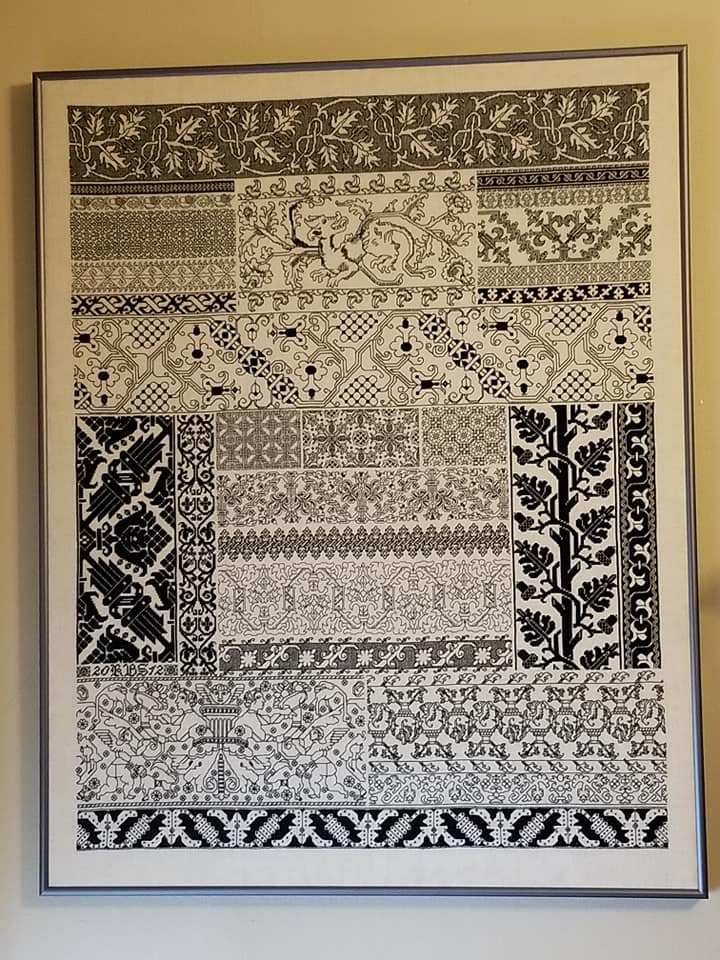
PROGRESS BY THE BEACH
Lest anyone think I’m on vacation, not so. Yes, we ran away to the beach place this three-day weekend past, but in this work from home era, we worked from there, and prepped the place for our booked guests in compliance with the state COVID-era short term rental requirements.
Still, even though it wasn’t all for fun, on Sunday I did get the chance to stitch on the beach. I adore it, even though the intense sunshine can lead to “white out” conditions on the linen, making thread counting difficult.

As for how far I’ve gotten so far – I’m just starting on the third corner:

Excuse the wrinkles – I don’t iron until the very end.
You can see the diagonal “spine” of the mitered corner. A snail will squeeze itself in underneath the rightmost tumbler’s feet. I will wrap the plume edging up and around the corner, too. You can even see the start of the double border with extra knot on the inner edge of the rising strip-to-be.
I wish I had grand new insights to share on this piece, but being in the home stretch, I’m fresh out. This is also always the most dangerous part of a project for me. I’ve figured out all that’s new, and all that’s left is perseverance – dogged execution of the known until completion. It’s the point where I often wander off to do something novel and interesting, with the promise of new challenges.
So, if you have any questions about working these long repeats, keeping place in them, how to draft them up, or pretty much anything else, feel free to ask. Now’s a good time to engage my attention. And I’ll thank you for keeping me on track and marching in time with my bois.
FRAMED!
At long last. Framed and hung up in the bedroom.

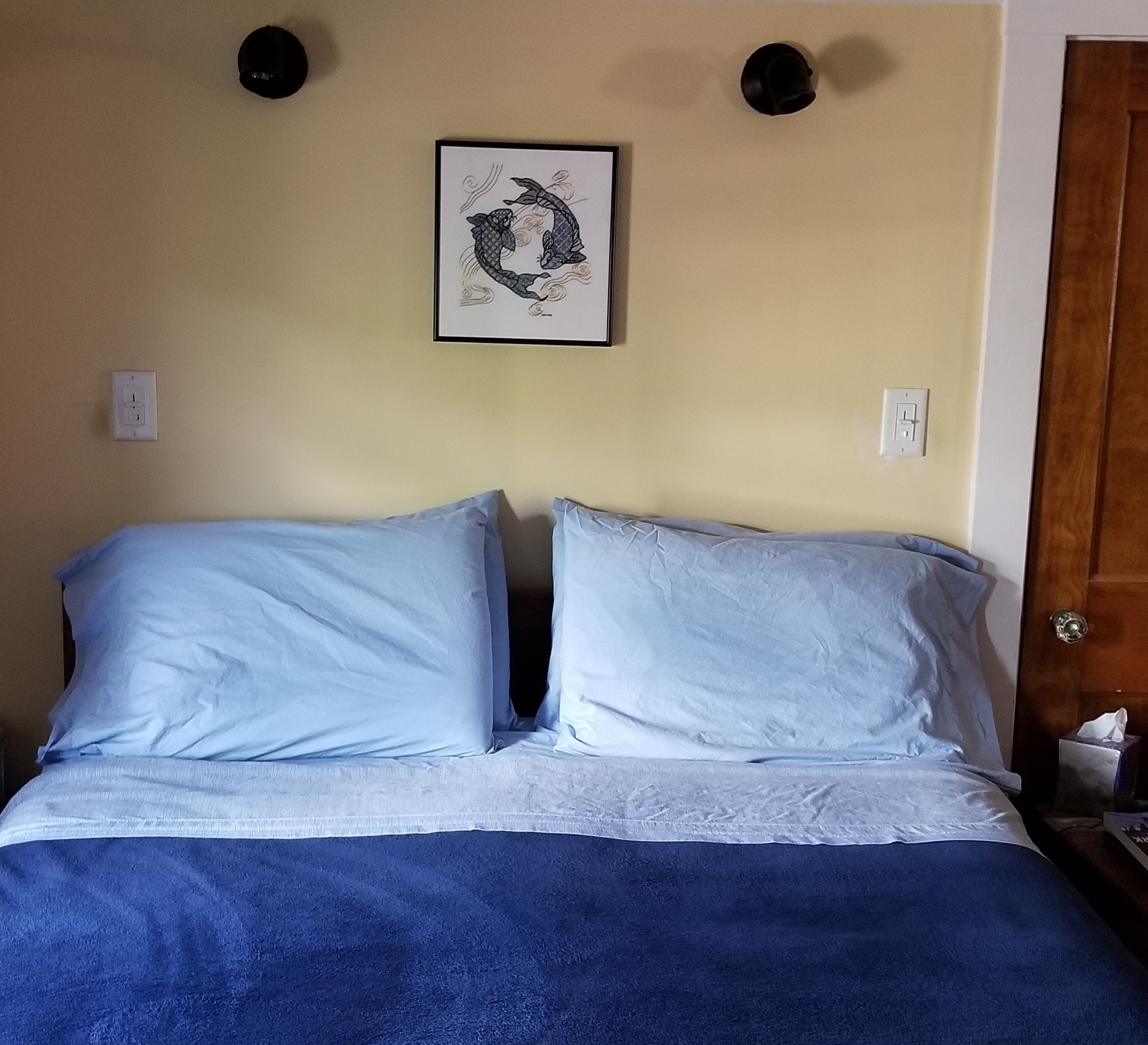
Obviously I now have to paint the bedroom walls…
I’m quite happy with the way this turned out. The frame is simple enameled steel, in deep navy. I ended up going to Walden Framer in Lexington, MA. Mr. Ed Pioli, the owner and artisan in chief, did an excellent job at a reasonable price. I will be bringing my other as-yet unframed pieces there, too.
To answer more questions on the piece’s composition, mostly from other people outside the framing shop when I was there. No, neither of us is a follower of astrology, and it’s not a panel depicting anyone’s sign. It’s just two koi, in a traditional arrangement. And no – there isn’t a boy-koi, and a girl-koi (or any other manifestation of yin/yang) intended. It’s just two koi swimming in a circle. And no, that’s not real gold thread. It’s high quality imitation gold sold for Japanese embroidery. And no, I didn’t sew it on a machine, I did it by hand. Really and truly. (People are curious about the strangest things.)
What am I working on now? Well, the Great Tablecloth/Napkins project is done, but I still itch to stitch. So I’m just doodling. Filling up a small piece of linen, waiting for the Inspiration Fairy to chuck a brick through my mental window.
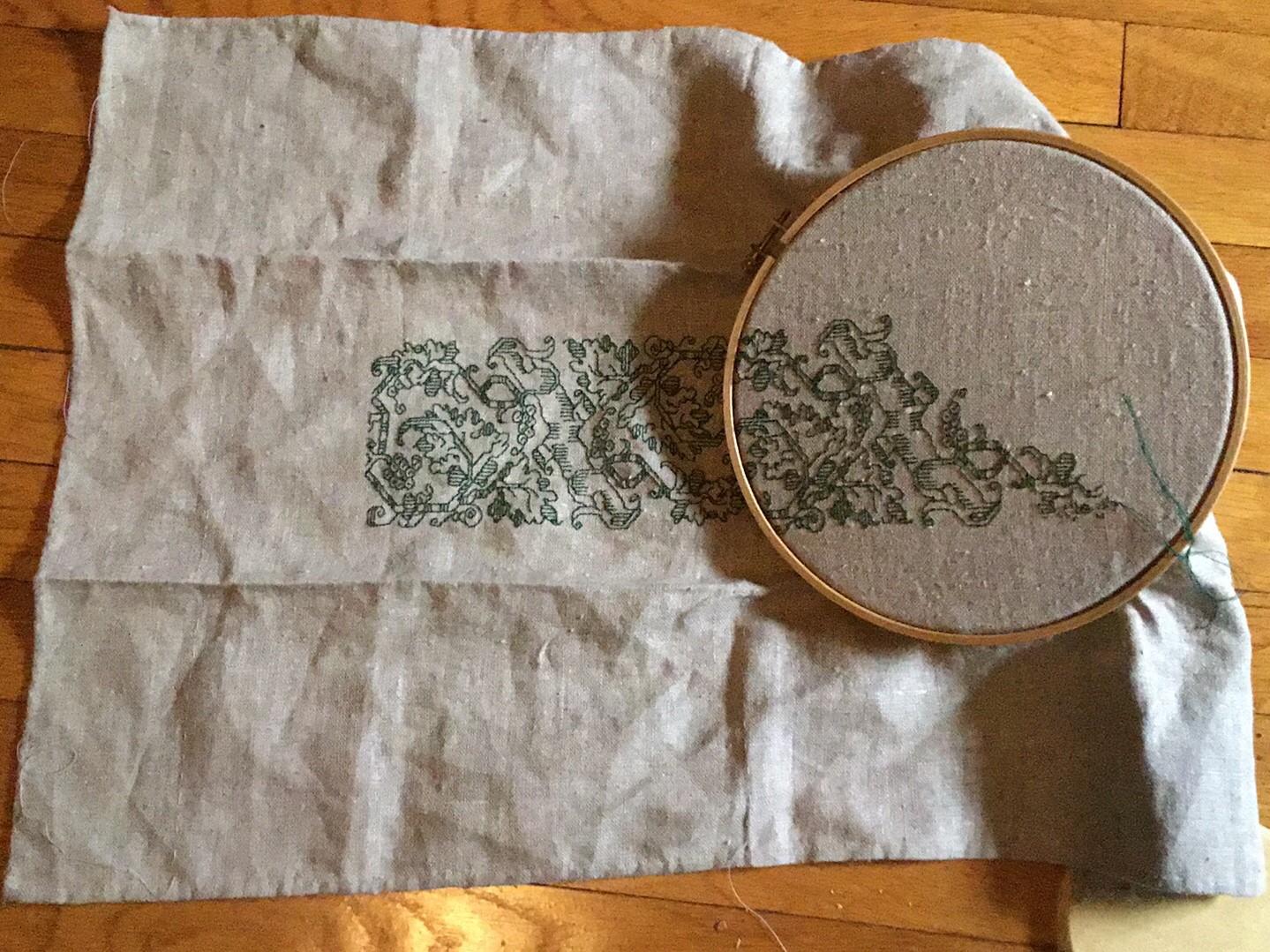
I’ve written about this design before. I think this time I’ll circle the center panel with other, narrower bands. Again, no set plan, I’ll just pick them as I go along, with no composition agenda in particular in mind. Eventually I’ll figure out what to stitch next.
UPDATE
It’s taken me a week or so to get this post up and out. In the mean time my doodle has grown, but still has no plan.
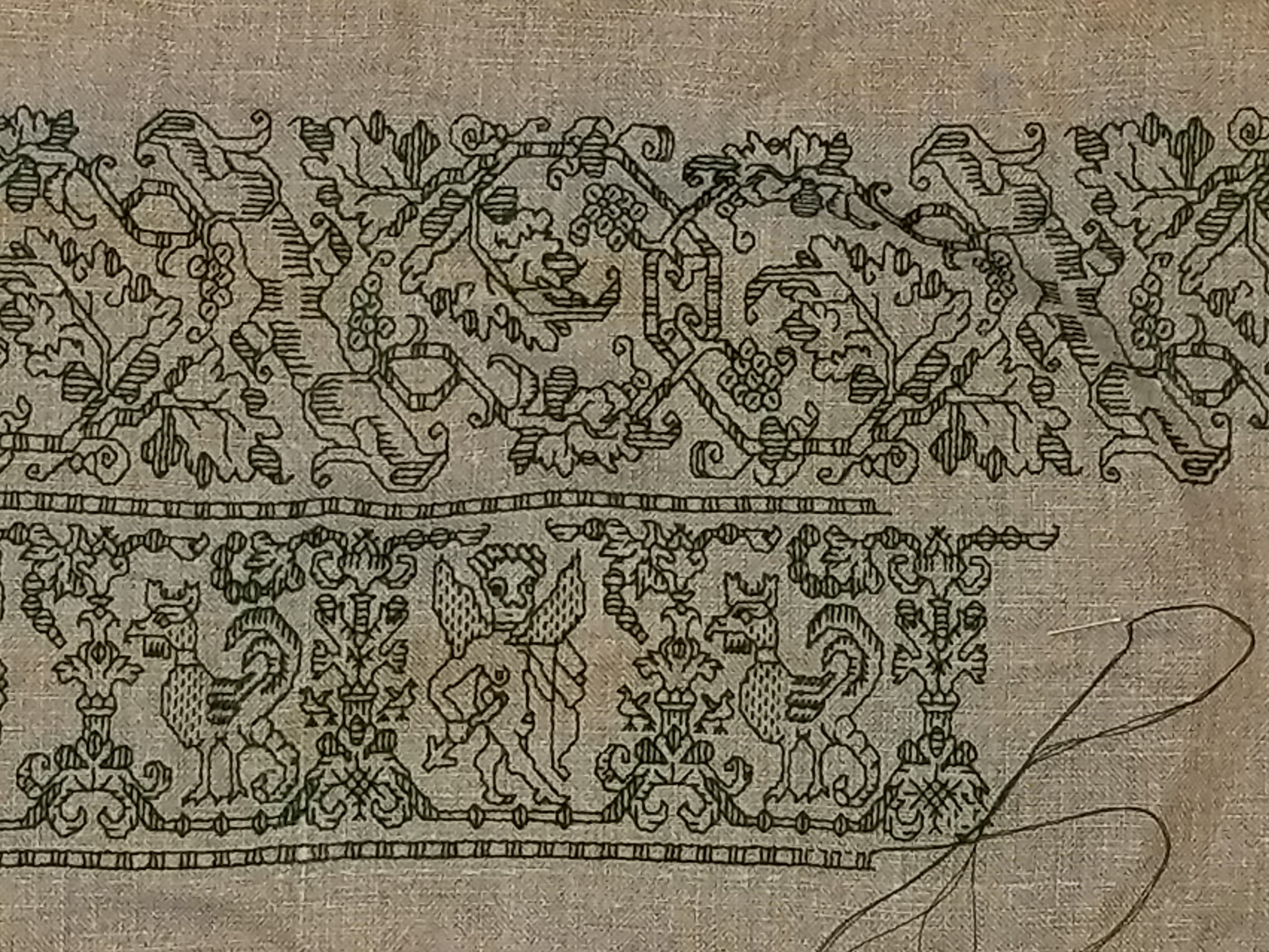
The lower design is a curious one. Although it’s a clear repeat with the rather bulbous naked cherub alternating with the cockatrice, there is little symmetrical inside the repeat. Close attention has to be paid to this one because even the internal framing mechanism (the bar and beads below the feet of each) has a different counts in each of its two instances, and the usual urn or leafy unit between the creatures also exists in two incarnations. It’s a curious one, for sure, but fun, and is keeping me on my toes.
Both of these designs will be in T2CM, which is moving again towards release. No date yet, but watch this space.
THE LEAFY FAMILY
I hope I’m not boring my readers (especially my knitting pals), but with just a little bit of encouragement, I’m off and running on more historical embroidery pattern families.
This one I’ve nicknamed “Oak Leaves.” It’s relatively well represented – not the design with the most extant examples, but I’ve managed to collect seven photos of artifacts displaying it, in various styles. No modelbook source (yet), and I particularly like when designs are interpreted in different ways.
As in many of these smaller fragments, museum provenances and dates are not necessarily precise. Some of these artifacts have not been revisited since they were originally donated to the hosting institutions. Putting these on a specific which-came-first timeline is problematic, especially doing so based on photos alone. However, there is a possibility here again of “separated at birth” pieces, where an original artifact was cut apart by a dealer and sold to multiple collectors.
I start with a piece given to the Cooper Hewitt by my idol, Marian Hague. She was an embroidery research expert and curator, who worked with several museums in the first half of the 20th century. Her work pairing extant pieces with modebook sources is legendary.
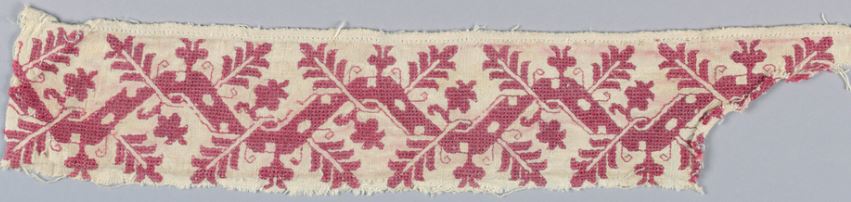
The Cooper-Hewitt citation for this piece dates it as 17th century, and of Italian origin. The museum’s accession number is 1971-50-97 and was acquired as a bequest from Ms. Hague. It displays the signature elements that make up the group – the center meander, with two heavily indented “oak” leaves sprouting left and right, overlapping the meander. A central smaller floral element in the center of each of the meander’s hump, and a secondary leafy sprout filling in the hollow of the design between the leaves. This particular piece also has voided spots along the length of the center meander.
Compare this piece from The Art Institute of Chicago:

They also attribute it as 17th century, Italian. The AIC accession number is 1907.742, acquired in 1907. Although the C-H example lacks the fringed edge, the executed design of both pieces is extremely close. C-H on left, AIC on right:


Ignore minor wear and tear. The count of the leaves, voiding of the stems, method of placing and working the spots, and placement of the tendrils is the same, although some of the tendrils on the AIC sample have fallen victim to time. Therefore I opine that these two pieces may have come from the same original. That Ms. Hague’s bit is a bit more savaged is not unusual. There are other instances where she had fragments of pieces in museum collections, but usually kept the more damaged bits for her own research.
Moving on here’s a fragment from the Metropolitan Museum of Art:
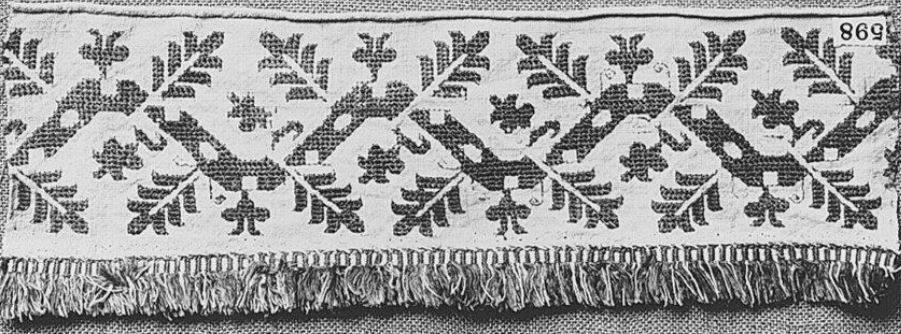
The Met places it as 16th-17th century, also Italian. Its accession number there is 09.50.3806, collected in 1909. This may or may not be part of the same original as the previous two, even though it is fringed like the AIC sample. For one – it’s mirror image. That in an of itself isn’t a big difference. Photos get reversed. Designs themselves are sometimes mirror-imaged if they appear on opposite sides of a larger artifact. Tendrils are missing, but this piece appears to have undergone more wear than the other two. There are enough partial remains of the double running (or back stitch) bits to posit their existence. But while the delicate linear stitching is more prone to damage the heavier interior stitching is more durable.
Look at the little interlace where the leaf-twig emerges from beneath the meander and crosses over it (AIC on left, Met on right):


The little “eye” of filling, which done in the solid filling stitch and should remain – is missing.
Might this be part of the same original, possibly a suite of hangings, covers/cloths or bed furnishings, but of a segment done by a less attentive stitcher? Possibly. But also possibly not, especially in light of the next example.
Here’s another one with an empty “eye.” This example was found by my Stealth Apprentice, and is in the Textiles Collection of the University for the Creative Arts in Farnam.
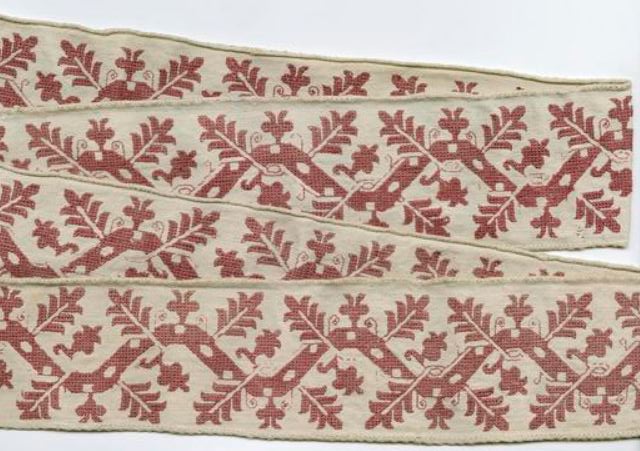
Unfortunately, the UCA gives no date or provenance for the work. Note how long this strip is, and that it’s folded – we see both sides. This might be double running and one of the double sided Italian cross stitch variants because regular long-armed cross stitch doesn’t look the same front and back. Tendrils? Check. Center meander with holes? Check. Oak leaves and supporting sprouts? Check. BUT those “eyes” – they are not worked, just as in the Met example.
OK, now we go on to other design adaptations. This voided piece from the Boston Museum of Fine Arts is undoubtedly an interpretation of the same design, but with a bit more elaboration on the stems – using twining instead of spots, and on the sprouts and leaves. It’s also doubled north/south – a very common method of taking a strip design and making it more dramatic by making it wider.

The MFA calls this piece out as being Italian, 16th-17th century, and names the technique used as “Punto di Milano.” (The MFA uses several stitch style names not commonly seen elsewhere, this is one.) The accession number is 83.236.
I am particularly intrigued by the unworked area at the upper right. The tightly overstitched pulled mesh technique used for the background is almost impossible to pick out, and even worn, leaves a very clear perturbation of the ground weave. I know this from sad experience. Even over the centuries, I have to say that the missing bit was just never worked. Which gives us an insight into working method – defining an area, then going back and filling it in.
Did this piece, in this style predate the more simplified depictions above? Again we can’t say for sure, but I tend to lean that way because the spots on the wide, plain meander to me look like the simplified descendants of the voids formed by twining stems in the MFA’s example. One person’s opinion – feel free to disagree.
Voiding. That was always done in long-armed cross stitch or the meshy stitch, right? Nope. Here’s another example of the same pattern, with an even more finely defined main twining meander, but done with a squared filling stitch. This one is also from the Metropolitan Museum of Art:

The Met lists this one as being Italian or Greek, from the 16th-17th century. It was acquired in 1909, and its accession number is 09.50.58.
This piece is my favorite of the set, both for the delicacy of the interlace and the squared ground. Obviously the tendrils are gone, as in the other voided interpretation, but it’s the same oak leaf design for sure. And did you catch the mistake? Upper right, where the meander is cut off from joining the previous repeat. That’s not wear and tear – that’s a place where stitching happened where it doesn’t appear in subsequent repeats.
And last, but not least, a pattern cousin. This one was also found by the Stealth Apprentice.
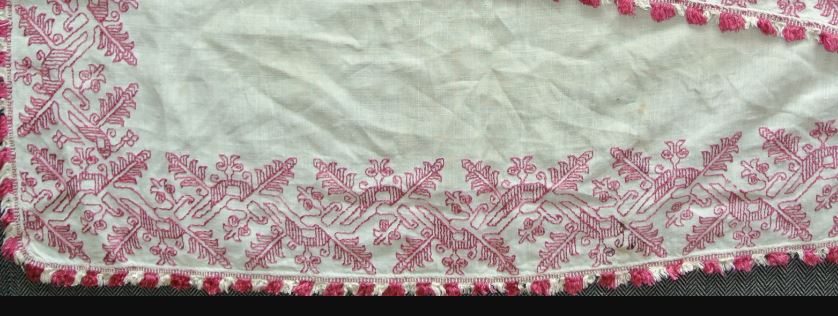
This is an Italian towel or napkin, claimed as 16th century, in the Marcus Jehn private collection. The only link I have for it is to the collector’s Pinterest board.
This is a curious piece. It’s clearly derived from the same pattern family, interpreted in a linear stitch. But the interlaces of the meander are rather heavy compared to the delicacy of the Met square-voided sample, above. The slightly fudged corner is also of interest. If I had to guess, I’d suspect that this piece was a see-me-and-copy, derived from something that looked more like the two voided examples.
So, what have we seen here? Mostly that there are design clusters that are clearly related. That there is no one canonical way in which to use these patterns – interpretations, some only a bit different, and others quite divergent, vary from artifact to artifact, even among those done in the same technique. And based on museum citations alone there’s no clear way to arrange them in parent-child relationships other than idle musing.
Most of all, I like that there is no one “right” way to stitch these designs, and that when I do my own variant, I’m adding to family that stretches back for hundreds of years.
UPDATE:
And another one of the same family surfaces! This one is the largest departure to date in terms of style, but it is clearly descended from the same pattern lineage.
Meet the Metropolitan Museum of Art’s holding #09.50.65 – entitled “Fragment,” dated to the 16th or 17th century, from Italy or Greece; added to the museum’s collection in 1909.

UPDATE UPDATE:
And another…
This one is from the Victoria and Albert Museum. It’s one piece of a composed group of borrders, displayed together. The entire group is attributed to 17th century Italy, and is cataloged together as museum number T.114-1930.
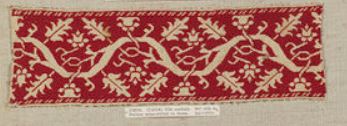
This one is sort of half-way between the versions with the heavy, abstract main trunk at the top of the page and the Met example with the squared ground. In this “missing link” you can see where the lozenge spots on the most abstract versions come from, while it still retains the coiled smaller branches of the most detailed example.
To complicate matters further, there is the fragment below, from the Met, accession 79.1.294, also sourced to 17th century Italy – Sicily in specific. Although the museum calls it a border, I don’t think it started out as one. The bottom edge is nice and neat, with a defined stitched edge, but the top piece is ragged – cut from a larger design. Now look at the V&A piece above and image it doubled, with two strips stacked one on top of another. (Doubling pattern strips this way was a very common method of achieving a deeper design.) In your thought experiment, now “cut” a section where the leaves are facing each other.

Hmmm….
Not only is this totally plausible as a strip cut off of a wider design based on our leafy friend, but the similarities to the Met’s strip are unmistakable. Again, we can prove nothing without artifact forensics on the ground and stitching thread, but I would not be surprised to find that these came from different stitched sections of the same original piece – possibly from a side strip and a wider decorated end of a towel or other cover.
 String-Or-Nothing