SEE YOU ON THE FLIP SIDE
That time has come. Tomorrow is the beginning of The Great Eviction, in which my invader and I will be separated. I am ready, packed, prepped, and armed with great ferocity and the single minded determination to overcome, outlast, and outwit my adversary and come back as unchanged as possible (except for the obligate scars, of course).
I’ve marked my level of optimism on my latest sampler. I haven’t mentioned progress in a while, but it quickly became my Emotional Support Embroidery after receiving my diagnosis last month. Not ironed, but as a WIP, it’s too early to think about doing that.

Yes, it’s still unfinished. I’ll do some more on it later today of course, but I won’t be done. That’s on purpose. I have every intention of future completion. And note the victory wreaths on the top as-yet-to-be-background-stitched strip. That strip is also deliberately placed skew to the centering of the rest of the sampler. My life has been tilted akilter, so this bit is, too.
I’d also like to everyone for the unexpected outpouring of support. I am overwhelmed by the vast number and generous sentiment of the comments here, on various social media platforms, and sent to me personally by direct message and email. I had no idea I had reached so many people around the globe. I am not a spiritual person, but I can say that if Providence can be petitioned, perhaps the wide ecumenical spread and volume of promised prayers in every major worldwide religion (and many of the less well known ones) will tilt the odds even more in my favor.
See you soon!
-Kim
CATCHING AN ASSIST
According to the posting date, it’s been about 10 days since I last reported in on progress on Assist. I’ve had a couple of mis-alignments due to low lighting and inattention. Some I’ve picked out, others I saved as cautionary lessons. And I’ve taken a slight departure from my usual working cadence.
Here’s the latest in-hoop view.

Obviously I’m working voiding on the row of snaky, vaguely draconic S-shaped flowers. But I’m only half-way done with that, yet I’ve gone on to start (although not finish) the row of smaller fills underneath.
Why the partials?
Because it’s very likely I’ll be attending Arisia over the weekend. It’s a big science fiction convention here in the Boston metro area. There will be discussions, panels, and lectures to attend. I like to keep my hands occupied at such things, so I can better follow along without distraction. Therefore to minimize lap clutter and make this project more portable I want to have enough started with established repeats, so I can work “off book/screen” for the balance of the weekend. That plus using the chatelaine means quick convenience – nothing can be dropped or left behind as we migrate from one panel room to the next.
As far as difficulty, the voiding requires no pattern reference once the foreground repeat is established. The partial fills each have enough detail that I don’t need to refer back to those patterns, either. I can just copy what I’ve already worked. Note that that second one is rather far along. In that case I DID get lost and decided to finish that square out here at home and not trust to luck on the go.
I’ll probably start on the foreground of the next voided strip, too. Either below the four-box fill row, or above the three-box fill row that sits on top of the motto (seen peeking out at top, from the folds underneath the frame). Which one I’ll do will depend on which design I pick next. I think one that’s as wide as or very slightly narrower than the Assist strip will sit nicely at the growing pile north of the motto. Something wider and more demonstrative for below. How wide and how demonstrative is going to be a function of the very narrow nature of the composition as a whole. I only have 102 units across to play with. Lots of my drama queen voided/double running strapwork strips have repeats significantly wider than that. We’ll see.
And a working hint. You can see that I’m not stitching up to the red double-running stitch boxes outlining my fills. I’m leaving a one-unit strip of unworked linen between the red outlines and the fills. Usually I “fig-leaf” any partial stitches when working fills in spaces buy doing them first, then stitching a heavy outline around the fill area to cover all sins. This time I opted for a lighter look. The hint is if you look at the on-deck set I’m currently stitching, and the two completed sets above (visible as partials in and above the hoop) you’ll see that I lay down the first pass of double-running, then work the fill, then go back and complete the double-running by stitching the second pass. I’m doing this because counting those little dashes is immensely easier to do than trying to navigate by counting the stitches in a completed line.
The uncorrected mistakes to date? There are four, and I hang my head in shame.
First, my original basted guidelines were off by three units. The natural vertical center of the piece is three units to the right of my first go at basting. That I didn’t catch until I had finished the voiding on Assist. Voiding is not something that should be picked out by the faint-hearted, especially in silk on somewhat fragile vintage linen. So I adjusted my alignments rather than picking out. When I frame or finish this up as a scroll there will be some compensation to keep the final field even all the way around.
Second, I’m off by an entire unit somewhere between the vertical center and right guide line, probably with two one-thread width displacements in an earlier slubby or worn/fuzzy bit on the vintage linen. There I didn’t catch that until the first row of fills and Assist were done. Oops.
Third, that interlace box. The interlaces are not centered, again they’re off. This error I blame on SWI – stitching while intoxicated. We had a lovely bottle of champagne that evening, to celebrate the close of the holiday season, consumption of the last of our leftovers and cookies, and (in passing) to toast our 43rd wedding anniversary. Obviously it went straight to my head. I left that one in to warn me against similar excesses in the future.

And last, the width of the rightmost box on the current fill line. All of the ones in this row are supposed to be squares of 24 stitches. Except that one. There was only room for him to be 23 units wide. Now four boxes of 24 units plus three separators of two units each equals 102. But there he is, one stitch unit narrow. So it goes. I’ll pick a nice scattered fill with a half-drop repeat and no one will notice. Plus an added benefit of the strident, visually distracting alternating strips is that they break cadence. I can correct the count after the next one is done, and the correction will be difficult to see because of the solid red mass separating it from the fills above.
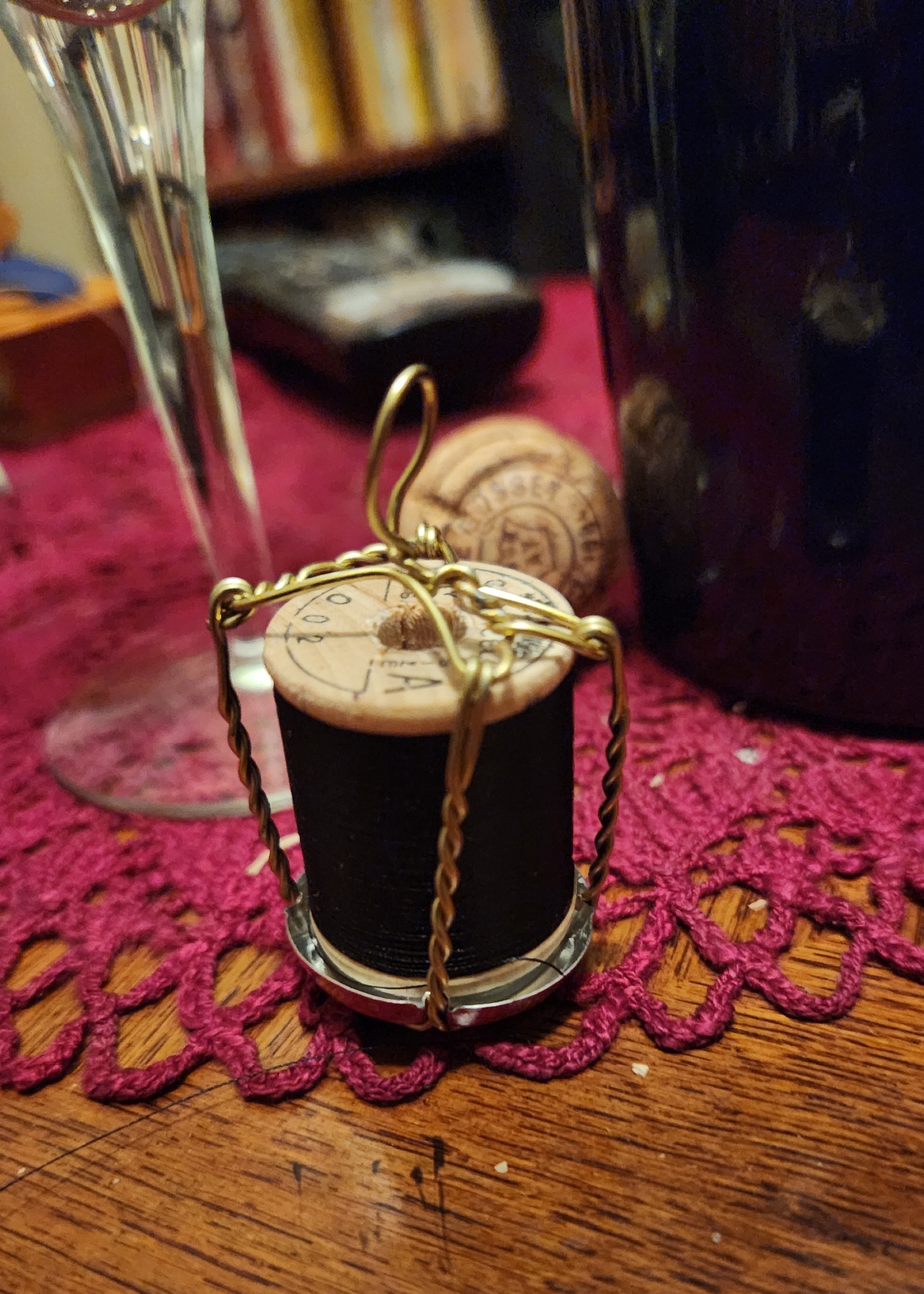
Oh. I did get a side benefit from the dissolute evening of sodden stitchery. I took the cork cage/bail from the bottle and twisted it into a spool holder for my chatelaine. I may go back and redo this with a silver tone one I had saved from last year’s bottle, but for now, it’s working well. The tiny spool of Corticelli Size A embroidery silk spins with little effort; just enough to make inadvertent unwinding unlikely, but easily enough to reel off what I need.
Will this piece be absolutely perfect? Nope. Far from it. And that doesn’t bother me because I have the next stitching project already in sight.
LONG-LOST TWINS, PART VII
Today’s my birthday, and needlework friend Barbara posted a snippet to my Facebook feed of a voided panel showing couples dancing. That bit of fun led to more digging on my part. I knew of similar panels in a couple of places, so I decided to do another of these posts that only a needlework geek could love.
First, here’s the one that was most prominent in my notes. It’s in the collection of the Rhode Island School of Design (RISD), accession 47.199. They attribute it as Italian, circa 1600, and cite both the ground and the stitching as being cotton. I have some doubts about the materials citation, but I’m not an expert and haven’t seen the piece up close and personal. I do note however that it would be one of the two easiest examples of this family to chart.

It’s hard to see, but the ground appears to be in that tightly pulled Meshy stitch I’ve written about before. I do not know if the foreground and outlines are done in double running or back stitch. There’s no other info on working method or object purpose. But I sort of suspect that this might have been part of household decor – possibly a bed valence or decorative cover sheet, remotely possible – a tablecloth, but for that I would expect to see a butted corner, and not the arbitrary unworked bit at the extreme right of the stitching. It is interesting to see the tease that confirms my working method – there’s a tiny bit of the foliage on the “room divider” at the right edge that was outlined, but the voiding wasn’t worked up and around that little bit of outline, leaving it orphaned and alone. More argument for this having been displayed with that selvedge bit tucked away and unseen, as I would expect for the upper hanging around a bed.
In any case, here are some relatives. First a piece from the Boston Museum of Fine Arts, accession 38.1104. They cite it as 16th century, and Italian, worked in red silk on linen. Looks like the Meshy background to me.

You can see that the design is very close, but isn’t spot on exact. There is a different treatment of detail in both the foliage divider and the castle tower divider. The border (if there was one) is also gone, but we can’t judge that in absentia. There are also lots more small bits and bobs surrounding the dancers and the little guy in the RISD sample. The male figure has traded his crowned turban-line hat for a lush head of hair. And the little guy looks to be better dressed. I’d be tempted to call him a page in this version and possibly a cupid or eros figure in the RISD piece, due to the bit of arrow fletching? sticking up over his shoulder. And although I haven’t counted the units, or investigated closely enough to see if the thread count of the two grounds are even, the MFA’s snippet does seem to be a bit compressed north-south, compared to the RISD one. But not uniformly so. The upper bodies appear to be less squished than their lower halves.
And the third – this one from the Cleveland Museum of Art, Accession 1929.840. They note their piece as being done in silk on linen. It’s pretty clear that this one is in Meshy, too.

Based on very strong similarity between this piece and the MFA holding, I suspect these might have been true siblings, pieces from the same original, cut apart and sold to two separate collectors, which then ended up in two different museum collections. In fact if you compare the right edge of the MFA piece, and the left edge of this one we can see a bifurcated page boy – it is pretty likely that we are looking at the exact snip line where they were separated. As an aside, I like the little unfinished bit underneath the lower left leaf of the foliage divider, at the left edge of the piece. Again, confirmation that outlines were laid down first, then the background was worked.
This one is in the Metropolitan Museum of Art in New York City, accession 47.40. They call it “Border” and cite it as being Italian, and 17th century, worked in silk on linen.

Their original photo is a bit fuzzy, but it’s pretty clear that this piece is possibly another section of the same original that furnished the RISD snippet. Not only are the borders and proportions intact, but the small details of crown/hat, arrow, interior detail on the dividing motifs, and even the dress border of the woman dancer is identical.
And to wrap up, I have one more snippet in my notes. This is also from the MET collection, accession 07.62.58. They cite it as Italian or Greek, 17th century, and note that it’s silk on linen. They rightly describe the meshy ground as drawnwork.

By now you should be familiar with the details of this design. Yes – it looks closer to the CMA and MFA snippets than it does to the RISD and the other MET holding. But there are some subtle differences. The ground line is most obvious. In the other two non-bordered bits of this variant, the stitchers have taken more pains to keep a stable bottom edge of the stitching. That’s not to say there aren’t deviations from that on both pieces, but on this one is is far more evident. There are also some other minor differences in detail on the dividers and on the dancers’ outfits. Now I suspect that it was not uncommon for a very large project like a set of bed hangings to be worked by multiple stitchers. Even if a master laid down the outlines and had a crew working “clean-up” behind, filling in background and detail, a large team working quickly might make these minor copyist errors. I don’t think that there is enough difference here to clearly claim that this has no chance of being a piece of the same original as the CMA and MFA fragments.
So to sum up, I do think that two original artifacts furnished all of these bits. And I would go further to posit that the unbordered one might have even been unfinished prior to its dismemberment. I thank the collectors of the “Indiana Jones” era for heading off on their Grand Tours, and bringing back these pieces. I thank the museums for hanging onto these rarely studied snippets, and for posting photos of them on line, so we can speculate about their origin. And I thank Barbara for flagging the dancers for my birthday.
I return you now to regularly scheduled, non-boring Internet content. 🙂
BLACKWORK/STRAPWORK RESOURCES HERE ON STRING
NOTE: UPDATED TO BE CURRENT THROUGH 15 JULY 2025
Blackwork embroidery seems to be having an Official Moment right now, with tons of new interest. I’ve got a lot of resources here that might be useful to folk beginning or continuing their journeys, but it’s not well indexed. So I post this round-up of on site resources in the hope of lending a hand. And to be able to point to the whole set if asked. Image at the end for the eye candy effect. List below has been updated since it was originally posted.
Technique and Tools
- Double Running Stitch Logic. One of many times I’ve tried to explain double running stitch and two-sided work. This post led to the tutorial series listed below.
- Assorted Blackwork Hints. Answers to questions about my working methods. Making mistakes; guidelines; where to start; simple tracing using “the poor person’s light box”; multicolor; equipment hints (frames, needles, wax); and a list of tricks for path planning in double running logic.
- Blackwork Thread Thickness and Grounds. One strand or two for double running? Why is it sometimes hard to keep your lines straight and even.
- Blackwork Heresy. Back stitch, double running, and the hybrid that floats between them, which I nicknamed “Heresy Stitch.” Useful but not something I’ve documented in historical works. Can be easier for people who get lost when working double running, and saves thread when compared to back stitch.
- What Makes a Blackwork Pattern Difficult? Cautions and mitigations for three challenges, that might help simplify those trouble spots.
- On Charting. How to look at a photo and then translate the design to paper.
- Determining the Thread Count of Small-Gauge Linens. How to use a penny (or other tiny thing with a known and stable diameter) plus a cell phone camera to figure out the count of a hard-to-see ground.
- Cornered Again. One way to handle placement of bands on a band sampler and a wrap around frame edging, with minimal advanced planning.
- Filling In. More questions from the mailbag, including some unusual names for stitch techniques that appear in museum annotations.
- Proofing. How I check alignment as I stitch, to make sure I’m not wandering off count.
- Turning a Strip Repeat into an All-over. This one also belongs under the free linear stitch patterns heading below. A couple of ways to make a single width strip into a double, and how I ended up turning it into a Green Man square.
- Travel Cover for a Flat Frame. How I made mine, and how you can make one, too.
- Hoops! Sizes, thicknesses, wrapping, and more.
- Working on skew counts (non-evenweave linens). An aside in the discussion of a past project, but lots of tech info here.
- Typography in embroidery design. Choose your typefaces carefully!
- The Buzz on Beeswax. Why I am such a fan of using it in blackwork.
Inspiration
- Elizabethan Blackwork Smock. Photos of the famous Victoria & Albert Museum smock (1575-1585), Accession T.113 through 118-1997, plus my redaction of some of the fills used on it.
- Blackwork Inspiration. Some sources for folk looking for project ideas for original pieces of contemporary blackwork
- Digression – Blackwork Embroidery. Lots of links to portraits and other artworks showing blackwork. Some of them might still work.
- More Inspiration from Historical Sources. Another link roundup of countwork appearing in paintings and portraits. Some of these links may still be live, too.
- Forehead cloths. The coif’s companion. Much easier to wear in modern context (see Bragging, below).
- Ironwork at the V&A. These pieces sing “outline potential” to me.
Voided Works
- Voided Grounds. A roundup of various treatments for voided work, where the background is overstitched but the foreground remains (mostly) unworked. This is the style that was reborn in the 1800s as Assisi work, and is also known as reserva stitching.
- Voided Pieces and Outlines. Do historical voided pieces always sport outlines? Were they done first? Were they always on the count?
- Voided Narrative Panels. A style cluster of voided works probably done by drawing the foreground designs freehand, then working the background up to those lines.
- Meshy! Working that hard-pulled mesh like voided style that totally encapsulates the ground fabric’s threads.
History, Speculation, Pattern Clusters, Printing Block Migrations and Other Musings
- The Twain do Meet. Introduction to Kasuthi Kashida. Blackwork’s Indian cousin
- Looking East Again. Double running stitch pieces from the Wardak Hazara people of Pakistan. Another example of a South Asian stitching tradition that may be one of blackwork’s lesser known Eastern cousins.
- A Missing Link? A curious family of Egyptian Islamic artifacts of the 10th to 15th centuries, that have no proven relationship to inhabited blackwork (the kind with hard outlines and geometric fills), yet presage its aesthetic.
- The Azemmour Cluster. A group of patterns that in the time I’ve been paying attention has had their commonality and point of origin increasingly recognized, moving them from late 19th century source annotations that identified them as Renaissance era products made everywhere from Greece to Spain, and placing them in Morocco.
- The Spider Flower. A design that is probably part of the Azemmour Cluster
- Revisiting the Stupid Cupids – Multiple versions of the cupid and oak leaf meander.
- A Pattern’s Pedigree. Random thoughts about a specific family of patterns that shows up both voided and unvoided.
- The Leafy Family. A wide leaf-bearing meander that shows up multiple times in artifact inventories.
- More Cousins. The Leafy Bricks group.
- Cornered! Possible working direction and four different corner treatments of a famous, oft photographed handkerchief in the V&A.
- Italian Leafy, Occasionally Multicolor. Another design family of large panels and edgings that have curiously similar design elements, and a direct association of one example with the Jewish community of Rome, hard dated to 1582/1583.
- Long Lost Twins, Part I. That ubiquitous urns and piping harpies design. (I revisited this one in Part V, below)
- Long Lost Twins, Part II. Oak branch, leaf and acorn design, executed in both monochrome and polychrome, multiple versions.
- Long Lost Twins, Part III. Another very common pattern with multiple iterations, in multiple museums, two instances of which may have been cut from one original piece.
- Long Lost Twins, Part IV. Multiple instances of a simple Y and wrap meander.
- Long Lost Twins, Part V. Lots more on that harpies/urns design; found in many museums, many iterations, and even multiple stitching modalities.
- Long Lost Twins, Part VI. Two instances of a column design, very probably once cut from the same artifact. Fragments of which are held in two museums
- Long Lost Siblings? Another case of a single source artifact probably cut in two, now held by two different museums.
- Long Lost Twins, Part VII. Resuming the series. This is a voided pattern showing dancers, several pieces possibly cut from two originals before dispersal to various collectors.
- When is More of the Same Not More of the Same? Examining differences among different editions of various modelbooks, trying to parse out whether they were reprinted from the same block, hand tinted, or recarved.
- Modelbook Blocks: Acorns and Chickens. A classic. Was the block simply traded and reprinted, or was there copying afoot?
- One Design’s migration. Another look into multiple printings of the same design, and differences/similarities among those iterations.
- Early Marketing? Or Not… Speculation set aside by actually looking at the when and where of a pattern published both with and without religious mottoes.
- Repeating On and On on Repeats. A summary of the types of rotations and mirrorings commonly seen in long strip patterns
- Ocular Proof? My argument that Othello’s strawberry speckled handkerchief used in the play to implicate Desdemona might have been conceived of by Shakespeare as a countwork piece.
- A Curious Applique Technique. Not embroidery, but often appearing in modelbooks alongside it. Take a strip of leather or cloth, cut it with precision into a pattern that duplicates itself on either side of the bisecting line. Twice the yardage and no waste. Wildly clever.
- The Symmetries of Linear Stitched Fills and Strips. The difference between designs with even and odd numbered stitch counts, and how they can be used to best advantage. Plus pitfalls of aligning them with each other, especially when using purpose-woven grounds like Aida.
- Griffins. A discussion of a very common griffin design, and how it moved through time and across geography.
- The Unstitched Coif Project Exhibit. My photos and links for all of the coifs produced.
- More on 16th and 17th century pieces associated with Italy’s Foa family. Recognizable design elements characterize this cluster.
- Even More on Azemmour. Additional observations on a cluster of embroideries from Morocco, common in museum and private holdings. Some of which were sold to early collectors as Renaissance fragments.
The Unstitched Coif Project
- Completed coif – discussion of my materials, sources, and method. Includes a writeup of the stitches used, and why.
- Completed coif – discussion of my finish and fills. Close ups of the completed project, plus a motif by motif round up.
- The Unstitched Coif exhibit. All of the coifs submitted for display in December 2023.
- All of the posts tagged with Unstitched Coif. For those who want to get up close and personal with each motif as it was created.
 My Unstitched Coif Project contribution, now available in high definition photography of both the front and back. It was collected by the Victoria & Albert Museum, and they have updated the piece’s permanent on-line accession page with those images.
Talks and Classes
The Stitches Speak
These are the slides from a round-up of historical counted styles I presented at a Society for Creative Anachronism needlework and textiles gathering in 2012. Mostly eye candy, and divided for ease of posting, not by subject area. However sources are listed.
- My post-event summary
- Part 1. The rest of these are my slide deck as presented. No script, just the images.
- Part 2.
- Part 3.
- Part 4.
- Part 5.
- Part 6.
Workshop Handout
This is the broadside I hand out when I teach workshops on double running stitch. It’s pretty much a self-paced tutorial, with the simplest designs at the upper left, and progressing in difficulty to the lower right. If you work these at your own speed as a band or jumble sampler, by the time you’ve done them all you can tackle just about any linear design. And although I do use this to teach double running stitch logic, no one will say you sinned if you decide to complete it in back stitch.
- Class handout. (Also available on the Embroidery Patterns tab).
Patterns
Free
Linear Units (Line Segments)
- Ensamplario Atlantio. Seconnd Edition. A collection of blackwork fills from my doodle notebooks, some my own, some from artifacts, but when I started this I didn’t intend to publish, so I didn’t keep track. Some of the larger ones work well as all-over designs, or for small projects like biscornus or holiday ornaments. All four previous segments of the original release stitched back together, along with some additional content.
- Ensamplario Atlantio Volume II. More fills, plus some strip designs and yokes. 90% original (exceptions are footnoted). In one file this time, as technology marched on since publication of the first.
- Ensamplario Atlantio Volume III. You guessed it. Even more fills, plus lots of strip and all-over patterns and even a couple of yokes. Same paradigm as the previous volumes, with the few redacted designs called out in footnotes. Anything indicated with a star is my own original work.
- My Embroidery Patterns tab. Most but not all of the designs below also appear there, plus more.
- Rose Chart. Outline for a heraldic style rose
- Ganesh Project. How to replicate my blackwork method Lord Ganesh, done as a present for a family friend in India.
- Crowdsourced simple diamond interlace, with small motif fills provided by String’s followers. Use some or all. (Also on the Embroidery Patterns tab).
- Dancing Pirate Octopodes. The design that led to the crowdsourced project. (Also on the Embroidery Patterns tab)
- Leopards. (Also on the Embroidery Patterns tab)
- The Epic Fandom Stitch-Along. 19 bands, 9 of which are quasi-traditional, 10 of which are wildly anachronistic, with spaceships, dinosaurs, pirates, references to Star Trek, Star Wars, and Dr. Who. Guidance for the whole project is included.
- The Epic Fandom Stitch-Along in ONE easy to download PDF. The whole thing, informational posts, instructions and all charts for the project above.
- Cat and Mouse. A large panel with Art Deco style cats, mice, and yarn balls. (Also on the Embroidery Patterns tab).
- Bands from a 16th century Camica. Hem, collar, seam bands, and striping. (Also on the Embroidery Patterns tab)
- Those Snails. They crawl all over my work. I share some.
- Jesters at the Fence. A snippet from TNCM (see below).
- Bead border. (Also available on the Embroidery Patterns tab)
- Ring of Rats. Another Art Deco style chart (also available on the Embroidery Patterns tab)
- Tessellated Cats. This design is included in the free book Ensamplario Atlantio Volume III, available on the My Books Tab.
- Elizabeth Hardwick’s Sleeves. Another redacted chart for a historical alll-over design. Redacted from a portrait. (An easy downloadable PDF is also on the Embroidery Patterns tab).
- PERSIST sampler – a chart for a slightly slimmed down version of my Persist piece. (An easy downloadable PDF is also on the Embroidery Patterns tab).
- A Holbein Collar. Collar on a man’s shirt, redacted from a portrait. (An easy downloadable PDF is also on the Embroidery Patterns tab).
- Hebrew Alphabet and commonly embroidered words. I mashed up a few sources to come up with this one, including a very early Apple II pixelated typeface. But the letter forms are tweaked enough to be mine. (An easy downloadable PDF is also on the Embroidery Patterns tab).
- Border or strip design. I used this one on my chatelaine ribbon. It’s also in Ensamplario Atlantio III. (An easy downloadable PDF is also on the Embroidery Patterns tab).
- A Spanish Gentleman’s Collar. An actual example of Spanish blackwork. Redacted from a portrait. (An easy downloadable PDF is also on the Embroidery Patterns tab).
- Another Portrait, Another Redaction. Sleeve detail for a woman’s chemise charted from a circa 1500 Italian portrait. This one with chickens. (An easy downloadable PDF is also on the Embroidery Patterns tab).
- Pattern from a Gentleman’s collar, circa 1560. Chart and discussion of graphing from a painting. (An easy downloadable PDF is also on the Embroidery Patterns tab).
- Correction to The New Carolingian Modelbook, Plate 73 – the really wide interlace. I finally got around to stitching this one up and discovered that two of the overlaps as charted in the book were wrong. So I issue an update. Given the better layout and composition of my more recently composed plates, this pattern is now presented on two pages, both as a wide border and as an even wider iteration that can be used as an all over and as an even wider border. This PDF also available on the Embroidery Patterns tab
Box Units (squares)
- Unicorn. Box unit (not linear) chart for a unicorn, courtesy of Elder Offspring.
- Castles and Caravels. Box unit design featuring a three-towered castle, and its relationship of that motif to some Spanish pieces.
- Knot More Knots! Simple interlaces in box units (Also on the Embroidery Patterns tab)
- Simple Geometric from 1546. This one is also box units, and works well for stitching, knitting, and crochet.
- Da Sera Bud Interlace. Another box unit pattern. (Also available on the Embroidery Patterns tab)
- Fun with Odonata. Another box unit design, this one for dragonflies. Note that they can be used for knitting, too. (Also on the Embroidery Patterns tab)
- Fun with Lagomorphs. A box unit design for a leaping rabbit. (Also on the Embroidery Patterns tab)
- A Simple Interlace. I lost the source annotation for this box unit design aeons ago.
Not Free
- The New Carolingian Modelbook: Counted Patterns from Before 1600. Also known as TNCM. Sadly out of print. It’s in queue for update as scholarship has advanced in the years since it came out. There are corrections aplenty! You might be able to find it on the used market, but at a wildly inflated price.
- The Second Carolingian Modelbook: A Collection of Charted Patterns for Needleworkers and Artisans. Also known as T2CM Link to Amazon page is on the indicated post.
Tutorials
These are also accessible via the Tutorials tab at the top of every page here. but below they are listed in the correct chronological order
Double Running Stitch Logic
- Double Running Stitch Logic 101 – Two Sided Work and Baseline Identification. Basic logic of why baselines matter if you want to work something either totally two sided, or using two-sided logic for thread economy
- Double Running Stitch Logic 102 – Working from the Baseline. How to follow one, step by step.
- Double Running Stitch Logic 103 – Accreted and Hybrid Approaches. Breaking down a large non-linear chart for easier stitches.
- Double Running Stitch Logic 104. A review comparing back stitch and double running, and how to determine if a design can be worked totally two-sided or not.
Charting Linear Designs using GIMP Drafting Software
I found commercial charting software treats linear charts as an afterthought, so with help, I invented my own graphing method which I have used for all of my books. This series is for folk who want to move on to designing and drawing their own charts, and doing so using the dot and bar method I invented. GIMP is freeware, and if you’ve ever used Photoshop or Illustrator, and are familiar with layer-based drawing logic, the learning on-ramp for this method will be familiar. Although this was prepared for an earlier version of GIMP, these instructions are still relevant, although the GIMP menu screens now look slightly different.
- Charting. A comparison of my dot-and-bar method with the traditional drawn-on-quadrille-graph-paper method.
- GIMP Charting Tutorial 101. The logic of a layer-based drafting tool.
- GIMP Charting Tutorial 102. Getting started, basics of working with GIMP.
- GIMP Charting Tutorial 103. Building the dot layer of your template.
- GIMP Charting Tutorial 104. Layer management and building the design and mask layers of your template
- GIMP Charting Tutorial 105. Drawing the design.
- GIMP Charting Tutorial 106. Additional tools including those for erasing, flipping, alignment, and rotation
- GIMP Charting Tutorial 107. Hints on printing
- GIMP Charting Tutorial 108. Preconstructed templates to save you time.
Just Bragging
- My big underskirt forepart. Why I stitched it
- Forehead cloths for modern wear. Kind of like a kerchief, works well and keeps the hair out of my eyes in seaside winds, adapted from the companion piece often seen with a matching coif.
- Trifles wall hanging. Made as a “mom nag” for my younger spawn, done using blackwork techniques and fills.
- Blackwork sampler done in 1983. Musings on why this piece is not entirely successful in terms of stitching density distribution.
- Two Fish. No astrological connection, just two koi circling on couched gold water. Indigo and deep green silk on 40 count linen
- Fangirl Sampler – A key phrase from the science fiction series by my Resident Male, in an off-world language. It translates to “Life’ll kill you”. I am after all his fangirl army of one. Alphabet from an old Sajou leaflet, but the rest is all my design. The dancing skeletons border is available on the Embroidery Patterns tab.
- Grape Sideboard Scarf. An artifact-based main field with a self-designed companion border.
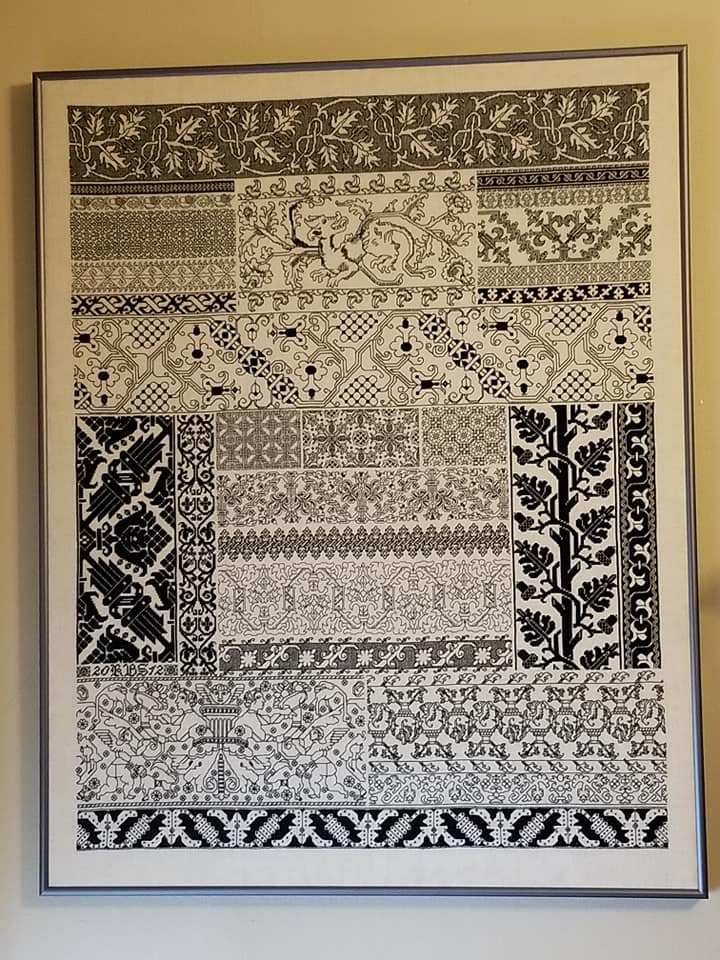
- Blackwork sampler done as the cover for T2CM, finished in 2012. Below.
AMENDS
Modern Assisi work vs. historical voided work. I know that the counted thread stitching community lumps them together, but they are not exactly the same thing. What I call “modern Assisi” is the 19th century revival of voided stitching, that draws heavily on Italian folk and church embroidery styles, which in turn trace their roots back to Renaissance era voided pieces. And that late 19th century revival was again echoed in the 20th century, with the collection and republication of many patterns, and issue of new books on the subject.
Yes, both Assisi and earlier styles include prominent outlines usually done in double running or back stitch. And both feature largely unstitched foregrounds (sometimes with additional ornamentation) that contrast strongly with a stitched background.
One of the key defining characteristics of modern Assisi is the use of cross stitch for the background. That’s “plain old cross stitch (POCS)” – not long-armed cross stitch. The Renaissance era voided styles use many different ground stitches and approaches, but so far after looking at hundreds of extant examples, I haven’t seen any in POCS.
Which is why I got very excited when I stumbled across this piece. Now before you get excited too, I did NOT find the unicorn of POCS in pre 1650-era voided work.

“End of a Tablecloth” 15th-16th century. Italian, Sicilian or Spanish. Metropolitan Museum of Art, Accession 08.48.132
I made the mistake of idly browsing on my phone with its tiny screen, and jumping the gun I posted about the piece before I got back to my laptop and high resolution monitor. Obviously, once I was able to zoom in I corrected my mistake, but I did look like an idiot.
So to atone for my egregious lack of judgement, I charted the design in question, and make the chart available as a broadside, for your own personal, non-commercial use. Please do not republish my redaction or include it in other pattern collections.
CLICK HERE TO DOWNLOAD A PDF BROADSIDE OF THE CHART.
Some notes on this piece.
My redaction is not true to any one repeat of the design. Instead I averaged all of them, evening out replication errors as best I could, to arrive at a single, uniform representation of the motifs. All design elements are there, in correct proportion and placement to each other, but there will be small deviations between the chart above and any one of the artifact’s pattern iterations.
The background is not worked in POCS. It was worked squared and unlike every other example of the squared filling on historical works I’ve seen, the stitches were pulled very tightly, bundling the ground cloth’s threads together. Meshy techniques for grounds were very popular in the 1600s and 1700s, but every other example I’ve seen has completely covered the bundled threads with stitching, making a very hard-wearing totally overstitched square mesh ground. In this case the ground cloth’s weave does show through.
The squared filling was worked up to but not touching the outlines of the foreground motifs. A one-unit “halo” was left around them. I’ve tried to represent that on my chart. There was considerable “fudging” in the way the filling was carried into the nooks and crannies of the foreground design. I’ve chosen the least acrobatic of them to include in the chart. Note that there are a couple of deviation points where a diagonal stitch was used to carry the ground thread up into a narrow area of the design.
Colors. Your guess is as good as mine. The outlines and the ground fill are clearly two different colors. If I had to guess, I would probably opt for black for the outlines and madder red for the fill. But other color combos do exist – not every historical piece was done in black and red.
The outlines – double running or back stitch? It’s impossible to tell from just looking at the front. I do note however that the spots on the leopards are all connected to the outline. There are none just floating in space, which makes the piece easier to execute in double running than a piece with discontinuous bits. The only minor challenge in this one if worked in double running would be that little hunting dog. It’s a small area not connected to any of the rest of the design.
And finally, the complementing edging. Note that the squared background is terminated with little “fingers” that slant up and to the right on the top of the strip, and down and to the left at the bottom. I tried to get the whole repeat on the chart, but I ran out of room. For absolute fidelity, work the bottom fingers exactly as tall as the ones on top. Don’t truncate as I was forced to do.
The moral of the story? Check, double check, and do so on the highest resolution display device you have to hand. Never let your excitement run away with you.
MESHY DONE, PLUS KITTING OUT THE FRAME
Yaay! A bit of self discipline imposed, and the forever voiding on the meshy lettuce pattern panel is complete. I have to admit that while I adore the look, I am not wildly fond of the hard-pulling needed to achieve it. I might try it again if I ever find a linen that’s the right combo of threads-per-inch plus nice soft and lofty constituent threads, instead of skinny hard-spun ones.

How does this strip fit into the growing project? After all – it has been about 8 years since we’ve seen the whole thing laid out. For the record, I’ve filled about 45% of the available real estate – there’s a lot more to go.

Now for the next. I don’t think I’ve play-tested these dolphins before (another design in the ever-forthcoming T2CM). The original showed them with a squared fill background in voided style, but I wanted something lighter to follow the dark band I just finished. I left off the voiding, but then decided that the bit looked rather spare. My dolphins needed something to play with, so I added the round elements, and am now pleased. A quickie, this bit took just Saturday and Sunday evenings:
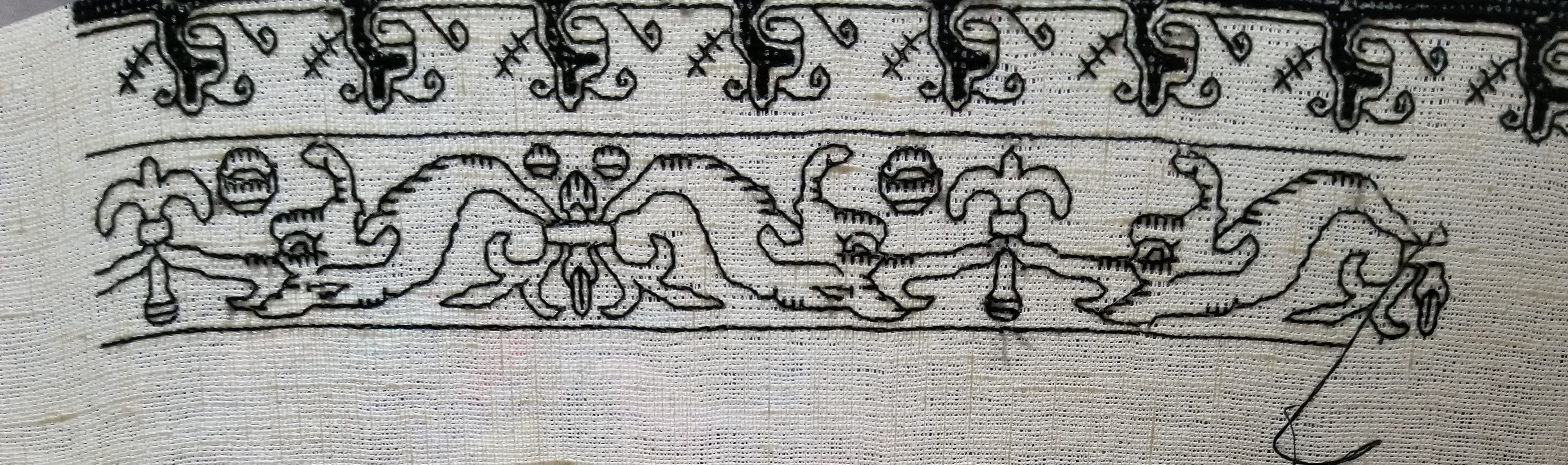
I will add the roundels to the dolphin at right of center, but I left it off so you can see the rather unfinished look it had without something there.
After this one? Probably another narrow strip, possibly a bit wider than this one, and possibly darker for contrast. Then after that I have a double running stunner queued, but it’s rather wide and needs a bit more spacer ground between it and the giant meshy lettuce panel.
In the mean time, as I get up close and personal with the frame I am making little improvements to my set-up. For example, the jaw of the Lowery is steel, and well loved by magnets. But it’s not exactly accessible with the large frame extender unit. BUT when I flip the thing over to terminate a thread, it is. Add a strong classic U-shaped magnet, and I’ve got a handy place to park my snips (the red magnet is just behind the red snipper).

My needle minder works quite well, and sometimes I use it to park my threader. It often does double-duty as a holder for my pattern page. But that can get in the way of the stitching area. So I glued a magnet to the flat side of one of my Millennium frame scroll bars – on the flat side (yes, I tested it to make sure the correct side was up – that’s the one that attracts rather than repels the other magnetic goodies I wanted to use):

I can use this as a rather plain needle minder all by itself, or I can park my fancy one there instead of in the hidden spot where you see it now. Or I can use another magnet with it to hold my pattern page. But best of all, I can use it in conjunction with this page holder I picked up years ago (it used to stick on my fridge door, to hold tickets, recipes, coupons, or whatever).

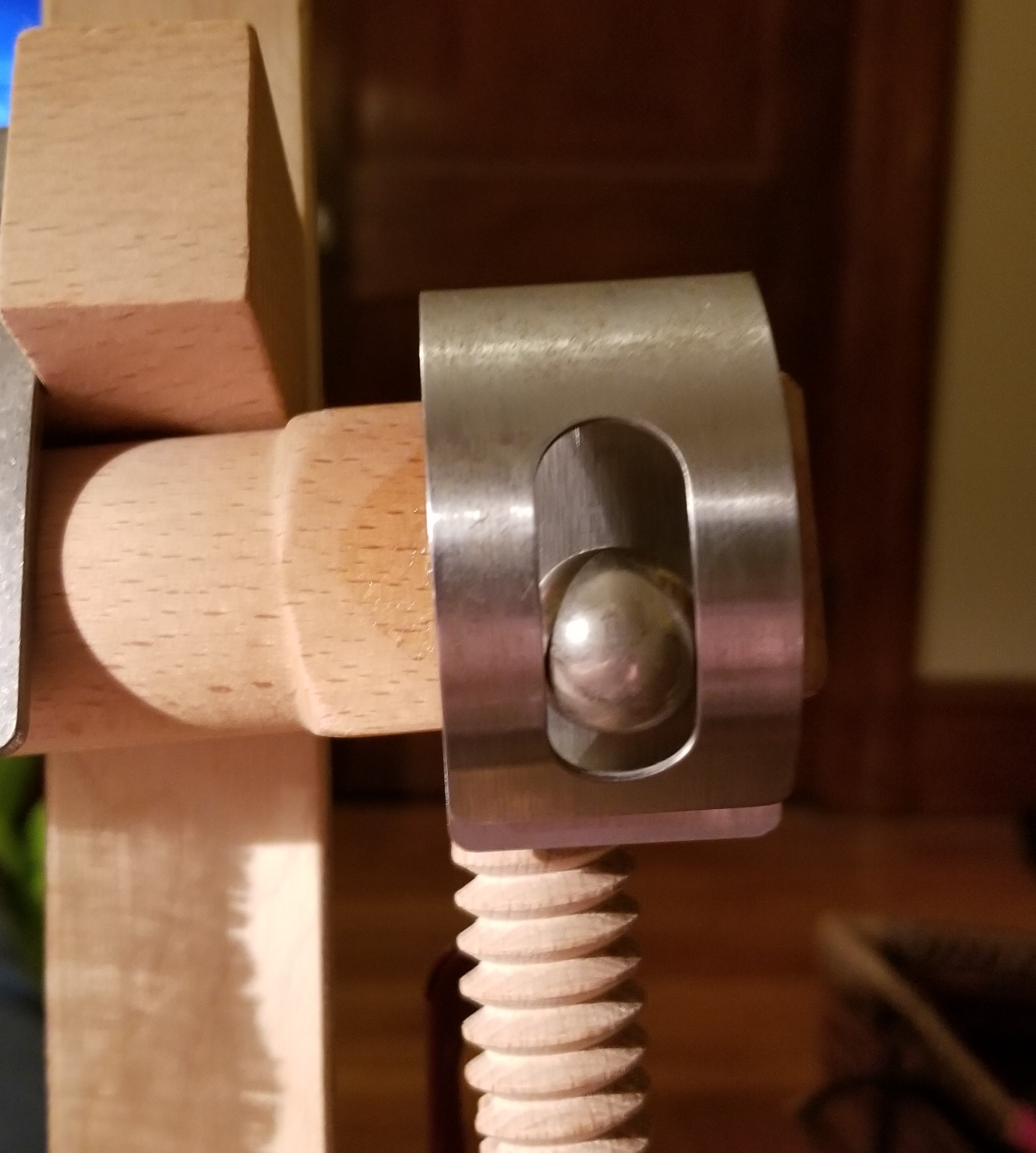
By just gluing on a magnet, I’ve left the door open for all sorts of other magnet-enabled organizers. There are other styles of clips. Hooks and loops with magnetic bases could accommodate scissors, for example. Finally, I’m still looking for it to test out, but because the rare-earth magnet I used is so strong, I’m betting it can hold my smaller flat metal magnet board. That would allow me to use placeholder magnets on my pattern page while the page is displayed right on my work area.
And where to find inexpensive strong-hold magnets? I recommend the geeky source, American Science & Surplus. They are a clearing house for engineering tidbits, science gear, weird surplus items, kids’ educational toys, and other miscellanea. They are especially good for containers, magnifiers, bags, precision scales and measurers, cutting implements, office supplies, and magnets. Like any surplus store, their inventory turns over quickly, so if you don’t see what you want there today, visit again next week.
CAT AND MOUSE
An odd confluence of happenstances and the resulting doodle.
Last week there was a discussion in one of the Facebook groups dedicated to 1500s costuming or blackwork that started with someone asking for a historical blackwork design that featured cats. There aren’t many examples, and the chat covered iconography, citing that cats weren’t the most auspicious of symbols at that time.
Then an unusual source came across my feed: a line-rendered group of cats, but not from the period in question. This plate flew across my Twitter feed. The source is Ernest Allen Batchelder’s Design in Theory and Practice, New York: Macmillan, 1910.

This appears on page 157. The book is a rather lively examination of design principles across history, and appears to be a transitional work, including the natural elements of the aesthetic/Art Nouveau style, but more solidly grounding the more angular principles that characterize the Art Deco/late Craftsman mood. For all I know it may be a seminal point in decorative design history, but I will leave that point to be hashed over by any readers who are schooled in design theory and lineages.
In any case, here were some linear cats just crying out to be graphed and stitched. So in response to a generalized (as opposed to Elizabethan-specific) demand for cats and to delight cat-loving friends and family, here is what the Batchelder sketch inspired:

This is rather large to be used as a fill pattern in inhabited blackwork (the subtype with outlines and fancy fills), but it is in scale for use as a large all-over design. I could see it being worked as is, in double running or back stitch, in monochrome or in multiple colors (those yarn balls cry out for variegated thread). It could be done voided, with the background filled in. The cats could be solidly stitched or left as is, or customized to match the markings of favorite pets (I provide a rudimentary tabby and tuxedo but any other markings might be fudged in). A frieze of this as the leftmost third of a placemat might be fun. I leave use up to you.
Like my other designs of late, this is “good-deed-ware.” If you like it and use it, I encourage you to look around and make a donation to a local cause that is helping people hit hard by plague-related economic challenges. “Starving artist” should be a metaphor, not a life description.
BOOKMAKING 106: QUESTIONS ON THE VOIDED DIAMOND GROUND
Yesterday’s post has inspired a few really good questions. Thanks for sending them in!
Are you working the diamond background in double running stitch?
Susan wants to know if the background diamonds are being worked totally double sided. I answer that while they certainly can be, in this case I am not bothering to do so.
No one will see the back of this piece once it’s in place on the target book. So I am working mostly, but not entirely in double running. Since I have jumped the gun somewhat and begun the background before all of my foreground motifs are complete, I have to be careful not to get ahead of myself and fill in too much – painting my yellow across the site of a future leaf. Therefore I am mostly working in double running, but reserving the right to pop over to “heresy stitch” to advance my working thread as needed, and to avoid painting myself into a corner, or covering up an area that would need to be picked out later.
There must be gaps where the diamonds don’t meet up with the leaves. Are you working half-stitches to fill in those bits?
Lisa, this is an excellent question, and really observant of you to pick up on the issue! Here’s a diagram illustrating what she was talking about.
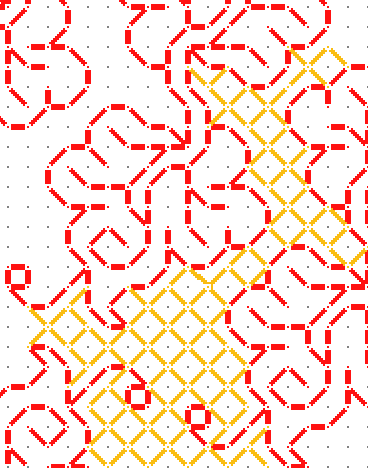
Note how in some spots, and especially around the tendrils and lobed leaf sections there is a half-stitch gap between the red outlines of my double leaf, and the yellow diamonds. Now I COULD go and work half stitches to continue the diamonds right up to the edge of the red, but in truth – it doesn’t matter. Because the yellow is so light compared to the red, and I’m working with a relatively heavy thread thickness for the count of the ground, the visual impact of those half-stitches is almost nil. So I cheat, and leave them out all together.
How do you get the diamonds to match up as you go around the leaves?
Another excellent question, Erin! The secret to doing this is NOT to start the diamonds in several spots. Begin it in one place, and grow it out from there, working around obstructions as they are encountered. It’s kind of like a fairy ring, (or if you are computer gaming fan – The Creep). By always extending the pattern area from an established bit of work out into new territory, I stay on target, and my diamonds always align.
Have more questions? Ask away!
VOIDED GROUNDS
OK. Here’s the post folks have asked for. Warning. It’s long.
I don’t claim this to be totally inclusive (I’m always stumbling across new-to-me things as I browse museum on-line photo collections), but it’s a start. Feel free to comment with additional examples.
There’s been lively discussion on what stitches and techniques were used for the backgrounds of voided works. I’m going to try to present as many examples as I can.
To start – voided pieces are a family of works that feature a more or less uniform background treatment that leaves the main design of the piece plain (or minimally worked. It results in a visual “reverse silhouette” look. There are many manifestations of this aesthetic over time. One widely known subset is Assisi work – a simplified but charming 19th century revival inspired by earlier Renaissance era embroideries. The revival used cross stitch (aka “plain old cross stitch” or POCS) ornamented by back or double running stitches. Earlier styles were more varied.
Meshy
One of the most common treatments was a tightly pulled four-sided stitch, worked to completely cover the threads of the woven ground. None of the ground threads were cut – they were just bundled together, making an extremely durable net-like texture. How do I know it’s durable? I’ve stitched some, made a mistake, and found it absolutely impossible to rip back or deconstruct (perhaps that’s why so many fragments of it exist, even after the towels, pillowcases and other linen they adorned have frayed to death).

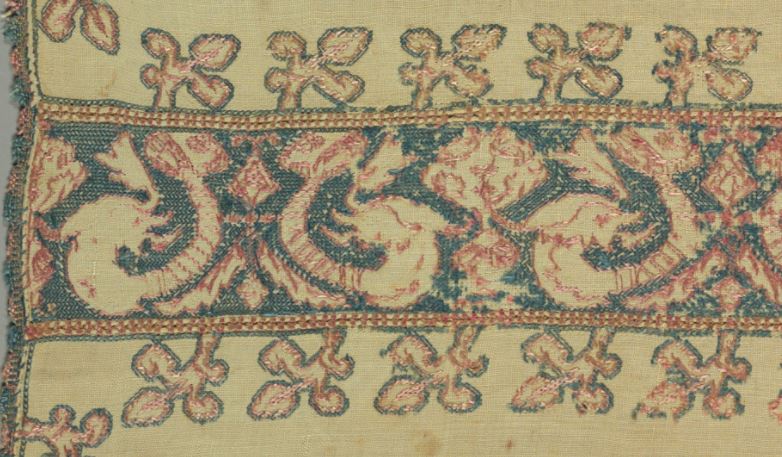
The border above is in the Art Institute of Chicago (accession 1896.112, and is attributed to Italy, in the early 1600s. I believe the outlines were established first, in either double running or back stitch, and then the background was filled in, working right up to and in some cases, encroaching on those outlines. Close examination of the photo where the outlines are broken shows no cut ground threads, just distortion. The “wing shapes” in the connecting meandering branches are very amusing to me. I know from experience that working in closed areas is challenging. it looks like the stitcher saved some time and effort by drawing a diagonal between the bud and the side sprig on the branch, and just not filling in between them.
Here’s another example, Italian, but undated, resident in the Harvard Art Museum collection (accession 1916.388). Also outlined with the meshy stitch worked up to the outlines. Note that companion edging though. I can’t tell for sure, but the branches that little leaves grow on at least may be cross stitches. Not sure about the leaves themselves. On this one it’s very clear that the ground cloth threads are bundled, not cut.

Here is a variant – a similar tightly stitched mesh, over a somewhat coarser linen ground, BUT in this case the stitcher did NOT establish an outline and then fill in the background. The piece is most definitely done on the count (not on a freehand outline), but the only stitching that established the motifs is the background mesh. This bit is also from the Cooper Hewitt (accession 1946-42-9a), dated 17th century, but has no posted place of origin. One other thing to note is a bit of directionality in the mesh. Mesh can be worked either on the diagonal or back and forth across succeeding rows. In this case the stitcher did the latter. But it’s NOT long armed cross stitch. It’s still the tightly overworked mesh.

This variant of meshy was done by someone who didn’t encroach on the established outlines. Instead this stitcher left a “halo” of unworked ground around the foreground motifs. There is no companion line on the outer edge of the halo area – the mesh stitch simply starts. I’ve mentioned this piece before in my series on long-lost siblings, and it’s in the Harvard Art Museum (accession 1916.377), but bears no date or location notes.

Here’s a piece that the holding institution claims was done by withdrawing threads, but the detail photo at left (a section where the red stitching has been lost) clearly shows the distortion of groups of 3×3 threads, with no snips or darns. I maintain that this is the pulled meshy stitch, too. Another Cooper-Hewitt sample (accession 1971-50-90), Italian from the 1500s. Love that needle lace edging detail, too!
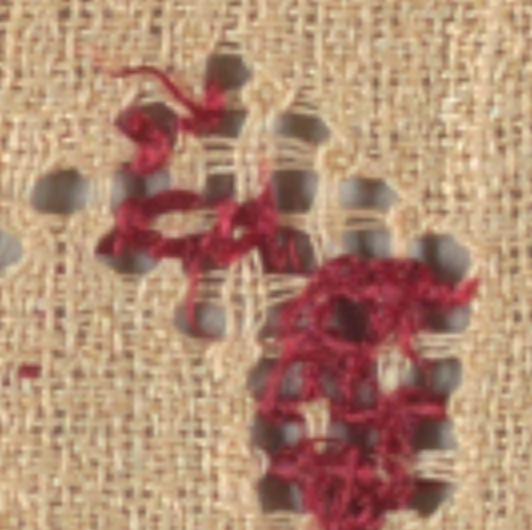

Cut and Withdrawn/Overstitched Mesh
What about withdrawn thread work, where threads are snipped or turned back and the edges secured, with the remaining scaffolding overstitched to make a meshy background? I’m pretty sure it exists, but I need to find a well documented and clearly photographed sample that explicitly shows the snipped rather than distorted threads of the ground fabric’s weave. Have a reference? Feel free to share it in the comments. If a good one shows up I’ll edit this and include a cut thread heading and photo here.
Long Armed Cross Stitch (LACS)
Another popular ground treatment was long-armed cross stitch. This produces a distinctive almost braided texture when worked back and forth across the piece. The piece below is in the Cooper-Hewitt (accession 1971-50-100 ), with a provenance of Spain, of the 16th-17th century. Again the main design is outlined with back or double running stitch, and the background is filled in later. Note that the stitcher kludged this a bit where the rows of LACS meet up with angles, and that POCS is used for edge ornamentation.

But again, working with an linear outline is not mandatory. Here’s a jaunty falconer on his mount. He is also worked in LACS, but without the double running or back stitch outline, in spite of the complexity of the design. And yes, there ARE some plain old cross stitch bits in there. Much of the surface detail in the otherwise unworked foreground areas are done in POCS. I’d even entertain an argument that outlining was also done in POCS, but is mostly disguised by encroachment of the background LACS. However, the bulk of the background is clearly LACS. You can find this piece in the Cooper-Hewitt (accession 1904-17-4), dated to the 17th century, no provenance. I do wonder about the dating though. The design seems a bit “modern-revival” to me, unless there was a nostalgia movement in the 1600s that presented folk in “antique dress.” Also that cross stitch for outlining thing is very, very rare. (I’ll wait for the experts on dating to chime in on this one.)

More long-armed cross stitch – but more tightly pulled. It’s not true meshy – the plaited like texture and 1×2 crossings are still evident. This time with outlines. In green. This Italian piece is from The Art Institute of Chicago (accession 1937.779), and is dated from 1500s/1600s or so.

Another one just for fun. Clearly LACS-like, and you can make out that 1×2 cross on the very uniform top legs. From the uniformity of those legs I think that this piece was not worked in stitch-by-stitch mode (the standard way of working LACS, but as an entire row, with the stitcher first laying down the “short legs” and then covering them by a second pass working just the “long legs” in the opposite direction. This supposition is borne out by the way the successive rows cross. Note that there has been absolutely no effort to keep the successive rows of LACS either alternating left to right as is done when it’s worked in the usual manner, or all aligning in the same direction. Instead the rows “bounce” when they encounter an obstruction, and do so in a way that’s congruent with the in-two-passes approach. Obviously this one has outlining done in a different color, and the ground done in a very atypical yellow. Sprightly, even with the massive loss of the now blue/green thread. It’s from the Cooper-Hewitt collection (accession 1971-50-77), and dated to the 1500s (no provenance.)
Boxed Fill
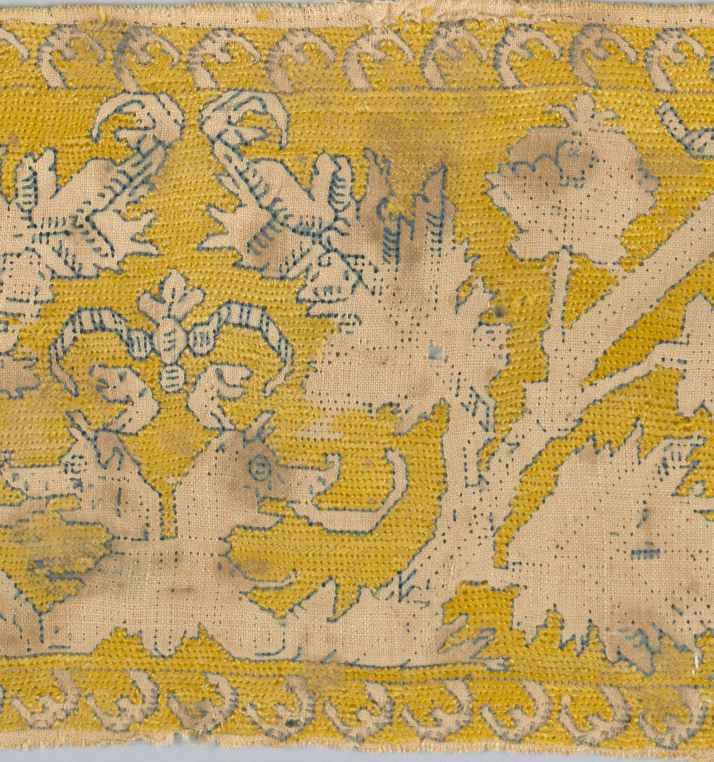
There are a few pieces that use an effective but simple fill. The final appearance is that of boxes. The samples I have seen have all been double-sided, and from the pattern produced by unevenly dyed or faded threads, I suspect most of them were worked in double running on the diagonal. No proof though without picking one out, and that would be heresy. This piece is from the Philadelphia Museum (accession 1894-30-116). It’s Italian, of the late 1500s. In addition to the boxed fill the foreground is ornamented with cutwork, which makes it a double-curiosity. On some of these the outlines of the motifs are also done in double running. In others, in back stitch (or possibly very neatly done outline/stem stitch), so that the reverse presents a heavier line defining them. Whether or not those who first used these considered the heavier outlined side the public side is something we may never know.

Here’s the most well known sample of the boxed substyle – the Metropolitan Museum of Art’s apron (accession 38.19.8) – Italian, 16th-17th century. This one doesn’t use outlines to define the motifs. The edges of the box ground units themselves define the edges of the foreground motif.

Here’s another example of the squared filling style (with outlines). This piece is from Musées Royaux d’Art et d’Histoire, in Brussels (accession T.1578), and is dated to the 1500s. It combines variants of two of my favorite designs, the “lettuce” pattern on the left, and another that shows up again and again on the right. Both of these designs turn up in other voided and un-voided presentations, with meshy or LACS as the ground treatment. Or none at all. Variants of these two will be in my ever forthcoming book.

Plain Old Cross Stitch (POCS)
Yup. You had to peek to see what I would say here. Sadly, although I’ve examined hundreds of samples of voided pieces, I have found none with a ground worked in plain cross stitch until the mid/late 19th century revival of that style. That doesn’t mean there aren’t any – just that I haven’t stumbled across them yet. Got one? Feel free to send the reference to me. I’d love to find one and add it to the greater family.
But here’s a prime example of the most complex end of the revived style. These two designs have clear Renaissance era precursors (well, close at least – maybe not exact pedigrees), but are rendered using POCS, with and without linear outlines. This is from The Antique Pattern Library’s copy of Album des Broideries au Point de Croix, compiled by Therese de Dillmont, probably an edition of the 1880s,

Other Modern Treatments
I can cite no historical precedent for these treatments – I admit, I was just riffing on the squared box theme. But they do work and are interesting. These are my own: diagonals, diamonds, and steps. I like the mirroring on the diagonals in the top sample, the second one has all of the diagonals going in the same direction for the entire strip. All of these are worked on designs for which I have citations, and that have or will appear in my books.



UPDATE – Diagonal Cross Hatch
No research is ever “forever.” New things are imaged or otherwise rise to attention. Therefore there is little point ever saying “they never did it that way.” But one can always say “I haven’t seen that yet.”
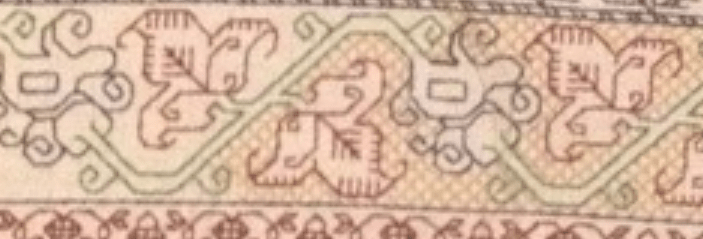
Well now I have. For at least one of my modern interpretations. Note that third item under “Other Modern Treatments” above – the leafy meander with the yellow diagonal cross-hatch. Well, lo and behold; here’s a historical example.

This is a fragment in the collection of the Smithsonian Institution, Accession 1971-50-108. It’s dated 15th or 16th century and attributed as German. It’s pretty clear that these are whole stitches, worked within a double running stitch or backstitched outline – exactly as I worked mine, with whole diagonals that intersect, not “checkerboard spaced” plain old cross stitches whose crossed centers make up every other intersection.

Now I do think the museum dating is a bit off, it’s probably 16th or 17th century, but there’s no doubt about it. We have solid artifact basis for diagonal cross hatch.
And who knows what will turn up next….
UPDATE – Zig-Zag Ground
Yet another stumble-upon. This one from a rather “loving hands at home” look piece in the collection of the Cooper-Hewitt Museum, Accession 1949-64-15. This one is dated 16th-17th century, and is attributed as being Italian. The ground is done in nested zig-zags. Half way there, but still not plain old cross stitch.

VOIDED NARRATIVE PANELS
Voided work is a catch-all term for a family of embroideries where the background is covered by stitching, and voids in that solid stitching make up the motifs (the foreground). Sometimes the foreground is further ornamented by additional stitching, sometimes not. There are many different styles of this work, lots of posited points of origin/provenance, and just as many design or pattern groupings that have come and gone in and out of style over the centuries that voided work has been done. While modern Assisi (simplified motifs done with cross-stitch backgrounds) is the form of voided work most widely known today, it’s not the only type, and there is a lot to explore in the allied family of voided styles.
Here’s one subgroup – Story Panels. This is a family of works that I’ve run across as I’ve researched counted voided styles, that hangs together as a subset based on a number of commonalities.
First, the examples:
l. From the Cooper-Hewitt collection, Band. Italy, 16th–18th century; silk on linen; H x W: 24.1 x 172.1 cm (9 1/2 x 67 3/4 in.); Gift of Richard C. Greenleaf; 1954-167-5. These four panels show elements of the Adam and Eve story, and the workaday life after Eden . It’s done in red silk on linen, with a densely overworked meshy background. I don’t necessarily agree that it’s long armed cross stitch – that has a different look of directionality. This has more of a meshy appearance. Foregrounds are outlined (back stitch according to the listing), and ornamented by knot stitches.

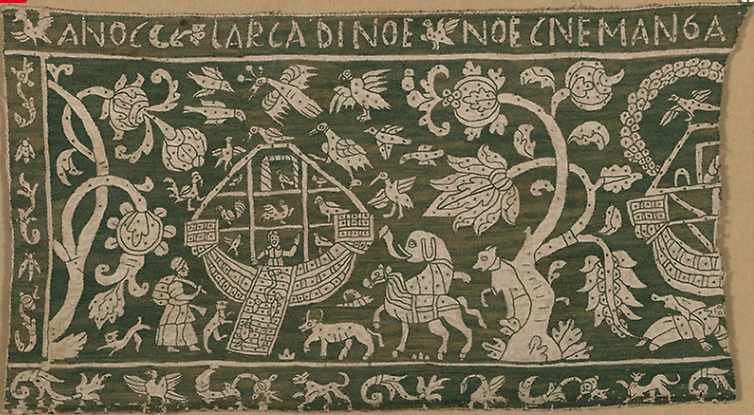
2. From the Art Institute of Chicago, Fragment (from a border), Italy, 1575-1625, silk on linen. 22.8 x 41.4 cm (9 x 16 3/8 in.); Art Institute of Chicago Purchase Fund; 1907.827 Part of the story of Noah. Outlined foreground elements with spot decoration, ground in long armed cross stitch aka LACS (that back and forth almost plaited looking directonality is evident.)
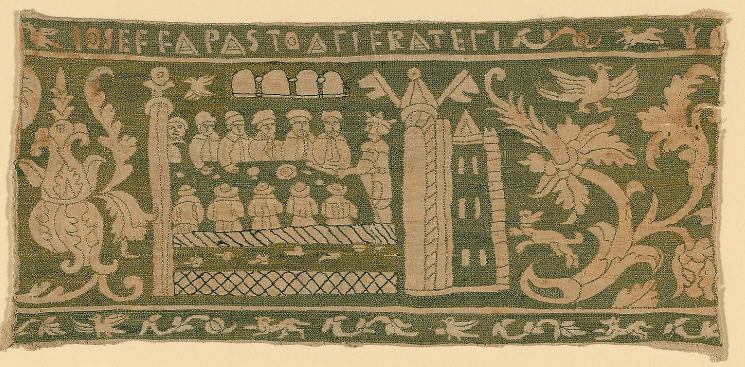
3. Another from the Art Institute of Chicago. Fragment (from a border) Italy, 1575-1625, silk on linen, 19 x 40.6 cm (7 1/2 x 16 in.); Art Institute of Chicago Purchase Fund; 1907.826. Joseph and his brothers. This may or may not be part of the same original (or series of originals) as #2, above. Similar color, and LACS technique, but the heights are different, and the motifs are simpler in this one – less ornamented, less detailed.
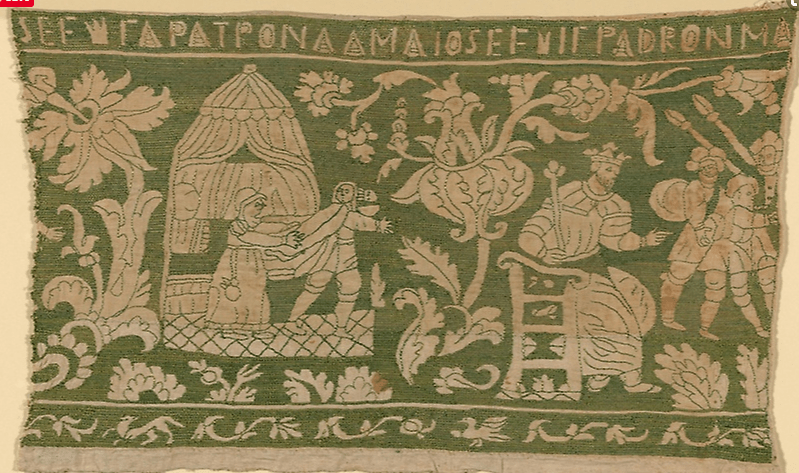
4. And also from The Art Institute of Chicago, Fragment (from a border), Italy, 1575-1625, Linen with silk. 276 x 44.2 cm (10 7/8 x 17 3/8 in.), Art Institute of Chicago Purchase Fund; 1907.825. To my eye based on these photos, it looks like this panel (Joseph and Potiphar’s wife?) is done the same way as #4, above.
5. From the Cleveland Art Museum, Embroidered Border: The Baking of Unleavened Bread, Italy 16th-17th century. Silk on linen. 18.1×45.4cm (7 1/8 x 17 7/8 in.) Gift of the Textile Arts Club; 1939.354. From Probably LACS (no prominent holes like the meshy style). Foreground lightly outlined with what looks to be a thinner thread, foreground details in back or double running. No knot stitches. I’ve discussed the group of four panels from which this comes once before.
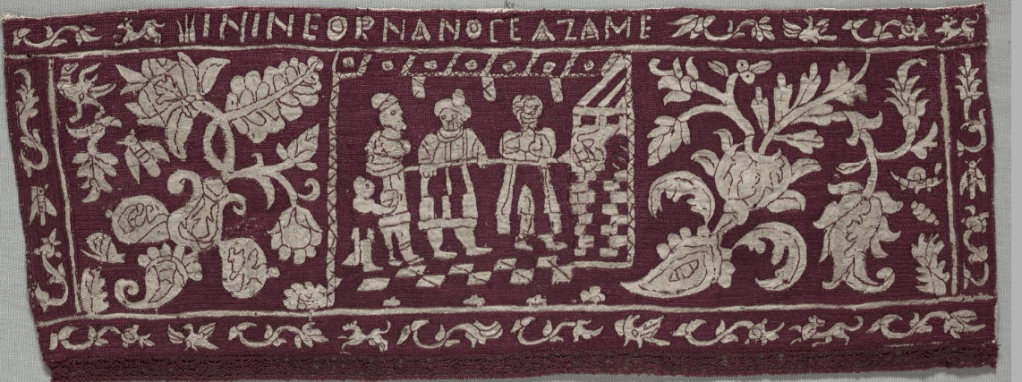
6. From the Metropolitan Museum of Art, Strip, Italy, 16th century, silk on linen, 9 1/8 x 25 in (23.2 x 63.5cm), Gift of Mrs. Harry Ge Friedman; 48.57. I’m guessing from the inscription that this is part of the Joseph in Egypt narrative, where he has dealings with his half-brother Simon. Again, probably long armed cross stitch, with either double running or back stitch outlines of the voids.
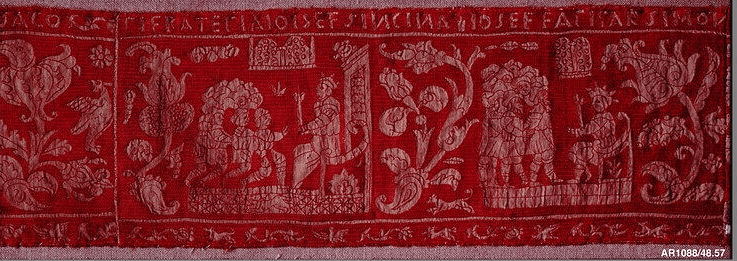
7. Also from the Metropolitan Museum of Art, Panel with Noah’s Ark. Italy, late 16th/early 17th century. Silk on linen. 14 1/4 x 39 1/4 in. (36.2 x 99.7 cm) with lace. Robert Lehman Collection, 1975.11784. Another Noah’s Ark. Note that the base drawing of the ark section is very, very close to the green one, although the follow on panel is different.
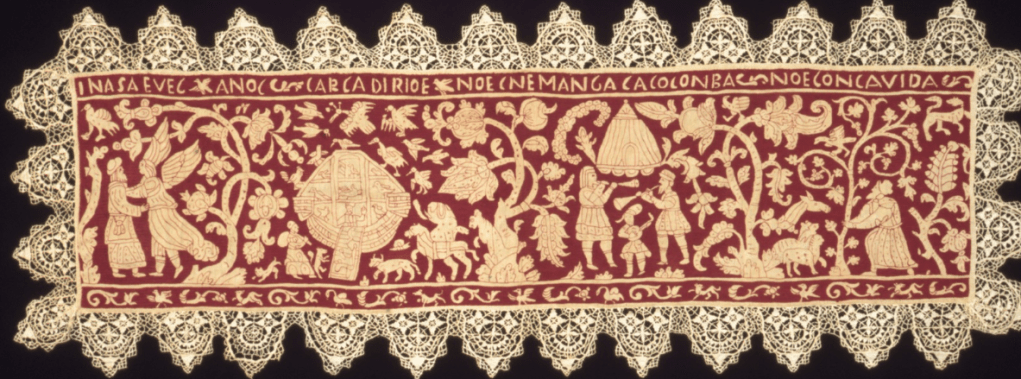
8. Still more. From the Cooper-Hewitt, Band, Italy, Late 16th, early 17th century, linen, silk; H x W: 150 x 19 cm (59 1/16 x 7 1/2 in.); 1950-29-8. The center panel is probably David avoiding Saul’s spear, but the rest of the iconography is hazy and there’s no top line inscription to help. Very clearly long armed cross stitch, possibly double running on the outlines (there are also a few later repairs done using another color, to reunite the stitched ground with the open foreground but that doesn’t count).
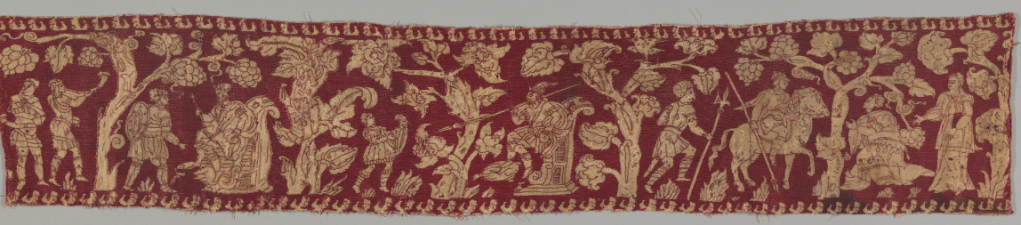
9. From the Cooper Hewitt, Band, Italy. Late 16th, early 17th century. silk embroidery on linen foundation; H x W: 23.5 x 60.6 cm (9 1/4 x 23 7/8 in.); Bequest of Richard Cranch Greenleaf in memory of his mother, Adeline Emma Greenleaf; 1962-52-1. This one doesn’t have lettering at the top, but it’s clearly the story of Isaac. LACS, outlined foreground, some ornamentation of foreground with straight stitches (possibly double running or back stitch).
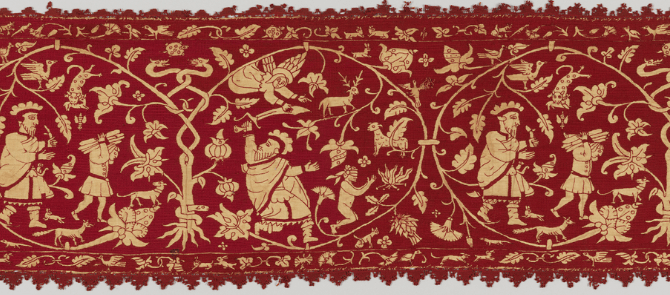
10. And finally, from the Yale University Art Gallery, Unknown Fragment, Italy, 17th century. Linen ground with red silk, 19.1 x 43.2 cm (7.5 x 17 inches), Gift of Howard L. Goodhart; 1928.151. Very had to tell from the photo but it’s probably LACS, with double running or back stitch for the lines. This bit is probably Jonah and the whale, and is clearly part of a multi-panel piece (or once was).

Now, I am sure there are lots more of these out there, that I haven’t included here. And there are narrative panels done in other stitched styles, but these do seem to hang together, more or less.
First, unlike most (but not all) other voided work examples, they display no symmetry. There are no reflection or bounce points; the designs are not aligned in balance around center urns, trees, or other elements. Each one of these panels stands alone, without a clear repeat inside its sequence.
Second, most (but not all of them) rely on similar framing techniques – a narrative with a very similar looking style of letter representation on top, and the curious mix of birds, dogs, and leaf/branch/flower elements below (which does repeat).
Third, none of these were done on the count. By that I mean that the foreground elements were not carefully copied from a graphed source. They incorporate strange angles and curves, and the ground stitching behind them – which was done on the count – looks to have been “mashed in” around the designs where they present those odd curves and angles.
I posit that these were hand drawn onto the cloth, overstitched using double running or back stitch (or possibly even SINGLE running in some cases); the foreground ornament was done, and then the backgrounds were stitched, in neat lines going back and forth across the cloth. BUT it’s pretty clear that some sort of common cartoon (in the tapestry sense) was used for the two Noah’s Ark panels – #2 and #7. Same ship, same placement of birds, bit players and leaves around it, but with just enough difference of detail and odd angles to look like tracings from the same original, not copies of the same chart.
Fourth, for #1-8 above, there are clear divisions into panels, with strangely familiar fat-fruited, full-leaved vegetation or ruled dividers separating the scenes.
Fifth, all appear to be Old Testament scenes. Given the time and place, it’s kind of strange that no large scale New Testament scenes are included. Now those may exist elsewhere, I don’t claim to have gathered a definitive collection of these fragments, but one would think that there would be a Last Supper, Passion or stray Saint among the lot. The closest we get is the Agnus Dei (lamb with cross standard) in the Jonah panel – #10, and even that is background – not the “featured scene.” It’s also worth noting that even with the popularity of Greek/Roman myth images at the time (just look at emblem books and early pattern books) – we’ve got no Aphrodites, Sieges of Troy, or other mythic representations.
Now, what conclusions can we draw from all this? Sadly very few without further research.
Who made these and why? I am tempted to say there was a small number of professional ateliers producing these in late 16th century Italy, due to the strong similarities of style, and the fact that these examples are relatively few among the large number of other voided work fragments we have today. Given the elaborate nature of the non-repeats and the scale of these sequential multi-panel narratives, I somehow doubt that these were loving-hands-at-home works created for household use.
Many of those other bits are probably domestic works – with designs that are symmetrical, with clear easy to replicate repeats. While it’s certainly possible that these panels were bed or other secular hangings, but I think it is more likely they were made for liturgical/didactic use.
And #9 and #10 – the odd outliers? I think they were clearly influenced by the group as a whole, but given the difference in their visual styles and details, I would not be surprised to find out they were done a bit later – or possibly even by competing contemporary workshops – in emulation of the established style.
Have you found other examples of these stitched comic books (biblical or not)? Share!
UPDATE
Readers have most graciously pointed out additional examples! Thank you – keep them coming
11. Holly found this in The Jewish Museum in New York, Embroidered Panel: The Story of David and Bathsheba. Greece, 19th century. Silk on linen. 10.5 x 29 inches (26.7 x 73.7cm). From the H. Ephriam and Mordecai Benguiat Family Collection, Accession S 202. The date and provenance are different from the rest, but it does appear to have some stylistic commonality with #8, above.

12. Melinda Sherbring alerts us to a holding in the Los Angeles Museum of Art, Embroidered Textile Panel Depicting Scenes from Genesis. Iberian Peninsula (Spain or Portugal), late 16th century. Linen plain weave with silk embroidery. (a): 9 7/8 × 64 1/4 in. (25.08 × 163.2 cm); (b): 35 3/4 × 9 5/8 in. (90.81 × 24.45 cm) Costume Council Fund (M.87.230a-b) . Sadly, there is no shared image available there, but from her detailed descriptions, it’s another version of the Adam and Eve panel (second panel in #1, above), and the Ark panel (#2 and 7 above), done in long armed cross stitch, in red silk. The foreground ornament of both is a bit simplified compared to the other versions posted here.
Melinda and her co-conspirator in textile history high-jinks, Robin Berry, had the opportunity to examine the piece up close. They have given me permission to share their notes on technique:
- Fabric thread count approximately 96 tpi.
- Embroidery floss is filament silk, finer than a single strand of Eterna; possibly Kreinik size 0.
- Motif colors: background color card 19-12 and 19-11 for Genesis, approximately DMC 3687.
- Technique: long armed cross stitch background with backstitch for details and outlines. Looks like the same thread was used for background and for details. Stitches over 3 threads, approximately 18 stitches per inch.
- There are holes along the edges clearly where fabric was nailed or tacked to a support.
Robin additionally points out that voided works with Iberian origins are properly termed “Reserve.”
Melinda agrees with me that the base layout of these pieces were probably traced or drawn rather than established by count. Having three examples of such a work is quite special.
UPDATE – NOVEMBER 2022
13. I’ve found another Old Testament scene stitched in a very similar style. This one is Adam and Eve, from the collection of the Boston Museum of Fine Arts, Accession #83.241. The museum places it as mid-17th century.

It’s most similar to items 1-7 above, with the foreground enhanced by little scattered stitches, the inscription running across the top, and the alternating floral/critter band below.
UPDATE – JANUARY 2024
And another one turns up.

This one is in the collection of the National Museum of Scotland, Accession A.1989.202. It’s attributed as Portuguese, from 1620. The inscription reads “Toreo das Damas Adonas” possibly, bullfight of the Adonas ladies (or so Google Translate tells me). I can’t parse out if there is a biblical reference here, but the drawing style is reminiscent of the others in this group. The ground however is done in meshy – tightly overstitched four-sided stitch, totally covering the threads of the weave. Close examination shows that the ground threads were not cut, just bundled. And that the thread used to outline and work the interior detail of the design are now a different shade of green than the meshy ground. One can even spot that the ground covers or is stitched into those outline threads in places. There are also remnants of red ink behind some of the double running (or back stitch) foreground lines. All of this makes the theory of a drawn cartoon, overworked in double running or back first, then ground filled at a later sitting more probable.
 String-Or-Nothing